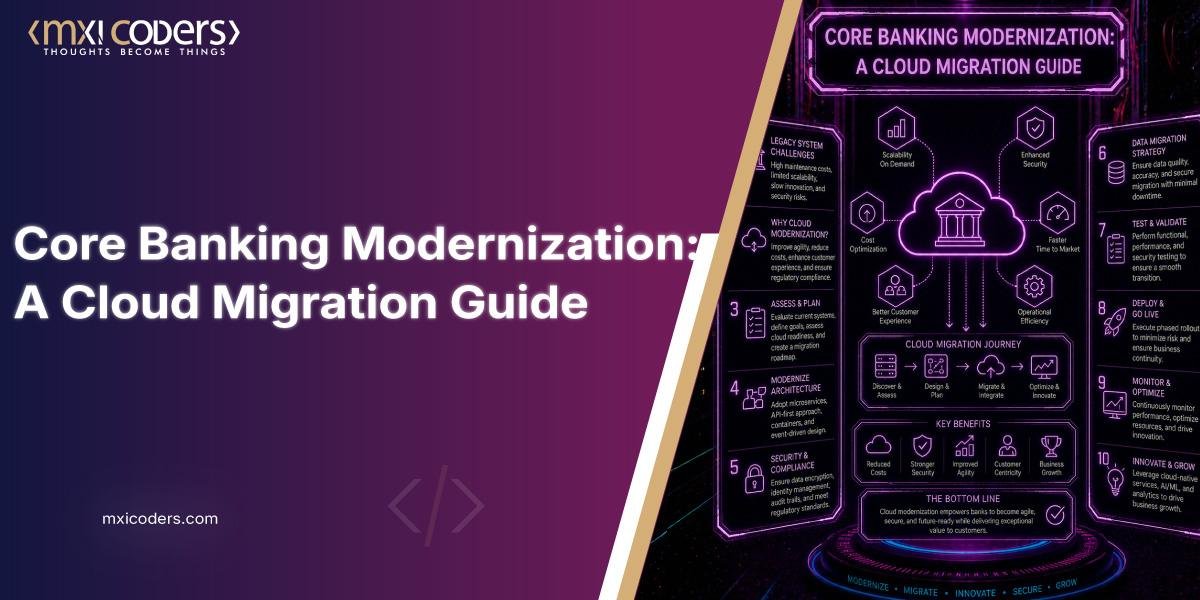
Modernizing a core banking system means replacing or wrapping the legacy platform that runs deposits, loans, and payments with a cloud based core banking platform built on APIs and microservices. Most banks use one of three paths: full replacement, phased coexistence, or wrapping the legacy core in new services.
➤ Why is legacy system migration suddenly urgent?
Two forces are pushing this from “someday” to “now.” First, regulation. The EU’s Digital Operational Resilience Act became directly applicable to banks, insurers, and their ICT providers on 17 January 2025, and it makes a bank’s leadership personally responsible for how resilient its technology is, not just its IT department. Second, cost. Research cited by FutureBank found that banks still running outdated core systems carry operating costs roughly ten times higher than banks on next generation cores, and IDC projects that 40 percent of global banks will be running a sidecar or coexistence modernization strategy by 2026. Standing still is no longer the cheaper option. EIOPA + 2
The market reflects that pressure. Grand View Research put the global core banking software market at 13.32 billion dollars in 2025, projecting it to reach 28.48 billion dollars by 2033, and cloud is where the growth is concentrated. Fortune Business Insights, citing the Future of Cloud in Banking report, found 60 percent of banks in North America, 82 percent in Europe and the Middle East and Africa, and 83 percent in Asia Pacific are increasing their cloud investment. Grand View ResearchFortune Business Insights
➤ What’s the actual difference between a legacy core and a modern one?
| Feature | Legacy core system | Cloud based core banking platform |
| Architecture | Monolithic, on premise | Cloud native, API first, microservices |
| Scaling | Manual, expensive to expand | Elastic, on demand |
| Cost model | Heavy upfront capital spend | Pay as you go operating spend |
| Change speed | Months per release | Continuous, incremental deployment |
| Security posture | Patched reactively | Updated continuously, built for compliance |
➤ Which modernization strategy should a bank actually pick?
There’s no single right answer here; it depends on risk appetite, budget, and how tangled your legacy core already is.
| Option | Mechanism | Best fit | Trade off |
| Full replacement (“big bang”) | Complete cutover from old to new core banking system in one event | Smaller institutions with simpler product lines | Fastest to finish, but a single point of failure with no rollback runway |
| Phased coexistence (“strangler fig”) | New platform takes over one product or segment at a time while the legacy core keeps running | Mid size and large banks with complex, interlinked products | Slower and more expensive to run two systems in parallel, but far lower risk per step |
| Wrap and augment | Legacy core stays in place underneath, exposed through new APIs and microservices | Banks needing fast digital capability without touching the ledger | Doesn’t remove legacy technical debt, just hides it behind a newer front end |
Most large institutions now land somewhere between the second and third options. As Visa’s technology team described it in a Forbes contribution, only about 48 percent of digital transformation initiatives meet their stated goals according to Gartner research, and McKinsey has found that only around 30 percent of transformations over the past decade were completed in full, with timelines often underestimated by as much as 75 percent. That track record is exactly why “rip and replace” has fallen out of favor. Forbes
➤ How should a bank actually run the migration?
Whatever strategy you pick, the execution pattern that keeps showing up in successful projects looks like this:
- Assess first, migrate second. Map every dependency, data silo, and process bottleneck in the current banking technology stack before scoping a target platform.
- Set up real governance. A program office with representatives from IT, operations, risk, and legal should own the transition, not a single project manager.
- Run a genuine parallel period. Keep the legacy and new systems live side by side long enough to validate the new core banking solution against real transaction volume before decommissioning anything.
- Cleanse data before you move it, not after. Data quality problems found mid migration are the most expensive kind to fix.
- Treat change management as its own workstream. Staff adoption, not code, is usually what determines whether the new system actually gets used.
➤ Limitations and industry challenges
Migrations still go wrong, even at large, well resourced institutions. In April 2018, TSB Bank’s move off Lloyds infrastructure onto Sabadell’s platform went badly enough that customers were locked out of accounts and saw incorrect balances for weeks; industry estimates put the total cost of the incident at around 330 million pounds, with roughly 80,000 customers lost, and UK regulators later reported a sharp rise in IT related outages across the sector in the aftermath. It’s a useful reminder that a technically sound migration plan still needs a realistic cutover window and a tested rollback path, not just executive buy in. slideshare
One honest limitation of this guide: general migration statistics and regulatory timelines are well documented, but there’s no publicly verifiable data on real world Mxi coders client outcomes to cite here, so none is claimed.
➤ Conclusion
Core banking modernization has stopped being optional. Between DORA’s compliance requirements, the operating cost gap between legacy and modern cores, and competitive pressure from fintechs, the institutions still running 1990s era cores are the ones taking on the most risk, not the ones migrating. The safest path for most banks isn’t a full replacement; it’s a phased, well governed move toward a cloud based core banking platform, with realistic timelines and a genuine parallel run before anything legacy gets switched off.
If you’re scoping a cloud migration for a banking platform or need help evaluating vendors for a banking platform rebuild, that’s exactly the kind of assessment work worth getting outside eyes on early, through something like software consulting before you commit to a strategy.
➤ Frequently asked questions
- How long does core banking modernization actually take?
It depends heavily on scope. A single domain sidecar project typically runs 18 to 36 months, while a full platform migration for a large bank often takes 3 to 5 years once decommissioning is included, and decommissioning alone frequently runs 12 to 24 months past the original estimate. - Is a full “big bang” replacement ever the right call?
Occasionally, for smaller institutions with a narrow product range and lower transaction complexity. For anything larger, the failure data above is the reason most banks now default to phased coexistence instead. - What’s the single biggest cause of migration cost overruns?
Data migration and cleansing, consistently. Budget overruns tied to data integrity issues and underestimated cutover complexity show up across nearly every independent study of banking core migrations. - Does DORA apply to banks outside the EU?
Not directly, but it reaches further than EU headquartered banks. Because DORA also covers third party ICT providers to EU financial entities, firms outside Europe that provide technology or outsourcing services to EU banks need to meet its requirements too. - What should replace “rip and replace” as a default strategy?
A phased coexistence or wrap and augment approach, where the legacy core and new platform run in parallel and functions move over in stages. This is now the dominant approach for mid size and large institutions specifically because it lets you catch problems before they touch the whole customer base.
➤ Sources Used
- EIOPA, Digital Operational Resilience Act (DORA)
- Grand View Research, Core Banking Software Market Size Report, 2026 to 2033
- Fortune Business Insights, Core Banking Software Market
- Forbes/Visa BrandVoice, How To De-Risk Core Banking Modernization With Composable Architecture
- FutureBank, Banks are warned against failed core strategies
- Curiosity Software, TSB 2018 Core Banking Failure case data