[ Your Headline ] [ Highlight Word ]

[ One or two lines describing the offer — e.g. "Experience our services with a FREE 30-minute consultation." ]

[ Optional second line, e.g. "Have a concept in mind? Let's brainstorm together!" ]

Google ★★★★★ 4.8
GoodFirms ★★★★★ 4.7
Clutch ★★★★★ 5.0
Software

ERP and Agentic AI: The Next Generation of Business Automation

Ashok Rathod

Tech Consultant

Posted on
13th Oct 2026
5 min
Read

Table of Contents

  • Quick Tips
  • Familiarize yourself with Cash App
  • Enable two-factor authentication
  • Utilize the optional Cash App
  • Conclusion

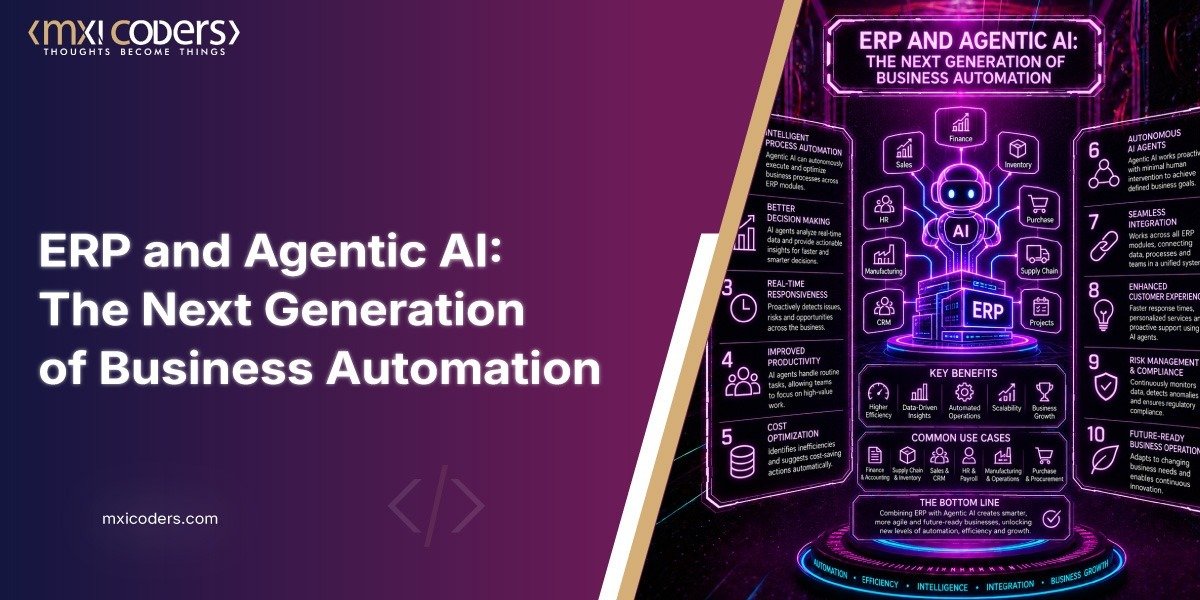
The use of Agentic AI in ERP includes AI agents who have knowledge about the enterprise’s objectives, reasoning ability with ERP data and rules, and the ability to take appropriate action with minimal human intervention. This shifts ERP systems from logging events to coordinating and executing processes. Gartner projected in February 2026 that the expenditure on ERP software that is agentic would be $72 billion by 2030, with a 5-year CAGR of 74.6%.

➤ What Is Agentic AI in ERP?

ERP uses AI agents that understand business goals, make decisions, and perform tasks autonomously without human dependency. While an AI assistant helps humans to do tasks and provide suggestions.

➤ How Is Agentic AI Changing ERP Automation?

ERP systems with agent-based artificial intelligence can perform beyond following prescribed steps. They can accomplish certain goals, take care of certain processes from beginning to end, and interact with other AI agents.

➥ From Rule-Based Automation to Goal-Based Execution

Rule Based Automation implies application of rules that say “if X occurs, then Y must occur.” The AI agents will analyze the objective, analyze the situation, analyze the available moves, and decide on the move to make.

The role of the agent responsible for sending invoices that are due can be analysis of the payment history, analyzing the process of recovery of dues, preparing itself for communication, updating accounts, and informing the financial officer in case of an abnormal situation.

➥ From Individual Tasks to End-to-End Workflows

Agentic ERP system can join together steps which previously needed many people or screens. Procurement activity could analyze the request, check its compliance with the policy, compare suppliers, monitor purchasing activities, and make key decisions to approve them.

Specific agents can exchange context among different departments. The supply agent can see that there is a shortage, the procurement agent can assess the suppliers, and the finance agent can estimate the budget.

➤ What Are the Key Agentic ERP Use Cases in 2026?

Current vendor releases show practical use in finance, procurement, supply chain, HR, and operations.

➥ Finance and Accounting

Microsoft states that the Dynamics 365 Account Reconciliation Agent is being extended to bulk process exceptions. Finance Agent is also capable of reconciliation, data preparation, variance analysis, collections, and reporting within Microsoft 365 and Dynamics 365 Finance.

SAP has introduced an Autonomous Close Assistant for journal entries, reconciliation, and exception management. The company has also announced over 50 domain-specific Joule Assistants that coordinate over 200 specialized agents.

Oracle has launched Fusion Agentic Applications in March 2026. They use agents that collaborate, reason and act within the business processes based on the enterprise data, policies, approvals, and permissions.

Infor’s release 2026.10 includes Financials Agent for financials analysis and reporting.

➥ Procurement and Supply Chain

Analysis of Microsoft’s procurement agent impact involves tracing any modifications in purchase orders by suppliers, which relate to sales, production, transfer orders, and inventory. Oracle’s supply chain agents include planning, procurement, manufacturing, maintenance, and logistics. Oracle’s Autonomous Sourcing Assistant can manage sourcing of low value but high volume through negotiation creation, supplier selection, and purchase order preparation.

The Procurement Agent of Infor analyzes supplier performance and risk management while its Supply Chain Agent manages dynamic demands.

➥ HR and Operations

SAP has been expanding its range of Joule Assistants to HCM and Operations. Infor also mentions its Industry AI Agents for HR, Customer Service, Logistics, Service, Manufacturing, and Process Operations.

➤ What Do Businesses Need for Agentic ERP?

Businesses need trusted data, clear workflows, controlled system access, and strong governance before agents receive authority to act.

Key requirements include:

  • Reliable enterprise data with clear ownership.
  • Standardized workflows and exception paths.
  • Secure ERP connections to approved data and business logic.
  • Agent permissions based on role, task, value, and risk.
  • Logging and audit trails for agent actions.
  • Human approval for payments, hiring, contracts, large purchases, and other high-impact decisions.

An agent should know what it may do and when it must stop for review.

➤ ERP to ERX: What Comes Next?

ERX was developed by Gartner in 2026 and is the next level of intelligent and autonomous ERP. According to Gartner, it is a system that reasons, acts, and adapts without human intervention at each step of the process.
ERP captures business transactions. AI-based ERP enhances prediction and decision-making. Agentic ERP incorporates goal-directed action. ERX takes this further to continuous business action and adaptation.

Goals, boundaries, and responsibility continue to be determined by people while the software does the coordination.

➤ What Are the Challenges of Agentic ERP?

The main risks come from giving software permission to act, not only recommend.

  • Poor data quality may result in poor decision-making.
  • Legacy systems may lack proper data and behavior.
  • Overpermissions may lead to agent having too much power.
  • Lack of governance may lead to ambiguity about ownership.
  • Conflicts of rules and missing context may cause an inappropriate action.
  • Even risky transactions require human approval.

One strategy that can be adopted is that of graduated autonomy, whereby the person has more power when he performs tasks that involve lower risks.

➤ How Should a Company Begin Using Agentic ERP?

Start small by automating one quantifiable process and not attempting to automate the whole organization at once.

  • Pick one valuable process.
  • Check for preparedness in data and systems.
  • Set up agent permissions and approvals.
  • Pilot and test for accuracy, increased efficiency, exceptions, and control.
  • Expand gradually only after success of the pilot.

Some examples of good starting processes are reconciliation, invoice processing, supplier follow-ups, inventory exceptions, and employee requests.

➤ Conclusion

ERP system has also become intelligent as it can plan and implement actions according to the policies, not just storing data. There are several requirements for implementation such as quality data, connectivity, governance, permission, and human control. If you wish to implement an ERP system using an AI-driven ERP software development company, you can consider MXICoders.

➤ Sources Used

erp and agentic ai (blog image) 1

The use of Agentic AI in ERP includes AI agents who have knowledge about the enterprise’s objectives, reasoning ability with ERP data and rules, and the ability to take appropriate action with minimal human intervention. This shifts ERP systems from logging events to coordinating and executing processes. Gartner projected in February 2026 that the expenditure on ERP software that is agentic would be $72 billion by 2030, with a 5-year CAGR of 74.6%.

➤ What Is Agentic AI in ERP?

ERP uses AI agents that understand business goals, make decisions, and perform tasks autonomously without human dependency. While an AI assistant helps humans to do tasks and provide suggestions.

➤ How Is Agentic AI Changing ERP Automation?

ERP systems with agent-based artificial intelligence can perform beyond following prescribed steps. They can accomplish certain goals, take care of certain processes from beginning to end, and interact with other AI agents.

➥ From Rule-Based Automation to Goal-Based Execution

Rule Based Automation implies application of rules that say “if X occurs, then Y must occur.” The AI agents will analyze the objective, analyze the situation, analyze the available moves, and decide on the move to make.

The role of the agent responsible for sending invoices that are due can be analysis of the payment history, analyzing the process of recovery of dues, preparing itself for communication, updating accounts, and informing the financial officer in case of an abnormal situation.

➥ From Individual Tasks to End-to-End Workflows

Agentic ERP system can join together steps which previously needed many people or screens. Procurement activity could analyze the request, check its compliance with the policy, compare suppliers, monitor purchasing activities, and make key decisions to approve them.

Specific agents can exchange context among different departments. The supply agent can see that there is a shortage, the procurement agent can assess the suppliers, and the finance agent can estimate the budget.

➤ What Are the Key Agentic ERP Use Cases in 2026?

Current vendor releases show practical use in finance, procurement, supply chain, HR, and operations.

➥ Finance and Accounting

Microsoft states that the Dynamics 365 Account Reconciliation Agent is being extended to bulk process exceptions. Finance Agent is also capable of reconciliation, data preparation, variance analysis, collections, and reporting within Microsoft 365 and Dynamics 365 Finance.

SAP has introduced an Autonomous Close Assistant for journal entries, reconciliation, and exception management. The company has also announced over 50 domain-specific Joule Assistants that coordinate over 200 specialized agents.

Oracle has launched Fusion Agentic Applications in March 2026. They use agents that collaborate, reason and act within the business processes based on the enterprise data, policies, approvals, and permissions.

Infor’s release 2026.10 includes Financials Agent for financials analysis and reporting.

➥ Procurement and Supply Chain

Analysis of Microsoft’s procurement agent impact involves tracing any modifications in purchase orders by suppliers, which relate to sales, production, transfer orders, and inventory. Oracle’s supply chain agents include planning, procurement, manufacturing, maintenance, and logistics. Oracle’s Autonomous Sourcing Assistant can manage sourcing of low value but high volume through negotiation creation, supplier selection, and purchase order preparation.

The Procurement Agent of Infor analyzes supplier performance and risk management while its Supply Chain Agent manages dynamic demands.

➥ HR and Operations

SAP has been expanding its range of Joule Assistants to HCM and Operations. Infor also mentions its Industry AI Agents for HR, Customer Service, Logistics, Service, Manufacturing, and Process Operations.

➤ What Do Businesses Need for Agentic ERP?

Businesses need trusted data, clear workflows, controlled system access, and strong governance before agents receive authority to act.

Key requirements include:

  • Reliable enterprise data with clear ownership.
  • Standardized workflows and exception paths.
  • Secure ERP connections to approved data and business logic.
  • Agent permissions based on role, task, value, and risk.
  • Logging and audit trails for agent actions.
  • Human approval for payments, hiring, contracts, large purchases, and other high-impact decisions.

An agent should know what it may do and when it must stop for review.

➤ ERP to ERX: What Comes Next?

ERX was developed by Gartner in 2026 and is the next level of intelligent and autonomous ERP. According to Gartner, it is a system that reasons, acts, and adapts without human intervention at each step of the process.
ERP captures business transactions. AI-based ERP enhances prediction and decision-making. Agentic ERP incorporates goal-directed action. ERX takes this further to continuous business action and adaptation.

Goals, boundaries, and responsibility continue to be determined by people while the software does the coordination.

➤ What Are the Challenges of Agentic ERP?

The main risks come from giving software permission to act, not only recommend.

  • Poor data quality may result in poor decision-making.
  • Legacy systems may lack proper data and behavior.
  • Overpermissions may lead to agent having too much power.
  • Lack of governance may lead to ambiguity about ownership.
  • Conflicts of rules and missing context may cause an inappropriate action.
  • Even risky transactions require human approval.

One strategy that can be adopted is that of graduated autonomy, whereby the person has more power when he performs tasks that involve lower risks.

➤ How Should a Company Begin Using Agentic ERP?

Start small by automating one quantifiable process and not attempting to automate the whole organization at once.

  • Pick one valuable process.
  • Check for preparedness in data and systems.
  • Set up agent permissions and approvals.
  • Pilot and test for accuracy, increased efficiency, exceptions, and control.
  • Expand gradually only after success of the pilot.

Some examples of good starting processes are reconciliation, invoice processing, supplier follow-ups, inventory exceptions, and employee requests.

➤ Conclusion

ERP system has also become intelligent as it can plan and implement actions according to the policies, not just storing data. There are several requirements for implementation such as quality data, connectivity, governance, permission, and human control. If you wish to implement an ERP system using an AI-driven ERP software development company, you can consider MXICoders.

➤ Sources Used

➤ Frequently Asked Questions

What is agent-based AI in ERP?
It involves the use of AI agents to analyze goals, analyze ERP information and rules, and perform authorized tasks.
How is agentic ERP different from traditional ERP?
Traditional ERP documents transactions and implements pre-designed workflows. On the other hand, in agentic ERP, there are added agents that are able to plan, coordinate, and act within certain restrictions.
What can AI agents be automated in ERP?
These include reconciliation, invoicing, procurement, vendor management, inventory decision making, employee workflow automation, reporting, and exception handling.
What is ERX?
ERX stands for Enterprise Resource Execution, Gartner’s 2026 concept for more autonomous, continuous business execution.
Can agentic AI work with existing ERP systems?
Yes, if the ERP provides reliable data, workflows, permissions, and callable business actions. Older systems may need APIs, middleware, or data cleanup first.
Does agentic ERP replace human employees?
No. Agents handle repetitive coordination and routine actions, while people remain responsible for judgment, approvals, policy, and accountability.

Feel free to Connect us on

Ready to transform your business with smart software solutions?

Harness the power of custom software development to streamline operations, reduce costs, and boost efficiency. Start by exploring cutting-edge approaches like cloud-native platforms, API-first architecture, and AI-driven automation to future-proof your systems and stay ahead of the competition.

Book free consultation

Let’s build your idea together and serve society.

Author

Ashok Rathod

Tech Consultant

Experience
25 Years
Growth Architect for Startups & SMEs | Blockchain, AI , MVP Development, & Data-Driven Marketing Expert.

Transform the Carbon Credit Industry

Build a Transparent, Scalable Carbon Credit Marketplace with Blockchain.