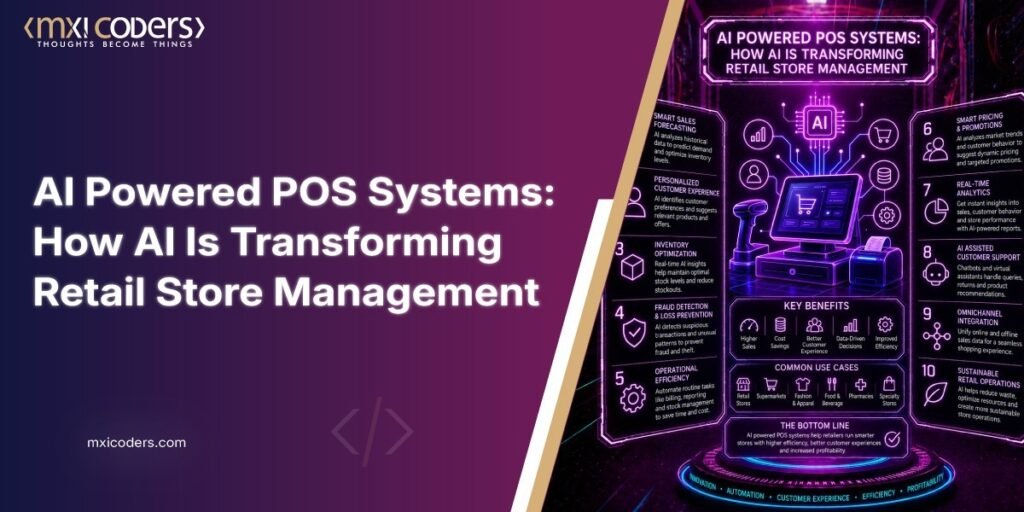
An AI based POS system allows business owners to handle a number of functions through the same system. Some of these functions include storing customer information, tracking transactions, and generating reports.. Artificial intelligence can also cut down on some manual tasks and predict what items may be needed. IBM found that 88% of retail executives see demand forecasting as an important use case for AI.
➤ What Is an AI Powered POS System?
An AI powered POS system is a billing system that also helps manage your store. It does more than just take payments. You can use it to keep your track of sales, check your inventory, save customer details, and get a better idea of how your store is doing.
For example, it can show you which products are selling the most and let you know when you’re running low on stock. It can also help you see when your store gets the most customers. By reviewing your past sales, the system can give you an idea of which products you need to stock up on. This can save time and make day to day store operations a little easier.
➥ How Does an AI Powered POS System Work?
The POS system will analyze the data received through the sales, inventory, and customer activities. The data is analyzed to look for any patterns, automate regular activities, and provide helpful insight to make the management easier.
➥ What Data Does an AI POS System Use?
The AI POS system has access to data on sales, stock, customer orders, price tags, and transaction details. The system then uses all this data to identify the buying pattern of the customers.
➤ The difference between an AI POS and a traditional POS.
A traditional POS mainly records sales and payments. An AI based POS also analyzes data for forecasting, personalization, automation, and predictive decisions.
| Area | Traditional Pos | AI Based Pos |
| Transactions | Record Sales | Record and Analyzes Sales |
| Inventory | Tracks Stock | Forecasts and reorder suggestions |
| Reporting | Historical Reports | Real time and predictive views |
| Forecasting | Manual or Limited | Date based Estimates |
| Personalization | Basic Loyalty Rules | Behavior based Offers |
| Recommendations | Mostly Manual | Automated Suggestions |
| Operations | Staff leds Tasks | Automated alerts and reports |
➥ How AI-based Point-of-Sale Systems are Reshaping Retail Store Management?
They add transparency to how much stock there is, what sales have been made, who has bought, and how the store is operating, through translating data collected on a daily basis into suggestions.
➥ Smarter Inventory Management
AI can track stock, identify fast and slow-moving items, predict demand, warn when there is a shortage of stock, and suggest restocking.
➥ Faster and More Accurate Checkout
The POS software can offer such features as automatic discounts, payment via various types of payments, minimal manual entries, creation of receipts, and linking of the payments with sales.
➥ Personalized Customer Experience
Customer information concerning purchasing behavior and loyalty can help create customer segments, repeat buying behavior analysis, and appropriate offers and suggestions. Privacy policies and access need to be taken into consideration.
➥ Sales and Demand Forecasting Using AI
AI will be capable of analyzing sales trends, seasonality, promotions, and present demands for forecasting the future ones. As mentioned by IBM, AI-based demand forecasting is based on historical and present data.
➥ Automated Retail Operations
Some aspects of the retail business can be automated, including report creation, stock notifications, reordering, promotions monitoring, and parts of staff reporting.
➥ Real-time retail analytics and business insights
Information about revenues, sales performance, movements of the stock, customer behavior, and even comparisons between stores can be presented on dashboards. Reporting gives historical data, while predictions provide information for the future.
➤ What Types of Retail Businesses Can Use AI Powered POS Systems?
POS systems are suitable for a variety of retail enterprises such as fashion and apparel stores, grocery stores, electronics stores, cosmetic and beauty stores, furniture stores, and any other specialized store. The following requirements may be required for Smoke Shop POS Software: Product controls; Age-related workflow when necessary; Reporting by category.
➤ Practical Examples of AI in Retail POS
➥ Inventory Demand Forecasting
Previous purchases, season, current inventory, and demand can assist in forecasting future inventory requirements.
➥ Slowing Inventory Identification
AI can alert managers about underperforming products for further consideration in terms of pricing or ordering.
➥ Loyalty Program Customization
Purchase history could be used to determine the customer’s tastes and make offers based on previous purchases.
➥ Comparison of Sales across Multiple Stores
Reporting from one central place would allow comparison of sales, inventory, and category performance. Shopify offers integrated reporting and inventory management.
➤ Selecting the Right POS System With AI for Your Retail Store
Many things should be considered when selecting an appropriate system, such as store size, transactions per second, inventory management, integration, security, cost, and forecasting.
➥ Considerations Regarding Store Size, AI, and Inventory Management Process
Considerations should include number of stores, product line, employee numbers, sales channels, forecasting ability, dashboard reports, inventory management process, out of stock alert system, vendor software, transfer management and multisite management.
➥ Considerations Regarding Integration, Security, and Cost
Consider integration with ecommerce, accounting, CRM, loyalty, ERP, and warehouse systems.Check for encryption, user permissions, backup, hardware, subscription cost, transaction cost, training, customer support, and installation cost. PCI DSS establishes minimum standards for securing payment card account information.
➤ Factors that Retailers Need to Consider Before Implementation of AI Based POS System
This problem that the company would face could be anything from proper inventory management to checking out process, reports, customer loyalty schemes, forecasting, and management of multiple locations. The important thing here is to evaluate the problems relating to data quality, compatibility, migration, training, privacy, security, and cost. Consider stockouts, checkouts, transaction size, inventory turns, promotions, repeat purchase, and administrative time of employees.
➤ What Are the Limitations of AI Based POS Systems?
AI depends on reliable data. Poor records can produce weak recommendations, and unexpected events can reduce forecast accuracy.
Setup may require hardware, migration, training, and technical support. Managers should review major AI recommendations before acting. NIST’s AI Risk Management Framework stresses managing AI risks and trustworthiness across the system life cycle.
➤ What Is the Future of AI in POS Systems?
Retail POS systems will increasingly rely on the use of predictive analysis, recommendations for replenishment, real-time alerts, customer segmentation, integrated online and in-store information, and natural language reports.
Questions such as “What is out?” may be answered by AI helpers that have access to store data.”
➤ Conclusion
The POS solutions implemented by retailers will evolve from simple payments systems into intelligent solutions that will work for the retailer. AI will be able to process information about the store and produce signals for management, sales, forecasting, reporting, and operations.
It is crucial to select a system based on your business requirements, its security, data quality, scalability, integrations, and performance. Mxicoders can assist you with assessing POS solutions development.
➤ Sources Used
- IBM, AI Demand Forecasting. IBM source
- PCI Security Standards Council, PCI DSS. PCI DSS source
- National Institute of Standards and Technology, AI Risk Management Framework 1.0. NIST source
- Shopify, Retail POS. Shopify source