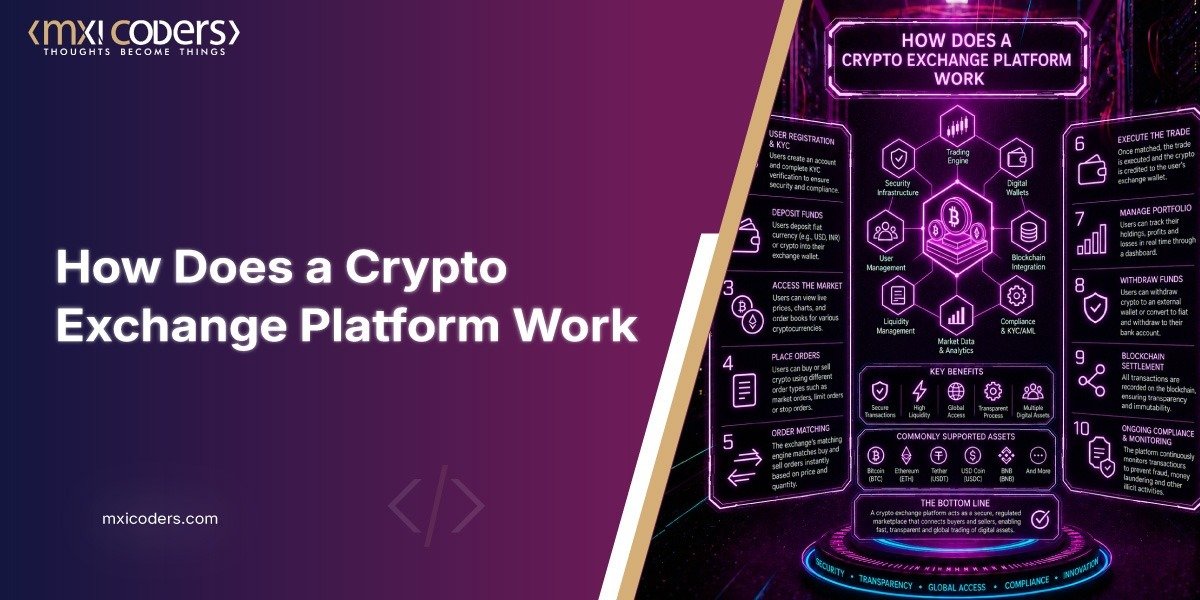
A crypto exchange platform is a digital marketplace where users can buy, sell, deposit, withdraw, and trade cryptocurrencies. On a centralized exchange, the platform usually manages accounts, holds assets, accepts orders, matches buyers with sellers, and updates balances after trades. Behind the interface are connected systems for KYC, payments, wallets, order books, matching, accounting, security, and blockchain transactions. Together, they move a user from registration to trade execution and withdrawal.
➤ What Is a Crypto Exchange Platform?
A crypto exchange enables digital assets to be exchanged for fiat money or other cryptocurrencies. Trading happens through pairs such as BTC/USD or ETH/USDT.
Centralized exchanges, or CEXs, operate the trading infrastructure and typically custody customer assets. Decentralized exchanges, or DEXs, generally let users trade from self-custody wallets through smart contracts.
Other models also exist. A p2p crypto exchange platform connects individual buyers and sellers, often with escrow or dispute controls. A multi-exchange crypto trading platform can connect users or trading systems to several exchanges through one interface.
➤ How Does a Crypto Exchange Platform Work?
The following workflow mainly describes a centralized exchange because DEXs may execute trades directly through smart contracts.
➥ Step 1: User Registration and KYC
The user first creates an account. Depending on the jurisdiction and services offered, the exchange may request identity information and complete Know Your Customer verification.
Checks can include government ID verification, sanctions screening, Anti-Money Laundering monitoring, and risk assessment. FATF standards call for virtual asset service providers to apply measures such as customer due diligence, record-keeping, and suspicious-transaction reporting where applicable.
➥ Step 2: Deposits and Wallet Management
Users need funds before trading. They may deposit fiat through supported payment methods or transfer crypto from an external wallet. For crypto deposits, the exchange provides an address for the selected asset and network. After enough blockchain confirmations, the exchange credits the user’s balance. Platforms may use hot wallets for operational liquidity and cold storage for assets that do not need immediate online access.
➥ Step 3: Placing a Buy or Sell Order
The user selects a trading pair and places an order. A market order seeks immediate execution at available prices. A limit order executes only at the specified price or better. A stop order becomes active after a defined trigger price.
For example, a BTC limit buy at 60,000 USDT means the trader wants to buy at that price or lower, subject to available liquidity. Coinbase documentation lists market, limit, stop, and stop-limit order types.
➥ Step 4: Order Matching
Open buy and sell orders are stored in an order book. Buy orders are bids, while sell orders are asked. The matching engine compares incoming orders with available orders using rules such as price, quantity, and time priority. When compatible orders meet, the trade executes. A large order may be filled against several smaller orders.
Liquidity matters because deeper order books generally allow trades to execute with less price movement.
➥ Step 5: Trade Execution and Settlement
After a match, the exchange records the trade, deducts any applicable fee, and updates both users’ balances.On most centralized exchanges, settlement happens on an internal ledger rather than through a separate blockchain transaction for every trade. Coinbase documentation tracks filled size, fees, execution value, order status, and settlement within the exchange system.
Blockchain settlement becomes relevant when assets move between the exchange and an external wallet or when trading occurs directly on-chain.
➥ Step 6: Crypto Withdrawal
For a withdrawal, the user selects the cryptocurrency and network, enters a destination address and amount, and confirms the request. The exchange may run security checks before sending funds. Once approved, it signs and broadcasts a blockchain transaction. Kraken’s documentation describes withdrawals moving through internal checks, network broadcasting, and blockchain confirmation before completion.
➤ How Do Crypto Exchanges Keep User Funds Secure?
Security usually combines several controls:
- Multi-factor authentication for user and administrative access.
- Cold storage for assets not needed for immediate withdrawals.
- Encryption for sensitive data and communications.
- Withdrawal controls and address verification.
- Transaction monitoring, fraud detection, and risk scoring.
- Role-based access, logging, testing, and security audits.
NIST guidance supports multi-factor authentication and access controls as important cybersecurity practices. Users should still protect credentials, verify wallet addresses, and understand how the platform handles custody.
➤ Final Takeaway
The typical centralized exchange flow is:
Registration → KYC → Deposit → Order → Matching → Execution → Settlement → Withdrawal
A reliable exchange requires more than a trading interface. Matching technology, liquidity, wallets, accurate accounting, cybersecurity, compliance, and dependable infrastructure all affect how the platform works. If you are evaluating or planning an exchange, use this flow as a checklist and review the platform’s custody model, liquidity, wallet design, compliance controls, security measures, and withdrawal process before moving forward.
➤ Frequently asked questions
- Are crypto trades recorded on the blockchain?
Not always. Centralized exchanges usually record trades on an internal ledger. Blockchain transactions generally occur during deposits, withdrawals, or on-chain trading. - What is a matching engine?
A matching engine pairs compatible buy and sell orders according to rules such as price, time priority, and quantity. - What is a crypto exchange platform?
A crypto exchange platform is an online platform where users can buy, sell, and trade cryptocurrencies like Bitcoin and Ethereum. - How does a crypto exchange work?
A crypto exchange connects buyers and sellers to trade cryptocurrencies. It processes transactions and charges fees for its services.
➤ References
- Financial Action Task Force (FATF) — Virtual Assets standards and 2025 targeted update. FATF Virtual Assets guidance
- Coinbase Developer Documentation — Exchange order and settlement documentation. Coinbase Developer Documentation
- Kraken Support — Cryptocurrency withdrawal process and statuses. Kraken withdrawal documentation
- National Institute of Standards and Technology (NIST) — Multi-factor authentication and access-control guidance. NIST cybersecurity guidance