[ Your Headline ] [ Highlight Word ]

[ One or two lines describing the offer — e.g. "Experience our services with a FREE 30-minute consultation." ]

[ Optional second line, e.g. "Have a concept in mind? Let's brainstorm together!" ]

Google ★★★★★ 4.8
GoodFirms ★★★★★ 4.7
Clutch ★★★★★ 5.0
Technology

AngularJS vs ReactJS vs VueJS: Which Front-End Framework Should You Pick in 2026?

Ashok Rathod

Tech Consultant

Posted on
9th Jul 2026
6 min
Read
Share

Table of Contents

  • Quick Tips
  • Familiarize yourself with Cash App
  • Enable two-factor authentication
  • Utilize the optional Cash App
  • Conclusion

AngularJS reached end of life on December 31, 2021, and receives no further security patches, so it shouldn’t be on a 2026 shortlist at all. The real decision is between ReactJS, the most widely used library at 44.7% developer adoption, and VueJS, a lighter framework built for faster onboarding, according to the 2025 Stack Overflow Developer Survey. stackoverflow

➤ Is AngularJS still a safe choice in 2026?

No. AngularJS’s official support window closed at the end of 2021, and by 2026 that means no security patches, no bug fixes, and no updates of any kind are being issued for it. Teams still running it are working with a framework that has effectively frozen while browsers, tooling, and the rest of the JavaScript ecosystem kept moving. If you’re building anything new, AngularJS isn’t a contender. The only legitimate reason to still be dealing with it is a legacy app that hasn’t been migrated yet, and even then, the sensible move is planning that migration rather than adding to the codebase.

It’s worth being precise about naming here too. “AngularJS” refers to the original version 1.x framework from Google. It’s a completely different codebase from “Angular” (sometimes called Angular 2+), the TypeScript-based framework Google still actively maintains. Angular itself is on a regular release and support cycle, with older major versions cycling out of support every year or so as newer ones ship. So when people say “Angular is dead,” they usually mean AngularJS specifically, not the modern framework.

➤ What actually makes React’s virtual DOM fast?

React keeps a lightweight, in-memory copy of your UI tree called the virtual DOM. When state changes, React builds a new version of that tree, compares it against the previous one through a process called reconciliation, and only pushes the specific differences to the real browser DOM instead of repainting everything. That diffing step is what lets React update a page without triggering expensive full re-renders. The React 19 release, which shipped in December 2024, kept this core reconciliation model but expanded around it with Actions, a use API for reading resources during render, and built-in support for handling async form submissions and optimistic UI updates. None of that changes how the diffing itself works, but it does mean less manual state juggling around the data fetching that used to sit on top of it. react

➤ VueJS in 2026: still worth learning?

Vue remains the framework most developers describe as easy to pick up quickly, mainly because its template syntax stays close to plain HTML and its official documentation walks through real patterns rather than just API references. It’s a solid fit for teams that want a full framework experience (routing, state management, build tooling) without React’s more layered ecosystem of separate libraries, or Angular’s steeper architectural learning curve. Where it still trails both React and Angular is raw adoption. Fewer large enterprises have standardized on it, which can mean a smaller local hiring pool depending on your market.

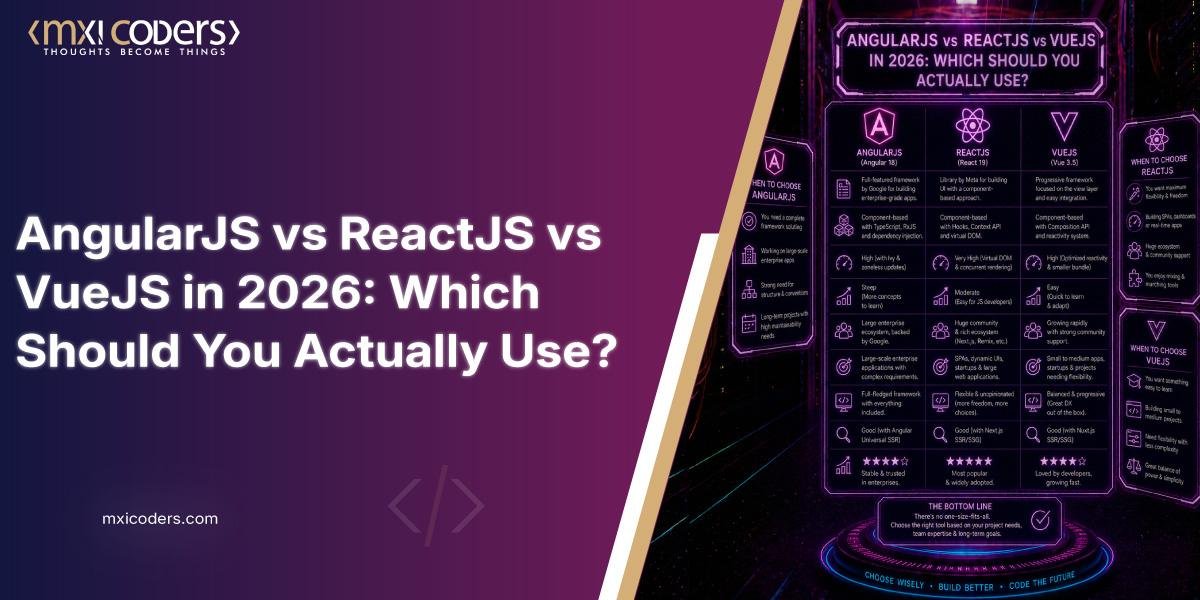
➤ AngularJS vs Angular vs ReactJS vs VueJS Comparison

OptionMechanismBest fitTrade-off
AngularJS (1.x)Two-way data binding, MVC structureLegacy maintenance onlyEnd of life since 2021, no security patches
Angular (current)TypeScript, component architecture, dependency injectionLarge enterprise apps with big teamsSteeper learning curve, heavier initial bundle
ReactJSVirtual DOM with reconciliation/diffingComponent-heavy UIs, teams that want ecosystem flexibilityState management and routing need separate libraries
VueJSReactive template compiler, single-file componentsSmall to mid-size apps, fast onboardingSmaller enterprise adoption and hiring pool

➤ Which framework is actually more popular right now?

Among all respondents to the 2025 Stack Overflow Developer Survey, React led usage at 44.7%, followed by Angular at 18.2% and Vue.js at 17.6%, while AngularJS specifically had fallen to 7.2%. On developer sentiment, the same survey found React and Vue rated similarly by developers who’d actually used them in the past year and wanted to keep using them, with Angular close behind and AngularJS trailing well behind all three. In practice, that gap between AngularJS’s usage number and its sentiment number tells you most of what you need to know: people are still using it because they’re stuck with it, not because they’d choose it today. stackoverflowstackoverflow

➤ Which one should you actually pick?

If you’re maintaining an old AngularJS codebase, the priority is planning a migration path, not adding new features to it. For new projects, React makes sense when you want the largest talent pool and don’t mind assembling routing and state management from separate libraries. Vue makes sense when you want a lighter, faster-to-learn framework with more built in out of the box. Modern Angular (not AngularJS) still earns its place in large enterprise teams that value a prescriptive, batteries-included structure over flexibility.

➤ Limitations and Caveats

Framework popularity numbers shift year over year, and “best fit” genuinely depends on your team’s existing skills, your app’s complexity, and how long the project needs to be maintained. A framework that’s the right call for a five-person startup building an MVP can be the wrong call for a 50-engineer enterprise platform, and vice versa. Treat this comparison as a starting point for a conversation with your own team, not a substitute for it.

➤ Frequently asked questions

  1. Is AngularJS the same as Angular?
    No. AngularJS is the original 1.x version, discontinued since 2021. Angular is a separate, actively maintained TypeScript framework that replaced it starting with Angular 2.
  2. Do I need Redux or another library to use React?
    Not always. React’s built-in state (useState, useContext) handles plenty of apps fine. Libraries like Redux or Zustand tend to earn their keep once state needs to be shared across many unrelated components.
  3. Is Vue a good choice for a large enterprise application?
    It can be, but fewer large enterprises have standardized on it compared to React or Angular, which can mean a smaller local hiring pool. Evaluate that against your specific market before committing.
  4. Can I mix React and Vue in the same project?
    Technically yes, through micro-frontend approaches, but it adds real build and maintenance complexity. Most teams are better off picking one for a given application rather than blending them.

➤ Conclusion

The AngularJS vs ReactJS vs VueJS framing made sense a decade ago. It doesn’t anymore, because one of those three options stopped receiving security updates in 2021. The actual decision in 2026 is React versus Vue for most new projects, with modern Angular as a third option for large, prescriptive enterprise builds. React’s ecosystem size and virtual DOM performance make it the safer default for most teams, Vue rewards teams that want to move fast with less setup, and Angular still has a place where architectural consistency across a big team matters more than flexibility.

➤ Ready to build with the right framework for your project?

If you’re weighing React development against Vue.js development for a new build, or need help planning a migration off an old AngularJS codebase, Mxicoders’ web app development team can help you scope the right approach. Book a free consultation to talk through your specific requirements.
➤ Sources Used

  • Stack Overflow, 2025 Developer Survey – Technology Section (Published 2025)
  • The React Team, React v19 Official Release (December 5, 2024)
  • SCAND, “AngularJS End of Life: Support Options, LTS, and Migration in 2026″
AngularJS-Vs-ReactJS-Vs-VueJS

AngularJS reached end of life on December 31, 2021, and receives no further security patches, so it shouldn’t be on a 2026 shortlist at all. The real decision is between ReactJS, the most widely used library at 44.7% developer adoption, and VueJS, a lighter framework built for faster onboarding, according to the 2025 Stack Overflow Developer Survey. stackoverflow

➤ Is AngularJS still a safe choice in 2026?

No. AngularJS’s official support window closed at the end of 2021, and by 2026 that means no security patches, no bug fixes, and no updates of any kind are being issued for it. Teams still running it are working with a framework that has effectively frozen while browsers, tooling, and the rest of the JavaScript ecosystem kept moving. If you’re building anything new, AngularJS isn’t a contender. The only legitimate reason to still be dealing with it is a legacy app that hasn’t been migrated yet, and even then, the sensible move is planning that migration rather than adding to the codebase.

It’s worth being precise about naming here too. “AngularJS” refers to the original version 1.x framework from Google. It’s a completely different codebase from “Angular” (sometimes called Angular 2+), the TypeScript-based framework Google still actively maintains. Angular itself is on a regular release and support cycle, with older major versions cycling out of support every year or so as newer ones ship. So when people say “Angular is dead,” they usually mean AngularJS specifically, not the modern framework.

➤ What actually makes React’s virtual DOM fast?

React keeps a lightweight, in-memory copy of your UI tree called the virtual DOM. When state changes, React builds a new version of that tree, compares it against the previous one through a process called reconciliation, and only pushes the specific differences to the real browser DOM instead of repainting everything. That diffing step is what lets React update a page without triggering expensive full re-renders. The React 19 release, which shipped in December 2024, kept this core reconciliation model but expanded around it with Actions, a use API for reading resources during render, and built-in support for handling async form submissions and optimistic UI updates. None of that changes how the diffing itself works, but it does mean less manual state juggling around the data fetching that used to sit on top of it. react

➤ VueJS in 2026: still worth learning?

Vue remains the framework most developers describe as easy to pick up quickly, mainly because its template syntax stays close to plain HTML and its official documentation walks through real patterns rather than just API references. It’s a solid fit for teams that want a full framework experience (routing, state management, build tooling) without React’s more layered ecosystem of separate libraries, or Angular’s steeper architectural learning curve. Where it still trails both React and Angular is raw adoption. Fewer large enterprises have standardized on it, which can mean a smaller local hiring pool depending on your market.

➤ AngularJS vs Angular vs ReactJS vs VueJS Comparison

OptionMechanismBest fitTrade-off
AngularJS (1.x)Two-way data binding, MVC structureLegacy maintenance onlyEnd of life since 2021, no security patches
Angular (current)TypeScript, component architecture, dependency injectionLarge enterprise apps with big teamsSteeper learning curve, heavier initial bundle
ReactJSVirtual DOM with reconciliation/diffingComponent-heavy UIs, teams that want ecosystem flexibilityState management and routing need separate libraries
VueJSReactive template compiler, single-file componentsSmall to mid-size apps, fast onboardingSmaller enterprise adoption and hiring pool

➤ Which framework is actually more popular right now?

Among all respondents to the 2025 Stack Overflow Developer Survey, React led usage at 44.7%, followed by Angular at 18.2% and Vue.js at 17.6%, while AngularJS specifically had fallen to 7.2%. On developer sentiment, the same survey found React and Vue rated similarly by developers who’d actually used them in the past year and wanted to keep using them, with Angular close behind and AngularJS trailing well behind all three. In practice, that gap between AngularJS’s usage number and its sentiment number tells you most of what you need to know: people are still using it because they’re stuck with it, not because they’d choose it today. stackoverflowstackoverflow

➤ Which one should you actually pick?

If you’re maintaining an old AngularJS codebase, the priority is planning a migration path, not adding new features to it. For new projects, React makes sense when you want the largest talent pool and don’t mind assembling routing and state management from separate libraries. Vue makes sense when you want a lighter, faster-to-learn framework with more built in out of the box. Modern Angular (not AngularJS) still earns its place in large enterprise teams that value a prescriptive, batteries-included structure over flexibility.

➤ Limitations and Caveats

Framework popularity numbers shift year over year, and “best fit” genuinely depends on your team’s existing skills, your app’s complexity, and how long the project needs to be maintained. A framework that’s the right call for a five-person startup building an MVP can be the wrong call for a 50-engineer enterprise platform, and vice versa. Treat this comparison as a starting point for a conversation with your own team, not a substitute for it.

➤ Frequently asked questions

  1. Is AngularJS the same as Angular?
    No. AngularJS is the original 1.x version, discontinued since 2021. Angular is a separate, actively maintained TypeScript framework that replaced it starting with Angular 2.
  2. Do I need Redux or another library to use React?
    Not always. React’s built-in state (useState, useContext) handles plenty of apps fine. Libraries like Redux or Zustand tend to earn their keep once state needs to be shared across many unrelated components.
  3. Is Vue a good choice for a large enterprise application?
    It can be, but fewer large enterprises have standardized on it compared to React or Angular, which can mean a smaller local hiring pool. Evaluate that against your specific market before committing.
  4. Can I mix React and Vue in the same project?
    Technically yes, through micro-frontend approaches, but it adds real build and maintenance complexity. Most teams are better off picking one for a given application rather than blending them.

➤ Conclusion

The AngularJS vs ReactJS vs VueJS framing made sense a decade ago. It doesn’t anymore, because one of those three options stopped receiving security updates in 2021. The actual decision in 2026 is React versus Vue for most new projects, with modern Angular as a third option for large, prescriptive enterprise builds. React’s ecosystem size and virtual DOM performance make it the safer default for most teams, Vue rewards teams that want to move fast with less setup, and Angular still has a place where architectural consistency across a big team matters more than flexibility.

➤ Ready to build with the right framework for your project?

If you’re weighing React development against Vue.js development for a new build, or need help planning a migration off an old AngularJS codebase, Mxicoders’ web app development team can help you scope the right approach. Book a free consultation to talk through your specific requirements.

➤ Sources Used

  • Stack Overflow, 2025 Developer Survey – Technology Section (Published 2025)
  • The React Team, React v19 Official Release (December 5, 2024)
  • SCAND, “AngularJS End of Life: Support Options, LTS, and Migration in 2026″

Feel free to Connect us on

Ready to transform your business with smart software solutions?

Harness the power of custom software development to streamline operations, reduce costs, and boost efficiency. Start by exploring cutting-edge approaches like cloud-native platforms, API-first architecture, and AI-driven automation to future-proof your systems and stay ahead of the competition.

Book free consultation

Let’s build your idea together and serve society.

Author

Ashok Rathod

Tech Consultant

Experience
25 Years
Growth Architect for Startups & SMEs | Blockchain, AI , MVP Development, & Data-Driven Marketing Expert.

Transform the Carbon Credit Industry

Build a Transparent, Scalable Carbon Credit Marketplace with Blockchain.

Index

Get in Touch

Ready to transform your ideas into reality? Contact our team today and let’s discuss your project.