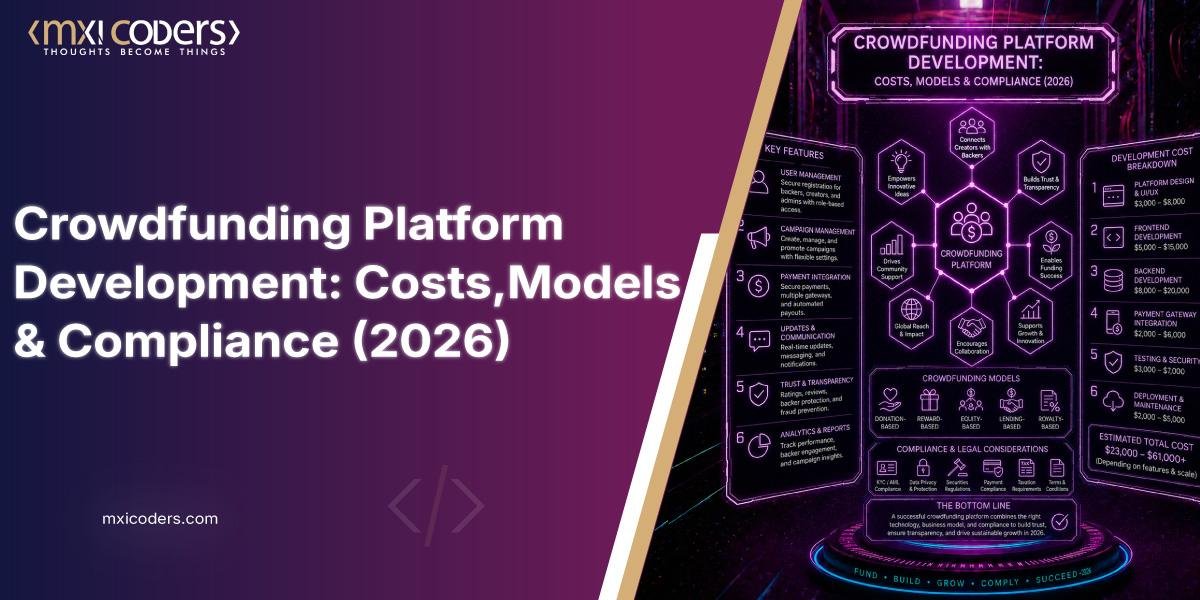
A crowdfunding platform is a website or app that lets a project creator raise money from many small contributors at once, in exchange for a reward, equity, debt repayment, or nothing at all depending on the model. Building one in 2026 means choosing a funding model, meeting securities rules where they apply, and budgeting realistically for payments, compliance, and campaign tooling.
➤ How Does a Crowdfunding Website Actually Work?
Every crowdfunding platform, regardless of niche, runs on the same basic loop. A creator submits a campaign with a funding goal and a deadline. Backers pledge money through the platform’s payment gateway. If the campaign hits its target (or in some models, regardless of whether it hits target), the platform releases funds to the creator, usually after taking a cut. The mechanics that differ are what the backer gets in return and how tightly the whole thing is regulated.
➤ What Are the Different Crowdfunding Models, and Which One Should You Build?
Before writing a line of code, you need to pick a lane. A donation based crowdfunding site has almost no securities exposure but also caps how much backers are typically willing to give. An equity crowdfunding platform can raise far more capital per campaign but drags in securities law, KYC, and investor accreditation checks from day one.
| Option | Mechanism | Best fit | Trade-off |
| Donation based crowdfunding | Backers give money with no expectation of return; sometimes get a token thank-you gift | Charities, medical costs, disaster relief, community causes | Lowest regulatory burden, but campaigns rarely scale into large capital raises |
| Reward based crowdfunding | Backers pledge in exchange for the eventual product or a perk | Product launches, creative projects, hardware pre-orders | Acts like a pre-order system; creators owe backers a real deliverable, which creates fulfillment risk |
| Equity crowdfunding platform | Backers receive shares or a stake in the company | Startups raising early capital from a broad investor base | Highest funding ceiling, but triggers securities regulation, investor limits, and disclosure filings |
| Debt based crowdfunding (peer to peer lending) | Backers lend money and are repaid with interest | Small business loans, revenue-based financing | Predictable backer returns, but requires credit assessment and default handling |
Real estate crowdfunding and other hybrid models generally sit inside the equity or debt categories above, depending on how the underlying deal is structured, according to peer-to-peer lending research site P2P Market Data.
➤ What Rules Govern an Equity Crowdfunding Platform in the US?
If you’re building anything that resembles an equity crowdfunding platform for US-based issuers, you’re almost certainly operating under Regulation Crowdfunding (Reg CF). Under the SEC’s Regulation Crowdfunding framework, an eligible company can raise up to $5 million through crowdfunding offerings in a rolling 12-month period, and every transaction has to run through an SEC-registered broker-dealer or funding portal, not a bare-bones payment page.
The rules got noticeably more specific this year. In five new Compliance and Disclosure Interpretations published on February 17, 2026, the SEC’s Division of Corporation Finance clarified that the $5 million cap is measured on a rolling 12-month basis from each individual closing date, not from the offering’s original start date. It also confirmed that “annual income,” used to calculate how much a non-accredited investor can put into a single Reg CF raise, means the calendar year, matching the standard already used under Regulation D. If your platform lets an issuer stay open for more than 120 days past its fiscal year end after at least one closing, it now needs to prompt for an updated Form C amendment with fresh financial statements. None of this changed the $5 million cap itself or the accredited investor definition, contrary to some of the confusion the update generated.
Outside the US, an equity crowdfunding platform aimed at EU investors typically needs to work within the European Crowdfunding Service Providers Regulation, which caps offerings and gives licensed platforms a single passport to operate across EU member states without setting up a local entity in each one, per Mordor Intelligence’s February 2026 crowdfunding market analysis.
➤ What Features Does a Crowdfunding Platform Need?
On the creator and admin side, expect to build campaign approval workflows, category management, video embedding for pitches, fraud and duplicate-project detection, and reporting dashboards that show who’s backing what. On the investor or backer side, you need project discovery with filters (trending, most funded, ending soon), secure payment processing, a way to comment or ask the creator questions, and for equity or debt models specifically, KYC and accreditation verification baked into signup rather than bolted on afterward.
A payment gateway and PCI DSS-compliant processing are non-negotiable regardless of model. Beyond that, the feature list splits by model: donation and reward platforms lean on social sharing and campaign storytelling tools, while an equity crowdfunding platform needs cap table tracking, investor dashboards, and audit-ready disclosure records.
➤ How Much Does Crowdfunding Website Development Actually Cost?
Published figures vary a lot depending on scope, and it’s worth treating any single number with some skepticism. On the lower end, a basic MVP with campaign pages, payments, and user accounts runs roughly $30,000 to $50,000, with fully custom builds starting around $70,000 and climbing from there as analytics, moderation, and scaling features get added, according to Scrile’s 2026 development breakdown. Other development shops put a fully custom crowdfunding platform closer to $70,000 to $115,000, according to Yellow.Systems. Costs climb well past that for platforms with heavier compliance requirements, since KYC/AML integration, investor accreditation checks, and cap table management all add engineering hours that a simple donation site never needs.
The single biggest lever on price is which model you build. A donation based crowdfunding site can often launch on a white label crowdfunding software base with light customization. An equity crowdfunding platform built from scratch, with compliance tooling included, sits at the higher end of every estimate above.
➤ Is Building on White Label Crowdfunding Software Faster Than Building Custom?
For most teams that aren’t trying to differentiate on the underlying technology, yes. White label crowdfunding software gives you a working platform, campaign management, and often KYC and payment integrations already wired in, and you rebrand and configure it rather than writing the core system from scratch. The trade-off is customization ceiling: you’re working within whatever the vendor’s architecture allows, which can matter a lot if your model doesn’t fit their assumptions (a debt-based platform trying to run on a donation-focused white label tool, for instance).
Custom development makes more sense when your fee structure, investor workflow, or compliance requirements are unusual enough that no existing white label product fits cleanly, or when owning the full codebase is a strategic requirement rather than a nice-to-have.
➤ Limitations and Open Questions
Cost estimates for crowdfunding platform development vary widely across the industry, from around $30,000 for a bare MVP to well over $200,000 for a compliance-heavy build, and none of these figures come from a single authoritative source, so treat any quoted number as a starting point for your own scoped estimate rather than a fixed price. Regulatory guidance is also still moving: the SEC has an open petition (filed and under review as of July 2026) to potentially raise Reg Crowdfunding’s offering limits, and the EU’s ECSP framework continues to see interpretive updates as more member states align local practice with the regulation. Anyone building a platform intended to launch in the next year should check both trackers again before finalizing legal architecture.
➤ Frequently asked questions
- What’s the real difference between equity crowdfunding and donation based crowdfunding for platform builders?
Beyond backer intent, the technical build differs sharply. A donation platform mainly needs payments and campaign pages. An equity crowdfunding platform needs investor accreditation checks, cap table records, and compliance reporting built into the core architecture from the start, not added later. - Can I switch a Reg CF offering from one platform to another mid-campaign?
Per the SEC’s February 2026 guidance, an issuer can move an offering to a different intermediary’s platform before making any sales, but only by canceling the original offering, removing it from the first platform, and filing a new Form C on the new one. - Do I need a licensed funding portal partner to launch an equity crowdfunding platform?
In the US, yes. Reg CF transactions must run through an SEC-registered broker-dealer or funding portal; you can’t operate a bare equity crowdfunding site as an unregistered intermediary. - Is white label crowdfunding software cheaper long-term than custom development?
Usually cheaper upfront and faster to launch, but many white label vendors charge ongoing licensing or per-transaction fees that can outpace custom development costs once volume grows, so it’s worth modeling both over a 3 to 5 year horizon rather than just comparing launch cost.
➤ Conclusion
The crowdfunding model you pick decides almost everything else about the build, from what compliance work is required to what a realistic budget looks like. Donation and reward platforms can launch fast and cheap on existing white label crowdfunding software. Equity crowdfunding platforms carry real securities law exposure in both the US and EU, and that exposure has kept shifting through 2026 as regulators clarify how the rolling offering caps and investor limits actually work in practice. Getting the model and the compliance groundwork right before development starts saves far more time than any framework choice later in the build.
➤ Ready to Build Your Crowdfunding Platform?
Mxicoders has spent over two decades building fintech and blockchain platforms, including crowdfunding, exchange, and tokenization products for clients across multiple regions. If you’re weighing custom development against a white label crowdfunding software base, our team can scope both paths against your specific model and compliance needs. Book a free consultation or reach us at info@mxicoders.com.
➤ Sources Used
- Yellow.Systems, “How Much Does It Cost to Create a Crowdfunding Platform?”
- SEC, Regulation Crowdfunding Overview
- InvestmentNews, “SEC Updates Regulation Crowdfunding Interpretations” (February 17, 2026)
- Mordor Intelligence, Crowdfunding Market Report (February 2026)
- P2P Market Data, “Donation-based Crowdfunding: What It Is & Examples” (December 2024)
- Scrile, “How to Create a Crowdfunding Platform in 2026″ (April 2026)