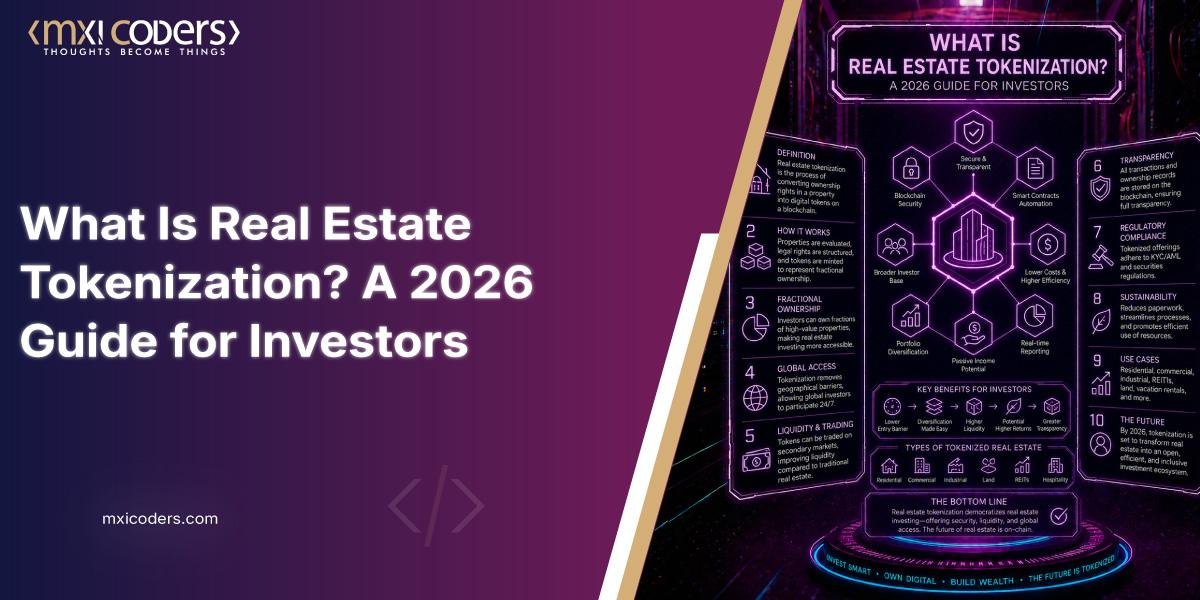
Real estate tokenization is the process of converting ownership rights, or the income rights, in a property into digital tokens recorded on a blockchain. Instead of buying a whole building, an investor can buy a token representing a slice of it, similar to how a share represents a slice of a company. That’s the short version. The long version has more nuance, and it matters if you’re actually putting money into this.
➤ How Does Real Estate Tokenization Actually Work?
A property owner, or a sponsor putting a deal together, sets up a legal entity that holds the real asset, usually an LLC. That entity then issues digital tokens on a blockchain, and each token represents a fractional claim on the entity, not the property’s deed directly. A smart contract handles the token issuance, transfer rules, and sometimes automated distribution of rental income to token holders. The property itself doesn’t move onto a blockchain. What moves is the ownership structure sitting on top of it.
This distinction trips people up constantly. You’re not buying a piece of a wall. You’re buying a token that represents a legal claim on an entity that owns the wall, and that claim is enforceable through the entity’s operating agreement, not through the blockchain itself.
➤ What Is Asset Tokenization in a Broader Sense?
Asset tokenization is the umbrella term, and real estate is just one category under it. The same mechanics apply to art, private equity funds, commodities, and even carbon credits. What makes real estate a popular target for this is the size of the asset class combined with how historically illiquid and hard to subdivide it’s been. A $10 million commercial building can’t be sold in fractions through a traditional deed transfer without enormous legal overhead. Tokenization gives that building a way to be split into a thousand $10,000 claims instead.
➤ How Big Is the Real Estate Tokenization Market in 2026?
Market size figures for this sector vary a lot depending on what’s being measured, and that’s worth flagging rather than glossing over. A market report from Insight Ace Analytic published in January 2026 pegs the real estate tokenization market at USD 3.73 billion in 2025, predicted to reach USD 23.99 billion by 2035 at a 21.0% CAGR. A separate April 2026 report from Dataintelo puts 2025 at $3.8 billion, projected to reach $26.4 billion by 2034 at a 24.0% CAGR, and notes the market is expected to surpass $4.7 billion by 2026. Insightaceanalytic + 2
Those are platform and service revenue figures, though, not the total value of assets sitting on tokenization rails. Looking further out and using a different measuring stick entirely, Deloitte’s analysis projects tokenized private real estate funds alone could grow to US$1 trillion by 2035, with total tokenized real estate related value potentially reaching roughly US$4 trillion by 2035. The gap between a $4 billion platform market and a $4 trillion asset value figure isn’t a typo. It’s two analysts measuring completely different things, and any article that gives you one number without saying which one it’s using is skipping a step you should care about.
➤ What Types of Property Get Tokenized?
Three broad categories dominate right now, and each has a different risk and liquidity profile.
Commercial property. Office buildings, retail centers, and industrial space, where tokenization mainly appeals to sponsors trying to bring in smaller check sizes without running a full syndication.
Residential property. Single family rentals, apartment buildings, and vacation properties, where the pitch to investors is usually rental yield split across token holders.
Trophy assets. Luxury resorts, landmark buildings, high end condos, where tokenization is used less for liquidity and more to open up access to a class of property that was previously reserved for large institutional buyers.
➤ Is Real Estate Tokenization Legal in the US?
Yes, but it runs entirely through existing securities law, not a separate crypto framework. On January 28, 2026, three divisions of the SEC issued a joint statement confirming that distributed ledger technology is a form of record keeping and does not, on its own, create a new legal category for a token. In plain terms, if the token passes the Howey Test, it’s a security no matter what chain it’s issued on. That was followed on March 17, 2026 by a joint SEC and CFTC Digital Asset Interpretation, a 68 page taxonomy that defines five token categories and treats digital securities as a fixed classification that can’t later be reclassified as a commodity. OmiSoftOmiSoft
Practically, that means every tokenized real estate deal in the US has to fit inside an existing exemption. The three most common paths:
| Option | Mechanism | Best Fit | Trade-off |
| Regulation D (506c) | Private placement, general solicitation allowed | Accredited investors only, sponsors wanting unlimited raise size | No cap on funds raised, but non accredited retail investors are locked out and resale is restricted |
| Regulation CF | Crowdfunding through an SEC registered funding portal | Smaller raises open to non accredited retail investors | Capped at $5 million per 12 month period, and must run through a registered intermediary |
| Regulation A+ | Semi public offering, SEC qualified | Larger raises that still want retail participation | Tier 2 allows up to $75 million in 12 months with the most extensive disclosure burden of the three |
One detail that catches new investors off guard: tokens sold under Regulation D or CF are restricted securities subject to resale limitations under Rule 144, and those holding period and volume restrictions apply regardless of the blockchain based form of the security. Buying a token doesn’t automatically mean you can sell it next week. The “instant liquidity” pitch you sometimes see in marketing material oversimplifies this. Tokenizationpolicy
➤ What Are the Real Advantages of Tokenizing Real Estate?
Lower entry cost. Fractional shares mean an investor can put in a few thousand dollars instead of needing to buy a whole property or fund a large syndication check.
Faster settlement. Smart contracts can automate distribution of rental income and cut down on the manual paperwork a traditional closing requires.
Broader investor access. Properties that used to be reserved for institutional buyers, large syndications, or high net worth individuals, can open up to a wider pool once fractionalized.
None of this makes tokenized real estate more liquid than public stock. It’s still tied to the underlying property’s market value, and secondary trading venues for security tokens remain thin compared to public equity markets.
➤ What Should You Actually Check Before Investing?
Before putting money into a tokenized real estate offering, look at three things specifically. First, which exemption is the offering using, since that tells you your resale rights up front. Second, who is the actual custodian of the underlying property, and what happens to your claim if the platform issuing the token shuts down. Third, ask whether the token issuer is registered with the SEC and FINRA where required, since Regulation CF offerings specifically must run through a registered intermediary.
➤ What Are the Real Challenges Facing This Market?
Regulatory fragmentation is the biggest one. Rules differ by jurisdiction, and a token structured to comply with US securities law won’t automatically satisfy requirements in the EU or Singapore. Custody and wallet recovery is another underappreciated risk. If an investor loses access to their wallet, recovering a claim tied to a real property isn’t as simple as a bank password reset. Secondary market depth is also thin right now. Even where resale is legally permitted, there often isn’t a deep enough pool of buyers to exit a position quickly, which somewhat undercuts the liquidity pitch that got the investor interested in the first place.
➤ Conclusion
Real estate tokenization isn’t a workaround for securities law, and it isn’t a shortcut to instant liquidity either. It’s a structural tool for subdividing ownership and automating parts of the transaction process, layered on top of the same legal framework that’s governed private real estate deals for decades. For investors, the diligence checklist barely changes: know your exemption, know your custodian, and know your exit before you know your expected return.
➤ Ready to Build a Compliant Tokenization Platform?
If you’re a real estate company exploring how to structure and launch a tokenized offering, MXICoders works as a blockchain development company building tokenization platforms, smart contracts, and investor facing infrastructure for real estate sponsors. Get in touch to talk through your project.
➤ Sources Used:
- Tokenization Policy, “SEC Tokenized Securities Framework: Complete 2026 Regulatory Guide” (March 17, 2026)
- Insight Ace Analytic, “Real Estate Tokenization Market Size, Trends and Forecast 2026 to 2035″ (Published January 27, 2026)
- Dataintelo, “Real Estate Tokenization Market Research Report 2034″ (April 2026)
- Omisoft, “Real Estate Tokenization Regulations 2026: US, UAE, SG & EU” (Citing SEC joint statement of January 28, 2026, and SEC/CFTC Digital Asset Interpretation of March 17, 2026)
- Real Cap Analytics, “The Ultimate Guide to SEC Regulations for Real Estate Funds and Syndications”