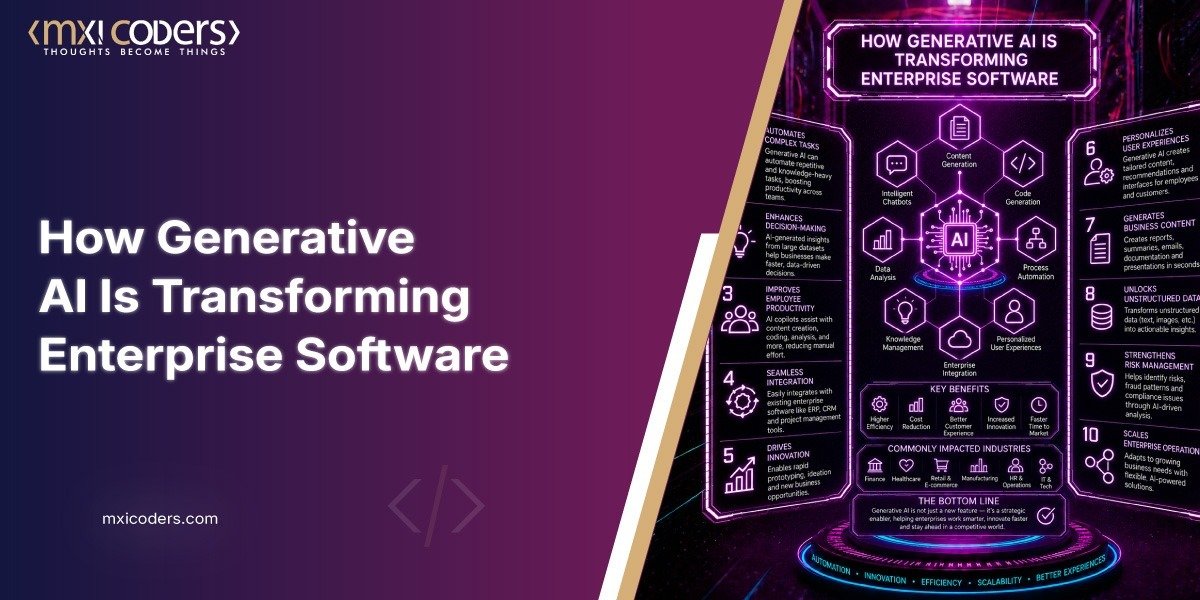
The use of enterprise software makes use of the capabilities of generative AI to allow it to perform some of the processes by itself so that there would be no need for more time in order to make use of such software by the employees. Generative AI is used in composing reports, answering employee inquiries based on the company’s documentations, writing and testing code and insights drawn from unstructured data. What generative AI brings to the table when it comes to enterprise software is the capability to ask for something in natural language without going through ten different screens.
➤ What Is Generative AI in Enterprise Software?
The development of AI involves the creation of models that generate new material through learning the pattern of content in a huge database. The typical layers found in an organization include:
- Large language models (LLMs) will understand queries and answer.
- Retrieval augmented generation (RAG) involves the extraction of company’s relevant content, documents, records, or policy before answering the query, making sure that the answer is based on your data, not generic knowledge.
- The enterprise data includes ERP, CRM, and data warehouse content, thus providing the business context.
Such examples include products like Microsoft Dynamics 365 Copilot, Salesforce Agentforce, and SAP Joule, which incorporate conversational agents into existing enterprise software solutions.
➤ How Generative AI Is Transforming Enterprise Software
➥ Automating Enterprise Workflows
Repetitive and rule-bound activities are those that AI would be quickest at automating in any business environment. As an illustration, one’s purchasing department can get AI to analyze purchase requisition forms, verify whether they comply with the company’s budget policy, and generate approval comments.
➥ Improving Business Intelligence and Decision-Making
Dashboards provide information on what has occurred. Generative AI explains why this occurred. For instance, the manager of the regional sales force could ask: “Why did the margins go down in the West region?” and get a quick response that connects discount trends to certain products.
➥ Personalizing Customer Experiences
Models can tailor messages using purchase history and support interactions. A telecom provider, for instance, can generate retention offers that match each customer’s usage pattern, which works far better than a generic “we miss you” email.
➥ Accelerating Software Development and Testing
Tools to develop generative AI software generate code, test units, and make sense of legacy logic. For instance, in an experiment conducted by GitHub, developers who used Copilot took 55% less time to complete a coding task. The internal IT departments follow this methodology for modifying legacy software.
➥ Enhancing ERP and CRM Systems
A CRM can now summarize a 40-minute sales call, update the deal stage, and suggest the next follow-up. In ERP, AI can flag unusual journal entries or draft supplier communications directly from transaction data.
➤ Traditional Enterprise Software vs. AI-Powered Enterprise Software
| Factor | Traditional Software | AI-Powered Enterprise Software |
| Automation | Fixed, rule-based scripts | Handles unstructured inputs such as emails and PDFs |
| Data Analysis | Predefined reports | On-demand answers in plain language |
| User Interaction | Menus, forms, filters | Conversational, natural-language queries |
| Decision support | Shows historical data | Explains trends and recommends actions |
| Adaptibility | Needs developer changes | Adjusts to new context through prompts and data |
➤ Key Benefits of Generative AI for Enterprises
- Efficiency in operations: Less manual transfer of information within processes.
- Productivity of employees: Employees save time spent on researching, summarizing, and writing.
- Quick business intelligence: Managers receive their answers instantly rather than waiting for reports.
- Enhanced customer support: According to research conducted on more than 5,000 customer support reps, the use of AI increased productivity by 14%, mostly benefiting newer reps.
- Flexibility in business processes: Processes can be changed without re-coding.
➤ Real-World Enterprise Use Cases of Generative AI
- Finances and invoice management: AI pulls apart lines in various invoices, connects them with the purchase orders and highlights any discrepancies.
- Logistics and inventory planning: The planner asks what the SKUs in danger of being out of stock are and gets recommendations for restocking according to demand indications.
- Human resources and company’s knowledge base search: The employee poses the question, “How many vacation days do we get credit for?” and gets the information taken from the policy manual.
- Customer service and sales operations: Customer service representatives get suggestions for the responses, and the sales team gets automated call summaries. It’s where generative AI for business tends to pay off the fastest.
➤ Challenges of Implementing Generative AI
- Data security and privacy: Sensitive data needs control mechanisms, encryption, and instructions regarding what the models should have access to.
- Model hallucinations and mistakes: Models can make confident mistakes. RAG and human-in-the-loop solve this challenge.
- Integration with legacy systems: Legacy systems don’t always have robust APIs, so the integration process will take more time.
- Costs, governance, and compliance: Usage fees, monitoring costs, and regulatory compliance like the EU AI Act come into play. The NIST AI RMF will help you get it right from the beginning.
➤ How to Integrate Generative AI into Enterprise Software
- State an explicit business challenge. Begin by defining a single challenge rather than using AI “everywhere.”
- Determine the quality and security needs for the data. Bad data leads to bad answers.
- Pick appropriate AI models and integration approaches. Decide whether you should use API-based models, open-source models, or copilots from vendors based on budget and control.
- Implement a carefully designed pilot program. Experiment with a small group of people and actual workloads.
- Measure accuracy, adoption, cost, and business impact. Compare results with a baseline.
- Expand while monitoring and managing human involvement. Human intervention is needed for critical decisions.
➤ The Future of Generative AI in Enterprise Software
- AI agents that can execute multi-stage processes in order to get things done like “reconcile this vendor account” end-to-end.
- Natural language interfaces being the new default for interacting with business software applications.
- ERP and CRM systems that are more context-aware, anticipating user needs.
- Governance of AI systems, with human oversight of each critical workflow.
➤ Conclusion
Generative AI in Enterprise software is evolving from a record-keeping tool to an active collaborator in the workplace. However, the companies that see real benefits start with a real issue rather than marketing hype. Select a procedure, confirm its efficacy, and then expand on it. We at MXICoders can help whether you’re considering creating specialized AI-based business apps or incorporating AI into your existing solutions.