[ Your Headline ] [ Highlight Word ]

[ One or two lines describing the offer — e.g. "Experience our services with a FREE 30-minute consultation." ]

[ Optional second line, e.g. "Have a concept in mind? Let's brainstorm together!" ]

Google ★★★★★ 4.8
GoodFirms ★★★★★ 4.7
Clutch ★★★★★ 5.0
Software

How Hospital Management System Software Is Streamlining Modern Healthcare Operations

Ashok Rathod

Tech Consultant

Posted on
19th Oct 2026
7 min
Read

Table of Contents

  • Quick Tips
  • Familiarize yourself with Cash App
  • Enable two-factor authentication
  • Utilize the optional Cash App
  • Conclusion

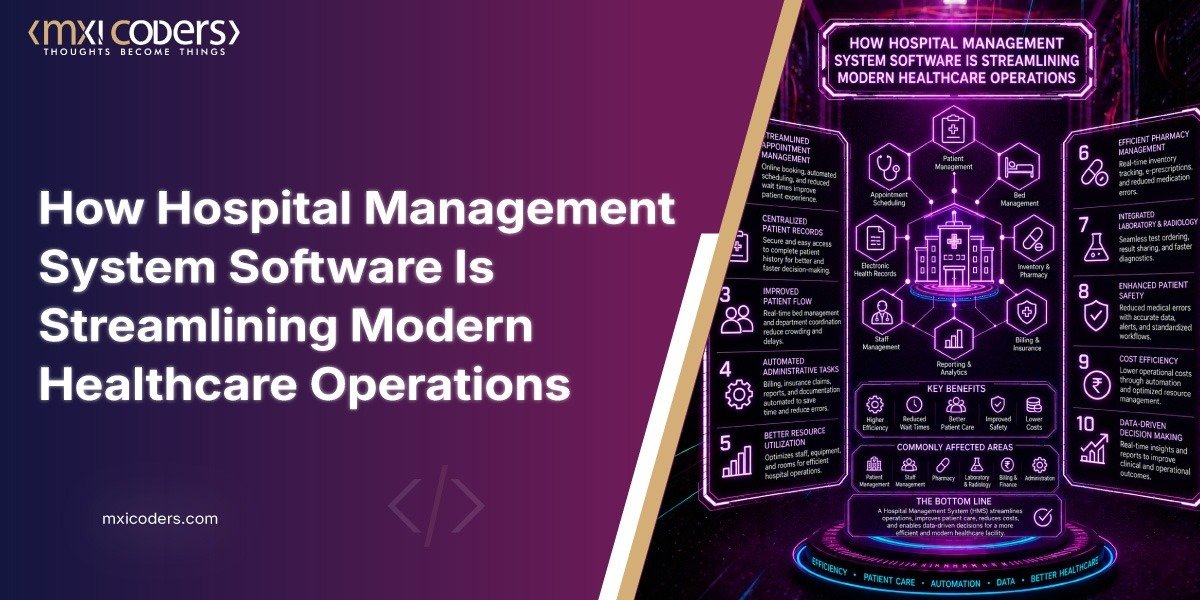
Because of the use of the hospital management system software in the hospitals, there is facilitation of this process because of the link of various departments in the hospital, automation of the processes, centralization of information, and visualization of appointments, billing, inventory, records, and resources. This eliminates fragmentation and makes the information transfer in the hospital more consistent.

The year 2026 is characterized by the application of AI technology at the operational level. After the analysis of HIMSS survey conducted by Guidehouse, 78% of health systems surveyed had AI projects but only 52% were operationally ready to deploy AI technology.

➤ What Is Hospital Management Software?

Hospital management software is a digital platform used to coordinate administrative and operational processes across a healthcare facility. It can connect patient administration, appointments, billing, pharmacy, laboratory work, inventory, staffing, and reporting around shared workflows and data.

The goal is not simply to replace paper. It is to reduce duplicate data entry, make information available to authorized teams, and give managers a more complete operational view.

➤ How Is Hospital Software Reducing Administrative Work?

Hospital software minimizes administrative tasks by shifting routine tasks into a digital workflow process. Information collected during registration can be used for appointment and billing processes; appointments can create alerts, and completed tasks can be transferred to billing or report creation without duplication. Workflows for claim processing and insurance claim processing can be created on the basis of standardized information, status checking, and exceptions.

For instance, prior to any automation process, a patient could have provided similar information for registration, laboratory, and billing processes. Reconciliation of different entries is done manually by staff members. In the case of an automated process, the entire process is conducted using the same patient and visit information for all authorized teams.

➤ How Does Interoperability Improve Hospital Operations?

Interoperability helps in improving efficiency through the exchange of useful information rather than working in silos, which is possible only for authorized systems. The EHR system can be integrated with scheduling systems, laboratories, pharmacies, billing systems, patient-facing systems, and other third-party health technologies using API and other standards like HL7 and FHIR. As per ONC, around 9 out of 10 hospitals in the U.S. have implemented patient access to their health information via API in 2024. Seven in ten hospitals had access via standards-based API, including HL7 FHIR-based APIs.

According to ONC, EHR data was being exchanged between hospitals and third-party technologies both for clinical and administrative uses but this is largely based on non-standardized methods. This means that interoperability maturity is not only a technical but also an operational challenge.

➤ How Is AI Changing Hospital Management Systems?

AI is increasingly utilized to assist with scheduling, workload forecasting, billing reviews, resource management, workflow routing, administrative productivity, and operational alerts. The role of AI is to enable employees to prioritize and process information quickly, and not to eliminate their accountability. The WHO guidance issued in 2026 mentions that AI should complement, and not substitute for human decision-making and that human oversight is required in AI-based decisions.

The 2026 Guidehouse-HIMSS research illustrates the importance of readiness as well. The barriers to scale-up of AI mentioned by healthcare professionals include cybersecurity, privacy, data quality, governance, budget constraints, and lack of expertise.

➤ Why Are Data Quality and Cybersecurity Becoming More Important?

Quality of data and cybersecurity are important in this context because the automated systems need high quality data as well as controlled access to it. Duplicate records, lack of required fields, code inconsistencies or old data can affect the analytics and cause the misrouting of the processes through automation. This holds especially true for AI, which, according to WHO, needs quality-controlled health data and 2026 Guidehouse-HIMSS Survey noted the issues with data quality, standardization, availability or governance by 42% of its participants.

The guidance on cybersecurity in healthcare system from HHS involves the use of encryption, access management, logging, incident response, vulnerability management and recovery readiness. This implies role-based access controls, logging and auditing, secure data transfer, backup and recovery processes.

➤ How Does Hospital Software Improve the Patient Experience?

Hospitals improve the experience of the patients by ensuring that there are no administrative inconveniences in these programs. For instance, automated registration can reduce paperwork, online booking can be done easily, and interconnected data can help the respective departments in getting information without having to repeat the same for the patients.

Applications that are patient-friendly will enable the patients to view their records and have electronic communication. According to ONC statistics, API-based access to the medical records is widespread in the hospitals all over the US. These facilities do not guarantee improved clinical results; however, they make administrative interaction easier.

➤ What Should Hospitals Look for in Modern Management Software?

Hospitals should evaluate software against their workflows, technology environment, security obligations, growth plans, and reporting needs rather than choosing a platform only because it has a long feature list.

CapabilityWhy does it matters
InteroperabilityConnects healthcare systems
AutomationReduces repetitive work
AnalyticsSupports operational decisions
SecurityProtects sensitive information
ScalabilitySupports future growth
User access controlsLimits inappropriate access
ReportingTracks performance
IntegrationConnects existing tools

Hospitals should also check whether staff can use the system comfortably, whether data can move reliably between existing applications, and whether automation can be governed over time.

➤ What Is the Future of Hospital Management Software?

The near future implies a shift towards connectivity on the basis of an AI-powered workflow, data exchange standardization, real-time operational analytics, advanced cybersecurity, and better digital experience.

Nevertheless, by 2026, the big shift will be a change from the use of AI on trial to its governance and measurement. HIMSS-supported research highlights such aspects as readiness, cybersecurity, data governance, process design, and organizational alignment. Furthermore, WHO mentioned such aspects as accountability, data quality, human oversight, and governance readiness when introducing AI technology.

Future-proof software has to offer trustworthy data, authorization, activity tracking, workflow flexibility, and governance to facilitate automation management.

➤ Conclusion

The current healthcare management systems are evolving from being mere systems for recording to platforms that are automated, integrated, analytical, and eventually use AI-driven processes. This evolution is worth it since it helps reduce fragmentation, with data, security, and human control remaining a priority.

Hospitals that wish to implement such a platform or upgrade their systems might consider forming a partnership with  MXICoders as a tech vendor for architecture, interoperability, and workflow discussion.

➤ Frequently asked questions

  1. What does a hospital management platform do?
    It coordinates operational and administrative workflows across registration, appointments, billing, pharmacy, laboratory services, inventory, staffing, and reporting.
  2. How does hospital management software improve efficiency?
    It reduces repeated data entry, automates routine steps, improves information flow between departments, and gives staff faster access to operational information.
  3. Can hospital management software integrate with EHR systems?
    Yes. Modern platforms can connect with EHRs through APIs and healthcare data standards such as HL7 and FHIR, depending on the systems involved.
  4. How is AI used in hospital management software?
    AI can support scheduling, forecasting, billing workflows, resource planning, administrative automation, and operational alerts. Human oversight remains necessary for high-impact decisions.

➤ Sources Used

how hospital management system software (blog image)

Because of the use of the hospital management system software in the hospitals, there is facilitation of this process because of the link of various departments in the hospital, automation of the processes, centralization of information, and visualization of appointments, billing, inventory, records, and resources. This eliminates fragmentation and makes the information transfer in the hospital more consistent.

The year 2026 is characterized by the application of AI technology at the operational level. After the analysis of HIMSS survey conducted by Guidehouse, 78% of health systems surveyed had AI projects but only 52% were operationally ready to deploy AI technology.

➤ What Is Hospital Management Software?

Hospital management software is a digital platform used to coordinate administrative and operational processes across a healthcare facility. It can connect patient administration, appointments, billing, pharmacy, laboratory work, inventory, staffing, and reporting around shared workflows and data.

The goal is not simply to replace paper. It is to reduce duplicate data entry, make information available to authorized teams, and give managers a more complete operational view.

➤ How Is Hospital Software Reducing Administrative Work?

Hospital software minimizes administrative tasks by shifting routine tasks into a digital workflow process. Information collected during registration can be used for appointment and billing processes; appointments can create alerts, and completed tasks can be transferred to billing or report creation without duplication. Workflows for claim processing and insurance claim processing can be created on the basis of standardized information, status checking, and exceptions.

For instance, prior to any automation process, a patient could have provided similar information for registration, laboratory, and billing processes. Reconciliation of different entries is done manually by staff members. In the case of an automated process, the entire process is conducted using the same patient and visit information for all authorized teams.

➤ How Does Interoperability Improve Hospital Operations?

Interoperability helps in improving efficiency through the exchange of useful information rather than working in silos, which is possible only for authorized systems. The EHR system can be integrated with scheduling systems, laboratories, pharmacies, billing systems, patient-facing systems, and other third-party health technologies using API and other standards like HL7 and FHIR. As per ONC, around 9 out of 10 hospitals in the U.S. have implemented patient access to their health information via API in 2024. Seven in ten hospitals had access via standards-based API, including HL7 FHIR-based APIs.

According to ONC, EHR data was being exchanged between hospitals and third-party technologies both for clinical and administrative uses but this is largely based on non-standardized methods. This means that interoperability maturity is not only a technical but also an operational challenge.

➤ How Is AI Changing Hospital Management Systems?

AI is increasingly utilized to assist with scheduling, workload forecasting, billing reviews, resource management, workflow routing, administrative productivity, and operational alerts. The role of AI is to enable employees to prioritize and process information quickly, and not to eliminate their accountability. The WHO guidance issued in 2026 mentions that AI should complement, and not substitute for human decision-making and that human oversight is required in AI-based decisions.

The 2026 Guidehouse-HIMSS research illustrates the importance of readiness as well. The barriers to scale-up of AI mentioned by healthcare professionals include cybersecurity, privacy, data quality, governance, budget constraints, and lack of expertise.

➤ Why Are Data Quality and Cybersecurity Becoming More Important?

Quality of data and cybersecurity are important in this context because the automated systems need high quality data as well as controlled access to it. Duplicate records, lack of required fields, code inconsistencies or old data can affect the analytics and cause the misrouting of the processes through automation. This holds especially true for AI, which, according to WHO, needs quality-controlled health data and 2026 Guidehouse-HIMSS Survey noted the issues with data quality, standardization, availability or governance by 42% of its participants.

The guidance on cybersecurity in healthcare system from HHS involves the use of encryption, access management, logging, incident response, vulnerability management and recovery readiness. This implies role-based access controls, logging and auditing, secure data transfer, backup and recovery processes.

➤ How Does Hospital Software Improve the Patient Experience?

Hospitals improve the experience of the patients by ensuring that there are no administrative inconveniences in these programs. For instance, automated registration can reduce paperwork, online booking can be done easily, and interconnected data can help the respective departments in getting information without having to repeat the same for the patients.

Applications that are patient-friendly will enable the patients to view their records and have electronic communication. According to ONC statistics, API-based access to the medical records is widespread in the hospitals all over the US. These facilities do not guarantee improved clinical results; however, they make administrative interaction easier.

➤ What Should Hospitals Look for in Modern Management Software?

Hospitals should evaluate software against their workflows, technology environment, security obligations, growth plans, and reporting needs rather than choosing a platform only because it has a long feature list.

CapabilityWhy does it matters
InteroperabilityConnects healthcare systems
AutomationReduces repetitive work
AnalyticsSupports operational decisions
SecurityProtects sensitive information
ScalabilitySupports future growth
User access controlsLimits inappropriate access
ReportingTracks performance
IntegrationConnects existing tools

Hospitals should also check whether staff can use the system comfortably, whether data can move reliably between existing applications, and whether automation can be governed over time.

➤ What Is the Future of Hospital Management Software?

The near future implies a shift towards connectivity on the basis of an AI-powered workflow, data exchange standardization, real-time operational analytics, advanced cybersecurity, and better digital experience.

Nevertheless, by 2026, the big shift will be a change from the use of AI on trial to its governance and measurement. HIMSS-supported research highlights such aspects as readiness, cybersecurity, data governance, process design, and organizational alignment. Furthermore, WHO mentioned such aspects as accountability, data quality, human oversight, and governance readiness when introducing AI technology.

Future-proof software has to offer trustworthy data, authorization, activity tracking, workflow flexibility, and governance to facilitate automation management.

➤ Conclusion

The current healthcare management systems are evolving from being mere systems for recording to platforms that are automated, integrated, analytical, and eventually use AI-driven processes. This evolution is worth it since it helps reduce fragmentation, with data, security, and human control remaining a priority.

Hospitals that wish to implement such a platform or upgrade their systems might consider forming a partnership with  MXICoders as a tech vendor for architecture, interoperability, and workflow discussion.

➤ Frequently asked questions

  1. What does a hospital management platform do?
    It coordinates operational and administrative workflows across registration, appointments, billing, pharmacy, laboratory services, inventory, staffing, and reporting.
  2. How does hospital management software improve efficiency?
    It reduces repeated data entry, automates routine steps, improves information flow between departments, and gives staff faster access to operational information.
  3. Can hospital management software integrate with EHR systems?
    Yes. Modern platforms can connect with EHRs through APIs and healthcare data standards such as HL7 and FHIR, depending on the systems involved.
  4. How is AI used in hospital management software?
    AI can support scheduling, forecasting, billing workflows, resource planning, administrative automation, and operational alerts. Human oversight remains necessary for high-impact decisions.

➤ Sources Used

Feel free to Connect us on

Ready to transform your business with smart software solutions?

Harness the power of custom software development to streamline operations, reduce costs, and boost efficiency. Start by exploring cutting-edge approaches like cloud-native platforms, API-first architecture, and AI-driven automation to future-proof your systems and stay ahead of the competition.

Book free consultation

Let’s build your idea together and serve society.

Author

Ashok Rathod

Tech Consultant

Experience
25 Years
Growth Architect for Startups & SMEs | Blockchain, AI , MVP Development, & Data-Driven Marketing Expert.

Transform the Carbon Credit Industry

Build a Transparent, Scalable Carbon Credit Marketplace with Blockchain.