[ Your Headline ] [ Highlight Word ]

[ One or two lines describing the offer — e.g. "Experience our services with a FREE 30-minute consultation." ]

[ Optional second line, e.g. "Have a concept in mind? Let's brainstorm together!" ]

Google ★★★★★ 4.8
GoodFirms ★★★★★ 4.7
Clutch ★★★★★ 5.0
Blockchain,Digital Marketing,Tokenization,Web App Development

How to List Your ERC-20 Token on a Crypto Exchange?

hitesh s

Posted on
19th Aug 2026
7 min
Read
Share

Table of Contents

  • Quick Tips
  • Familiarize yourself with Cash App
  • Enable two-factor authentication
  • Utilize the optional Cash App
  • Conclusion

Getting a token listed is often treated as a single milestone, but the numbers tell a more layered story. Listing costs in 2026 range from a few thousand dollars on smaller platforms to $300,000 or more for top-tier centralized exchanges, and the full process typically takes two to four months from first application to live trading. Projects that skip a decentralized exchange launch and go straight for a major CEX listing often find that a DEX-first approach generates only 10 to 20% of the trading volume seen on centralized platforms, which is exactly why most experienced teams sequence their strategy rather than chasing a big exchange on day one. This guide breaks down what actually goes into listing an ERC-20 token, step by step, so you can budget and plan realistically before applying anywhere.

What Exchanges Look for Before Approving a Listing

Exchanges are not just evaluating a token’s technology. They are assessing risk, both to their platform and to the traders who will buy the token once it goes live.

Core Requirements Most Exchanges Check

  • A completed and passed smart contract audit from a recognized security firm
  • Verified circulating supply and clear tokenomics documentation
  • Proof of existing liquidity, either on a DEX or another CEX
  • A legal opinion confirming the token is not classified as an unregistered security in relevant jurisdictions
  • An active community and demonstrable product traction

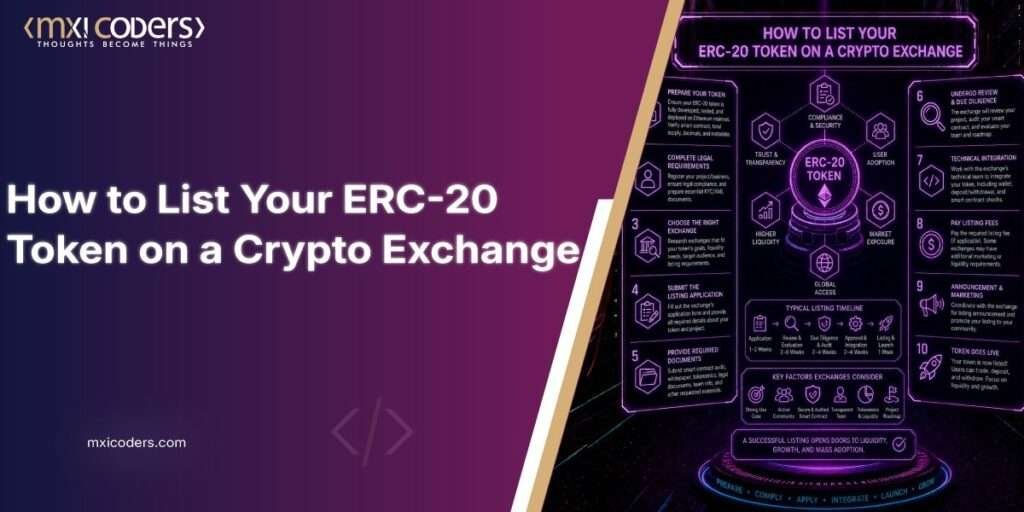
H2: Step by Step Process To List Your ERC-20 Token

Step 1: Prepare Your ERC-20 Token for Listing

Before submitting any application, the token itself needs to be technically and legally ready. This is where most delays actually happen, since exchanges routinely reject applications for incomplete documentation rather than the token concept itself.

  • Finalize and audit the smart contract, addressing every finding before resubmission
  • Publish a clear whitepaper covering utility, supply schedule, and vesting terms
  • Set up a verified contract on a block explorer like Etherscan
  • Prepare KYB documentation for the founding team and legal entity

Teams still finalizing their contract logic at this stage may want to revisit the differences between the ERC-20 token standard and other token formats, since choosing the wrong standard early on can create rework later in the audit process.

Step 2: Build Liquidity Before Applying

Exchanges are far more likely to approve a token that already shows trading activity than one asking to be listed cold. This is why most 2026 listing strategies start with a decentralized exchange rather than jumping straight to a centralized platform.

Why a DEX-First Strategy Works

  • Launching on Uniswap or a chain’s dominant DEX builds an organic trading history
  • Three to six months of consistent volume gives a project negotiating leverage with CEX teams
  • A visible holder base reduces the perceived risk exchanges associate with new listings
  • DEX listings carry the lowest cost and highest approval likelihood of any listing type

Step 3: Choose the Right Exchange Tier

Not every token needs a Tier 1 exchange, and applying too early to a major platform without traction usually results in rejection or an unaffordable fee quote.

  • Tier 1 exchanges (Binance, Coinbase, OKX) offer the highest visibility but require substantial liquidity commitments, audits, and fees that can run into hundreds of thousands of dollars
  • Tier 2 exchanges compete more aggressively for mid-cap projects and often have faster, more transparent review processes
  • Tier 3 exchanges and regional platforms are more accessible for early-stage tokens still building a track record

Step 4: Submit the Application and Prepare for Due Diligence

Once liquidity and documentation are in place, the formal application process begins. Exchanges typically review submissions across compliance, technical security, and market readiness before quoting terms.

  • Submit the audit report, legal opinion, and tokenomics package together, not piecemeal
  • Expect a due diligence period of several weeks, longer for Tier 1 platforms
  • Be prepared to negotiate listing fees, which are rarely fixed regardless of what is initially quoted
  • Budget separately for market making and liquidity provisioning, since these are usually additional to the base listing fee

Step 5: Plan for Post-Listing Market Making and Liquidity

A successful listing is not the finish line. Exchanges and traders both watch how a token behaves in its first weeks of live trading, and thin liquidity right after launch can undo months of preparation.

  • Arrange market making support to keep the order book active and reduce price volatility
  • Monitor slippage and spread closely during the first two to four weeks post-listing
  • Keep enough reserve liquidity to support the token through both DEX and CEX venues simultaneously

Projects that underestimate this phase often run into the same category of problems covered in our breakdown of common blockchain adoption mistakes, where insufficient planning after launch undermines otherwise solid technical work.

Costs You Should Actually Budget For

Listing fees are only one line item in a much larger budget. A realistic plan should account for the full stack of expenses involved in getting a token live and stable.

  • Smart contract audit fees, which vary based on contract complexity
  • Legal opinion and KYB compliance costs
  • Exchange listing fees, ranging from a few thousand dollars to six figures depending on tier
  • Market making and liquidity provisioning for the first several months post-listing
  • Marketing and community-building costs tied to exchange-side promotional requirements

Working with a team experienced in smart contract development from the start can reduce the audit and rework cycle significantly, since contracts built with listing requirements in mind tend to pass review faster than those retrofitted later.

Frequently Asked Questions

How long does it take to list an ERC-20 token on a crypto exchange?

Most listings take two to four months from first application to live trading, though Tier 1 exchanges with deeper due diligence requirements can take longer.

Do all exchanges charge a listing fee?

Some exchanges state they charge no direct listing fee, but total costs including liquidity commitments, market making, and marketing obligations can still run into the hundreds of thousands or even millions of dollars for the largest platforms.

Should a new token launch on a DEX before applying to a CEX?

Yes, in most cases. A DEX-first approach builds trading history and holder traction at lower cost, which strengthens a project’s position when it later applies to centralized exchanges.

Common Mistakes That Delay a Listing

  • Applying to a Tier 1 exchange before building any trading history or liquidity
  • Submitting an incomplete audit or unresolved security findings
  • Underestimating the legal opinion requirement for tokens with utility beyond simple payments
  • Failing to budget for market making, leading to thin liquidity right after launch
  • Treating tokenomics documentation as an afterthought rather than a core part of the application

Conclusion

Listing an ERC-20 token on a crypto exchange is less about a single application and more about a sequenced process: audited contracts, verified liquidity, clean documentation, and a realistic budget that goes well beyond the headline listing fee. Projects that build traction on a DEX first, choose an exchange tier that matches their current stage, and prepare thoroughly for due diligence consistently move through the process faster and with fewer surprises than those chasing a major exchange too early.

References

  1. Listing.help, How Much Does It Cost to List a Token in 2026?
  2. Listing.help, OKX Listing Cost 2026: Fees, Requirements & Budget
  3. The Signal, How to Get Listed on a Crypto Exchange: Process, Costs, and Requirements
  4. DataGlobeHub, Cost of Listing on Crypto Exchanges: Statistics and Insights 2026
how to list your erc 20 token on a crypto exchange

Getting a token listed is often treated as a single milestone, but the numbers tell a more layered story. Listing costs in 2026 range from a few thousand dollars on smaller platforms to $300,000 or more for top-tier centralized exchanges, and the full process typically takes two to four months from first application to live trading. Projects that skip a decentralized exchange launch and go straight for a major CEX listing often find that a DEX-first approach generates only 10 to 20% of the trading volume seen on centralized platforms, which is exactly why most experienced teams sequence their strategy rather than chasing a big exchange on day one. This guide breaks down what actually goes into listing an ERC-20 token, step by step, so you can budget and plan realistically before applying anywhere.

What Exchanges Look for Before Approving a Listing

Exchanges are not just evaluating a token’s technology. They are assessing risk, both to their platform and to the traders who will buy the token once it goes live.

Core Requirements Most Exchanges Check

  • A completed and passed smart contract audit from a recognized security firm
  • Verified circulating supply and clear tokenomics documentation
  • Proof of existing liquidity, either on a DEX or another CEX
  • A legal opinion confirming the token is not classified as an unregistered security in relevant jurisdictions
  • An active community and demonstrable product traction

H2: Step by Step Process To List Your ERC-20 Token

Step 1: Prepare Your ERC-20 Token for Listing

Before submitting any application, the token itself needs to be technically and legally ready. This is where most delays actually happen, since exchanges routinely reject applications for incomplete documentation rather than the token concept itself.

  • Finalize and audit the smart contract, addressing every finding before resubmission
  • Publish a clear whitepaper covering utility, supply schedule, and vesting terms
  • Set up a verified contract on a block explorer like Etherscan
  • Prepare KYB documentation for the founding team and legal entity

Teams still finalizing their contract logic at this stage may want to revisit the differences between the ERC-20 token standard and other token formats, since choosing the wrong standard early on can create rework later in the audit process.

Step 2: Build Liquidity Before Applying

Exchanges are far more likely to approve a token that already shows trading activity than one asking to be listed cold. This is why most 2026 listing strategies start with a decentralized exchange rather than jumping straight to a centralized platform.

Why a DEX-First Strategy Works

  • Launching on Uniswap or a chain’s dominant DEX builds an organic trading history
  • Three to six months of consistent volume gives a project negotiating leverage with CEX teams
  • A visible holder base reduces the perceived risk exchanges associate with new listings
  • DEX listings carry the lowest cost and highest approval likelihood of any listing type

Step 3: Choose the Right Exchange Tier

Not every token needs a Tier 1 exchange, and applying too early to a major platform without traction usually results in rejection or an unaffordable fee quote.

  • Tier 1 exchanges (Binance, Coinbase, OKX) offer the highest visibility but require substantial liquidity commitments, audits, and fees that can run into hundreds of thousands of dollars
  • Tier 2 exchanges compete more aggressively for mid-cap projects and often have faster, more transparent review processes
  • Tier 3 exchanges and regional platforms are more accessible for early-stage tokens still building a track record

Step 4: Submit the Application and Prepare for Due Diligence

Once liquidity and documentation are in place, the formal application process begins. Exchanges typically review submissions across compliance, technical security, and market readiness before quoting terms.

  • Submit the audit report, legal opinion, and tokenomics package together, not piecemeal
  • Expect a due diligence period of several weeks, longer for Tier 1 platforms
  • Be prepared to negotiate listing fees, which are rarely fixed regardless of what is initially quoted
  • Budget separately for market making and liquidity provisioning, since these are usually additional to the base listing fee

Step 5: Plan for Post-Listing Market Making and Liquidity

A successful listing is not the finish line. Exchanges and traders both watch how a token behaves in its first weeks of live trading, and thin liquidity right after launch can undo months of preparation.

  • Arrange market making support to keep the order book active and reduce price volatility
  • Monitor slippage and spread closely during the first two to four weeks post-listing
  • Keep enough reserve liquidity to support the token through both DEX and CEX venues simultaneously

Projects that underestimate this phase often run into the same category of problems covered in our breakdown of common blockchain adoption mistakes, where insufficient planning after launch undermines otherwise solid technical work.

Costs You Should Actually Budget For

Listing fees are only one line item in a much larger budget. A realistic plan should account for the full stack of expenses involved in getting a token live and stable.

  • Smart contract audit fees, which vary based on contract complexity
  • Legal opinion and KYB compliance costs
  • Exchange listing fees, ranging from a few thousand dollars to six figures depending on tier
  • Market making and liquidity provisioning for the first several months post-listing
  • Marketing and community-building costs tied to exchange-side promotional requirements

Working with a team experienced in smart contract development from the start can reduce the audit and rework cycle significantly, since contracts built with listing requirements in mind tend to pass review faster than those retrofitted later.

Frequently Asked Questions

How long does it take to list an ERC-20 token on a crypto exchange?

Most listings take two to four months from first application to live trading, though Tier 1 exchanges with deeper due diligence requirements can take longer.

Do all exchanges charge a listing fee?

Some exchanges state they charge no direct listing fee, but total costs including liquidity commitments, market making, and marketing obligations can still run into the hundreds of thousands or even millions of dollars for the largest platforms.

Should a new token launch on a DEX before applying to a CEX?

Yes, in most cases. A DEX-first approach builds trading history and holder traction at lower cost, which strengthens a project’s position when it later applies to centralized exchanges.

Common Mistakes That Delay a Listing

  • Applying to a Tier 1 exchange before building any trading history or liquidity
  • Submitting an incomplete audit or unresolved security findings
  • Underestimating the legal opinion requirement for tokens with utility beyond simple payments
  • Failing to budget for market making, leading to thin liquidity right after launch
  • Treating tokenomics documentation as an afterthought rather than a core part of the application

Conclusion

Listing an ERC-20 token on a crypto exchange is less about a single application and more about a sequenced process: audited contracts, verified liquidity, clean documentation, and a realistic budget that goes well beyond the headline listing fee. Projects that build traction on a DEX first, choose an exchange tier that matches their current stage, and prepare thoroughly for due diligence consistently move through the process faster and with fewer surprises than those chasing a major exchange too early.

References

  1. Listing.help, How Much Does It Cost to List a Token in 2026?
  2. Listing.help, OKX Listing Cost 2026: Fees, Requirements & Budget
  3. The Signal, How to Get Listed on a Crypto Exchange: Process, Costs, and Requirements
  4. DataGlobeHub, Cost of Listing on Crypto Exchanges: Statistics and Insights 2026

Feel free to Connect us on

Ready to transform your business with smart software solutions?

Harness the power of custom software development to streamline operations, reduce costs, and boost efficiency. Start by exploring cutting-edge approaches like cloud-native platforms, API-first architecture, and AI-driven automation to future-proof your systems and stay ahead of the competition.

Book free consultation

Let’s build your idea together and serve society.

Author

hitesh s

Experience

Transform the Carbon Credit Industry

Build a Transparent, Scalable Carbon Credit Marketplace with Blockchain.

Let's build something real!

Share your ideas with us and we’ll turn them into powerful digital solutions.

500+

Projects

20+

Experience

255+

Clients

Tell us about your project

Our team will get back to you within 24 hours