...

[ Your Headline ] [ Highlight Word ]

[ One or two lines describing the offer — e.g. "Experience our services with a FREE 30-minute consultation." ]

[ Optional second line, e.g. "Have a concept in mind? Let's brainstorm together!" ]

Google ★★★★★ 4.8
GoodFirms ★★★★★ 4.7
Clutch ★★★★★ 5.0
Blockchain,Smart Contract Development

Common Mistakes Businesses Make When Adopting Blockchain

Ashok Rathod

Tech Consultant

Posted on
27th Jul 2026
7 min
Read
Share

Table of Contents

  • Quick Tips
  • Familiarize yourself with Cash App
  • Enable two-factor authentication
  • Utilize the optional Cash App
  • Conclusion

Businesses often struggle with blockchain adoption because they focus on the technology before defining the business problem it needs to solve. Gartner estimates that 25% of Global 2000 companies will run blockchain in production by the end of 2026, up from just 11% in 2024, and the enterprise blockchain market itself is projected to grow from roughly $12.77 billion in 2025 to $29.29 billion by 2033. Yet not every pilot turns into a lasting deployment. Common blockchain adoption mistakes include choosing blockchain without a clear use case, underestimating regulatory requirements, ignoring interoperability, overlooking cybersecurity, and failing to plan for long-term scalability and governance.

Interest in blockchain for businesses is increasing across finance, supply chain, and healthcare, driven by demand for tamper-evident records and faster settlement. But blockchain is not automatically the right solution for every business problem. Successful enterprise blockchain adoption requires more than blockchain development alone. It requires a business blockchain strategy that accounts for compliance, integration, cost, and user adoption, since launching a blockchain-based application is not the same as adopting blockchain in a way that changes how an organization operates.

Quick Answer: The most frequent blockchain adoption mistakes are starting with the technology instead of the problem, picking the wrong architecture, underestimating scalability and integration needs, assuming blockchain equals security, and treating compliance as an afterthought rather than a design requirement from day one.

➤ What Are the Most Common Blockchain Adoption Mistakes?

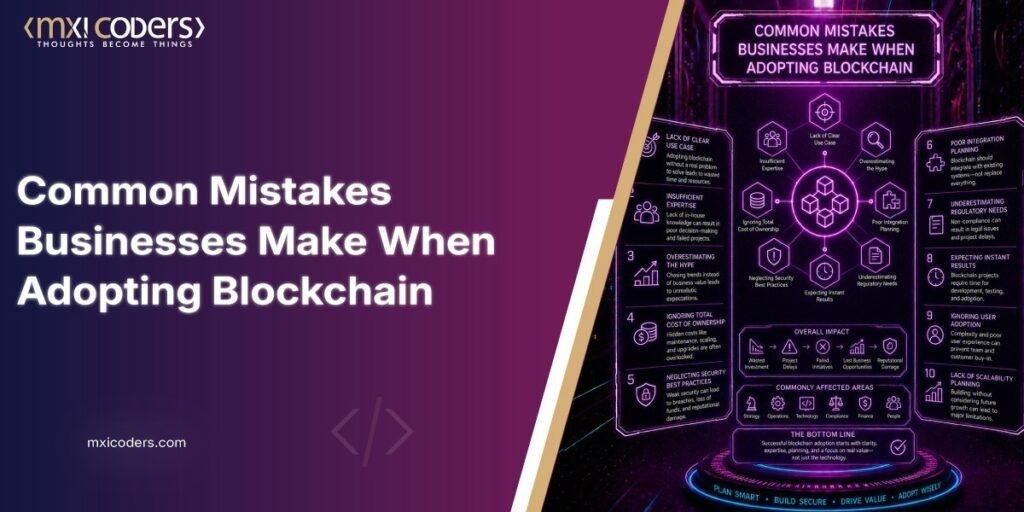
  1. Adopting blockchain without a clear business use case
  2. Choosing blockchain because it is a technology trend
  3. Selecting the wrong blockchain architecture
  4. Ignoring scalability and performance requirements
  5. Underestimating integration with existing systems
  6. Treating blockchain as inherently secure
  7. Overlooking smart contract vulnerabilities
  8. Failing to plan for regulatory and compliance requirements
  9. Ignoring data privacy and governance
  10. Underestimating costs and operational complexity

➤ Some Common Blockchain Adoption Challenges Explained 

1. Choosing Blockchain Before Defining the Business Problem

Many teams start with “we need blockchain” or “our competitors are using blockchain” instead of identifying the operational problem first. Before moving forward, ask:

  • What problem are we actually trying to solve?
  • Does it require decentralisation?
  • Do multiple parties need to share a trusted record?
  • Would a traditional database work more efficiently?

Key takeaway: Blockchain should be selected because it solves a specific problem, not because it looks impressive on a roadmap.

2. Adopting Blockchain Without a Clear ROI Model

Blockchain implementation challenges often trace back to unclear financial justification. Development, auditing, compliance, and infrastructure costs add up quickly, and businesses frequently skip defining measurable KPIs such as cost reduction, processing time, fraud reduction, and partner adoption. How do you measure the ROI of blockchain adoption? Track cost savings against legacy processes, transaction efficiency gains, and adoption rates among partners and customers over a defined pilot period, then compare those figures against your original business case.

3. Choosing the Wrong Blockchain Architecture

Businesses need to decide between public, private, permissioned, consortium, Layer 2, or hybrid architecture based on:

  • Data privacy needs
  • Transaction volume
  • Governance requirements
  • Regulatory obligations
  • Interoperability with partner networks

There is no universally superior architecture. The right choice depends entirely on the business model and technical requirements, which is why a custom enterprise blockchain development approach tends to outperform one-size-fits-all templates.

4. Underestimating Scalability and Performance Requirements

As user volumes grow, businesses run into transaction throughput limits, network congestion, and rising fees. Enterprise blockchain solutions should be stress-tested before launch. Plan ahead by estimating future transaction volumes, running performance tests, evaluating Layer 2 options, and designing modular architecture. Can blockchain scale for enterprise use? It can, but only with deliberate performance engineering rather than default settings.

5. Ignoring Integration With Existing Business Systems

Blockchain rarely operates alone. It typically connects with ERP platforms, CRM systems, payment rails, and legacy databases. Frequent integration mistakes include:

  • No clear API strategy
  • Poor data mapping between systems
  • Duplicate or inconsistent records
  • Weak identity management

For companies exploring blockchain development for businesses, the ledger is often only one piece of a much larger technology ecosystem.

Also Read: Future of Smart Contracts: Trends, Use Cases & What to Expect

6. Assuming Blockchain Automatically Makes a Business More Secure

Blockchain can support transaction integrity and distributed validation, but NIST describes blockchain as a shared, tamper-evident and tamper-resistant digital ledger, not a guarantee that every surrounding component is secure. Private keys, APIs, cloud infrastructure, oracles, and third-party integrations still need independent protection. Is blockchain completely secure? No. Strong integrity properties do not eliminate risks in wallets, applications, or smart contracts.

7. Skipping Smart Contract Audits and Security Testing

For teams relying on a smart contract development service, security testing should be built into the process rather than left for the end. Common risks include reentrancy vulnerabilities, access control flaws, oracle manipulation, and privilege escalation. A thorough smart contract development lifecycle includes code review, static and dynamic analysis, independent audits, and post-deployment monitoring, along with gas optimization techniques to keep execution costs predictable. An audit reduces risk, but it does not guarantee a system is completely secure.

8. Treating Regulatory Compliance as an Afterthought

Jurisdiction, AML/KYC rules, token classification, and licensing all shape blockchain implementation mistakes if left until late in the project. For businesses in the EU, MiCA establishes a harmonised framework for certain crypto-assets and crypto-asset service providers, covering authorisation, disclosure, and supervision, and ESMA’s ongoing technical standards show that implementation continues to evolve. Why is regulatory compliance important for blockchain adoption? Because it directly shapes token design, data storage, and onboarding decisions, not just legal paperwork after launch.

9. Ignoring Data Privacy and the Permanence of Blockchain Records

Blockchain’s persistence can clash with privacy regulations and data correction requirements. Better practices include:

  • Avoiding storage of sensitive personal data directly on-chain
  • Keeping sensitive information off-chain with references or hashes
  • Applying encryption and clear data ownership rules
  • Running privacy impact assessments

Key takeaway: Immutable does not mean suitable for storing every type of business data.

10. Underestimating Blockchain Costs and Operational Complexity

Beyond development, businesses often forget costs tied to security audits, cloud infrastructure, legal consultation, monitoring, and ongoing user support. These hidden expenses are among the most overlooked common blockchain adoption challenges, especially for teams that budgeted only for the initial build.

➤ Blockchain Adoption Mistakes: Quick Comparison Table

MistakePotential ImpactBetter Approach
No clear use caseWasted investmentStart with business objectives
Wrong architecturePerformance and governance problemsEvaluate requirements first
Poor scalability planningHigher costs, slow performanceDesign for expected growth
Weak securityExploits and financial lossesUse audits and layered security
Compliance ignoredRegulatory exposureConduct legal review early
Poor integrationOperational inefficiencyPlan APIs and data flows
No privacy strategyData protection risksSeparate sensitive data appropriately
No governanceDecision-making conflictsDefine ownership and controls
Poor UXLow adoptionSimplify user experience
No ROI modelDifficult to justify investmentDefine measurable KPIs

The biggest blockchain adoption mistake is treating blockchain as the goal instead of the technology that supports a business objective. Start with the business problem, validate the use 

➤ Final Thoughts: Blockchain Adoption Requires Strategy, Not Hype

The biggest blockchain adoption mistake is treating blockchain as the goal instead of the technology that supports a business objective. Start with the business problem, validate the use case, choose architecture carefully, plan security and compliance from day one, and measure outcomes against real KPIs rather than industry buzz.

If your team is ready to move past pilots and build a system designed around your actual requirements, partnering with an experienced custom enterprise blockchain development company can help you avoid these pitfalls and turn blockchain technology adoption into measurable business value.

Businesses often struggle with blockchain adoption because they focus on the technology before defining the business problem it needs to solve. Gartner estimates that 25% of Global 2000 companies will run blockchain in production by the end of 2026, up from just 11% in 2024, and the enterprise blockchain market itself is projected to grow from roughly $12.77 billion in 2025 to $29.29 billion by 2033. Yet not every pilot turns into a lasting deployment. Common blockchain adoption mistakes include choosing blockchain without a clear use case, underestimating regulatory requirements, ignoring interoperability, overlooking cybersecurity, and failing to plan for long-term scalability and governance.

Interest in blockchain for businesses is increasing across finance, supply chain, and healthcare, driven by demand for tamper-evident records and faster settlement. But blockchain is not automatically the right solution for every business problem. Successful enterprise blockchain adoption requires more than blockchain development alone. It requires a business blockchain strategy that accounts for compliance, integration, cost, and user adoption, since launching a blockchain-based application is not the same as adopting blockchain in a way that changes how an organization operates.

Quick Answer: The most frequent blockchain adoption mistakes are starting with the technology instead of the problem, picking the wrong architecture, underestimating scalability and integration needs, assuming blockchain equals security, and treating compliance as an afterthought rather than a design requirement from day one.

➤ What Are the Most Common Blockchain Adoption Mistakes?

  1. Adopting blockchain without a clear business use case
  2. Choosing blockchain because it is a technology trend
  3. Selecting the wrong blockchain architecture
  4. Ignoring scalability and performance requirements
  5. Underestimating integration with existing systems
  6. Treating blockchain as inherently secure
  7. Overlooking smart contract vulnerabilities
  8. Failing to plan for regulatory and compliance requirements
  9. Ignoring data privacy and governance
  10. Underestimating costs and operational complexity

➤ Some Common Blockchain Adoption Challenges Explained 

1. Choosing Blockchain Before Defining the Business Problem

Many teams start with “we need blockchain” or “our competitors are using blockchain” instead of identifying the operational problem first. Before moving forward, ask:

  • What problem are we actually trying to solve?
  • Does it require decentralisation?
  • Do multiple parties need to share a trusted record?
  • Would a traditional database work more efficiently?

Key takeaway: Blockchain should be selected because it solves a specific problem, not because it looks impressive on a roadmap.

2. Adopting Blockchain Without a Clear ROI Model

Blockchain implementation challenges often trace back to unclear financial justification. Development, auditing, compliance, and infrastructure costs add up quickly, and businesses frequently skip defining measurable KPIs such as cost reduction, processing time, fraud reduction, and partner adoption. How do you measure the ROI of blockchain adoption? Track cost savings against legacy processes, transaction efficiency gains, and adoption rates among partners and customers over a defined pilot period, then compare those figures against your original business case.

3. Choosing the Wrong Blockchain Architecture

Businesses need to decide between public, private, permissioned, consortium, Layer 2, or hybrid architecture based on:

  • Data privacy needs
  • Transaction volume
  • Governance requirements
  • Regulatory obligations
  • Interoperability with partner networks

There is no universally superior architecture. The right choice depends entirely on the business model and technical requirements, which is why a custom enterprise blockchain development approach tends to outperform one-size-fits-all templates.

4. Underestimating Scalability and Performance Requirements

As user volumes grow, businesses run into transaction throughput limits, network congestion, and rising fees. Enterprise blockchain solutions should be stress-tested before launch. Plan ahead by estimating future transaction volumes, running performance tests, evaluating Layer 2 options, and designing modular architecture. Can blockchain scale for enterprise use? It can, but only with deliberate performance engineering rather than default settings.

5. Ignoring Integration With Existing Business Systems

Blockchain rarely operates alone. It typically connects with ERP platforms, CRM systems, payment rails, and legacy databases. Frequent integration mistakes include:

  • No clear API strategy
  • Poor data mapping between systems
  • Duplicate or inconsistent records
  • Weak identity management

For companies exploring blockchain development for businesses, the ledger is often only one piece of a much larger technology ecosystem.

Also Read: Future of Smart Contracts: Trends, Use Cases & What to Expect

6. Assuming Blockchain Automatically Makes a Business More Secure

Blockchain can support transaction integrity and distributed validation, but NIST describes blockchain as a shared, tamper-evident and tamper-resistant digital ledger, not a guarantee that every surrounding component is secure. Private keys, APIs, cloud infrastructure, oracles, and third-party integrations still need independent protection. Is blockchain completely secure? No. Strong integrity properties do not eliminate risks in wallets, applications, or smart contracts.

7. Skipping Smart Contract Audits and Security Testing

For teams relying on a smart contract development service, security testing should be built into the process rather than left for the end. Common risks include reentrancy vulnerabilities, access control flaws, oracle manipulation, and privilege escalation. A thorough smart contract development lifecycle includes code review, static and dynamic analysis, independent audits, and post-deployment monitoring, along with gas optimization techniques to keep execution costs predictable. An audit reduces risk, but it does not guarantee a system is completely secure.

8. Treating Regulatory Compliance as an Afterthought

Jurisdiction, AML/KYC rules, token classification, and licensing all shape blockchain implementation mistakes if left until late in the project. For businesses in the EU, MiCA establishes a harmonised framework for certain crypto-assets and crypto-asset service providers, covering authorisation, disclosure, and supervision, and ESMA’s ongoing technical standards show that implementation continues to evolve. Why is regulatory compliance important for blockchain adoption? Because it directly shapes token design, data storage, and onboarding decisions, not just legal paperwork after launch.

9. Ignoring Data Privacy and the Permanence of Blockchain Records

Blockchain’s persistence can clash with privacy regulations and data correction requirements. Better practices include:

  • Avoiding storage of sensitive personal data directly on-chain
  • Keeping sensitive information off-chain with references or hashes
  • Applying encryption and clear data ownership rules
  • Running privacy impact assessments

Key takeaway: Immutable does not mean suitable for storing every type of business data.

10. Underestimating Blockchain Costs and Operational Complexity

Beyond development, businesses often forget costs tied to security audits, cloud infrastructure, legal consultation, monitoring, and ongoing user support. These hidden expenses are among the most overlooked common blockchain adoption challenges, especially for teams that budgeted only for the initial build.

➤ Blockchain Adoption Mistakes: Quick Comparison Table

MistakePotential ImpactBetter Approach
No clear use caseWasted investmentStart with business objectives
Wrong architecturePerformance and governance problemsEvaluate requirements first
Poor scalability planningHigher costs, slow performanceDesign for expected growth
Weak securityExploits and financial lossesUse audits and layered security
Compliance ignoredRegulatory exposureConduct legal review early
Poor integrationOperational inefficiencyPlan APIs and data flows
No privacy strategyData protection risksSeparate sensitive data appropriately
No governanceDecision-making conflictsDefine ownership and controls
Poor UXLow adoptionSimplify user experience
No ROI modelDifficult to justify investmentDefine measurable KPIs

The biggest blockchain adoption mistake is treating blockchain as the goal instead of the technology that supports a business objective. Start with the business problem, validate the use 

➤ Final Thoughts: Blockchain Adoption Requires Strategy, Not Hype

The biggest blockchain adoption mistake is treating blockchain as the goal instead of the technology that supports a business objective. Start with the business problem, validate the use case, choose architecture carefully, plan security and compliance from day one, and measure outcomes against real KPIs rather than industry buzz.

If your team is ready to move past pilots and build a system designed around your actual requirements, partnering with an experienced custom enterprise blockchain development company can help you avoid these pitfalls and turn blockchain technology adoption into measurable business value.

Feel free to Connect us on

Ready to transform your business with smart software solutions?

Harness the power of custom software development to streamline operations, reduce costs, and boost efficiency. Start by exploring cutting-edge approaches like cloud-native platforms, API-first architecture, and AI-driven automation to future-proof your systems and stay ahead of the competition.

Book free consultation

Let’s build your idea together and serve society.

Author

Ashok Rathod

Tech Consultant

Experience
25 Years
Growth Architect for Startups & SMEs | Blockchain, AI , MVP Development, & Data-Driven Marketing Expert.

Transform the Carbon Credit Industry

Build a Transparent, Scalable Carbon Credit Marketplace with Blockchain.

Index

Get in Touch

Ready to transform your ideas into reality? Contact our team today and let’s discuss your project.