...

[ Your Headline ] [ Highlight Word ]

[ One or two lines describing the offer — e.g. "Experience our services with a FREE 30-minute consultation." ]

[ Optional second line, e.g. "Have a concept in mind? Let's brainstorm together!" ]

Google ★★★★★ 4.8
GoodFirms ★★★★★ 4.7
Clutch ★★★★★ 5.0
Blockchain,Smart Contract Development

Future of Smart Contracts: Trends, Use Cases & What to Expect

Ashok Rathod

Tech Consultant

Posted on
17th Jul 2026
6 min
Read
Share

Table of Contents

  • Quick Tips
  • Familiarize yourself with Cash App
  • Enable two-factor authentication
  • Utilize the optional Cash App
  • Conclusion

Smart contracts are quietly becoming one of the most important pieces of digital infrastructure of this decade. In simple terms, they are self-executing agreements that run on a blockchain and enforce their own terms without needing a middleman. Industry estimates suggest the global smart contract market could grow at a compound annual rate of well over 20% through the next five years, with enterprise adoption cited as the biggest driver. Businesses across finance, healthcare, and logistics are paying closer attention because the technology now touches areas that used to feel purely experimental. AI, tokenization, DeFi, and automation are pushing smart contract development into mainstream enterprise conversations rather than niche crypto circles. This article walks through the trends, real-world use cases, and future opportunities shaping where this technology is headed.

➤ What Are Smart Contracts?

➥ Definition of Smart Contracts

At their core, blockchain smart contracts are self-executing digital agreements. They are built on blockchain networks, meaning no single party can quietly alter them after deployment. Once conditions written into the code are met, the contract executes automatically, without waiting on a bank, lawyer, or clearinghouse.

➥ How Smart Contracts Work

  • Agreement creation between parties, written as code
  • Deployment on a blockchain network
  • Trigger conditions defined in advance
  • Automatic execution once conditions are met
  • Immutable record stored permanently on-chain

➥ Key Benefits

  • Trustless execution between parties who don’t know each other
  • Transparency, since terms are visible and verifiable
  • Reduced intermediaries and the fees that come with them
  • Faster settlements compared to manual processing
  • Lower operational costs over time

➤ Why Smart Contracts Matter in 2026

Adoption is no longer confined to crypto-native companies. Traditional industries are now testing these systems for real operational gains.

  • Rising adoption in finance, real estate, and supply chain management
  • Regulatory clarity improving across key markets, reducing legal uncertainty
  • Cost and time savings compared to legacy paper-based contract systems

This shift is part of a broader set of blockchain development trends where automation, transparency, and reduced reliance on intermediaries are becoming standard business expectations rather than optional upgrades.

➤ Key Trends Shaping the Future of Smart Contracts

1. AI-Integrated Smart Contracts

  • Self-adjusting terms based on real-world data inputs
  • AI oracles feeding live information into contract logic

The combination of AI and smart contracts allows agreements to respond to changing conditions instead of relying on fixed, static rules.

2. Cross-Chain Interoperability

  • Multi-chain execution across different networks
  • Bridges and interoperability protocols connecting isolated ecosystems

3. Regulatory & Legal Recognition

  • Countries formalizing the legal status of smart contracts
  • Compliance-focused contract templates designed for regulated industries

4. Real-World Asset (RWA) Tokenization

Perhaps the biggest structural shift is RWA tokenization, where physical assets like real estate, invoices, and commodities are represented on-chain. This turns illiquid assets into programmable, tradeable digital tokens governed by smart contract rules.

  • Fractional ownership of high-value assets
  • Faster settlement for traditionally slow asset classes

5. Improved Security & Auditing Tools

  • Automated vulnerability scanning before deployment
  • Formal verification methods that mathematically prove contract behavior

Better tooling here directly addresses smart contract security concerns that have historically slowed enterprise adoption.

Also Read: Top Gas Optimization Techniques for Solidity Smart Contracts

➤ Top Use Cases of Smart Contracts (Current & Emerging)

➥ Finance & DeFi

  • Lending, staking, and automated settlements without a bank intermediary

These smart contract use cases remain the most mature, with billions of dollars already flowing through DeFi protocols.

➥ Supply Chain & Logistics

  • Automated payments triggered on delivery confirmation

➥ Healthcare

  • Data-sharing consent management and automated insurance claims processing

➥ Real Estate

  • Automated escrow and title transfers, reducing closing delays

➥ Gaming & NFTs

  • In-game asset ownership and automatic royalty payouts to creators

Enterprise smart contracts are increasingly being piloted across these sectors as companies look for provable, auditable ways to automate agreements at scale.

➤ What Experts Predict for the Next 5 Years

  • By the early 2030s, a meaningful share of enterprise contracts may include some form of smart contract automation
  • Regulatory frameworks are expected to mature faster than in the previous decade
  • AI integration will likely become a default feature rather than an add-on
  • Mainstream fintech platforms are expected to embed smart contract functionality directly into everyday products

➤ Emerging Technologies Enhancing Smart Contracts

➥ Artificial Intelligence

Improves decision-making within contract logic using live data feeds.

➥ Internet of Things (IoT)

Connects physical sensors to contracts, triggering execution based on real-world events like temperature or location.

➥ Zero-Knowledge Proofs

Allow verification of information without revealing the underlying data, useful for privacy-sensitive agreements.

➥ Decentralized Identity (DID)

Gives individuals and organizations verifiable digital identities that contracts can reference securely.

➥ Blockchain Oracles

Feed external, real-world data into contracts that would otherwise be isolated from outside information.

➥ Quantum-Resistant Cryptography

Prepares contract infrastructure for future threats posed by quantum computing.

Many of these technologies are converging inside custom enterprise blockchain development projects, where businesses need tailored architecture rather than off-the-shelf templates to meet compliance and scalability requirements.

➤ Key Takeaways

  • Smart contracts are moving from experimental to essential enterprise infrastructure
  • AI, tokenization, and interoperability are the biggest trends to watch
  • Security tooling is finally catching up with real-world enterprise demands
  • Industries from finance to healthcare are already running live use cases
  • The next five years will likely bring clearer regulation and wider mainstream adoption

Businesses exploring this space don’t need to build everything from scratch. Working with an experienced smart contract development service can shorten the learning curve considerably, and partnering with a dedicated smart contract development agency helps ensure contracts are audited, compliant, and built to scale from day one.

➤ Frequently Asked Questions (FAQ)

1. Are smart contracts legally binding?

In many jurisdictions, yes, provided the underlying agreement meets standard contract law requirements. Legal recognition is improving but still varies by country.

2. What blockchain is best for smart contracts?

Ethereum remains the most widely used, though platforms like Solana and Polkadot are gaining ground for speed and lower fees.

3. Can smart contracts be changed once deployed?

Generally no, since immutability is a core feature. Some contracts include upgrade mechanisms, but this must be planned before deployment.

4. What industries will adopt smart contracts first?

Finance, real estate, and supply chain are leading, with healthcare and gaming following closely behind.

5. Are smart contracts safe from hacking?

No system is completely risk-free, but formal audits, automated scanning tools, and improved coding standards have significantly reduced vulnerabilities compared to earlier years.
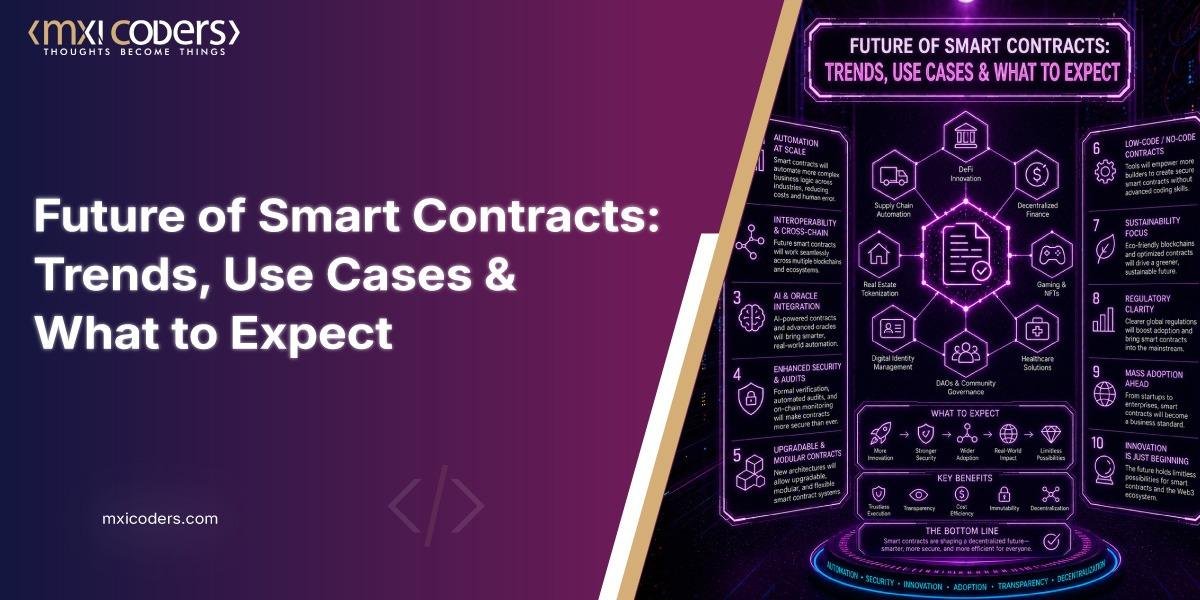
smart contract trends

Smart contracts are quietly becoming one of the most important pieces of digital infrastructure of this decade. In simple terms, they are self-executing agreements that run on a blockchain and enforce their own terms without needing a middleman. Industry estimates suggest the global smart contract market could grow at a compound annual rate of well over 20% through the next five years, with enterprise adoption cited as the biggest driver. Businesses across finance, healthcare, and logistics are paying closer attention because the technology now touches areas that used to feel purely experimental. AI, tokenization, DeFi, and automation are pushing smart contract development into mainstream enterprise conversations rather than niche crypto circles. This article walks through the trends, real-world use cases, and future opportunities shaping where this technology is headed.

➤ What Are Smart Contracts?

➥ Definition of Smart Contracts

At their core, blockchain smart contracts are self-executing digital agreements. They are built on blockchain networks, meaning no single party can quietly alter them after deployment. Once conditions written into the code are met, the contract executes automatically, without waiting on a bank, lawyer, or clearinghouse.

➥ How Smart Contracts Work

  • Agreement creation between parties, written as code
  • Deployment on a blockchain network
  • Trigger conditions defined in advance
  • Automatic execution once conditions are met
  • Immutable record stored permanently on-chain

➥ Key Benefits

  • Trustless execution between parties who don’t know each other
  • Transparency, since terms are visible and verifiable
  • Reduced intermediaries and the fees that come with them
  • Faster settlements compared to manual processing
  • Lower operational costs over time

➤ Why Smart Contracts Matter in 2026

Adoption is no longer confined to crypto-native companies. Traditional industries are now testing these systems for real operational gains.

  • Rising adoption in finance, real estate, and supply chain management
  • Regulatory clarity improving across key markets, reducing legal uncertainty
  • Cost and time savings compared to legacy paper-based contract systems

This shift is part of a broader set of blockchain development trends where automation, transparency, and reduced reliance on intermediaries are becoming standard business expectations rather than optional upgrades.

➤ Key Trends Shaping the Future of Smart Contracts

1. AI-Integrated Smart Contracts

  • Self-adjusting terms based on real-world data inputs
  • AI oracles feeding live information into contract logic

The combination of AI and smart contracts allows agreements to respond to changing conditions instead of relying on fixed, static rules.

2. Cross-Chain Interoperability

  • Multi-chain execution across different networks
  • Bridges and interoperability protocols connecting isolated ecosystems

3. Regulatory & Legal Recognition

  • Countries formalizing the legal status of smart contracts
  • Compliance-focused contract templates designed for regulated industries

4. Real-World Asset (RWA) Tokenization

Perhaps the biggest structural shift is RWA tokenization, where physical assets like real estate, invoices, and commodities are represented on-chain. This turns illiquid assets into programmable, tradeable digital tokens governed by smart contract rules.

  • Fractional ownership of high-value assets
  • Faster settlement for traditionally slow asset classes

5. Improved Security & Auditing Tools

  • Automated vulnerability scanning before deployment
  • Formal verification methods that mathematically prove contract behavior

Better tooling here directly addresses smart contract security concerns that have historically slowed enterprise adoption.

Also Read: Top Gas Optimization Techniques for Solidity Smart Contracts

➤ Top Use Cases of Smart Contracts (Current & Emerging)

➥ Finance & DeFi

  • Lending, staking, and automated settlements without a bank intermediary

These smart contract use cases remain the most mature, with billions of dollars already flowing through DeFi protocols.

➥ Supply Chain & Logistics

  • Automated payments triggered on delivery confirmation

➥ Healthcare

  • Data-sharing consent management and automated insurance claims processing

➥ Real Estate

  • Automated escrow and title transfers, reducing closing delays

➥ Gaming & NFTs

  • In-game asset ownership and automatic royalty payouts to creators

Enterprise smart contracts are increasingly being piloted across these sectors as companies look for provable, auditable ways to automate agreements at scale.

➤ What Experts Predict for the Next 5 Years

  • By the early 2030s, a meaningful share of enterprise contracts may include some form of smart contract automation
  • Regulatory frameworks are expected to mature faster than in the previous decade
  • AI integration will likely become a default feature rather than an add-on
  • Mainstream fintech platforms are expected to embed smart contract functionality directly into everyday products

➤ Emerging Technologies Enhancing Smart Contracts

➥ Artificial Intelligence

Improves decision-making within contract logic using live data feeds.

➥ Internet of Things (IoT)

Connects physical sensors to contracts, triggering execution based on real-world events like temperature or location.

➥ Zero-Knowledge Proofs

Allow verification of information without revealing the underlying data, useful for privacy-sensitive agreements.

➥ Decentralized Identity (DID)

Gives individuals and organizations verifiable digital identities that contracts can reference securely.

➥ Blockchain Oracles

Feed external, real-world data into contracts that would otherwise be isolated from outside information.

➥ Quantum-Resistant Cryptography

Prepares contract infrastructure for future threats posed by quantum computing.

Many of these technologies are converging inside custom enterprise blockchain development projects, where businesses need tailored architecture rather than off-the-shelf templates to meet compliance and scalability requirements.

➤ Key Takeaways

  • Smart contracts are moving from experimental to essential enterprise infrastructure
  • AI, tokenization, and interoperability are the biggest trends to watch
  • Security tooling is finally catching up with real-world enterprise demands
  • Industries from finance to healthcare are already running live use cases
  • The next five years will likely bring clearer regulation and wider mainstream adoption

Businesses exploring this space don’t need to build everything from scratch. Working with an experienced smart contract development service can shorten the learning curve considerably, and partnering with a dedicated smart contract development agency helps ensure contracts are audited, compliant, and built to scale from day one.

➤ Frequently Asked Questions (FAQ)

1. Are smart contracts legally binding?

In many jurisdictions, yes, provided the underlying agreement meets standard contract law requirements. Legal recognition is improving but still varies by country.

2. What blockchain is best for smart contracts?

Ethereum remains the most widely used, though platforms like Solana and Polkadot are gaining ground for speed and lower fees.

3. Can smart contracts be changed once deployed?

Generally no, since immutability is a core feature. Some contracts include upgrade mechanisms, but this must be planned before deployment.

4. What industries will adopt smart contracts first?

Finance, real estate, and supply chain are leading, with healthcare and gaming following closely behind.

5. Are smart contracts safe from hacking?

No system is completely risk-free, but formal audits, automated scanning tools, and improved coding standards have significantly reduced vulnerabilities compared to earlier years.

Feel free to Connect us on

Ready to transform your business with smart software solutions?

Harness the power of custom software development to streamline operations, reduce costs, and boost efficiency. Start by exploring cutting-edge approaches like cloud-native platforms, API-first architecture, and AI-driven automation to future-proof your systems and stay ahead of the competition.

Book free consultation

Let’s build your idea together and serve society.

Author

Ashok Rathod

Tech Consultant

Experience
25 Years
Growth Architect for Startups & SMEs | Blockchain, AI , MVP Development, & Data-Driven Marketing Expert.

Transform the Carbon Credit Industry

Build a Transparent, Scalable Carbon Credit Marketplace with Blockchain.

Index

Get in Touch

Ready to transform your ideas into reality? Contact our team today and let’s discuss your project.