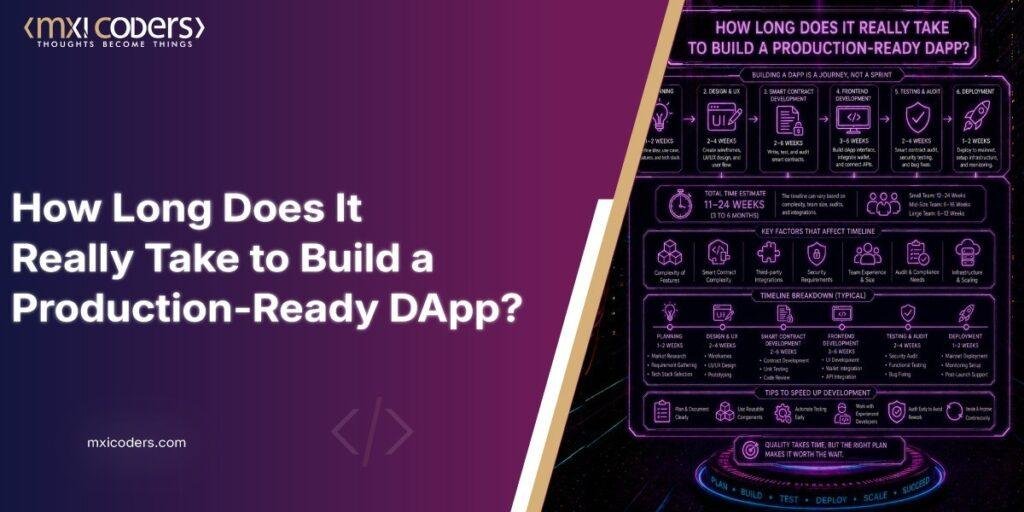
Ask ten founders how long it takes to build a DApp and you will likely get ten different answers, but the data converges more than the anecdotes suggest. Most production-ready DApps take between 4 and 8 months from the first line of code to mainnet launch, depending on complexity. Budgets follow a similarly wide but predictable range, with a basic MVP starting around $25,000 and complex multi-chain enterprise builds exceeding $750,000. The global decentralized application market itself is projected to grow from $18.5 billion in 2025 to $139.7 billion by 2033, a sign of just how many teams are entering this build process for the first time. This guide breaks the timeline down phase by phase, so expectations are set correctly before a single contract is written.
➤ What Actually Counts as “Production-Ready”
A DApp that runs on a testnet is not the same as one ready for real users and real funds. Production-ready generally means the smart contracts have passed a formal security audit, the frontend is integrated with reliable node infrastructure, and the system has been stress-tested under realistic transaction load. Skipping any of these steps to launch faster is one of the most common blockchain mistakes founders make, and it is usually the one that costs the most to fix later.
➤ The Typical DApp Development Timeline, Phase by Phase
Development rarely moves in a straight line, but most successful projects follow a similar sequence.
➥ Discovery and Architecture Planning (1 to 3 weeks)
- Defining core features, user flows, and technical constraints
- Choosing the blockchain network and consensus model
- Mapping out which components need to be on-chain versus off-chain
➥ UI/UX Design (3 to 6 weeks)
- Wireframing and prototyping the interface
- Designing wallet connection flows and transaction confirmation screens
- Testing usability with non-technical users, since Web3 interfaces still confuse many first-time participants
➥ Smart Contract Development (4 to 10 weeks)
Smart contract creation typically accounts for 25 to 40% of total project cost, making it the single largest line item in most budgets. This phase includes writing the core contract logic, unit testing, and preparing the codebase for external review.
➥ Frontend and Backend Integration (3 to 6 weeks)
- Connecting the frontend to deployed contracts through Web3 libraries
- Setting up backend services for data indexing and off-chain logic
- Integrating node infrastructure through providers or self-hosted nodes
➥ Security Audit and Testing (4 to 8 weeks, often longer)
A proper audit alone can run anywhere from $15,000 to $150,000 depending on contract complexity, and this phase is consistently underestimated. When an audit surfaces significant findings, which it usually does on the first pass, fix-and-re-audit cycles can add another 4 to 8 weeks. Teams that budget audit time as a single two-week window almost always launch late.
➥ Launch and Post-Launch Monitoring (2 to 4 weeks)
- Deploying contracts to mainnet
- Setting up monitoring for gas costs, transaction failures, and node performance
- Establishing an incident response plan before real funds are at risk
➤ What Actually Slows Teams Down
Timelines rarely blow up because of the code itself. They blow up because of a handful of recurring blockchain mistakes that repeat across nearly every delayed project:
- Treating the security audit as a final checkbox instead of an iterative process with buffer time built in
- Assuming a DApp needs no backend simply because it is decentralized, then scrambling to add one late in development
- Underestimating gas cost testing under real network conditions before launch
- Choosing a blockchain network late in the process, after design decisions have already been made around it
- Skipping load testing until after mainnet deployment, when fixing issues becomes far more expensive
➤ The Real Benefits of Getting the Timeline Right
Rushing a launch might feel like it saves time, but a properly paced build actually protects the return on investment. Some of the clearest smart contract benefits only show up when a project respects the full development cycle: fewer post-launch emergency patches, stronger user trust after a clean audit, and lower long-term maintenance costs since technical debt is not being built into the foundation. Projects that launch a focused MVP with a clear roadmap, rather than rushing every feature into version one, consistently spend less over the full lifecycle than teams that cut corners early and rebuild later.
➤ Complexity Drives the Timeline More Than Features Do
It is tempting to estimate a DApp timeline based on a feature checklist, but architecture is a better predictor. Two DApps with nearly identical user interfaces can have wildly different build times depending on what happens underneath.
- A simple token or NFT DApp with wallet connection typically takes 2 to 4 months
- A DeFi protocol with lending, staking, or liquidity pools typically takes 5 to 8 months
- A cross-chain or multi-network application typically takes 7 months or longer, since bridging logic adds substantial testing overhead
➤ When It Makes Sense to Bring in Outside Help
Few internal teams have deep Solidity and audit experience on staff, and misjudging that gap is often what pushes a timeline past its estimate. Bringing in a specialized smart contract development service can shorten the discovery and contract phases meaningfully, since experienced teams already have audit relationships and testing pipelines in place rather than building that process from scratch mid-project.
➤ Why Enterprises Face Longer Timelines
Custom enterprise blockchain development introduces requirements that rarely apply to a consumer-facing token project, including permissioned network setup, compliance documentation, and integration with existing internal systems. These projects often run on private or consortium chains rather than public networks, which adds governance and access-control work that a typical MVP timeline does not account for. Enterprise teams should expect timelines closer to the higher end of the range, and should build in extra weeks for legal and compliance review that a smaller consumer app would not need.
➤ Emerging Smart Contract Trends Affecting Build Time
Recent smart contract trends are starting to reshape how long these projects take. Layer-2 networks and sidechains like Polygon and Arbitrum have cut both cost and testing time compared to Ethereum mainnet deployments, since gas fees and confirmation times are far more forgiving during development. Account abstraction standards are also simplifying wallet onboarding, which used to be one of the more time-consuming parts of frontend integration. Meanwhile, AI-assisted code review tools are shortening the pre-audit cleanup phase, giving human auditors a cleaner codebase to start from, which can shave a week or more off the audit cycle.
➤ Frequently Asked Questions
- What is the fastest realistic timeline for a simple DApp?
A basic DApp with wallet connection and a small number of smart contracts can be built in as little as 2 to 3 months, though this leaves little room for a thorough audit cycle if issues are found. - Why do security audits take so long?
Audits are iterative rather than a single pass. Auditors review the code, report findings, developers fix the issues, and the contract is often reviewed again before it is considered safe for mainnet. - Does choosing a Layer-2 network shorten development time?
Yes, in most cases. Lower gas fees and faster confirmation times on Layer-2 networks make testing cycles quicker, which can meaningfully reduce the overall timeline compared to building directly on Ethereum mainnet.
➤ How to Set a Realistic Timeline for Your Project
Start by separating “must launch with” features from “can follow in version two.” Most delays come from scope creep during development rather than poor initial planning, so locking the feature set before smart contract work begins is one of the highest-leverage decisions a team can make. Pair that with a realistic audit buffer, and most teams land close to the 4 to 8 month range without unpleasant surprises near launch.
➤ Conclusion
Building a production-ready DApp is rarely a matter of weeks, and treating it that way is one of the fastest ways to end up with a rushed, vulnerable product. A realistic timeline runs from discovery through a properly resourced audit cycle to launch, typically landing somewhere between 4 and 8 months depending on complexity and network choice. Teams that respect each phase, particularly the audit stage, tend to launch with fewer post-release surprises and a stronger foundation for future growth.