...

[ Your Headline ] [ Highlight Word ]

[ One or two lines describing the offer — e.g. "Experience our services with a FREE 30-minute consultation." ]

[ Optional second line, e.g. "Have a concept in mind? Let's brainstorm together!" ]

Google ★★★★★ 4.8
GoodFirms ★★★★★ 4.7
Clutch ★★★★★ 5.0
Blockchain,DApps,Smart Contract Development,Web3

Layer 1 vs Layer 2: Simple Guide for Non-Technical Founders

Ashok Rathod

Tech Consultant

Posted on
22nd Jul 2026
6 min
Read
Share

Table of Contents

  • Quick Tips
  • Familiarize yourself with Cash App
  • Enable two-factor authentication
  • Utilize the optional Cash App
  • Conclusion

Blockchain networks can become expensive and slow as usage increases, and the numbers make that plain. Ethereum alone processed over 200 million transactions in the first quarter of 2026, up roughly 43 percent from the previous quarter, and activity like this is exactly what pushes fees up during busy periods. Scaling networks have absorbed most of that growth, now handling close to 95 percent of Ethereum’s total transaction throughput.

Not every blockchain project needs to operate directly on a Layer 1 network. Layer 2 solutions can help businesses scale without abandoning the underlying Layer 1 blockchain they depend on for security. This distinction matters to non-technical founders for a few concrete reasons:

  • Development costs
  • Transaction fees
  • User experience
  • Scalability
  • Security
  • Long-term business growth

No coding knowledge is required to follow this guide. The focus throughout is on business decisions rather than technical implementation.

Quick answer: Layer 1 is the main blockchain network where transactions are processed and secured. Layer 2 is a secondary network built on top of Layer 1 to improve scalability, reduce transaction costs, or increase transaction speed.

➤ What Is Layer 1 Blockchain?

➥ Layer 1 Explained in Simple Terms

In plain English, Layer 1 is the base blockchain infrastructure that everything else is built on. It is responsible for:

  • Processing transactions
  • Maintaining network security
  • Validating transactions
  • Recording data permanently

➥ Examples of Layer 1 Blockchains

  • Ethereum
  • Bitcoin
  • Solana
  • Avalanche
  • BNB Chain

Tip: avoid treating these as interchangeable. They differ significantly in architecture, performance, decentralization, ecosystem maturity, and developer tooling.

➥ Advantages of Layer 1

  • Strong foundational security
  • Direct blockchain settlement
  • Greater control over network architecture
  • Independent governance in some ecosystems
  • Broad ecosystem support

➥ Limitations of Layer 1

  • Network congestion
  • Higher transaction fees during demand spikes
  • Scalability limitations
  • Potentially slower transaction processing
  • More expensive high-volume applications

➤ What Is Layer 2 Blockchain?

➥ Layer 2 Explained in Simple Terms

Layer 2 is a network that works on top of an existing Layer 1 rather than replacing it. The basic idea comes down to two roles:

  • Layer 1 acts as the foundational settlement and security layer
  • Layer 2 acts as the scaling and transaction-processing layer

➥ Why Was Layer 2 Created?

  • Reduce transaction costs
  • Increase transaction throughput
  • Improve user experience
  • Reduce congestion on Layer 1
  • Enable applications with frequent transactions

➥ Examples of Layer 2 Solutions

  • Optimistic rollups
  • Zero-knowledge rollups
  • State channels
  • Plasma-based approaches

What problem does Layer 2 solve? Layer 2 primarily addresses blockchain scalability challenges by processing transactions more efficiently while relying on an underlying Layer 1 for settlement and security, depending on the specific design.

➤ Layer 1 vs Layer 2: What Is the Difference?

FactorLayer 1Layer 2
RoleBase blockchainScaling layer
Transaction processingDirectly on main networkOften processed separately
ScalabilityGenerally more limitedGenerally higher
Transaction costsCan be higherOften lower
Security modelNative to networkDepends on design and underlying L1
Best suited forCore settlement and independent networksHigh-volume applications and scaling
InfrastructureMain blockchainBuilt on or connected to Layer 1

➥ Layer 1 vs Layer 2: Which Is Faster?

Layer 2 solutions are generally designed to improve transaction throughput, though not every Layer 2 is automatically faster in every scenario. Speed in practice depends on:

  • Network design
  • Transaction batching
  • Settlement mechanisms
  • Congestion
  • Withdrawal or bridging requirements

➥ Layer 1 vs Layer 2: Which Is Cheaper?

Layer 1 fees can rise during congestion, while Layer 2 can reduce cost per transaction. Costs vary depending on:

  • Network
  • Transaction type
  • Data availability model
  • Bridging requirements
  • Gas fees

Also Read: Web2 vs Web3: What Are the Key Differences and Why Do They Matter?

➤ Layer 1 vs Layer 2: How Should Founders Think About It?

➥ Think About Your Business Requirements First

Ask:

  • How many transactions will users make?
  • How sensitive are users to transaction fees?
  • Does your application require high throughput?
  • Does your project need independent blockchain infrastructure?
  • How important is direct settlement?
  • What level of decentralization does the business require?
  • What security assumptions are acceptable?

➥ Consider Your User Experience

High transaction fees can discourage users, and slow transactions can hurt adoption just as easily. Complex bridging creates onboarding friction, and wallet compatibility matters more than founders often expect. Users may not care whether your product runs on Layer 1 or Layer 2. They care whether it works smoothly.

➥ Consider Your Budget

Evaluate:

  • Development costs
  • Infrastructure costs
  • Transaction fees
  • Smart contract deployment
  • Security audits
  • Maintenance
  • Cross-chain or bridging requirements

➤ When Should a Founder Choose Layer 1?

Layer 1 may be a better fit if:

  • You need your own blockchain network
  • Your project requires independent infrastructure
  • You need direct control over network rules
  • Your application depends heavily on native Layer 1 security
  • You are building infrastructure rather than just an application
  • Your business model justifies the cost of operating on a base network

Examples of potential use cases: new blockchain networks, custom blockchain ecosystems, infrastructure protocols, and large-scale Web3 platforms requiring independent architecture.

If this describes your project, a team experienced in custom enterprise blockchain development can help you avoid costly architectural mistakes, since decisions made at the infrastructure level are hard to reverse later.

➤ When Should a Founder Choose Layer 2?

Layer 2 may be a better fit if:

  • You are building on an established Layer 1 ecosystem
  • Your application requires frequent transactions
  • Transaction costs are a major concern
  • You need improved scalability
  • You want to serve a large number of users
  • You don’t need to build your own base blockchain

Examples of potential use cases: DeFi applications, NFT marketplaces, blockchain gaming, Web3 social applications, high-frequency transactions, and consumer-facing decentralized applications.

Most of what people search for under Layer 2 scaling solutions falls here, which is often the best blockchain for startups that want to move fast without paying Layer 1 prices for every user action. Whichever direction you choose, a capable smart contract development service can turn your business logic into secure, working code, and a thorough smart contract audit before launch is one of the cheapest forms of insurance available to a founder. Pairing that with gas optimization techniques during development can meaningfully lower the ongoing cost of running your product.

Final Takeaway: Layer 1 vs Layer 2 Is a Business Decision

There is no universally “best” choice. Layer 1 provides foundational blockchain infrastructure. Layer 2 focuses on scaling and efficiency. The right decision depends on:

  • Business model
  • Transaction volume
  • Budget
  • Security requirements
  • Scalability needs
  • User experience
  • Long-term strategy

Founders who get this right tend to evaluate the business problem first and blockchain architecture second, letting the technical choice follow from what the product actually needs. Treat this less as a single Layer 1 vs Layer 2 blockchain verdict and more as an ongoing part of blockchain development for businesses, one that may shift as the product grows.
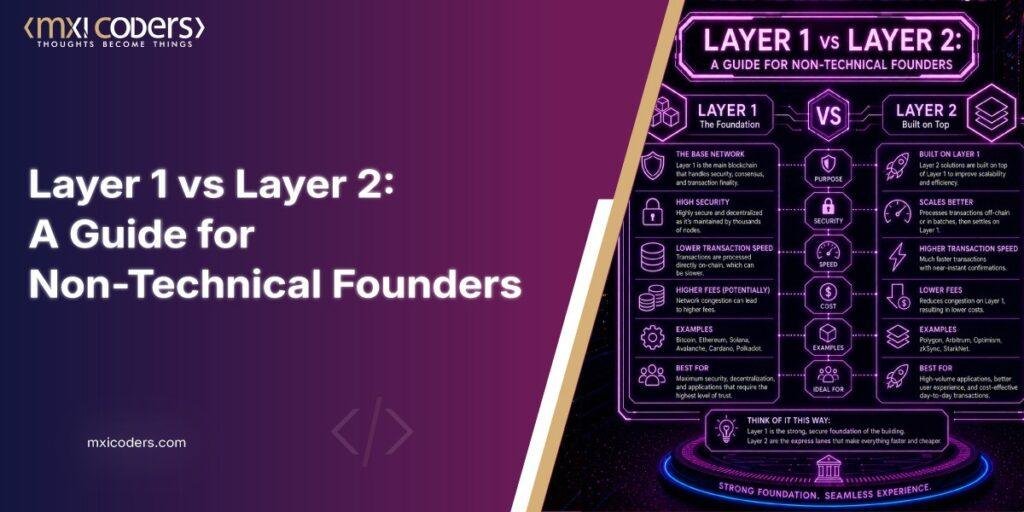

Layer 1 vs Layer 2 A Guide for Non-Technical Founders

Blockchain networks can become expensive and slow as usage increases, and the numbers make that plain. Ethereum alone processed over 200 million transactions in the first quarter of 2026, up roughly 43 percent from the previous quarter, and activity like this is exactly what pushes fees up during busy periods. Scaling networks have absorbed most of that growth, now handling close to 95 percent of Ethereum’s total transaction throughput.

Not every blockchain project needs to operate directly on a Layer 1 network. Layer 2 solutions can help businesses scale without abandoning the underlying Layer 1 blockchain they depend on for security. This distinction matters to non-technical founders for a few concrete reasons:

  • Development costs
  • Transaction fees
  • User experience
  • Scalability
  • Security
  • Long-term business growth

No coding knowledge is required to follow this guide. The focus throughout is on business decisions rather than technical implementation.

Quick answer: Layer 1 is the main blockchain network where transactions are processed and secured. Layer 2 is a secondary network built on top of Layer 1 to improve scalability, reduce transaction costs, or increase transaction speed.

➤ What Is Layer 1 Blockchain?

➥ Layer 1 Explained in Simple Terms

In plain English, Layer 1 is the base blockchain infrastructure that everything else is built on. It is responsible for:

  • Processing transactions
  • Maintaining network security
  • Validating transactions
  • Recording data permanently

➥ Examples of Layer 1 Blockchains

  • Ethereum
  • Bitcoin
  • Solana
  • Avalanche
  • BNB Chain

Tip: avoid treating these as interchangeable. They differ significantly in architecture, performance, decentralization, ecosystem maturity, and developer tooling.

➥ Advantages of Layer 1

  • Strong foundational security
  • Direct blockchain settlement
  • Greater control over network architecture
  • Independent governance in some ecosystems
  • Broad ecosystem support

➥ Limitations of Layer 1

  • Network congestion
  • Higher transaction fees during demand spikes
  • Scalability limitations
  • Potentially slower transaction processing
  • More expensive high-volume applications

➤ What Is Layer 2 Blockchain?

➥ Layer 2 Explained in Simple Terms

Layer 2 is a network that works on top of an existing Layer 1 rather than replacing it. The basic idea comes down to two roles:

  • Layer 1 acts as the foundational settlement and security layer
  • Layer 2 acts as the scaling and transaction-processing layer

➥ Why Was Layer 2 Created?

  • Reduce transaction costs
  • Increase transaction throughput
  • Improve user experience
  • Reduce congestion on Layer 1
  • Enable applications with frequent transactions

➥ Examples of Layer 2 Solutions

  • Optimistic rollups
  • Zero-knowledge rollups
  • State channels
  • Plasma-based approaches

What problem does Layer 2 solve? Layer 2 primarily addresses blockchain scalability challenges by processing transactions more efficiently while relying on an underlying Layer 1 for settlement and security, depending on the specific design.

➤ Layer 1 vs Layer 2: What Is the Difference?

FactorLayer 1Layer 2
RoleBase blockchainScaling layer
Transaction processingDirectly on main networkOften processed separately
ScalabilityGenerally more limitedGenerally higher
Transaction costsCan be higherOften lower
Security modelNative to networkDepends on design and underlying L1
Best suited forCore settlement and independent networksHigh-volume applications and scaling
InfrastructureMain blockchainBuilt on or connected to Layer 1

➥ Layer 1 vs Layer 2: Which Is Faster?

Layer 2 solutions are generally designed to improve transaction throughput, though not every Layer 2 is automatically faster in every scenario. Speed in practice depends on:

  • Network design
  • Transaction batching
  • Settlement mechanisms
  • Congestion
  • Withdrawal or bridging requirements

➥ Layer 1 vs Layer 2: Which Is Cheaper?

Layer 1 fees can rise during congestion, while Layer 2 can reduce cost per transaction. Costs vary depending on:

  • Network
  • Transaction type
  • Data availability model
  • Bridging requirements
  • Gas fees

Also Read: Web2 vs Web3: What Are the Key Differences and Why Do They Matter?

➤ Layer 1 vs Layer 2: How Should Founders Think About It?

➥ Think About Your Business Requirements First

Ask:

  • How many transactions will users make?
  • How sensitive are users to transaction fees?
  • Does your application require high throughput?
  • Does your project need independent blockchain infrastructure?
  • How important is direct settlement?
  • What level of decentralization does the business require?
  • What security assumptions are acceptable?

➥ Consider Your User Experience

High transaction fees can discourage users, and slow transactions can hurt adoption just as easily. Complex bridging creates onboarding friction, and wallet compatibility matters more than founders often expect. Users may not care whether your product runs on Layer 1 or Layer 2. They care whether it works smoothly.

➥ Consider Your Budget

Evaluate:

  • Development costs
  • Infrastructure costs
  • Transaction fees
  • Smart contract deployment
  • Security audits
  • Maintenance
  • Cross-chain or bridging requirements

➤ When Should a Founder Choose Layer 1?

Layer 1 may be a better fit if:

  • You need your own blockchain network
  • Your project requires independent infrastructure
  • You need direct control over network rules
  • Your application depends heavily on native Layer 1 security
  • You are building infrastructure rather than just an application
  • Your business model justifies the cost of operating on a base network

Examples of potential use cases: new blockchain networks, custom blockchain ecosystems, infrastructure protocols, and large-scale Web3 platforms requiring independent architecture.

If this describes your project, a team experienced in custom enterprise blockchain development can help you avoid costly architectural mistakes, since decisions made at the infrastructure level are hard to reverse later.

➤ When Should a Founder Choose Layer 2?

Layer 2 may be a better fit if:

  • You are building on an established Layer 1 ecosystem
  • Your application requires frequent transactions
  • Transaction costs are a major concern
  • You need improved scalability
  • You want to serve a large number of users
  • You don’t need to build your own base blockchain

Examples of potential use cases: DeFi applications, NFT marketplaces, blockchain gaming, Web3 social applications, high-frequency transactions, and consumer-facing decentralized applications.

Most of what people search for under Layer 2 scaling solutions falls here, which is often the best blockchain for startups that want to move fast without paying Layer 1 prices for every user action. Whichever direction you choose, a capable smart contract development service can turn your business logic into secure, working code, and a thorough smart contract audit before launch is one of the cheapest forms of insurance available to a founder. Pairing that with gas optimization techniques during development can meaningfully lower the ongoing cost of running your product.

Final Takeaway: Layer 1 vs Layer 2 Is a Business Decision

There is no universally “best” choice. Layer 1 provides foundational blockchain infrastructure. Layer 2 focuses on scaling and efficiency. The right decision depends on:

  • Business model
  • Transaction volume
  • Budget
  • Security requirements
  • Scalability needs
  • User experience
  • Long-term strategy

Founders who get this right tend to evaluate the business problem first and blockchain architecture second, letting the technical choice follow from what the product actually needs. Treat this less as a single Layer 1 vs Layer 2 blockchain verdict and more as an ongoing part of blockchain development for businesses, one that may shift as the product grows.

Feel free to Connect us on

Ready to transform your business with smart software solutions?

Harness the power of custom software development to streamline operations, reduce costs, and boost efficiency. Start by exploring cutting-edge approaches like cloud-native platforms, API-first architecture, and AI-driven automation to future-proof your systems and stay ahead of the competition.

Book free consultation

Let’s build your idea together and serve society.

Author

Ashok Rathod

Tech Consultant

Experience
25 Years
Growth Architect for Startups & SMEs | Blockchain, AI , MVP Development, & Data-Driven Marketing Expert.

Transform the Carbon Credit Industry

Build a Transparent, Scalable Carbon Credit Marketplace with Blockchain.

Index

Get in Touch

Ready to transform your ideas into reality? Contact our team today and let’s discuss your project.