The internet has reinvented itself before. The static, read-only web of the 1990s gave way to the interactive, social, platform-driven web we use today. Now another shift is underway, and this one touches something more fundamental: who controls the internet, who owns the data, and who captures the value.
According to a 2024 report by Statista, over 5.4 billion people use the internet globally. Nearly all of them interact daily with Web2 platforms, Google, Meta, Amazon, YouTube, without ever questioning the ownership structure underneath. Meanwhile, the Web3 market is projected to surpass $116 billion by 2033, growing at a CAGR of 43.7% (Grand View Research). Blockchain wallet users crossed 84 million in 2024, and decentralized application usage grew 43% year over year.
Understanding the difference between Web2 and Web3 is no longer just a technical exercise. It is a strategic one. For businesses evaluating digital infrastructure, for developers choosing which skills to build, and for users increasingly concerned about privacy, the Web2 to Web3 transition is a shift worth understanding clearly. This guide breaks it down without the hype.
➤ What Is the Difference Between Web2 and Web3?
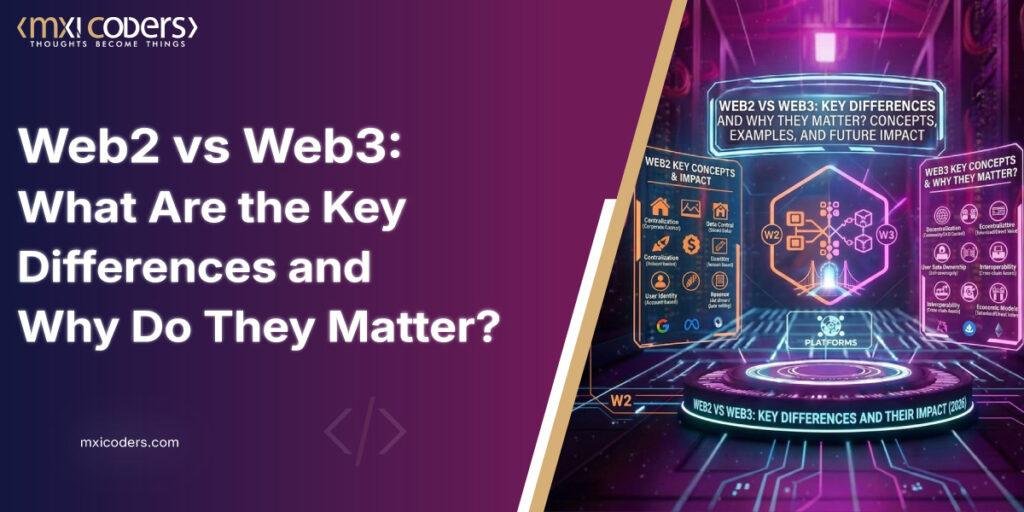
Web2 is the centralized internet most people use today, dominated by platforms and intermediaries that own user data and control access. Web3 is a decentralized internet built on blockchain technology, where users hold ownership and control over their own data, assets, and identities. The core difference is not cosmetic. It is architectural.
➤ What Is Web2?
Web2 refers to the interactive internet that emerged in the early 2000s, shaped by the rise of social media, user-generated content, and mobile applications. It made the internet easy to use and globally accessible. But it did so through a specific trade-off: centralization in exchange for convenience.
➥ Key characteristics of Web2:
- Controlled by large corporations including Google, Meta, and Amazon
- Users create content, but platforms own and monetize the data
- Revenue is driven primarily by advertising and behavioral data
- High performance and mature infrastructure built for billions of users
➥ Examples of Web2 Platforms
The Web2 internet is the one most people live in every day. Social platforms like Facebook, Instagram, and X. Commerce platforms like Amazon and eBay. Content platforms like YouTube, Spotify, and Medium. All of them share a common model: the platform is the intermediary, and you are both the user and the product.
➤ What Is Web3?
Web3 is a vision of a decentralized internet built on blockchain infrastructure. The term was coined by Ethereum co-founder Gavin Wood in 2014. The core idea is to remove centralized intermediaries and replace institutional trust with cryptographic verification.
➥ Key characteristics of Web3:
- No single point of control; governed by protocols and communities
- Users own their data, assets, and digital identities
- Powered by smart contracts, tokens, and on-chain logic
- Trustless by design: interactions are verified by code, not corporations
➥ Core Technologies Behind Web3
- Blockchain networks such as Ethereum, Solana, and Polkadot form the base layer
- Smart contracts automate agreements without human intermediaries
- Decentralized storage solutions like IPFS and Arweave replace centralized servers
- Wallets and self-sovereign identity tools like MetaMask and ENS give users portable, platform-independent identities
- Tokens, both fungible (ETH, BTC) and non-fungible (NFTs), represent ownership on-chain
➤ Web2 vs Web3: The 7 Key Differences Explained
1. Data Ownership
In Web2, you accept a Terms of Service agreement and hand your data to the platform. In Web3, your data is tied to cryptographic keys that only you hold. No platform can access, sell, or delete it without your authorization.
2. Control and Governance
Web2 platforms can ban accounts, censor content, or change their rules overnight. Web3 protocols are governed by decentralized autonomous organizations (DAOs), where community members vote on changes through token-weighted governance.
3. Identity and Privacy
Web2 identity is managed by platforms. Google login and Facebook login are convenient, but they also mean a third party controls your access to everything connected to those accounts. Web3 wallets serve as a universal, portable identity that no platform can revoke.
4. Monetization
Creators in Web2 earn indirectly through platform ad revenue shares. In Web3, direct monetization is possible through token issuance, NFT sales, and DeFi protocol participation with no intermediary taking a majority cut.
5. Trust Model
Web2 requires you to trust the company operating the platform. Web3 replaces that with cryptographic trust: the protocol executes exactly as coded, and anyone can verify it.
6. Speed and Scalability
Web2 runs on mature infrastructure optimized for billions of simultaneous users. Web3 is still catching up. A layer1 blockchain like Ethereum processes roughly 15 to 30 transactions per second natively, though Layer 2 networks are closing that gap significantly.
7. Security
Web2 systems are vulnerable to centralized breaches because a single compromised server can expose millions of records. Web3 is more resilient by design, but it introduces its own risks: smart contract vulnerabilities and wallet key theft require serious technical diligence.
➤ Web2 vs Web3 in the Real World: Practical Examples
➥ Web2 Applications You Already Use
Google Docs, Gmail, Netflix, Uber, and Instagram are all Web2. They are fast, polished, and convenient. But every interaction runs through a centralized server owned by a corporation with its own interests.
➥ Web3 Applications Gaining Traction
- DeFi platforms like Uniswap and Aave enable lending and trading without banks or brokers
- NFT marketplaces like OpenSea provide verifiable digital ownership recorded on-chain
- DAOs like MakerDAO and Nouns allow communities to govern protocols directly
- Decentralized social networks like Lens Protocol and Farcaster give users ownership of their social graphs
- Web3 gaming platforms like Axie Infinity and Immutable enable players to own in-game assets
➤ Why the Web2 vs Web3 Debate Matters Right Now
➥ For Users
Data privacy has become a mainstream concern post-GDPR and post-Cambridge Analytica. Web3 offers an alternative model where users hold sovereignty over their own information. The trade-off is a steeper learning curve and less polished user experience, for now.
➥ For Developers
Web3 introduces a new programming paradigm built around smart contracts and on-chain logic. Demand for Solidity and Rust developers has grown sharply, and organizations looking to hire web3 developers are competing in a tight talent market. Building these skills early creates significant career leverage.
➥ For Businesses
Web3 disrupts platform-dependent business models by removing the intermediaries businesses currently rely on and pay to reach customers. New opportunities exist in tokenization, decentralized loyalty programs, and transparent supply chain infrastructure. Companies evaluating custom enterprise blockchain development are increasingly treating it as a strategic investment rather than an experiment.
➥ For Society
DeFi is providing financial services to underbanked populations in regions where traditional banking infrastructure is limited. Broader questions remain around regulation, energy consumption, and ensuring that Web3 does not simply replicate existing inequalities in a new format.
➤ Web2 vs Web3: Where Is the Internet Headed?
The most important differences to carry forward are these: Web3 shifts data ownership from platforms to users, replaces institutional trust with cryptographic verification, and introduces direct monetization models that do not require intermediaries. None of that makes Web2 obsolete. The two will coexist, and hybrid models are already emerging.
Web3 is still maturing. Scalability, regulation, and user experience remain genuine challenges. But the trajectory is clear. Businesses that want to hire blockchain developers and explore decentralized infrastructure today are getting ahead of a transition that is already underway. What to watch next: regulatory clarity in the US and EU, Layer 2 adoption at scale, and the growing convergence of AI and blockchain as complementary technologies. The internet is not finished evolving.