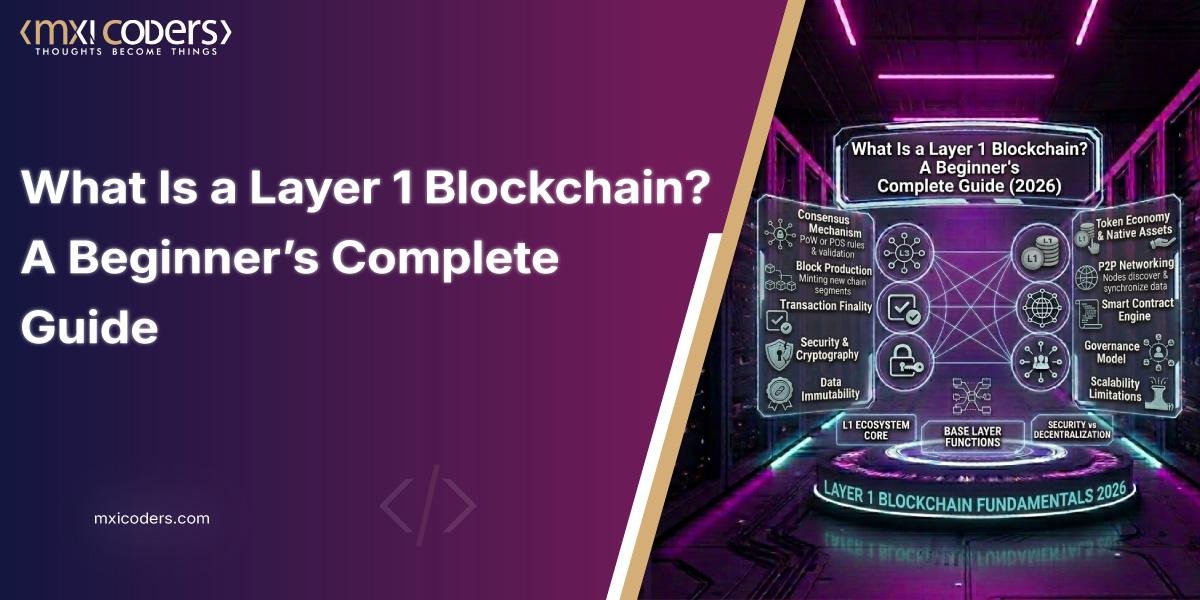
A Layer 1 (L1) blockchain is the core foundation of the digital economy. It’s the main network where all transactions are recorded and secured. Think of it as the base system that everything else depends on.
Unlike other layers built on top of it, an L1 blockchain works independently. It doesn’t rely on any external network to verify or process its data. That means this is the last resort; the place where trusted information is permanently stored.
Layer 2 solutions are designed to improve the speed and reduce the cost, but it still relies on Layer 1. Regardless of the sophistication of those layers, the L1 is the foundation that ensures security and reliability of the system as a whole.
➤ What Defines a Layer 1?
The blockchain platform architecture has a Layer 1 blockchain as the foundation layer. Layer 1 blockchains confirm and execute transactions without the assistance of a diverse network and compensate for transaction costs with cryptocurrencies.
For instance, Ethereum is a system that does not need an outside system to facilitate transactions and has a native cryptocurrency called Ether (ETH). Another Layer 1 blockchain is Solana, which was developed to enable more efficient transactions and lower fees.
➥ The important aspects of a Layer 1 are:
1. Total Independence
A characteristic feature of a Layer 1 is that it is the boss of its ecosystem. It does not borrow network security.
- Self-Sustaining: L1s have their own network of nodes — computers spread all around the world.
- Finality: A transaction transpiring on an L1 is the last word in this blockchain. It does not have to be connected to a parent network to determine whether a payment is valid.
2. The Power of Native Tokens
Each mainnet blockchain possesses its sovereign currency. Consider it the legal tender of a particular country. In Ethereum-land, you require $ETH. In Solana-land, you require $SOL. Those tokens aren’t just to speculate about — they’re the gas of the whole machine.
- Gas Fees: They are the fees that you have to pay every time that you move money within the network, or you use any kind of application. This will block spam and also help make up for the energy or effort you’ve expended to process your request.
- Staking and Incentives: Users or validators put in these native tokens to ensure security in the network, and are rewarded with extra tokens. They receive extra tokens as a reward for their work and sincerity in the network.
- Governance: Many times, tokens will come with a voting right to decide the fate of the network, such as decisions on software upgrades or changes in the fee structure.
3. The Rulebook and Consensus Mechanism
Being a Layer 1 means coordinating thousands of independent computers on real transactions. This is called a Consensus Mechanism.
The two most famous types are:
- Proof of Work (PoW): It relates to Bitcoin. Mining involves significant computational effort to solve puzzles. It’s highly safe but consumes a lot of energy.
- Proof of Stake (PoS): Ethereum and Solana are the related ones. Instead of powerful hardware, participants post their own tokens as collateral to be honest. It’s far more energy-efficient and high-speed in modern applications.
Most new blockchain protocol designs choose PoS because energy cost is a real issue. A PoW network can use as much electricity as a small country. PoS cuts that by 99%. That trade-off matters when institutions look at ESG requirements.
➤ How Does a Layer 1 Blockchain Work?
The blockchain technology behind the hood is complicated, but the process of a transaction is quite logical. Think of it as a virtual race where all the participants operate by the same rulebook.
➥ The life cycle of a transaction on a Layer 1 network:
- Initiation in Transactions: You begin it all. You make a digital request when you choose to transfer 0.5 ETH or interact with a decentralized application. You sign this request with your personal key — your digital signature that proves you own the funds.
- Broadcasting: After you send it, it isn’t processed by a central server. It’s relayed to a huge, worldwide network of nodes. It lands in a waiting room called the Mempool.
- Validation: A group of nodes pick your transaction and conduct a background check. They verify two things: Does your digital signature match? And do you actually have the 0.5 ETH plus gas fees?
- Your transaction gets bundled with hundreds of others into a single block. Think of it as an electronic page in a ledger that’s about to be filled.
- Consensus: This is the critical step. To decide who adds the new block, the network uses its algorithm — PoS or PoW. The remaining nodes then confirm the chosen block follows all the rules. This prevents double spending or counterfeiting of the currency.
- Finality: When the parties agree, the block is hashed and the own hash is linked to the previous hash in a cryptographic manner. That creates the chain. At this stage, the transaction becomes final. It’s permanently committed and practically irreversible.
Also Read: The Future of Blockchain in Finance: Key Predictions for 2030
➤ The Blockchain Trilemma: The Layer 1 Struggle
If establishing a layer 1 blockchain sounds like a straightforward engineering project, it’s time to face the biggest challenge: the Blockchain Trilemma.
Coined by Vitalik Buterin, it states that it’s almost unattainable for a single blockchain to achieve high levels of three properties at once.
- Security: The wall that can’t be compromised. A high-security L1 is resistant to 51% attacks where one party tries to control the ledger.
- Decentralization: The main tenet of Web3 is decentralization. It is about distributing control across thousands of independent nodes across the globe and not allowing any government or company to censor it.
- Scalability: The speed factor — capacity for high Transactions Per Second (TPS). A scalable network feels fast. A non-scalable one feels like a bank queue.
➥ The Great Trade-off: Why Most L1s Pick Two
Most Layer 1s are against one another. Push too far on one side, and you fall behind on another.
- The “Legacy” Approach (Security + Decentralization): Early networks like Bitcoin and the initial Ethereum focused on being unhackable and decentralized. Because thousands of nodes must agree on every bit of data, the network gets heavy and slow. That means low TPS and high fees during busy periods.
- The High-Performance Approach (Security + Scalability): Newer L1s get amazing speeds by reducing the number of nodes involved in consensus. The network is quick and safe, but more centralized — a few powerful servers hold more control.
➥ This led to the Layer 2 requirement
Since solving all three at Layer 1 is hard, the industry moved to a modular future. Layer 1 becomes the secure, decentralized Supreme Court. Layer 2 scaling solutions like Rollups run the hard work — processing thousands of transactions — then settle them on L1 for finality.
➤ The Future of Layer 1s
There can be multiple layers to a blockchain ecosystem, but it all comes down to Layer 1. Layer 2 solutions are being used to enhance speed and lower costs on networks such as Ethereum and Bitcoin. Others, such as Solana, are working on scaling at the base layer.
The emphasis switched from merely speed to the creation of multi-chain, interconnected systems in 2026. Projects now are concerned with interoperability — how one blockchain platform communicates with another. The overall objective remains the same, however.
In spite of these modifications, Layer 1 blockchains continue to be essential. They offer security, finality and trust that is essential to the whole world of blockchain. Without the base layer functioning there is no way to have any layer 2, sidechain or app.
Build on a weak L1, and everything above it shakes.