As blockchain adoption grows, scalability has become one of the industry’s most pressing challenges. Networks like Ethereum can process only around 15 to 30 transactions per second, while payment giants such as Visa handle over 24,000 in the same time frame. During periods of high demand, gas fees on popular networks have spiked past $50 per transaction, pushing everyday users away from decentralized applications. This gap between blockchain capacity and real-world demand is exactly why Layer 2 blockchain technology has emerged as a critical solution to speed, cost, and congestion issues. This article explores how Layer 2 works, its key benefits, the different types available, real-world use cases, current limitations, and where the technology is headed next.
➤ What Is Layer 2 Blockchain?
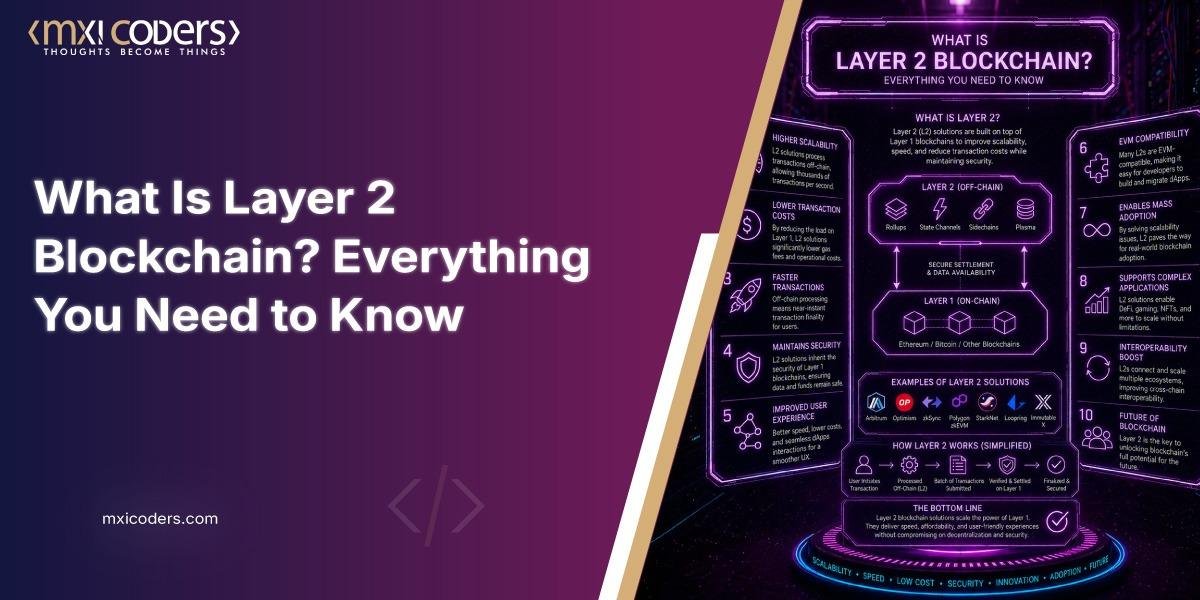
Layer 2 blockchain refers to a secondary framework built on top of a Layer 1 blockchain to improve scalability without altering the base network’s core rules. It processes transactions off the main chain, reduces transaction fees, and increases transaction speed, while still relying on the underlying Layer 1 blockchain for final security and settlement.
➤ Why Do Blockchains Need Layer 2 Solutions?
➥ The Blockchain Scalability Problem
Public blockchains were originally designed with security and decentralization as top priorities, often at the expense of speed. As more users and applications join these networks, several issues surface:
- Network congestion during peak usage periods
- Slow transaction confirmation times
- High gas fees that make small transactions impractical
- Limited transactions per second (TPS), restricting overall throughput
➥ The Blockchain Trilemma
This challenge is often described through the blockchain trilemma, the idea that a network can only fully optimize two of three properties at once:
- Security
- Decentralization
- Scalability
Key Takeaway: Improving scalability without sacrificing security is difficult because most attempts to speed up a network either reduce the number of validators or compromise data availability, both of which weaken the trust model that makes blockchain valuable in the first place.
➤ How Does Layer 2 Blockchain Work?
➥ Relationship Between Layer 1 and Layer 2
The two layers work together rather than in competition. A Layer 1 blockchain provides the base security and consensus, while Layer 2 handles the heavy lifting of transaction processing off-chain. Once transactions are processed, final settlement occurs back on the Layer 1 network, anchoring the activity to its security guarantees.
➥ Step-by-Step Transaction Flow
A typical Layer 2 transaction follows this general flow:
- The user initiates a transaction on the Layer 2 network
- Processing happens off-chain, away from the congested main network
- Multiple transactions are grouped into a batch
- The batch undergoes verification
- Final settlement is recorded back on the Layer 1 chain
➤ Types of Layer 2 Blockchain Solutions
➥ Rollups
Rollups bundle hundreds of transactions into a single batch before submitting them to the main chain, drastically cutting costs per transaction. Many teams offering a smart contract development service now build directly on rollup networks to keep deployment and execution costs low for their clients.
➥ Optimistic Rollups
Optimistic rollups assume transactions are valid by default and only run computations if a challenge is raised. This approach offers strong compatibility with existing smart contracts and works well for general-purpose applications like decentralized exchanges and lending platforms.
➥ Zero-Knowledge (ZK) Rollups
ZK rollups use cryptographic proofs to validate transactions before they are submitted, allowing for faster validation than optimistic models. They also offer privacy benefits, since underlying transaction data doesn’t always need to be fully exposed to be verified.
Also Read: How to Develop a Blockchain MVP That Validates Your Business Idea
➥ State Channels
A state channel is a private, off-chain communication path between two or more parties who transact repeatedly. Participants lock funds on the main chain, exchange numerous transactions off-chain, and only settle the final state back on-chain. Common applications include gaming, micropayments, and streaming payment systems.
➥ Sidechains
Sidechains are independent blockchains that run parallel to a main network and connect through asset bridging. They offer:
- Greater flexibility for custom rules and consensus mechanisms
- Faster transaction throughput
- Trade-offs in the form of separate security assumptions, since sidechains don’t inherit Layer 1 security directly
➥ Plasma Chains
Plasma chains create child chains that periodically commit summarized data back to the main network. Security relies on fraud proofs and the ability for users to exit to the main chain if something goes wrong. While an important early innovation, current adoption has slowed as rollup technology has taken the lead.
| Feature | Layer 1 Blockchain | Layer 2 Blockchain |
|---|---|---|
| Architecture | Base protocol layer | Built on top of Layer 1 |
| Transaction speed | Slower under load | Significantly faster |
| Fees | Often high during congestion | Substantially lower |
| Security | Native, independently secured | Inherits from Layer 1 |
| Scalability | Limited by base protocol design | Designed specifically to scale |
| Examples | Bitcoin, a Layer 1 blockchain like Ethereum | Arbitrum, Optimism, Polygon |
| Primary purpose | Consensus and settlement | Transaction processing and throughput |
| Network congestion | More prone during high demand | Reduces load on the base chain |
| Developer experience | Mature but constrained by gas costs | Cheaper testing and deployment |
➤ Benefits of Layer 2 Blockchain
Layer 2 scaling delivers measurable advantages for both users and businesses:
- Faster Transactions: Off-chain processing removes bottlenecks found on congested main networks
- Lower Gas Fees: Batching transactions spreads costs across many users, making individual fees a fraction of Layer 1 rates
- Improved Scalability: Layer 2 networks can handle significantly higher transaction volumes
- Better User Experience: Near-instant confirmations make blockchain applications feel closer to traditional apps
- Supports Mass Adoption: Lower costs and faster speeds remove barriers that previously kept everyday users away
- Reduced Network Congestion: Offloading activity eases pressure on the base layer
- Increased Throughput: More transactions can be processed per second compared to Layer 1 alone
➤ Limitations of Layer 2 Blockchain
Despite its advantages, Layer 2 technology comes with trade-offs worth understanding:
- Bridge security risks, since cross-chain bridges have historically been targeted by exploits
- Added complexity for developers and users managing multiple layers
- Liquidity fragmentation across different Layer 2 networks
- Withdrawal delays, particularly with optimistic rollups during challenge periods
- Compatibility challenges when integrating with existing tools and wallets
- Different trust assumptions depending on the specific solution chosen
- Adoption barriers as users adjust to bridging assets and navigating new interfaces
➤ Layer 2 Blockchain Scaling Solutions: Future of Blockchain Scalability
Layer 2 blockchain has become a foundational piece of modern blockchain technology advantages, offering a practical answer to the scalability problems that once limited on-chain activity. By processing transactions off the main network and settling results back on a secure base chain, Layer 2 blockchain scaling solutions deliver faster speeds, lower costs, and a smoother experience without abandoning the trust guarantees of the underlying network.
From rollups and state channels to sidechains and plasma chains, businesses now have multiple paths to build scalable applications, whether through Ethereum development, custom enterprise blockchain development, or broader Web 3 development initiatives. Smart contract development continues to benefit directly from these scaling improvements, since lower fees and faster confirmations make it far more practical to deploy complex, high-volume applications.
As adoption grows, Layer 2 networks are likely to keep maturing, closing the gap between blockchain performance and the expectations of mainstream users. The future points toward a blockchain ecosystem where speed, affordability, and usability finally align, making decentralized technology accessible to businesses and everyday users alike.