...
Blockchain,MVP

How to Develop a Blockchain MVP That Validates Your Business Idea

Ashok Rathod

Tech Consultant

Posted on
26th Jun 2026
7 min
Read
Share

Table of Contents

  • Quick Tips
  • Familiarize yourself with Cash App
  • Enable two-factor authentication
  • Utilize the optional Cash App
  • Conclusion

Building a blockchain product without first testing your idea is one of the costliest mistakes a startup can make. According to CB Insights, 35% of startups fail because there is no market need for their product, a problem that hits blockchain ventures especially hard given their complexity and capital requirements. The global blockchain market is projected to reach $943.8 billion by 2032, yet only a fraction of early-stage projects survive beyond their first year.

A Blockchain MVP, or Minimum Viable Product, offers a smarter path forward. Instead of investing months and millions into a full build, an MVP lets you launch a lean, functional version of your product to test real demand. It reduces cost, shortens time to market, and surfaces critical feedback before you scale. If you are planning to hire MVP developers for your blockchain project, starting with a validated MVP framework is the most effective strategy available.

➤ What Is a Blockchain MVP?

➥ Definition of a Blockchain Minimum Viable Product

A Minimum Viable Product in the blockchain space is a stripped-down version of your decentralized application or platform that includes only the core features needed to solve a specific problem. Unlike a traditional MVP, which typically runs on centralized infrastructure, a blockchain MVP incorporates decentralized components such as smart contract functionality, wallet integration, and on-chain transaction logic from the very beginning.

➥ Why Startups Should Build a Blockchain MVP First

Rushing into full-scale custom enterprise blockchain development without validation is a high-stakes gamble. A focused MVP helps you:

  • Validate whether real market demand exists for your product
  • Present a working prototype to attract early investors and stakeholders
  • Gather user feedback before committing to expensive architectural decisions
  • Minimize technical and business risk at the most vulnerable stage of development

➤ Why Validating Your Business Idea Is Critical in Blockchain Development

➥ Common Challenges Faced by Blockchain Startups

Blockchain projects come with a unique set of risks that make early validation non-negotiable:

  • High development costs mean building and auditing decentralized systems costs significantly more than traditional web applications
  • Unclear product-market fit leads many blockchain solutions to solve problems that do not actually require decentralization
  • Regulatory uncertainties create compliance challenges that vary widely across jurisdictions and continue to evolve
  • Scalability concerns mean blockchain networks can face throughput limitations that directly affect user experience at scale

➥ Benefits of Early Validation

Validating early prevents wasted spending and helps you refine the product around real pain points. It also accelerates your go-to-market strategy by giving you concrete data to present to partners, clients, and investors before your full product is ready.

Also Read: How to Build a dApp: The Complete Development Process

➤ Step-by-Step Process to Develop a Blockchain MVP

Step 1: Define the Core Problem Your Product Solves

Before writing a single line of code, you need absolute clarity on three questions:

  • What specific problem does the product solve?
  • Who are the intended users, and what do they actually need?
  • Why does this solution require blockchain rather than traditional technology?

Identifying target users and their pain points early prevents over-engineering. Many startups benefit from partnering with a reputable smart contract development service at this stage to understand what is technically feasible within a lean scope.

Step 2: Validate Market Demand

Market research is not optional; it is the foundation of every good MVP decision. Conduct competitor analysis, study industry trend reports, and speak directly with potential users before building anything.

Effective validation methods include:

  • One-on-one customer interviews
  • Online surveys and questionnaires
  • Landing pages that test messaging and collect sign-ups
  • Community discussions on forums and social channels
  • Prototype demonstrations with target users

Step 3: Identify Essential MVP Features

Must-Have Features

Scope discipline is everything at the MVP stage. Focus only on what is necessary:

  • User registration and authentication
  • Wallet integration
  • Core transaction history
  • A basic dashboard for user activity

The smart contract in blockchain architecture powers the trustless logic behind these features, automating agreements without requiring a centralized intermediary.

Features to Exclude Initially

Leave out advanced analytics, multi-chain support, gamification elements, and complex automation. These can be added in later iterations based on what your users actually request.

Step 4: Select the Right Blockchain Technology Stack

Choosing the right platform depends on your specific requirements. Key factors to evaluate include security needs, transaction speed, scalability, and development costs.

Popular platforms used in blockchain MVP builds:

  • Ethereum is the most widely used platform for decentralized applications with the largest developer ecosystem. Ethereum development remains the gold standard for smart contract-based products.
  • Polygon is a Layer 2 solution that offers faster transactions and lower fees
  • Solana provides high throughput with low latency, suited for performance-sensitive applications
  • Hyperledger is a permissioned framework ideal for enterprise use cases
  • Binance Smart Chain offers cost-effective transactions with EVM compatibility

Step 5: Design a User-Friendly MVP

Usability determines whether users actually engage with your product. Create wireframes before development begins, and focus on a seamless onboarding experience.

UX best practices for blockchain MVPs:

  • Simple, intuitive navigation
  • A clear wallet connection process
  • Minimal steps between a user’s intent and completing a transaction

If you plan to hire Web3 developers for your build, ensure they understand both the technical and UX dimensions of decentralized products.

Step 6: Develop and Test the MVP

Development moves through four key phases: smart contract development, frontend development, backend integration, and API integration. None of these phases should skip testing.

Critical testing areas include:

  • Smart contract security auditing to catch vulnerabilities before launch
  • Functional testing across all user flows
  • Performance testing under simulated load
  • User acceptance testing with real participants

Step 7: Launch the MVP and Collect Feedback

Release your MVP to a limited, targeted audience first. Monitor behavior carefully and track metrics that reveal real engagement rather than vanity numbers.

Key metrics to watch:

  • User acquisition and activation rates
  • User retention over 7, 14, and 30 days
  • Number of active wallets
  • Transaction volume over time
  • Customer feedback scores

➤ How to Measure Whether Your Blockchain MVP Has Successfully Validated Your Idea

➥ Signs Your MVP Is Working

  • Strong and growing user engagement
  • Positive, unsolicited feedback from early adopters
  • Rising transaction activity week over week
  • A growing community organically discussing your product
  • Repeat usage patterns without heavy prompting

➥ Indicators That Pivoting May Be Necessary

Low adoption rates, poor retention, and consistently negative feedback are signals that something fundamental needs to change, whether that is the product, the audience, or the underlying value proposition.

➤ Blockchain MVP Development Best Practices

The smart contract benefits of automation, transparency, and trust are only realized when the product is built thoughtfully. Keep these principles in mind throughout your build:

  • Start with the smallest possible scope and iterate quickly
  • Treat security as a first-class requirement, not an afterthought
  • Continuously validate your assumptions, not just at the start
  • Architect with scalability in mind even when building small
  • Keep users involved through every phase of development

➤ Conclusion

A blockchain MVP is not just a technical exercise; it is a business validation tool. By focusing on core features, gathering real user feedback, and iterating based on data, you dramatically increase the odds that your full-scale product will succeed in the market.

Whether you are building a decentralized finance platform, an NFT marketplace, or an enterprise supply chain solution, the path to product-market fit runs through a well-executed MVP. Start lean, validate fast, and scale only what the market confirms it wants.
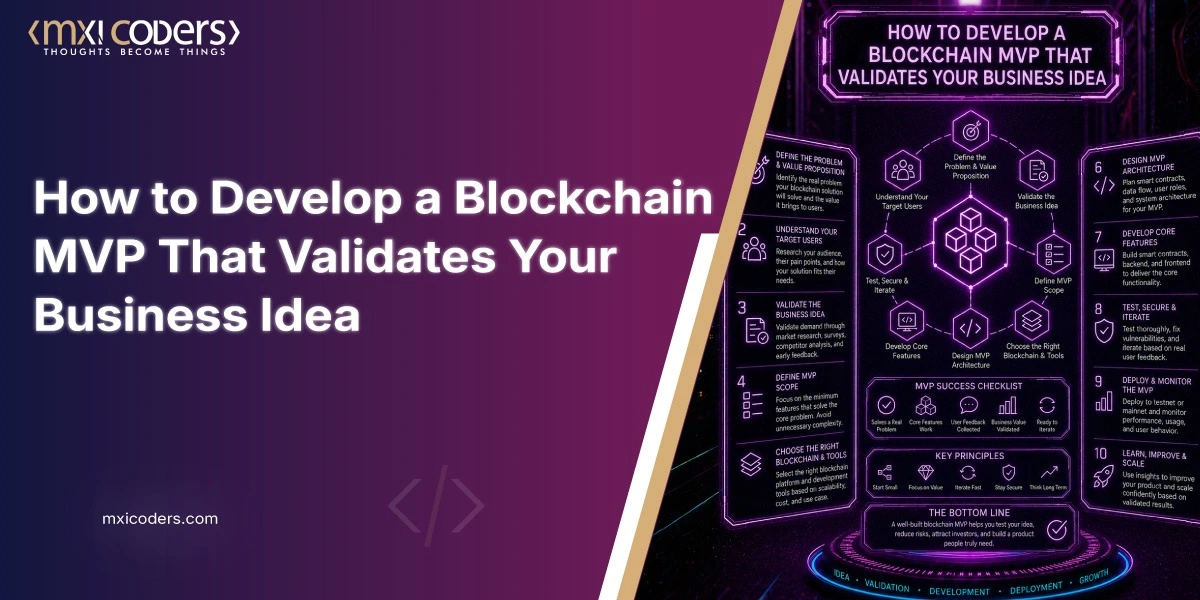
how to develop a blockchain mvp that validates your business idea

Building a blockchain product without first testing your idea is one of the costliest mistakes a startup can make. According to CB Insights, 35% of startups fail because there is no market need for their product, a problem that hits blockchain ventures especially hard given their complexity and capital requirements. The global blockchain market is projected to reach $943.8 billion by 2032, yet only a fraction of early-stage projects survive beyond their first year.

A Blockchain MVP, or Minimum Viable Product, offers a smarter path forward. Instead of investing months and millions into a full build, an MVP lets you launch a lean, functional version of your product to test real demand. It reduces cost, shortens time to market, and surfaces critical feedback before you scale. If you are planning to hire MVP developers for your blockchain project, starting with a validated MVP framework is the most effective strategy available.

➤ What Is a Blockchain MVP?

➥ Definition of a Blockchain Minimum Viable Product

A Minimum Viable Product in the blockchain space is a stripped-down version of your decentralized application or platform that includes only the core features needed to solve a specific problem. Unlike a traditional MVP, which typically runs on centralized infrastructure, a blockchain MVP incorporates decentralized components such as smart contract functionality, wallet integration, and on-chain transaction logic from the very beginning.

➥ Why Startups Should Build a Blockchain MVP First

Rushing into full-scale custom enterprise blockchain development without validation is a high-stakes gamble. A focused MVP helps you:

  • Validate whether real market demand exists for your product
  • Present a working prototype to attract early investors and stakeholders
  • Gather user feedback before committing to expensive architectural decisions
  • Minimize technical and business risk at the most vulnerable stage of development

➤ Why Validating Your Business Idea Is Critical in Blockchain Development

➥ Common Challenges Faced by Blockchain Startups

Blockchain projects come with a unique set of risks that make early validation non-negotiable:

  • High development costs mean building and auditing decentralized systems costs significantly more than traditional web applications
  • Unclear product-market fit leads many blockchain solutions to solve problems that do not actually require decentralization
  • Regulatory uncertainties create compliance challenges that vary widely across jurisdictions and continue to evolve
  • Scalability concerns mean blockchain networks can face throughput limitations that directly affect user experience at scale

➥ Benefits of Early Validation

Validating early prevents wasted spending and helps you refine the product around real pain points. It also accelerates your go-to-market strategy by giving you concrete data to present to partners, clients, and investors before your full product is ready.

Also Read: How to Build a dApp: The Complete Development Process

➤ Step-by-Step Process to Develop a Blockchain MVP

Step 1: Define the Core Problem Your Product Solves

Before writing a single line of code, you need absolute clarity on three questions:

  • What specific problem does the product solve?
  • Who are the intended users, and what do they actually need?
  • Why does this solution require blockchain rather than traditional technology?

Identifying target users and their pain points early prevents over-engineering. Many startups benefit from partnering with a reputable smart contract development service at this stage to understand what is technically feasible within a lean scope.

Step 2: Validate Market Demand

Market research is not optional; it is the foundation of every good MVP decision. Conduct competitor analysis, study industry trend reports, and speak directly with potential users before building anything.

Effective validation methods include:

  • One-on-one customer interviews
  • Online surveys and questionnaires
  • Landing pages that test messaging and collect sign-ups
  • Community discussions on forums and social channels
  • Prototype demonstrations with target users

Step 3: Identify Essential MVP Features

Must-Have Features

Scope discipline is everything at the MVP stage. Focus only on what is necessary:

  • User registration and authentication
  • Wallet integration
  • Core transaction history
  • A basic dashboard for user activity

The smart contract in blockchain architecture powers the trustless logic behind these features, automating agreements without requiring a centralized intermediary.

Features to Exclude Initially

Leave out advanced analytics, multi-chain support, gamification elements, and complex automation. These can be added in later iterations based on what your users actually request.

Step 4: Select the Right Blockchain Technology Stack

Choosing the right platform depends on your specific requirements. Key factors to evaluate include security needs, transaction speed, scalability, and development costs.

Popular platforms used in blockchain MVP builds:

  • Ethereum is the most widely used platform for decentralized applications with the largest developer ecosystem. Ethereum development remains the gold standard for smart contract-based products.
  • Polygon is a Layer 2 solution that offers faster transactions and lower fees
  • Solana provides high throughput with low latency, suited for performance-sensitive applications
  • Hyperledger is a permissioned framework ideal for enterprise use cases
  • Binance Smart Chain offers cost-effective transactions with EVM compatibility

Step 5: Design a User-Friendly MVP

Usability determines whether users actually engage with your product. Create wireframes before development begins, and focus on a seamless onboarding experience.

UX best practices for blockchain MVPs:

  • Simple, intuitive navigation
  • A clear wallet connection process
  • Minimal steps between a user’s intent and completing a transaction

If you plan to hire Web3 developers for your build, ensure they understand both the technical and UX dimensions of decentralized products.

Step 6: Develop and Test the MVP

Development moves through four key phases: smart contract development, frontend development, backend integration, and API integration. None of these phases should skip testing.

Critical testing areas include:

  • Smart contract security auditing to catch vulnerabilities before launch
  • Functional testing across all user flows
  • Performance testing under simulated load
  • User acceptance testing with real participants

Step 7: Launch the MVP and Collect Feedback

Release your MVP to a limited, targeted audience first. Monitor behavior carefully and track metrics that reveal real engagement rather than vanity numbers.

Key metrics to watch:

  • User acquisition and activation rates
  • User retention over 7, 14, and 30 days
  • Number of active wallets
  • Transaction volume over time
  • Customer feedback scores

➤ How to Measure Whether Your Blockchain MVP Has Successfully Validated Your Idea

➥ Signs Your MVP Is Working

  • Strong and growing user engagement
  • Positive, unsolicited feedback from early adopters
  • Rising transaction activity week over week
  • A growing community organically discussing your product
  • Repeat usage patterns without heavy prompting

➥ Indicators That Pivoting May Be Necessary

Low adoption rates, poor retention, and consistently negative feedback are signals that something fundamental needs to change, whether that is the product, the audience, or the underlying value proposition.

➤ Blockchain MVP Development Best Practices

The smart contract benefits of automation, transparency, and trust are only realized when the product is built thoughtfully. Keep these principles in mind throughout your build:

  • Start with the smallest possible scope and iterate quickly
  • Treat security as a first-class requirement, not an afterthought
  • Continuously validate your assumptions, not just at the start
  • Architect with scalability in mind even when building small
  • Keep users involved through every phase of development

➤ Conclusion

A blockchain MVP is not just a technical exercise; it is a business validation tool. By focusing on core features, gathering real user feedback, and iterating based on data, you dramatically increase the odds that your full-scale product will succeed in the market.

Whether you are building a decentralized finance platform, an NFT marketplace, or an enterprise supply chain solution, the path to product-market fit runs through a well-executed MVP. Start lean, validate fast, and scale only what the market confirms it wants.

Feel free to Connect us on

Ready to transform your business with smart software solutions?

Harness the power of custom software development to streamline operations, reduce costs, and boost efficiency. Start by exploring cutting-edge approaches like cloud-native platforms, API-first architecture, and AI-driven automation to future-proof your systems and stay ahead of the competition.

Book free consultation

Let’s build your idea together and serve society.

Author

Ashok Rathod

Tech Consultant

Experience
25 Years
Growth Architect for Startups & SMEs | Blockchain, AI , MVP Development, & Data-Driven Marketing Expert.

Transform the Carbon Credit Industry

Build a Transparent, Scalable Carbon Credit Marketplace with Blockchain.

Index