Blockchain technology has moved far beyond the hype of 2021. In 2026, the global blockchain market is projected to reach between $55 to $63 billion, with forecasts showing explosive growth at CAGRs ranging from 36% to over 60% through the early 2030s.
Yet, despite this momentum, blockchain is not a default solution for every business challenge. Many founders and CTOs have learned the hard way that forcing distributed ledger technology into unsuitable use cases creates more complexity than value.
Discover the measurable business benefits of blockchain technology from cost savings and efficiency gains to enhanced security and transparency. We’ll break down key advantages in real-world scenarios, pinpoint where blockchain delivers clear ROI (and where it falls short), and spotlight the top enterprise blockchain trends for 2026, including scalable layer-2 solutions and hybrid chains. If you’re a founder, CTO, or operations leader evaluating smart contract development service, this guide equips you to decide with confidence.
➤ What Blockchain Actually Means for Businesses in 2026
➥ Evolution of Blockchain from 2020 to 2026
Blockchain has evolved dramatically since the speculative crypto boom of the early 2020s. What began as a vehicle for digital currencies has matured into a tool for enterprise utility. The shift from public speculation to practical applications has been driven by:
- Tokenization of real-world assets (RWAs)
- Widespread use of smart contracts for automation
- Adoption of private and permissioned chains that prioritize control, compliance, and performance
Today, businesses view blockchain as infrastructure for building trust, reducing friction, and unlocking new efficiencies rather than a speculative asset class.
➥ Types of Blockchain Businesses Use Today
Enterprises typically choose from three main models:
- Public blockchains (e.g., Ethereum-based systems): Ideal for transparency and broad participation.
- Private (permissioned) blockchains: Enterprise-controlled networks offering higher speed, privacy, and governance.
- Hybrid models: Combining the best of both for flexibility in regulated environments.
The choice depends on your specific needs for security, scalability, and regulatory compliance.
Also Read: What is DAO in Blockchain and Why Should Your Business Use It?
➤ Core Business Benefits of Blockchain Technology
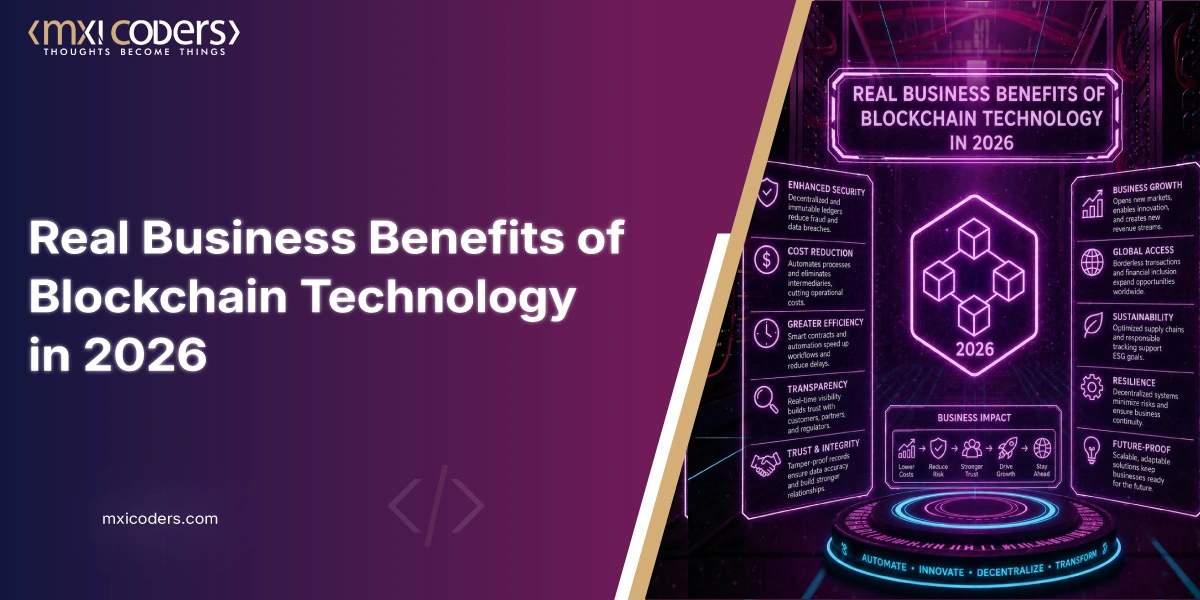
Here are the primary advantages of blockchain technology that deliver tangible value in 2026:
1. Trust Without Intermediaries
One of the main benefits of blockchain technology is enabling trust between parties that don’t fully trust each other. By removing reliance on centralized intermediaries, businesses can reduce delays, lower fees, and minimize counterparty risk.
Example: In cross-border payments, traditional systems can take days and incur high costs. Blockchain-enabled solutions settle transactions in minutes or seconds, cutting costs significantly.
2. Transparent and Immutable Record Keeping
Blockchain provides tamper-proof data storage, creating an auditable trail of every transaction. This is particularly valuable for audits, regulatory compliance, and supply chain tracking, where provenance and authenticity matter.
3. Automation Through Smart Contracts
Smart contracts: self-executing agreements coded directly onto the blockchain represent one of the strongest advantages of using blockchain technology. They automatically trigger actions when predefined conditions are met, reducing manual processes, human error, and operational overhead.
Real impact: Faster settlements and lower costs in areas like invoicing, royalties, and compliance.
4. Enhanced Security Architecture
Decentralized validation makes blockchain networks harder to hack than traditional centralized databases. There is no single point of failure, providing robust protection for sensitive data and transactions.
5. Cost Reduction in Operations
By eliminating intermediaries and streamlining reconciliation, blockchain delivers measurable cost savings, especially in finance, logistics, and supply chain operations. Some analyses suggest potential infrastructure cost reductions of up to 30–43% in targeted applications like traceability.
➤ Real-World Business Use Cases in 2026
➥ Finance and Payments
Blockchain powers faster cross-border transactions and DeFi integrations. Settlement times that once took days now occur near-instantly, with reduced fees and improved transparency. Payments remain one of the largest segments driving blockchain adoption.
➥ Supply Chain and Logistics
End-to-end visibility is a game-changer. Companies use blockchain for fraud prevention and product authenticity tracking from farm to table or factory to consumer. Walmart famously reduced food traceability time from days to seconds using this technology.
➥ Healthcare
Secure patient data sharing and improved interoperability between systems are key applications. The blockchain in the healthcare market is expanding rapidly, supporting everything from clinical data exchange to supply chain provenance for pharmaceuticals.
➥ Real Estate
Tokenization enables fractional ownership of assets and faster, more secure ownership transfers, reducing paperwork and intermediaries.
➥ Digital Identity and KYC
Self-sovereign identity systems reduce onboarding friction while enhancing security and compliance in KYC processes.
➤ When Blockchain Actually Makes Sense
Not every problem needs blockchain. Strategic adoption is key.
➥ Use Blockchain If:
- Multiple parties need shared, simultaneous access to the same data
- Trust is low or verification costs are high between participants
- Transparency and immutable audit trails are critical
- Processes involve frequent verification, reconciliation, or compliance checks
➥ Avoid Blockchain If:
- A simple centralized database meets your needs efficiently
- Transaction speed is the absolute priority over decentralization
- You don’t require trustless systems or shared truth
- It would introduce unnecessary complexity and cost
➤ Future Trends Shaping Blockchain for Business
➥ Integration with AI and Automation
AI combined with blockchain is emerging as a powerful duo for verifiable decision-making, fraud detection, and automated smart contract optimization. This convergence is one of the most exciting blockchain development trends in 2026.
➥ Growth of Tokenization
Real-world assets are becoming digitally tradable on blockchain networks, unlocking liquidity and new business models across industries.
➥ Enterprise Adoption Acceleration
We’re seeing a shift from experimental pilots to production-grade deployments. Large enterprises continue to lead, but improving tools and cloud services are making it easier for SMEs to participate.
➤ Conclusion
Blockchain is not a magic solution. Its real value emerges in specific use cases where the benefits of using blockchain technology, trust without intermediaries, transparency, automation via smart contracts, security, and cost reduction outweigh the complexity of implementation.
Businesses that win in 2026 will be those that use blockchain strategically, not blindly. Whether you’re planning to hire blockchain developers, focus on problems that involve multiple untrusted parties, high verification costs, or the need for immutable records.
The technology has matured. Now it’s time for targeted, high-ROI applications that drive genuine business advantage.