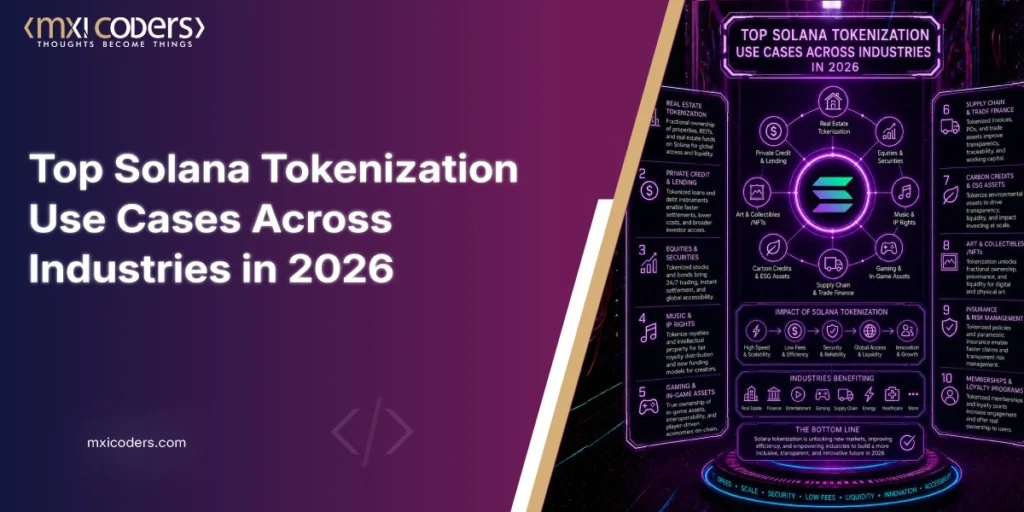
The global tokenization market is undergoing a rapid transformation. According to a 2024 report by Boston Consulting Group, the tokenized asset market is projected to reach $16 trillion by 2030, up from roughly $310 billion in 2022. Meanwhile, Solana has emerged as a leading infrastructure layer for this shift, processing over 65 million transactions per day at a fraction of a cent per transaction. As more businesses seek faster, more transparent ways to manage assets, Solana stands at the center of this evolution.
This guide explores how Solana tokenization is being applied across industries, what makes it technically compelling, and what businesses can expect in the years ahead.
➤ What Is Solana Tokenization?
Tokenization is the process of converting ownership rights to an asset, whether physical or digital, into a digital token recorded on a blockchain. On Solana, this means any asset, from a commercial property to a patent, can be represented as a programmable token that can be traded, transferred, or divided with minimal friction.
Unlike traditional asset ownership, which relies on paper contracts, intermediaries, and manual verification, tokenized assets on Solana are governed by code. Transactions settle in under a second, and records are immutable and publicly verifiable.
➥ Why Businesses Choose Solana for Tokenization
Solana blockchain capabilities make it particularly well-suited for enterprise-grade tokenization:
- High throughput processing thousands of transactions per second without network congestion
- Low transaction fees averaging less than $0.001 per transaction
- Energy-efficient infrastructure built on a Proof-of-History consensus mechanism
- A growing developer ecosystem with thousands of active contributors and expanding tooling
➤ How Solana Tokenization Works
The tokenization process follows several key steps: identifying the asset, completing a legal and regulatory compliance review, valuing the asset, creating the token, deploying smart contracts to govern ownership and transfers, and then enabling trading through decentralized or centralized platforms.
Technologies powering this process on Solana include SPL tokens (Solana’s native token standard), smart contracts, decentralized applications (dApps), and wallet integrations that allow users to hold and manage tokenized assets directly.
The smart contract development process is central to all of this. Smart contracts define the rules of ownership, automate compliance checks, trigger payouts, and handle transfers without requiring a third party to oversee each action.
➤ Top Solana Tokenization Use Cases Across Industries
➥ Real Estate
Real estate has historically been one of the most illiquid asset classes. Solana tokenization changes this by enabling fractional property ownership, where a single commercial building can be divided into thousands of tokens, each representing a proportional share.
Key benefits for real estate businesses include:
- Lower investment barriers that open premium properties to a broader pool of investors
- Faster fundraising cycles compared to traditional real estate syndications
- Simplified ownership transfers without lengthy escrow or title processes
- Reduced paperwork through on-chain documentation
Real estate investment platforms built on Solana allow cross-border property ownership that would otherwise require complex legal arrangements in multiple jurisdictions.
➥ Financial Services
Blockchain in fintech is perhaps most visible in the tokenization of traditional financial instruments. Securities, equities, bonds, and debt instruments can all be represented on Solana, enabling faster issuance, real-time settlement, and enhanced transparency for investors and issuers alike.
Tokenized bonds, for example, eliminate the multi-day settlement window common in traditional markets. Decentralized finance protocols built on Solana extend this further, enabling lending, borrowing, and yield generation without relying on a bank or broker.
For financial institutions, the benefits are measurable: lower transaction costs, broader accessibility for retail investors, and significantly enhanced liquidity for instruments that traditionally trade infrequently.
➥ Healthcare
Healthcare organizations handle some of the most sensitive data in existence, and tokenization offers a new framework for managing it. On Solana, patient records can be represented as tokenized assets that only the patient controls, sharing access with providers selectively and revocably.
Beyond data, healthcare asset tokenization opens up new financing models for medical equipment and clinical research:
- Hospitals can tokenize high-value equipment to raise funds without traditional loans
- Pharmaceutical research projects can attract decentralized investment through tokenized funding rounds
- Medical records can be securely shared across providers without exposing underlying data
The benefits of blockchain technology are especially tangible here: data transparency, enhanced security, and streamlined operations that reduce administrative overhead.
➥ Supply Chain and Logistics
Global supply chains suffer from opacity, fraud, and inefficiency. Solana tokenization addresses all three. Each product, shipment, or inventory item can be assigned a unique token that carries a full audit trail from manufacture to delivery.
Logistics companies adopting tokenized supply chains gain:
- Real-time inventory management with on-chain verification
- Product authentication that reduces counterfeiting in sectors like pharmaceuticals, luxury goods, and electronics
- Reduced fraud through immutable provenance records
- Greater transparency for both businesses and end consumers
Shipment tracking becomes more reliable when each handoff is recorded as a transaction on Solana’s blockchain, providing an unalterable record visible to all authorized parties.
Also Read: The Role of NFTs in Real Estate Tokenization Explained
➥ Gaming and Metaverse
Gaming has been one of the earliest and most enthusiastic adopters of blockchain tokenization. Solana’s speed and low fees make it ideal for in-game economies where thousands of microtransactions occur per hour.
Players can truly own digital assets such as weapons, character skins, and virtual land, and trade them freely across compatible platforms. Play-to-earn ecosystems distribute rewards through tokenized economies that operate without centralized control.
For developers, this creates new revenue opportunities. For players, it introduces true asset ownership and the ability to extract real-world value from time invested in a game.
➥ Retail and E-Commerce
Retailers are beginning to use tokenization to reimagine customer loyalty programs. Instead of proprietary points systems that expire or lose value, brands can issue blockchain-based tokens redeemable across partner networks.
This approach drives increased customer retention, builds brand loyalty through perceived ownership, and creates secondary markets where customers can trade or sell their rewards. Digital product ownership is another growing area, with verified on-chain records providing proof of authenticity for limited edition items.
➥ Intellectual Property and Media
For content creators, tokenizing copyrights and royalties through a custom enterprise blockchain development approach can eliminate many of the inefficiencies that plague the creative industry today. Music rights, publishing agreements, and digital content ownership can all be represented on-chain.
Smart contract benefits are particularly clear here. Royalty distributions that once took months to process through labels and publishers can be automated to trigger instantly every time a piece of content is consumed or licensed. Creators receive faster payments, retain more control over their work, and gain complete ownership transparency without depending on intermediaries.
➤ Future of Solana Tokenization Across Industries
Real world asset tokenization is moving from pilot programs to mainstream adoption. Institutional players including major asset managers and banks are actively building tokenized product offerings, and regulatory clarity is improving in key markets across the US, EU, and Asia.
Emerging trends expected to shape the landscape through 2026 and beyond include:
- AI-powered tokenized ecosystems that automate asset management and compliance
- Cross-chain interoperability allowing tokenized assets to move between Solana and other networks
- Broader institutional adoption of tokenized investment products
- Growth in tokenized private credit and infrastructure assets
Smart contract development services will play a central role in this expansion, helping businesses customize and deploy compliant token structures at scale.
➤ Key Takeaways
Solana is enabling scalable and cost-effective tokenization across a wide range of industries, from real estate and financial services to gaming and healthcare. Businesses that adopt tokenization early stand to gain meaningful advantages in liquidity, operational efficiency, and investor access. Security, legal compliance, and strategic planning remain essential to any successful tokenization initiative, but the infrastructure to execute at scale is already here.