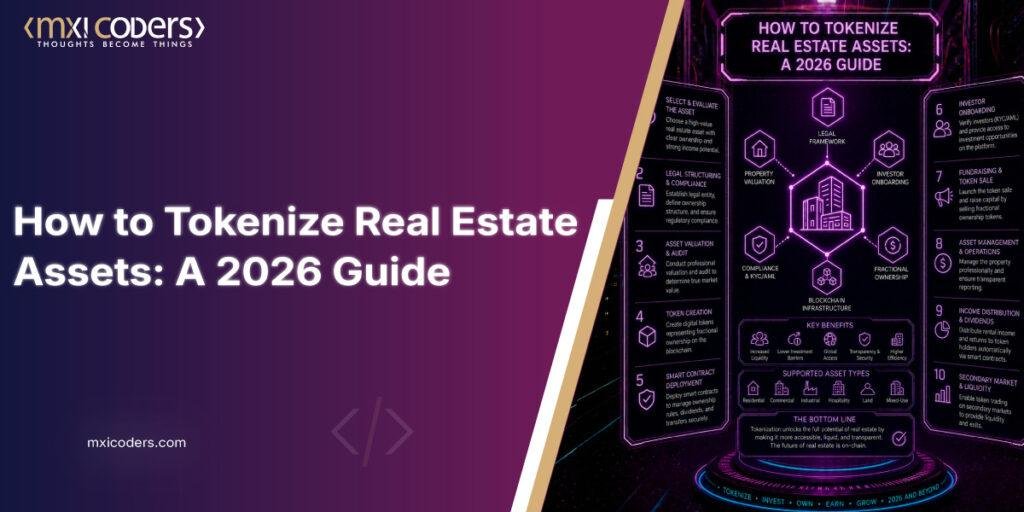
Real estate tokenization is the process of converting ownership of a property, or the cash flows it produces, into digital tokens recorded on a blockchain, so that a stake in the asset can be bought, sold, or transferred without going through a full property sale. Property tokenization also opens that asset up to fractional buyers who could never afford a whole building.
➤ What Is Actually Happening When You Tokenize a Property?
You’re not putting bricks on a blockchain. You’re creating a legal wrapper, usually a special purpose vehicle that holds title to the property, and then issuing tokens that represent shares in that vehicle. The token is a claim on an entity that owns the real estate, not a direct deed to the land itself. That distinction matters because it determines which securities laws apply, and it’s the part most beginner guides skip past.
Blockchain real estate projects almost always follow one of two paths: tokenizing a property you already own and operate, or building tokenization into a brand new development from the ground up. Existing assets move faster because the property already has income history and a valuation an appraiser can point to. Ground up projects take longer to structure but let you bake investor terms, governance, and reporting into the token itself from day one, instead of retrofitting them onto an existing ownership structure.
➤ Which Securities Exemption Should You Actually Use?
This is the decision that shapes everything else in an asset tokenization project, and it’s almost always decided before a single line of smart contract code gets written. Since a token representing property ownership is treated as a security in the United States, the offering has to fit under one of a handful of registration exemptions.
| Option | Mechanism | Best fit | Trade-off |
| Regulation D (506b/506c) | Private placement, accredited investors only, unlimited raise size according to Investor.gov | Larger raises from institutional or high net worth investors | No general public marketing under 506(b); 506(c) allows advertising but requires verified accreditation |
| Regulation A (Tier 1 or Tier 2) | Public offering with SEC qualification, capped at $20 million (Tier 1) or $75 million (Tier 2) in a 12 month period per SEC.gov | Projects that want to sell to non-accredited retail investors | Slower, more expensive qualification process than Reg D |
| Regulation CF | Crowdfunding exemption through a registered funding portal | Smaller raises, community-driven property projects | Lower fundraising ceiling than Reg A or Reg D |
| Regulation S | Offering made entirely outside the US to non-US persons | International investor base, cross-border property funds | Doesn’t solve US securities compliance if any US investors are involved |
Property owners frequently combine exemptions, running a Reg D round for accredited investors alongside a Reg S tranche for international buyers, rather than picking just one. Working with blockchain developers who’ve actually structured a token around one of these exemptions before saves real time here, because the smart contract’s transfer restrictions have to enforce whichever exemption you picked.
➤ How Do You Choose a Blockchain and Build the Smart Contracts?
Pick the chain based on transaction settlement speed, the maturity of its security token standards, and whether your legal counsel and transfer agent already have tooling built for it, not based on which chain is trending. Most real estate security tokens use an extension of the ERC-1400 or ERC-3643 standards specifically because they let you bake in transfer restrictions, whitelisting, and forced transfers for compliance directly into the contract, something a plain ERC-20 token can’t do on its own.
The smart contract needs to enforce who can hold the token (only verified, accredited or otherwise eligible investors), how many can hold it, and under what conditions a transfer is blocked. This is also where smart contract development work overlaps heavily with legal drafting, since the code is effectively encoding the offering’s legal terms.
➤ How Do You Actually Raise Money and Launch the Token?
Most real estate tokenization projects raise capital through a private placement first, using an investment memorandum that lays out the property details, projected returns, and risk factors, before any token trades publicly. Pricing is set using standard appraisal and comparable sales methods, the same as a conventional real estate deal, then converted into a per-token price based on the total token supply chosen for the offering.
After the raise closes, tokens are minted and distributed to verified investors, and post-launch support becomes an ongoing job, not a one time event: regular investor updates, dividend or rental income distributions if the structure pays them out, and continued compliance monitoring.
➤ Can Tokenized Property Shares Be Resold?
Yes, but only on platforms built to handle security tokens, since a regular crypto exchange isn’t set up to enforce the transfer restrictions baked into the contract. Secondary trading for tokenized real estate still happens on a fairly small number of specialized platforms, and liquidity depends heavily on whether a market maker is actively providing buy and sell orders for that specific token. Without one, a token holder can end up owning a share of a property with no easy way to sell it, which is one of the more overlooked risks in this space.
Mxicoders’ own MXI Prop platform is one working example of this in practice: a real estate tokenization deployment that has moved roughly $2 billion in tokenized property value through the platform, alongside a documented reduction in transaction costs compared to conventional property transfers.
➤ Limitations, Caveats, and Industry Challenges
Tokenized real estate is still a small fraction of the overall property market, and the numbers involved reflect projections, not current transaction volume. The Deloitte Center for Financial Services puts the current tokenized real estate market at under $300 billion as of 2024, with a forecast of roughly $4 trillion by 2035 at a 27% compound annual growth rate. That’s a meaningful gap between where the market is today and where the more optimistic forecasts say it’s headed, and it’s worth treating those long-range numbers as directional rather than guaranteed.
Regulatory uncertainty remains the biggest practical obstacle. Exemption rules, AML and KYC obligations, and state level securities regulation (“blue sky” laws) all still apply on top of whatever exemption is chosen, and the SEC’s own exempt offerings guidance confirms that states retain authority to investigate and enforce even when a federal exemption applies. Liquidity is the other honest weak point, since secondary markets for these tokens are thin compared to public equities.
➤ Frequently asked questions
- Is real estate tokenization legal in the United States?
Yes, provided the token offering fits within an existing securities exemption such as Regulation D, Regulation A, or Regulation CF. It isn’t a separate, tokenization-specific legal category, it’s a conventional securities offering wrapped in a different technical delivery mechanism. - How much does it typically cost to tokenize a property?
Costs vary widely based on the exemption chosen and the smart contract complexity, but legal structuring, SEC filings, and platform development are usually the largest line items, well before any blockchain transaction fees come into play. - Can you tokenize a property you already own outright?
Yes, this is the “existing development” path, and it’s generally faster than a ground up project since the property already has an appraised value and operating history to base the offering on. - Do investors need to be accredited to buy tokenized real estate?
It depends entirely on the exemption. Reg D 506(b) and 506(c) generally require accredited investors, while Reg A and Reg CF allow non-accredited retail investors to participate, within their respective offering caps. - What happens if a tokenized property’s platform shuts down?
This is one of the less discussed risks in the space. Token holders’ rights depend on how the underlying legal entity and transfer agent records are structured, which is why working with an experienced legal and technology team on the entity structure matters as much as the smart contract itself.
➤ Conclusion
Tokenizing a piece of real estate isn’t really a blockchain problem first, it’s a securities law problem that happens to be solved with blockchain tooling. The technical side, choosing a chain, writing the smart contract, building the issuance platform, is genuinely the more straightforward half. The exemption strategy, the jurisdiction, and the ongoing compliance obligations are where most projects either succeed or quietly stall out. Getting that structure right before writing a single line of contract code is what separates a tokenization project that actually raises capital from one that never gets past the planning stage.
Interested in scoping a real estate tokenization project for a specific property? Mxicoders works on end to end blockchain real estate builds, from smart contract development through platform launch. Book a free consultation to talk through your specific structure.