[ Your Headline ] [ Highlight Word ]

[ One or two lines describing the offer — e.g. "Experience our services with a FREE 30-minute consultation." ]

[ Optional second line, e.g. "Have a concept in mind? Let's brainstorm together!" ]

Google ★★★★★ 4.8
GoodFirms ★★★★★ 4.7
Clutch ★★★★★ 5.0
Blockchain

10 Essential Skills Every Blockchain Developer Needs in 2026

Ashok Rathod

Tech Consultant

Posted on
8th Jul 2026
11 min
Read
Share

Table of Contents

  • Quick Tips
  • Familiarize yourself with Cash App
  • Enable two-factor authentication
  • Utilize the optional Cash App
  • Conclusion

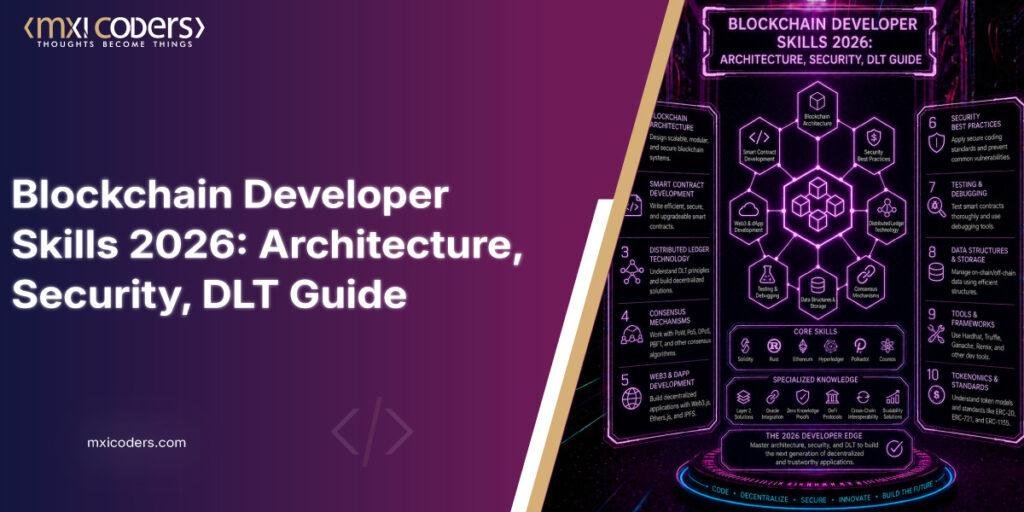
Blockchain developers need working knowledge of distributed ledger technology, smart contract languages like Solidity, blockchain architecture and consensus models, applied cryptography, and blockchain security practices. These five areas, backed by data structures, platform fluency, and testing discipline, separate developers who can ship production systems from those who can only prototype.

The market backing this demand keeps expanding. Fortune Business Insights projects the global blockchain technology market will grow from 17.68 billion dollars in 2026 to 469.49 billion dollars by 2030. That growth is not evenly distributed. It is concentrating in enterprise deployments, tokenization, and security-critical financial infrastructure, which is exactly why the skill list below leans harder on architecture and security than a typical “learn Solidity” tutorial does.

➤ What is distributed ledger technology, and why does it matter for blockchain developers?

Distributed ledger technology, or DLT, is a system where transaction records are replicated and synchronized across multiple independent nodes instead of living in one central database. Blockchain is one implementation of DLT, and understanding the underlying model, not just the blockchain layer on top of it, is what lets a developer reason about why a network behaves the way it does under load or attack.

A developer who only memorizes blockchain terminology tends to write code that works in a demo and fails under real network conditions. Understanding DLT itself means grasping three things in practice.

  1. Replication logic. How data propagates across nodes and what happens when nodes disagree.
  2. No central authority. Why removing a single administrator changes both the security model and the failure modes of an application.
  3. Trade-offs, not guarantees. DLT trades some performance for censorship resistance and tamper evidence, and a developer needs to know which trade-off their specific project actually needs.

➤ How do smart contracts work, and which languages should you learn?

A smart contract is code deployed on a blockchain that executes automatically when its programmed conditions are met, removing the need for a trusted intermediary to enforce the agreement. For Ethereum and most EVM-compatible chains, Solidity remains the primary language, while Vyper offers a more security-focused, Python-influenced alternative for teams that prioritize simplicity and auditability over feature breadth.

The language question has broadened since 2024, though. Non-EVM chains use different languages entirely: Solana favors Rust, and Move-based chains like Aptos and Sui use Move specifically because it was designed to make certain classes of asset-handling bugs structurally harder to write. Learning smart contract development today increasingly means picking a language based on which chain your target industry actually deploys on, not defaulting to Solidity by habit.

➤ What is blockchain architecture, and why does it matter for developers?

Blockchain architecture covers how a network is structured: whether it’s public, private, or a consortium model, how transactions get validated, and which consensus mechanism keeps nodes in agreement.

Public blockchains are open to anyone and maximize decentralization. Private blockchains are run by a single organization and trade some decentralization for privacy and control. Consortium blockchains sit between the two, governed jointly by a group of organizations, which is common in supply chain and interbank settlement projects. On the validation side, developers need working familiarity with how miners or validators confirm transactions, and with consensus mechanisms such as Proof of Work and Proof of Stake, since the mechanism a network uses shapes everything from transaction finality time to energy cost to attack surface.

➤ Why is cryptography a non-negotiable blockchain developer skill?

Cryptography is what makes a blockchain trustworthy without a central authority, and two concepts matter most in daily development work.

  • Hash functions. These convert any input into a fixed-length string that uniquely represents that data, which is how each block gets its tamper-evident fingerprint.
  • Public-key cryptography. A public key that anyone can see and a private key that only the owner holds, which together power digital signatures and let users prove ownership without exposing their private key.

Cryptography knowledge is also becoming more forward-looking. As blockchain security research matures, developers are expected to at least understand where quantum-resistant signature schemes fit into future protocol upgrades, even if implementing them isn’t yet a day-to-day task.

➤ Which data structures and algorithms matter most in blockchain development?

Two data structures come up constantly in blockchain codebases. Merkle trees let a system efficiently verify that a large dataset hasn’t been tampered with, without needing to check every piece of data individually, which is central to how blocks stay both fast to verify and secure. Patricia tries, used heavily in Ethereum-style chains, optimize how state data gets stored and retrieved, which directly affects how efficiently a network operates at scale.

Alongside these, developers need real algorithmic skill in three areas: optimizing code for gas and compute cost, applying cryptographic algorithms correctly rather than approximately, and understanding how different consensus algorithms actually secure a network rather than just naming them.

➤ Which blockchain platform should you learn first?

Platform choice should follow the industry you want to build for, not the other way around.

OptionMechanismBest fitTrade-off
EthereumProof of Stake, EVM smart contracts in Solidity or VyperPublic DApps, DeFi, NFTs, broadest developer communityHighest gas costs during congestion; public and pseudonymous by default
SolanaProof of History combined with Proof of Stake, Rust-based programsHigh-throughput consumer apps and trading platformsNewer tooling ecosystem than Ethereum; occasional network stability issues under load
Hyperledger FabricPluggable, permissioned consensusEnterprise supply chain and B2B consortium projectsRequires more setup and governance coordination than public chains
CordaNotary-based validation, permissionedFinancial services needing transaction-level privacyLimited to participants within its network; not designed for public, permissionless use

A simple way to choose: if your target industry is public-facing DeFi or NFTs, start with Ethereum. If it’s high-frequency trading or consumer-scale apps, learn Rust and Solana. If it’s enterprise supply chain or interbank work, Hyperledger Fabric or Corda will matter more than either of the first two.

➤ What does it take to build decentralized applications (DApps)?

DApps run on a peer-to-peer network instead of a centralized server, which shifts control away from any single operator and changes both the security model and the development workflow. Building one well requires five overlapping skill sets: smart contract development in your target chain’s language, a solid grasp of that chain’s protocol rules, front-end skills using frameworks like React or Angular, back-end skills such as Node.js to connect the interface to the contract layer, and security practices to protect against the vulnerabilities covered below. Teams building at scale often bring in dedicated DApp development expertise specifically because the front-end, back-end, and contract layers each carry different failure modes.

➤ How serious is blockchain security right now, and what should developers know?

Blockchain security has shifted meaningfully in the last two years, and the data shows exactly where. According to the Chainalysis mid-2026 crypto crime findings reported by TradingView, the largest hack of the first half of 2026 hit Drift Protocol for approximately 295 million dollars, and Ethereum remained the most targeted chain with 56 recorded incidents. Total losses in H1 2026 came in lower than the roughly 2.3 billion dollars lost in H1 2025, but the same report notes that attacks are shifting toward a larger number of smaller and medium-sized exploits rather than a few catastrophic ones, along with a rise in private-key and administrator-credential compromises rather than pure code bugs.

That shift shows up clearly in the OWASP Smart Contract Top 10 for 2026, which is anchored to 122 deduplicated 2025 incidents representing roughly 905 million dollars in contract-only losses. The 2026 edition moved business logic vulnerabilities up to the second-ranked risk category, expanding it to cover reward and fee logic flaws and state machine assumptions that individually pass every code-level check but still let a protocol fail because the enforced rules don’t match the rules the protocol actually needed. Access control failures remain the top category overall.

For a working developer, three practical takeaways follow from this data. First, code-level security reviews are necessary but no longer sufficient, since operator credential compromise now drives a large share of the biggest losses. Second, publishing verified source code matters more than it used to. A Chainalysis report covered by MEXC News found attackers increasingly reverse-engineer unverified, closed-source contracts specifically because obscurity no longer provides meaningful protection against modern decompilation tooling. Third, business logic review, not just checking for reentrancy, deserves as much audit time as classic technical vulnerabilities.

➤ How do you test and audit smart contracts properly?

Testing should move through three stages before anything reaches mainnet. Unit testing checks individual contract components in isolation. Integration testing verifies how those components interact with each other and with the blockchain itself. End-to-end testing simulates real usage conditions across the whole application. Common tooling includes the Truffle Suite and its companion Ganache for local Ethereum development, MythX for automated vulnerability scanning, and Remix for writing and testing Solidity directly in the browser. Given how much of the 2026 loss data traces back to business logic and access control rather than obscure bugs, testing plans should explicitly include adversarial scenarios for permission checks and fee or reward logic, not just standard functional coverage.

➤ How do you keep your blockchain development skills current?

The field moves fast enough that a static skill set has a short shelf life. Two habits matter most: actively engaging with current developer activity (Ethereum added an estimated 16,181 new developers in 2025 while Solana added roughly 11,534, according to developer activity data compiled by CoinLaw, which shows where community momentum and job opportunity are actually concentrating), and diversifying across projects rather than specializing in one chain too early. Reading primary sources such as protocol whitepapers and security post-mortems, rather than only secondary tutorials, tends to separate developers who can debug novel failures from those who can only follow familiar patterns.

➤ Limitations and Industry Caveats

Blockchain developer salary and hiring figures vary widely by source and region, and several industry reports describe a persistent talent shortage without agreeing on its exact size, so treat any single salary figure as directional rather than definitive. Security incident totals also differ between tracking firms (Chainalysis, CertiK, and SlowMist each publish separate annual figures) because they use different methodologies for what counts as a distinct incident, so cross-referencing more than one source before citing a specific loss total is good practice.

➤ Frequently asked questions

  1. Is a blockchain developer the same as a Web3 developer?
    Not exactly. “Web3 developer” is a broader label that includes front-end and wallet integration work, while “blockchain developer” more specifically implies protocol-level or smart contract work. In practice the titles overlap heavily, and job postings often use them interchangeably.
  2. Do you need a computer science degree to become a blockchain developer?
    No, but you need the equivalent knowledge. Most working blockchain developers come from a software development background first and add blockchain-specific skills afterward, since the underlying programming, data structure, and networking fundamentals transfer directly.
  3. Is Solidity alone enough in 2026?
    No longer reliably. Solidity still covers the largest share of EVM-based work, but Rust and Move fluency now open doors on Solana, Aptos, and Sui specifically because those ecosystems are attracting a growing share of new developer activity, as the CoinLaw data above shows.
  4. Are blockchain developer salaries still rising?
    Coursera’s guide, citing Glassdoor data, puts median blockchain developer pay at 137,000 dollars annually in the United States, with top-paying markets concentrated in New York and San Francisco. Multiple 2026 hiring reports describe continued upward pressure on compensation tied to a persistent shortage of specialized talent, though exact figures vary by source and role specialization.

➤ Conclusion

The skills that separated strong blockchain developers a few years ago, DLT fundamentals, smart contract fluency, and platform knowledge, still matter, but they’re no longer sufficient on their own. What’s changed by 2026 is where the risk actually lives: business logic flaws and credential compromise now account for as much damage as classic code-level bugs, and the platforms worth learning have multiplied beyond Ethereum alone. A developer who pairs solid architecture and cryptography fundamentals with genuine fluency in current security data, not just awareness that “security matters,” is the one who ends up trusted with production systems rather than prototypes.

Ready to build with a team that treats blockchain security as core to development, not an afterthought? Mxicoders works across blockchain development, smart contract engineering, and blockchain consulting for teams that need production-grade systems. You can also hire a blockchain developer directly if you have a specific project ready to scope.

➤ Sources Used

  • Fortune Business Insights, blockchain technology market size report
  • Chainalysis, Mid-2026 Crypto Crime Data (As reported by TradingView/Coinpedia)
  • Chainalysis unverified smart contract findings (As reported by MEXC News)
  • OWASP, Smart Contract Top 10 (2026 Edition) (Summary via Zealynx)
  • CoinLaw, Blockchain Developer Activity Statistics 2026
  • Coursera, Blockchain Developer Salary Guide (Citing Glassdoor)
blockchain developer skills 2026 (blog image)

Blockchain developers need working knowledge of distributed ledger technology, smart contract languages like Solidity, blockchain architecture and consensus models, applied cryptography, and blockchain security practices. These five areas, backed by data structures, platform fluency, and testing discipline, separate developers who can ship production systems from those who can only prototype.

The market backing this demand keeps expanding. Fortune Business Insights projects the global blockchain technology market will grow from 17.68 billion dollars in 2026 to 469.49 billion dollars by 2030. That growth is not evenly distributed. It is concentrating in enterprise deployments, tokenization, and security-critical financial infrastructure, which is exactly why the skill list below leans harder on architecture and security than a typical “learn Solidity” tutorial does.

➤ What is distributed ledger technology, and why does it matter for blockchain developers?

Distributed ledger technology, or DLT, is a system where transaction records are replicated and synchronized across multiple independent nodes instead of living in one central database. Blockchain is one implementation of DLT, and understanding the underlying model, not just the blockchain layer on top of it, is what lets a developer reason about why a network behaves the way it does under load or attack.

A developer who only memorizes blockchain terminology tends to write code that works in a demo and fails under real network conditions. Understanding DLT itself means grasping three things in practice.

  1. Replication logic. How data propagates across nodes and what happens when nodes disagree.
  2. No central authority. Why removing a single administrator changes both the security model and the failure modes of an application.
  3. Trade-offs, not guarantees. DLT trades some performance for censorship resistance and tamper evidence, and a developer needs to know which trade-off their specific project actually needs.

➤ How do smart contracts work, and which languages should you learn?

A smart contract is code deployed on a blockchain that executes automatically when its programmed conditions are met, removing the need for a trusted intermediary to enforce the agreement. For Ethereum and most EVM-compatible chains, Solidity remains the primary language, while Vyper offers a more security-focused, Python-influenced alternative for teams that prioritize simplicity and auditability over feature breadth.

The language question has broadened since 2024, though. Non-EVM chains use different languages entirely: Solana favors Rust, and Move-based chains like Aptos and Sui use Move specifically because it was designed to make certain classes of asset-handling bugs structurally harder to write. Learning smart contract development today increasingly means picking a language based on which chain your target industry actually deploys on, not defaulting to Solidity by habit.

➤ What is blockchain architecture, and why does it matter for developers?

Blockchain architecture covers how a network is structured: whether it’s public, private, or a consortium model, how transactions get validated, and which consensus mechanism keeps nodes in agreement.

Public blockchains are open to anyone and maximize decentralization. Private blockchains are run by a single organization and trade some decentralization for privacy and control. Consortium blockchains sit between the two, governed jointly by a group of organizations, which is common in supply chain and interbank settlement projects. On the validation side, developers need working familiarity with how miners or validators confirm transactions, and with consensus mechanisms such as Proof of Work and Proof of Stake, since the mechanism a network uses shapes everything from transaction finality time to energy cost to attack surface.

➤ Why is cryptography a non-negotiable blockchain developer skill?

Cryptography is what makes a blockchain trustworthy without a central authority, and two concepts matter most in daily development work.

  • Hash functions. These convert any input into a fixed-length string that uniquely represents that data, which is how each block gets its tamper-evident fingerprint.
  • Public-key cryptography. A public key that anyone can see and a private key that only the owner holds, which together power digital signatures and let users prove ownership without exposing their private key.

Cryptography knowledge is also becoming more forward-looking. As blockchain security research matures, developers are expected to at least understand where quantum-resistant signature schemes fit into future protocol upgrades, even if implementing them isn’t yet a day-to-day task.

➤ Which data structures and algorithms matter most in blockchain development?

Two data structures come up constantly in blockchain codebases. Merkle trees let a system efficiently verify that a large dataset hasn’t been tampered with, without needing to check every piece of data individually, which is central to how blocks stay both fast to verify and secure. Patricia tries, used heavily in Ethereum-style chains, optimize how state data gets stored and retrieved, which directly affects how efficiently a network operates at scale.

Alongside these, developers need real algorithmic skill in three areas: optimizing code for gas and compute cost, applying cryptographic algorithms correctly rather than approximately, and understanding how different consensus algorithms actually secure a network rather than just naming them.

➤ Which blockchain platform should you learn first?

Platform choice should follow the industry you want to build for, not the other way around.

OptionMechanismBest fitTrade-off
EthereumProof of Stake, EVM smart contracts in Solidity or VyperPublic DApps, DeFi, NFTs, broadest developer communityHighest gas costs during congestion; public and pseudonymous by default
SolanaProof of History combined with Proof of Stake, Rust-based programsHigh-throughput consumer apps and trading platformsNewer tooling ecosystem than Ethereum; occasional network stability issues under load
Hyperledger FabricPluggable, permissioned consensusEnterprise supply chain and B2B consortium projectsRequires more setup and governance coordination than public chains
CordaNotary-based validation, permissionedFinancial services needing transaction-level privacyLimited to participants within its network; not designed for public, permissionless use

A simple way to choose: if your target industry is public-facing DeFi or NFTs, start with Ethereum. If it’s high-frequency trading or consumer-scale apps, learn Rust and Solana. If it’s enterprise supply chain or interbank work, Hyperledger Fabric or Corda will matter more than either of the first two.

➤ What does it take to build decentralized applications (DApps)?

DApps run on a peer-to-peer network instead of a centralized server, which shifts control away from any single operator and changes both the security model and the development workflow. Building one well requires five overlapping skill sets: smart contract development in your target chain’s language, a solid grasp of that chain’s protocol rules, front-end skills using frameworks like React or Angular, back-end skills such as Node.js to connect the interface to the contract layer, and security practices to protect against the vulnerabilities covered below. Teams building at scale often bring in dedicated DApp development expertise specifically because the front-end, back-end, and contract layers each carry different failure modes.

➤ How serious is blockchain security right now, and what should developers know?

Blockchain security has shifted meaningfully in the last two years, and the data shows exactly where. According to the Chainalysis mid-2026 crypto crime findings reported by TradingView, the largest hack of the first half of 2026 hit Drift Protocol for approximately 295 million dollars, and Ethereum remained the most targeted chain with 56 recorded incidents. Total losses in H1 2026 came in lower than the roughly 2.3 billion dollars lost in H1 2025, but the same report notes that attacks are shifting toward a larger number of smaller and medium-sized exploits rather than a few catastrophic ones, along with a rise in private-key and administrator-credential compromises rather than pure code bugs.

That shift shows up clearly in the OWASP Smart Contract Top 10 for 2026, which is anchored to 122 deduplicated 2025 incidents representing roughly 905 million dollars in contract-only losses. The 2026 edition moved business logic vulnerabilities up to the second-ranked risk category, expanding it to cover reward and fee logic flaws and state machine assumptions that individually pass every code-level check but still let a protocol fail because the enforced rules don’t match the rules the protocol actually needed. Access control failures remain the top category overall.

For a working developer, three practical takeaways follow from this data. First, code-level security reviews are necessary but no longer sufficient, since operator credential compromise now drives a large share of the biggest losses. Second, publishing verified source code matters more than it used to. A Chainalysis report covered by MEXC News found attackers increasingly reverse-engineer unverified, closed-source contracts specifically because obscurity no longer provides meaningful protection against modern decompilation tooling. Third, business logic review, not just checking for reentrancy, deserves as much audit time as classic technical vulnerabilities.

➤ How do you test and audit smart contracts properly?

Testing should move through three stages before anything reaches mainnet. Unit testing checks individual contract components in isolation. Integration testing verifies how those components interact with each other and with the blockchain itself. End-to-end testing simulates real usage conditions across the whole application. Common tooling includes the Truffle Suite and its companion Ganache for local Ethereum development, MythX for automated vulnerability scanning, and Remix for writing and testing Solidity directly in the browser. Given how much of the 2026 loss data traces back to business logic and access control rather than obscure bugs, testing plans should explicitly include adversarial scenarios for permission checks and fee or reward logic, not just standard functional coverage.

➤ How do you keep your blockchain development skills current?

The field moves fast enough that a static skill set has a short shelf life. Two habits matter most: actively engaging with current developer activity (Ethereum added an estimated 16,181 new developers in 2025 while Solana added roughly 11,534, according to developer activity data compiled by CoinLaw, which shows where community momentum and job opportunity are actually concentrating), and diversifying across projects rather than specializing in one chain too early. Reading primary sources such as protocol whitepapers and security post-mortems, rather than only secondary tutorials, tends to separate developers who can debug novel failures from those who can only follow familiar patterns.

➤ Limitations and Industry Caveats

Blockchain developer salary and hiring figures vary widely by source and region, and several industry reports describe a persistent talent shortage without agreeing on its exact size, so treat any single salary figure as directional rather than definitive. Security incident totals also differ between tracking firms (Chainalysis, CertiK, and SlowMist each publish separate annual figures) because they use different methodologies for what counts as a distinct incident, so cross-referencing more than one source before citing a specific loss total is good practice.

➤ Frequently asked questions

  1. Is a blockchain developer the same as a Web3 developer?
    Not exactly. “Web3 developer” is a broader label that includes front-end and wallet integration work, while “blockchain developer” more specifically implies protocol-level or smart contract work. In practice the titles overlap heavily, and job postings often use them interchangeably.
  2. Do you need a computer science degree to become a blockchain developer?
    No, but you need the equivalent knowledge. Most working blockchain developers come from a software development background first and add blockchain-specific skills afterward, since the underlying programming, data structure, and networking fundamentals transfer directly.
  3. Is Solidity alone enough in 2026?
    No longer reliably. Solidity still covers the largest share of EVM-based work, but Rust and Move fluency now open doors on Solana, Aptos, and Sui specifically because those ecosystems are attracting a growing share of new developer activity, as the CoinLaw data above shows.
  4. Are blockchain developer salaries still rising?
    Coursera’s guide, citing Glassdoor data, puts median blockchain developer pay at 137,000 dollars annually in the United States, with top-paying markets concentrated in New York and San Francisco. Multiple 2026 hiring reports describe continued upward pressure on compensation tied to a persistent shortage of specialized talent, though exact figures vary by source and role specialization.

➤ Conclusion

The skills that separated strong blockchain developers a few years ago, DLT fundamentals, smart contract fluency, and platform knowledge, still matter, but they’re no longer sufficient on their own. What’s changed by 2026 is where the risk actually lives: business logic flaws and credential compromise now account for as much damage as classic code-level bugs, and the platforms worth learning have multiplied beyond Ethereum alone. A developer who pairs solid architecture and cryptography fundamentals with genuine fluency in current security data, not just awareness that “security matters,” is the one who ends up trusted with production systems rather than prototypes.

Ready to build with a team that treats blockchain security as core to development, not an afterthought? Mxicoders works across blockchain development, smart contract engineering, and blockchain consulting for teams that need production-grade systems. You can also hire a blockchain developer directly if you have a specific project ready to scope.

➤ Sources Used

  • Fortune Business Insights, blockchain technology market size report
  • Chainalysis, Mid-2026 Crypto Crime Data (As reported by TradingView/Coinpedia)
  • Chainalysis unverified smart contract findings (As reported by MEXC News)
  • OWASP, Smart Contract Top 10 (2026 Edition) (Summary via Zealynx)
  • CoinLaw, Blockchain Developer Activity Statistics 2026
  • Coursera, Blockchain Developer Salary Guide (Citing Glassdoor)

Feel free to Connect us on

Ready to transform your business with smart software solutions?

Harness the power of custom software development to streamline operations, reduce costs, and boost efficiency. Start by exploring cutting-edge approaches like cloud-native platforms, API-first architecture, and AI-driven automation to future-proof your systems and stay ahead of the competition.

Book free consultation

Let’s build your idea together and serve society.

Author

Ashok Rathod

Tech Consultant

Experience
25 Years
Growth Architect for Startups & SMEs | Blockchain, AI , MVP Development, & Data-Driven Marketing Expert.

Transform the Carbon Credit Industry

Build a Transparent, Scalable Carbon Credit Marketplace with Blockchain.

Index

Let's build something real!

Share your ideas with us and we’ll turn them into powerful digital solutions.

500+

Projects

8+

Experience

255+

Clients

Tell us about your project

Our team will get back to you within 24 hours