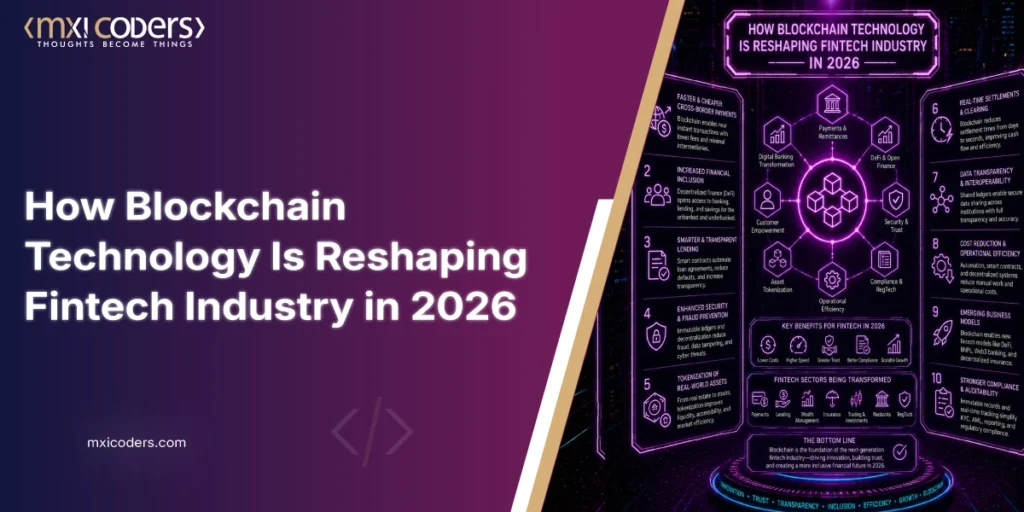
The financial world is undergoing a fundamental shift. Blockchain in fintech is no longer a concept confined to whitepapers and pilot programs. It is now powering real-world financial systems at scale. According to a 2025 report by MarketsandMarkets, the global blockchain in financial services market is projected to reach $62.39 billion by 2030, growing at a CAGR of 47.9%. A separate study by Deloitte found that 76% of financial executives believe digital assets and blockchain will replace fiat currency within the next decade.
In 2026, several key trends are accelerating this transformation: the rise of decentralized finance, growing regulatory clarity in major economies, the explosion of tokenized assets, and the push for real-time cross-border settlements. This article explores what blockchain is, why fintech needs it, and how businesses can put it to work from payments to digital identity to asset ownership.
➤ What Is Blockchain Technology?
➥ Understanding Blockchain in Simple Terms
At its core, blockchain is a distributed ledger technology. A shared database that records transactions across a network of computers rather than a single central server. Every transaction is grouped into a “block,” and each block is linked to the previous one, forming an unbroken chain. Once recorded, data cannot be altered without changing every subsequent block, making the system highly tamper-resistant.
Think of it as a Google Doc that thousands of people can view simultaneously, but nobody can silently edit.
➥ Core Features of Blockchain
- Decentralization: No single authority controls the network. Decisions are validated by consensus across nodes.
- Transparency: All participants can view transaction history, creating a shared source of truth.
- Security: Cryptographic hashing protects data at every layer.
- Immutability: Once a transaction is confirmed, it becomes a permanent, unalterable record.
- Smart contracts: Self-executing code that automatically enforces the terms of an agreement when predefined conditions are met.
➤ What Is Fintech and Why Does It Need Blockchain?
➥ Definition of Fintech
Fintech refers to technology-driven innovation in financial services. It encompasses digital banking, online payment platforms, peer-to-peer lending, robo-advisors for wealth management, insurance technology, and much more. Fintech companies essentially aim to make financial services faster, cheaper, and more accessible.
➥ Challenges Traditional Fintech Faces
Despite impressive growth, the fintech sector still battles significant structural problems:
- Fraud risks remain persistent, costing the global economy over $485 billion annually according to LexisNexis.
- Slow settlement times on cross-border transactions can take two to five business days.
- High transaction costs from intermediaries like correspondent banks eat into margins.
- Regulatory complexity across jurisdictions creates compliance bottlenecks.
- Cross-border payment issues including currency conversion fees and lack of transparency frustrate both businesses and consumers.
➥ Why Blockchain Is a Natural Fit for Fintech
Blockchain directly addresses these pain points. It enables faster, near-instant transactions by eliminating unnecessary middlemen. Its transparent, immutable ledger builds trust among parties who may not know each other. By removing intermediaries, it significantly reduces operational costs, and its cryptographic security framework makes data far harder to compromise.
➤ How Blockchain Technology Is Transforming the Fintech Industry
➥ Faster Cross-Border Payments
Traditional international transfers involve multiple correspondent banks, each adding time and fees. A wire transfer from the US to Southeast Asia might take three to five business days and cost 5–7% in fees. Blockchain-based payment systems such as Ripple’s XRP Ledger and Stellar process cross-border transactions in seconds at a fraction of the cost, settling with finality rather than provisional approval.
➥ Enhanced Security and Fraud Prevention
Every transaction on a blockchain is secured using cryptographic algorithms that are virtually impossible to forge. Because records are immutable, fraudulent alterations become immediately detectable. Blockchain also enables decentralized identity verification, allowing users to prove who they are without repeatedly sharing sensitive documents with multiple institutions.
➥ Lower Transaction Costs
By automating transaction processing through smart contracts and removing the need for intermediaries, companies can dramatically cut operational overhead. McKinsey estimates that blockchain could reduce infrastructure costs for cross-border payments, securities trading, and regulatory compliance by $15–20 billion per year by 2027.
➥ Increased Transparency
Every participant in a blockchain network can view transaction history in real time. For financial institutions, this means auditable records that satisfy regulators without requiring lengthy reconciliation processes. Compliance teams gain faster access to verifiable data, and consumers gain greater confidence in how their money is handled.
➤ Key Blockchain Applications in Fintech
➥ Digital Payments
Blockchain powers instant payment networks that facilitate peer-to-peer transfers and merchant payments without requiring a traditional bank account. Stablecoins like USDC and USDT now process billions of dollars in daily volume, providing a fast, programmable alternative to conventional payment rails.
➥ Smart Contracts
Smart contracts are reshaping lending, insurance, and legal agreements. A loan can be automatically disbursed when a borrower meets predefined criteria. An insurance claim can be processed and paid without any human adjudication. These automations reduce processing time from days to seconds.
➥ Decentralized Finance (DeFi)
DeFi platforms offer lending, borrowing, and yield-generation services without banks. By locking assets into smart contracts, users earn interest or access liquidity on their own terms. While regulatory oversight is still evolving, DeFi has demonstrated that financial markets can operate 24/7 without centralized gatekeepers.
➥ Digital Identity Verification
Blockchain-powered KYC (Know Your Customer) automation lets customers verify their identity once and share it across multiple platforms securely. This eliminates redundant document submissions and reduces the cost and time banks spend on compliance.
➥ Tokenization of Assets
One of the most consequential shifts is asset tokenization. The process of representing ownership of real-world assets as digital tokens on a blockchain. Stocks, bonds, private equity, and real estate can all be tokenized, enabling fractional ownership, faster settlement, and broader investor access.
Real estate tokenization, in particular, is opening previously illiquid markets to retail investors. A $5 million commercial property can be divided into thousands of tokens, each representing a fractional ownership share, tradable 24/7 on secondary markets.
Among the leading platforms for this purpose is Solana blockchain tokenization, which offers high throughput (up to 65,000 transactions per second) and extremely low fees, making it well-suited for high-frequency, small-denomination token transactions.
➤ How Fintech Businesses Can Implement Blockchain Successfully
➥ Identify Suitable Use Cases
Not every process benefits from blockchain. Start by identifying pain points where decentralization, transparency, or immutability would provide measurable value cross-border payments, KYC, trade finance, and asset settlement are strong candidates.
➥ Choose the Right Blockchain Platform
Public blockchains like Ethereum and Solana offer transparency and existing ecosystems. Private or permissioned blockchains like Hyperledger Fabric offer greater control and are better suited to regulated industries. Your choice should align with your compliance requirements, performance needs, and budget.
➥ Ensure Regulatory Compliance
Work closely with legal teams and regulators from the start. In 2026, frameworks like the EU’s MiCA regulation and the US Digital Asset Anti-Money Laundering Act are shaping how blockchain applications must be structured. Build compliance from day one rather than retrofitting it later.
➥ Prioritize Security
Conduct thorough code audits before any smart contracts go live. Engage independent security firms to stress-test your infrastructure, since a single vulnerability in a smart contract can expose millions of dollars. Use multi-signature wallets and access controls to limit risk.
➥ Partner with Experienced Blockchain Developers
Execution matters as much as strategy. To hire blockchain developers with domain expertise in fintech, look for professionals who understand both the technical stack (Solidity, Rust, Web3 libraries) and the regulatory environment. Firms specializing in financial-grade blockchain implementations can dramatically shorten your time to market and reduce costly mistakes.
➥ Actionable Checklist
- Define specific business goals and success metrics
- Select the appropriate blockchain architecture (public, private, or hybrid)
- Conduct comprehensive security audits before launch
- Test scalability under realistic transaction volumes
- Launch a controlled pilot project before full-scale deployment
➤ The Future of Blockchain in Fintech
Blockchain technology benefits are no longer theoretical. They are being realized at scale by banks, insurers, asset managers, and payment processors worldwide. Institutions like JPMorgan, HSBC, and BlackRock have moved beyond experimentation into production deployments.
Looking beyond 2026, several innovations will define the next chapter. Central Bank Digital Currencies (CBDCs) will bring blockchain-style infrastructure to sovereign money. AI-powered smart contracts will enable more complex, self-adjusting financial agreements. Interoperability protocols will allow different blockchain networks to communicate seamlessly, eliminating today’s silos.
The role of blockchain in banking sector operations will deepen as institutions recognize that distributed ledger technology is not a threat to their business model but it is an upgrade to it. Banks that embrace this shift will settle transactions faster, serve customers better, and compete more effectively in a global market.
For fintech companies, the question in 2026 is no longer whether to adopt blockchain and it is how quickly they can build the capabilities to lead with it.