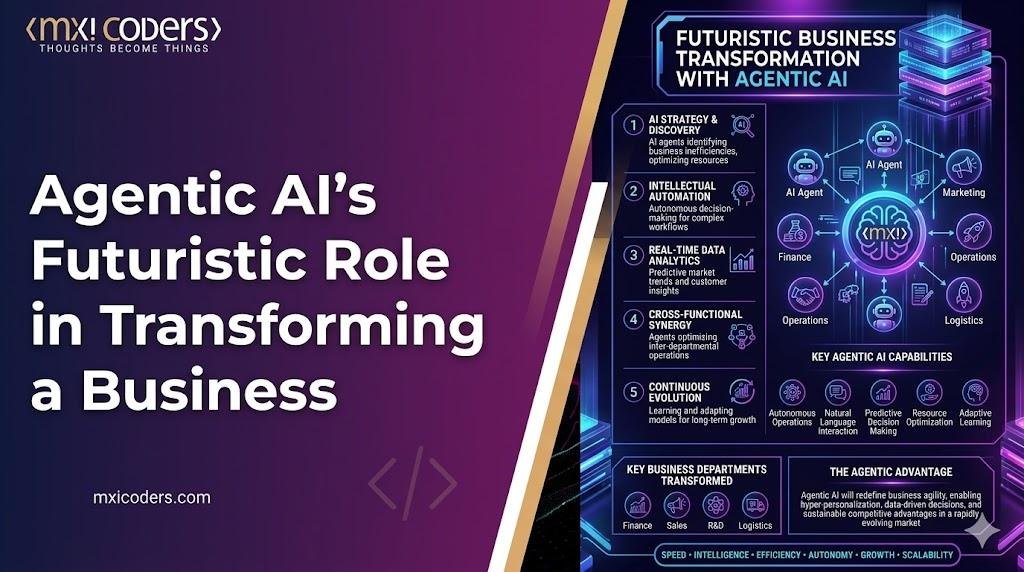
AI has already contributed $11 trillion to $18 trillion with no plans of stopping down. But something shifted. Agentic AI took the playbook from traditional automation and tore it up.
The market backs that up. Agentic AI was worth about $7.55 billion in 2025. It’s projected to climb at a 43.84% compound annual growth rate and hit $199.05 billion by 2034. According to McKinsey, the additional value on top of regular AI is in the range of $2.6 trillion to $4.4 trillion, primarily in marketing, sales, customer service and supply chains.
So what’s the difference, and why do Google’s rules in 2026 make this tech a bigger deal?
Agentic AI runs complex, multi-step jobs and makes calls on its own. It doesn’t wait for a human to click “approve”. Traditional AI follows scripts. Agentic AI is responsible for setting goals, planning the steps, and adapting when things change.
Here’s a quick contrast.
Say you want to return a product.
- Old way: You fill out a form. Print a label. Ship it. A basic bot can’t finish the job, so it kicks you to a person.
- Agentic way: The AI agent spots the issue. It starts the return, emails you a label, updates inventory, and triggers the refund. No humans needed.
How? Agentic systems are built from AI agents individual models trained to decide and act in real time. Think of a chatbot that handles FAQs. That’s one agent. Allow dozens of them stacked on one another, communicating with one another, paving way for a multi-agent system working towards a goal that’s impossible for an individual bot.
Expect the workflow go like this:
- Tracking: Capturing data from within the sensors, APIs, and/or even cameras.
- Understanding: Parse it with NLP, computer vision, and other ML tools.
- Deciding: Plan the best path using reasoning and prediction.
- Acting: Run code, hit APIs, send emails, or move physical assets.
- Learning: Check results, update its knowledge, and tweak the strategy for next time.
➤ How Agentic AI Can Change a Business for a Real Win?
McKinsey’s latest data shows 23% of companies already use agentic AI in at least one function. Another 39% are testing it. The uptake isn’t hype. Three gains keep showing up:
- Automation that finishes the job :Old AI handled tasks. Agentic AI runs entire workflows from start to end. That frees people for creative work and cuts cycle times. Less handoff, fewer errors.
- Decisions get sharper:These systems learn from each run. The analytics improve, risk drops, and teams spot new product angles faster. You’re not just faster you see moves others miss.
- Customers don’t wait: Agents work 24/7. They fix issues before a ticket gets filed, personalize across channels, and remember context. Satisfaction climbs because the experience feels human, minus the hold music.
➤ Where Agentic AI Works: Use Cases to Discuss?
Agentic AI isn’t theory. It’s in the wild across industries.
Finance
- Fraud detection: Agents watch transaction data, biometrics, device signals, and employee behavior. Spot something odd? They freeze the account on the spot. Mastercard already uses agents that transact for customers.
- Claims: Extraction of data from forms, coverage verification and automatic approval of low-risk claims with the help of OCR, NLP and LLM. Lemonade, GEICO, and Zurich Insurance Group run versions of this now.
E-commerce
- Customer service: An agent can purchase your “bag” or “book your flight”. It will listen to your request, tap into the eCommerce sites, payment gateways, and booking systems, select the most suitable one, pay for it and keep you updated on delivery.
- Inventory: Agents connect to ERPs, WMSs, POSs and IoT sensors to monitor inventory all the way from the warehouse to the store. They predict orders based on past sales, trends, weather, social media you name it then place orders with suppliers, ahead of you running out of inventory.
Manufacturing
- Supply Chain: The demand can be simulated by agents, based upon both climatic and geopolitical scenarios. If a port closes, they reroute shipments or ping backup suppliers. Resilience stops being a slide deck bullet.
- Quality + maintenance: Computer vision finds micro-defects on the line and flags or fixes them. IoT data informs agents whenever there is a dip in the machine’s health. Tweaks settings, schedules maintenance and orders parts without the manager’s email.
➤ The Hard Parts of Rolling Out Agentic AI and What Fixes Them?
Building one agent is easy. Orchestrating dozens is not. Four issues come up every time.
1. Integrations get messy
Agents should be capable of talking to one another, with the internal tools, and also the third-party APIs. Fix it with shared knowledge bases and solid messaging: REST, queues, pub/sub. Legacy systems? Expect custom middleware or a full re-architecture.
2. Security can’t be an afterthought
Adversarial inputs, plain bugs, model theft and breaches are all threats to agents. Encrypt it, put in firewalls, intrusion detection and regular audits. Include MFA/role based access. Penetration testing is the way to go around before things actually go live.
3. Privacy and ethics shouldn’t be ignored
Agents manage payment details and health information, as well as PII. Anonymise and/or pseudonymise as far as possible. Comply with GDPR, CCPA and HIPAA. Carry out data protection impact assessments. Pick-up just what you need. If it’s not trusted, then it will not be used by users.
4. Unpredictability and bias
Agentic AI doesn’t stick to fixed rules, so it can surprise you. Build error detection, fallbacks, and an “undo” button. For RAG systems, curate knowledge bases often. Use context-aware retrieval and validate sources. Examine information for credibility; avoid bias.
➤ Building Agentic Systems with MXICoders
Speed wins deals. Agentic AI gives freedom with automation, eliminating slogging through tasks, and lifting the overall customer experience. But you need groundwork: infrastructure that fits agents, governance that keeps them in check, and teams who know how to work with them.
That’s where MXICoders comes in. We live in AI and machine learning. We don’t just consult. We customize agents, integrate them, and implement full agentic systems. Security, reliability, and adaptability aren’t add-ons. They’re built in from day one.
Ready to see what agentic AI looks like in your stack? Book a call and let’s map your first workflow.
Want agentic AI that actually ships? Start with one process, not ten.