[ Your Headline ] [ Highlight Word ]

[ One or two lines describing the offer — e.g. "Experience our services with a FREE 30-minute consultation." ]

[ Optional second line, e.g. "Have a concept in mind? Let's brainstorm together!" ]

Google ★★★★★ 4.8
GoodFirms ★★★★★ 4.7
Clutch ★★★★★ 5.0
Blockchain

Centralized Exchange vs Decentralized Exchange: What's the Real Difference in 2026?

Ashok Rathod

Tech Consultant

Posted on
16th Jul 2026
7 min
Read
Share

Table of Contents

  • Quick Tips
  • Familiarize yourself with Cash App
  • Enable two-factor authentication
  • Utilize the optional Cash App
  • Conclusion

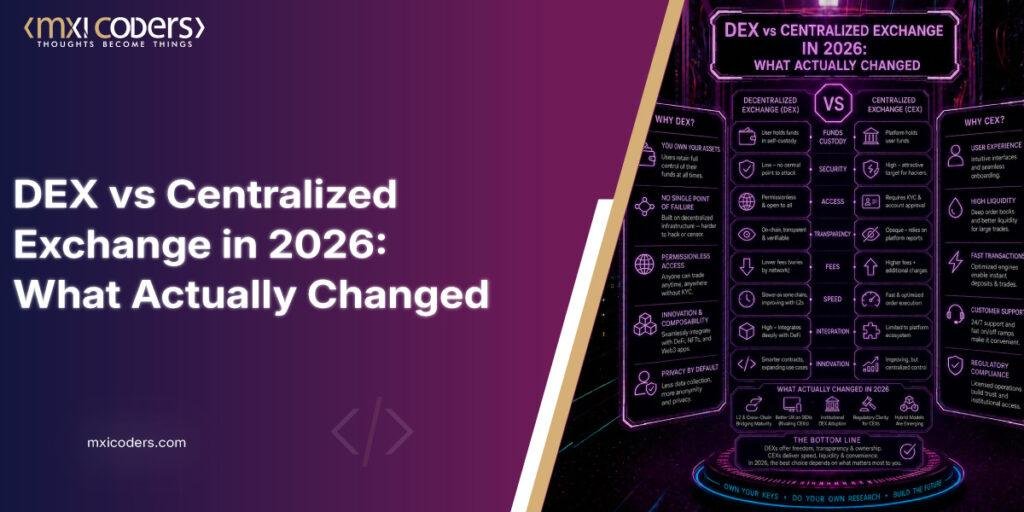
A centralized cryptocurrency exchange holds your private keys and matches trades on its own servers, while a decentralized exchange (DEX) lets you trade directly from your own wallet through smart contracts, with no company ever taking custody of your coins. Both exist side by side in 2026, and neither has replaced the other.

➤ Why do we even need a cryptocurrency exchange?

Anyone holding Bitcoin or another cryptocurrency who wants to convert it to dollars, or swap it for a different coin, needs a marketplace with enough buyers, sellers, and liquidity to get a fair price. That marketplace is a cryptocurrency exchange, and right now there are three broad flavors: centralized, decentralized, and peer to peer.

➤ How does a centralized exchange work, and how is that different from a DEX?

On a centralized exchange (CEX) like Coinbase, Binance, or Kraken, you deposit funds and the exchange takes custody of them, matching your orders against other users on an internal order book. On a decentralized exchange, you connect a self-custody wallet like MetaMask, and your trade executes against a liquidity pool or an on-chain order book, governed entirely by a smart contract. Nobody at a company ever holds your keys.

The market share numbers tell the story of how this has shifted. DEX share of total spot trading volume doubled from 6.9% in January 2024 to 13.6% in January 2026, according to CoinGecko’s 2026 CEX & DEX Trading Activity Report. In dollar terms, DEX spot volume more than doubled from $95.86 billion to $231.29 billion over that same stretch, and it briefly touched 24.5% of spot volume at its June 2025 peak. Even so, CEXs still process over $1 trillion in monthly spot volume, so they remain the dominant venue by a wide margin. CoinGecko + 3

➤ Comparison: exchange types in 2026

OptionMechanismBest fitTrade-off
Centralized exchange (CEX)Company-run order book, custodial wallets, KYC onboardingBeginners, high-liquidity pairs, fiat on/off rampsCustody risk, exchange can freeze or lose funds
Decentralized exchange (DEX)Smart-contract liquidity pools or on-chain order books, self-custodyTraders wanting control of assets, DeFi-native tokensHigher complexity, weaker fiat conversion, gas costs
Peer to peer (P2P) exchangeEscrow-secured, direct buyer-to-seller matching outside a central order bookLocal payment methods, privacy-focused tradingSlower settlement, relies on counterparty trust and escrow

➤ Is a peer to peer crypto exchange the same thing as a DEX?

Not quite. A peer to peer crypto exchange connects a buyer and seller directly and holds funds in escrow until payment is confirmed, which can be done through a smart contract or through secure backend software, and this model still supports far more local payment methods and currencies than most DEXs do. A DEX, by contrast, routes trades through liquidity pools rather than matching one specific buyer to one specific seller. Both share the same core idea of removing the custodial middleman, but they solve different problems: P2P is built for flexible, local settlement, while a DEX is built for fast, automated token swaps.

➤ Is a decentralized exchange actually safer than a centralized exchange?

Safer against certain risks, not against all of them. Centralized exchanges concentrate large pools of user funds in one custodial system, which makes them a high-value target. Chainalysis’s 2026 Crypto Crime Report recorded roughly $3.4 billion stolen from crypto services in 2025, and the February 2025 breach of Bybit alone accounted for close to $1.5 billion of that, the largest single digital asset theft on record. The top three hacks of the year made up 69% of all losses, and DPRK-linked actors were responsible for $2.02 billion, or 76% of all service compromises, per Chainalysis. Stingrai + 2

Because no company holds your keys on a DEX, that specific style of large-scale custodial breach mostly doesn’t apply. But DEXs carry their own risks: smart contract bugs, front-running, and lower liquidity outside major pairs. Trading volume on a DEX is also harder to fake, since every swap requires committed capital and leaves a permanent on-chain record, which is why analysts increasingly treat DEX data as more reliable than self-reported CEX figures for judging genuine trading activity. BYDFi

➤ Which decentralized exchanges lead the market in 2026?

Ethereum no longer dominates DEX activity the way it once did. Solana-based DEXs processed about $117 billion in January 2026 against Ethereum’s $52 billion, and by the first quarter of 2026, Solana captured 30.6% of total DEX spot market share, according to data reported by WEEX. On the derivatives side, Hyperliquid has emerged as the standout, running roughly $208 billion in 30-day volume and over 229,000 active traders as of March 2026, per NFT Plazas. Uniswap v4, which rolled out in late 2024, cut per-swap costs by routing multiple pools through a single contract, which has helped it hold onto larger traders who might otherwise move to a CEX. BYDFiBYDFi

➤ Do regulators treat DEXs and CEXs the same way?

No, and this is one of the biggest shifts happening right now. Under the EU’s Markets in Crypto Assets Regulation, centralized exchanges must hold a full Crypto Asset Service Provider license, with the transitional grandfathering period ending on July 1, 2026, according to LegalBison. Truly decentralized protocols with no identifiable operator currently sit outside MiCA’s direct scope, but the European Commission opened a review in May 2026 specifically to decide which DeFi applications still qualify for that exemption, with findings due by mid-2027. In the United States, stablecoin issuers now face licensing requirements under the GENIUS Act, while broader market structure rules are still being worked out across the SEC and CFTC.

➤ Limitations, Caveats, and Industry Challenges

DEXs still can’t fully replace centralized exchanges for everyday use. Converting crypto directly into fiat currency on most DEXs remains difficult or impossible without routing through a CEX or a P2P platform first. Liquidity outside major pairs like ETH/USDC or BTC/USDT is often thin, which can mean worse pricing on smaller trades. The interfaces are also still less forgiving for newcomers than a typical CEX app, and regulatory treatment of DeFi protocols is actively being redefined in the EU and the US right now, which means the compliance picture for DEXs could look different by the end of 2027.

➤ Frequently asked questions

  1. Do I need a crypto wallet to use a decentralized exchange?
    Yes. You’ll need a self-custody wallet like MetaMask connected to the DEX’s interface, along with enough of the network’s native token to cover gas fees for each trade.
  2. Can a centralized exchange freeze my funds?
    Yes, a CEX can freeze withdrawals or accounts, since it holds custody of your assets and must comply with its own terms of service and applicable regulations. A DEX cannot freeze your wallet, since it never takes custody in the first place.
  3. Are P2P crypto exchanges legal?
    In most jurisdictions, yes, though tiered KYC and AML checks are increasingly common on P2P platforms as regulators tighten oversight of crypto onboarding globally.
  4. Why did DEX trading volume grow so much between 2024 and 2026?
    A large part of the growth traces back to memecoin trading activity that began in mid-2024, along with routing changes like Binance’s Alpha 2.0 sending trades through PancakeSwap, both of which pulled meaningful volume onto decentralized platforms.

➤ Conclusion

The centralized versus decentralized exchange debate isn’t really a debate anymore, it’s a question of which tool fits the job. Centralized exchanges still carry the bulk of global trading volume and remain the easiest on-ramp between fiat and crypto. Decentralized exchanges have gone from a niche, degen-only corner of the market to a genuine share of daily trading activity, and peer to peer platforms continue to serve traders who want more control over payment methods and privacy. The more useful question for 2026 isn’t which one wins, it’s which one matches what you’re actually trying to do: hold custody yourself, get the deepest liquidity, or settle a trade locally on your own terms.

➤ Ready to Build on Any of These Models?

MXICoders builds centralized exchange, decentralized exchange, and P2P crypto exchange platforms end to end, from smart contract architecture to liquidity integration and compliance workflows. If you’re evaluating which exchange model fits your project, get a free consultation to talk through the build.

➤ Sources Used

  • CoinGecko, 2026 CEX & DEX Trading Activity Report
  • BYDFi CoinTalk, DEX Volume in 2026: Which Chains Lead
  • NFT Plazas, Decentralized Exchanges Statistics 2026
  • Chainalysis 2026 Crypto Crime Report, via FinanceFeeds
  • Chainalysis 2026 Crypto Crime Report, via Libertify
  • LegalBison, DeFi Protocols Under MiCA
  • LeoDex, MiCA Explained: CEX Rules, DEX Exemption
dex vs centralized exchange in 2026 (blog image)

A centralized cryptocurrency exchange holds your private keys and matches trades on its own servers, while a decentralized exchange (DEX) lets you trade directly from your own wallet through smart contracts, with no company ever taking custody of your coins. Both exist side by side in 2026, and neither has replaced the other.

➤ Why do we even need a cryptocurrency exchange?

Anyone holding Bitcoin or another cryptocurrency who wants to convert it to dollars, or swap it for a different coin, needs a marketplace with enough buyers, sellers, and liquidity to get a fair price. That marketplace is a cryptocurrency exchange, and right now there are three broad flavors: centralized, decentralized, and peer to peer.

➤ How does a centralized exchange work, and how is that different from a DEX?

On a centralized exchange (CEX) like Coinbase, Binance, or Kraken, you deposit funds and the exchange takes custody of them, matching your orders against other users on an internal order book. On a decentralized exchange, you connect a self-custody wallet like MetaMask, and your trade executes against a liquidity pool or an on-chain order book, governed entirely by a smart contract. Nobody at a company ever holds your keys.

The market share numbers tell the story of how this has shifted. DEX share of total spot trading volume doubled from 6.9% in January 2024 to 13.6% in January 2026, according to CoinGecko’s 2026 CEX & DEX Trading Activity Report. In dollar terms, DEX spot volume more than doubled from $95.86 billion to $231.29 billion over that same stretch, and it briefly touched 24.5% of spot volume at its June 2025 peak. Even so, CEXs still process over $1 trillion in monthly spot volume, so they remain the dominant venue by a wide margin. CoinGecko + 3

➤ Comparison: exchange types in 2026

OptionMechanismBest fitTrade-off
Centralized exchange (CEX)Company-run order book, custodial wallets, KYC onboardingBeginners, high-liquidity pairs, fiat on/off rampsCustody risk, exchange can freeze or lose funds
Decentralized exchange (DEX)Smart-contract liquidity pools or on-chain order books, self-custodyTraders wanting control of assets, DeFi-native tokensHigher complexity, weaker fiat conversion, gas costs
Peer to peer (P2P) exchangeEscrow-secured, direct buyer-to-seller matching outside a central order bookLocal payment methods, privacy-focused tradingSlower settlement, relies on counterparty trust and escrow

➤ Is a peer to peer crypto exchange the same thing as a DEX?

Not quite. A peer to peer crypto exchange connects a buyer and seller directly and holds funds in escrow until payment is confirmed, which can be done through a smart contract or through secure backend software, and this model still supports far more local payment methods and currencies than most DEXs do. A DEX, by contrast, routes trades through liquidity pools rather than matching one specific buyer to one specific seller. Both share the same core idea of removing the custodial middleman, but they solve different problems: P2P is built for flexible, local settlement, while a DEX is built for fast, automated token swaps.

➤ Is a decentralized exchange actually safer than a centralized exchange?

Safer against certain risks, not against all of them. Centralized exchanges concentrate large pools of user funds in one custodial system, which makes them a high-value target. Chainalysis’s 2026 Crypto Crime Report recorded roughly $3.4 billion stolen from crypto services in 2025, and the February 2025 breach of Bybit alone accounted for close to $1.5 billion of that, the largest single digital asset theft on record. The top three hacks of the year made up 69% of all losses, and DPRK-linked actors were responsible for $2.02 billion, or 76% of all service compromises, per Chainalysis. Stingrai + 2

Because no company holds your keys on a DEX, that specific style of large-scale custodial breach mostly doesn’t apply. But DEXs carry their own risks: smart contract bugs, front-running, and lower liquidity outside major pairs. Trading volume on a DEX is also harder to fake, since every swap requires committed capital and leaves a permanent on-chain record, which is why analysts increasingly treat DEX data as more reliable than self-reported CEX figures for judging genuine trading activity. BYDFi

➤ Which decentralized exchanges lead the market in 2026?

Ethereum no longer dominates DEX activity the way it once did. Solana-based DEXs processed about $117 billion in January 2026 against Ethereum’s $52 billion, and by the first quarter of 2026, Solana captured 30.6% of total DEX spot market share, according to data reported by WEEX. On the derivatives side, Hyperliquid has emerged as the standout, running roughly $208 billion in 30-day volume and over 229,000 active traders as of March 2026, per NFT Plazas. Uniswap v4, which rolled out in late 2024, cut per-swap costs by routing multiple pools through a single contract, which has helped it hold onto larger traders who might otherwise move to a CEX. BYDFiBYDFi

➤ Do regulators treat DEXs and CEXs the same way?

No, and this is one of the biggest shifts happening right now. Under the EU’s Markets in Crypto Assets Regulation, centralized exchanges must hold a full Crypto Asset Service Provider license, with the transitional grandfathering period ending on July 1, 2026, according to LegalBison. Truly decentralized protocols with no identifiable operator currently sit outside MiCA’s direct scope, but the European Commission opened a review in May 2026 specifically to decide which DeFi applications still qualify for that exemption, with findings due by mid-2027. In the United States, stablecoin issuers now face licensing requirements under the GENIUS Act, while broader market structure rules are still being worked out across the SEC and CFTC.

➤ Limitations, Caveats, and Industry Challenges

DEXs still can’t fully replace centralized exchanges for everyday use. Converting crypto directly into fiat currency on most DEXs remains difficult or impossible without routing through a CEX or a P2P platform first. Liquidity outside major pairs like ETH/USDC or BTC/USDT is often thin, which can mean worse pricing on smaller trades. The interfaces are also still less forgiving for newcomers than a typical CEX app, and regulatory treatment of DeFi protocols is actively being redefined in the EU and the US right now, which means the compliance picture for DEXs could look different by the end of 2027.

➤ Frequently asked questions

  1. Do I need a crypto wallet to use a decentralized exchange?
    Yes. You’ll need a self-custody wallet like MetaMask connected to the DEX’s interface, along with enough of the network’s native token to cover gas fees for each trade.
  2. Can a centralized exchange freeze my funds?
    Yes, a CEX can freeze withdrawals or accounts, since it holds custody of your assets and must comply with its own terms of service and applicable regulations. A DEX cannot freeze your wallet, since it never takes custody in the first place.
  3. Are P2P crypto exchanges legal?
    In most jurisdictions, yes, though tiered KYC and AML checks are increasingly common on P2P platforms as regulators tighten oversight of crypto onboarding globally.
  4. Why did DEX trading volume grow so much between 2024 and 2026?
    A large part of the growth traces back to memecoin trading activity that began in mid-2024, along with routing changes like Binance’s Alpha 2.0 sending trades through PancakeSwap, both of which pulled meaningful volume onto decentralized platforms.

➤ Conclusion

The centralized versus decentralized exchange debate isn’t really a debate anymore, it’s a question of which tool fits the job. Centralized exchanges still carry the bulk of global trading volume and remain the easiest on-ramp between fiat and crypto. Decentralized exchanges have gone from a niche, degen-only corner of the market to a genuine share of daily trading activity, and peer to peer platforms continue to serve traders who want more control over payment methods and privacy. The more useful question for 2026 isn’t which one wins, it’s which one matches what you’re actually trying to do: hold custody yourself, get the deepest liquidity, or settle a trade locally on your own terms.

➤ Ready to Build on Any of These Models?

MXICoders builds centralized exchange, decentralized exchange, and P2P crypto exchange platforms end to end, from smart contract architecture to liquidity integration and compliance workflows. If you’re evaluating which exchange model fits your project, get a free consultation to talk through the build.

➤ Sources Used

  • CoinGecko, 2026 CEX & DEX Trading Activity Report
  • BYDFi CoinTalk, DEX Volume in 2026: Which Chains Lead
  • NFT Plazas, Decentralized Exchanges Statistics 2026
  • Chainalysis 2026 Crypto Crime Report, via FinanceFeeds
  • Chainalysis 2026 Crypto Crime Report, via Libertify
  • LegalBison, DeFi Protocols Under MiCA
  • LeoDex, MiCA Explained: CEX Rules, DEX Exemption

Feel free to Connect us on

Ready to transform your business with smart software solutions?

Harness the power of custom software development to streamline operations, reduce costs, and boost efficiency. Start by exploring cutting-edge approaches like cloud-native platforms, API-first architecture, and AI-driven automation to future-proof your systems and stay ahead of the competition.

Book free consultation

Let’s build your idea together and serve society.

Author

Ashok Rathod

Tech Consultant

Experience
25 Years
Growth Architect for Startups & SMEs | Blockchain, AI , MVP Development, & Data-Driven Marketing Expert.

Transform the Carbon Credit Industry

Build a Transparent, Scalable Carbon Credit Marketplace with Blockchain.

Index

Let's build something real!

Share your ideas with us and we’ll turn them into powerful digital solutions.

500+

Projects

8+

Experience

255+

Clients

Tell us about your project

Our team will get back to you within 24 hours