[ Your Headline ] [ Highlight Word ]

[ One or two lines describing the offer — e.g. "Experience our services with a FREE 30-minute consultation." ]

[ Optional second line, e.g. "Have a concept in mind? Let's brainstorm together!" ]

Google ★★★★★ 4.8
GoodFirms ★★★★★ 4.7
Clutch ★★★★★ 5.0
Software

Childcare Software vs. Traditional Daycare Management: Which Is Better in 2026

Ashok Rathod

Tech Consultant

Posted on
12th Nov 2026
8 min
Read

Table of Contents

  • Quick Tips
  • Familiarize yourself with Cash App
  • Enable two-factor authentication
  • Utilize the optional Cash App
  • Conclusion

Running a daycare center goes far beyond caring for children. The director and administration are required to take care of attendance, schedule employees, receive tuition fees, handle enrollments, maintain all compliance documents, and communicate with parents every single day. The manual handling of these tasks may lead to the accumulation of paperwork and the increase in the probability of mistakes.A more efficient method exists. Childcare management systems assist childcare facilities in placing routine administrative tasks in one digital platform.

However, is the shift to digital daycare management necessary? This guide contrasts traditional and digital management in a daycare center, analyzes crucial features, discusses AI abilities, time savings, pricing, and data security to help childcare facilities make a choice in 2026.

Daycare management through traditional means makes use of paper, Excel sheets, and face-to-face interactions. On the other hand, digital management entails the automation of attendance, payment, enrollment, reports, and communication to parents. Even though the traditional system is applicable to small daycares operating out of homes, the digital approach has more advantages.

➤ What Is Childcare Management Software?

It is an electronic system that assists in managing day to day operations of childcare providers through one system. It facilitates childcare centers, preschools, family daycares, and multi-center providers with organization of children’s records, staff details, billing, attendance, and parent communication.

➥ Key Features of Daycare Software

Some common features are:

  • Electronic attendance: Manage child’s attendance details like check-in and check-out times.
  • Staff-to-children ratio: Facilitate monitoring of classroom capacity and staff-to-children ratio.
  • Billing and payment: Assist in creating invoices and processing tuition payments.
  • Parent communication: Exchange information, announcements, and reminders.
  • Enrollment management: Manage enrollment process, waitlist management.
  • Daily reporting: Report meals, naps, activities, and any incidents.
  • Staff management: Organize scheduling, documentation, and record keeping.

➤ What Is a Traditional Daycare Management System?

In traditional management, there is a need for managing the operations of the childcare facility through hard copies as well as through simple technology. There are still some small facilities that use the traditional management method due to the low cost of entry and simplicity associated with this process.

➥ Common Challenges of Traditional Daycare Management

  • Workload for administration: Teachers and administration take hours to fill in forms.
  • Mistakes in recordkeeping: Errors may be made in manual record keeping.
  • Difficult document handling: Accessing old documents is problematic.
  • Delayed communication: Communication with parents may be delayed.
  • Ratio management: Manually calculating ratios is necessary.
  • Scalability limitations: Scaling up to multiple classrooms is challenging.

➤ Childcare Management Software vs. Traditional Daycare Management: Key Differences

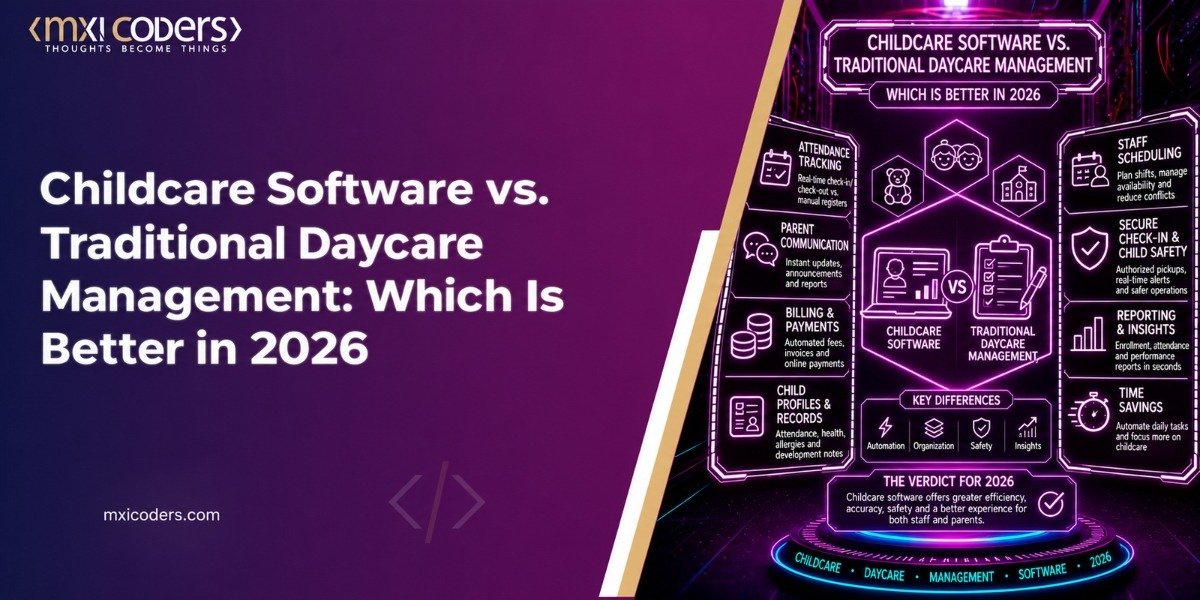
The biggest difference is how information is recorded, accessed, and managed. Traditional systems depend on manual processes, whereas digital platforms centralize information and automate repetitive work.

Comparison areaTraditional managementDigital management
AttendancePaper sign-in sheetsDigital check-in
Staff ratiosManual calculationsReal-time monitoring
BillingManual invoicesAutomated billing
CommunicationCalls and paper notesParent communication apps
Daily reportsHandwritten reportsDigital and AI-assisted reports
EnrollmentPaper applicationsOnline registration
CompliancePhysical recordsDigital documentation
Data securityPhysical file storageDigital security controls
ScalabilityDifficult to expandSupports multiple locations
CostLow initial investmentSubscription fees

View Post↗

➤ Why Are Daycare Centers Switching to Digital Management in 2026?

Childcare operators have increasing responsibilities in terms of running their operations, hiring new people, and dealing with parent expectations. Parents expect regular communication about how their children are doing and what they are up to.

Statistics reveal how big an operation this really is. As per the survey done by the UK government in 2025 on Childcare and Early Years Providers, there were approximately 353,700 paid childcare workers in England. This statistic reflects the size of the operation.

Reducing administrative work for growing businesses makes it possible for workers to give more time to children and families.

➤ What Is AI Childcare Management Software?

AI-enabled applications are different from conventional automation in that they use AI to organize information, create content, recognize patterns, and aid administrative decision-making processes. The major difference between the two is that AI can comprehend the meaning of information and help to create valuable insights; unlike conventional automation that strictly adheres to predefined protocols.

➥ How Does an AI Daily Report Generator for Daycare Work?

The tool developed to make reporting by the teacher easier on a day-to-day basis will work as follows:

  • Teachers will input information about meals, sleep, activities, and the children’s mood.
  • This information is processed by AI into comprehensible reports.
  • The teachers check and correct the information generated.
  • Corrected reports are sent to the parents.
  • Reports are stored for future use.

All responsibility for checking reports before distributing them lies with the teacher.

➥ Other Practical AI Applications in Daycare Software

  • Staffing forecasts: Identify possible scheduling and attendance trends.
  • Developmental summaries: Develop teacher observation notes.
  • Billing alerts: Aid in payment reminders.
  • Parental correspondence: Assist in crafting responses.
  • Administrative material: Develop newsletters and other updates.

➥ Limitations of AI in Childcare Management

Limitations of AI that should be understood by providers include:

  • Teachers will need to validate AI generated content.
  • Unfinished observation records will result in incorrect data analysis.
  • Information on children needs strict security protections.
  • Artificial intelligence cannot replace human monitoring, support, or judgment.

➤ How Much Time Can Daycare Software Save?

Administrative time savings depend on the center’s size, reporting requirements, and existing processes. Consider a hypothetical daycare with 60 children.

ActivityManual ReportingAI Assisted Reporting
Reports per day6060
Time per report3 minutes1 minute
Total daily time180 minutes60 minute
Time saved–120 minutes

Under these assumptions, the center saves two staff hours daily. Over 22 operating days, that represents approximately 44 hours monthly.

These are illustrative calculations, not verified customer results. Actual savings depend on teacher input, review requirements, and software functionality.

➤ Is Childcare Management Software Safe for Children’s Data?

Sensitive information like names, images, attendance history, medical information, and parent contact information could be stored in children’s records. When picking a platform, protecting the information will be a high priority.

Providers need to consider:

  • Encryption: Protection of information on transit and while storing.
  • Permissions: Only authorized teachers and administrators will be able to access the information.
  • Information about data storage locations and third parties.
  • Procedures for keeping and deleting records.
  • Policies for collecting, using, and sharing information.

The Children’s Online Privacy Protection Act (COPPA) applies to any covered website and online service that are directed to children under 13 or any other covered service with actual knowledge of collecting personal information from children.

FERPA might also be applied to any educational institution receiving money from relevant programs of the US Department of Education. Not every private daycare or preschool is automatically covered.

➤ When Does Traditional Daycare Management Still Make Sense?

Technology is not necessarily required in every childcare business. Some traditional systems might continue to work well for:

  • Home-based daycare services with low numbers of children.
  • Providers that do not require complex attendance and billing procedures.
  • Programs that operate in places where the Internet connectivity is unreliable.
  • Organizations that do not have complicated business management needs.
  • Daycare centers which maintain physical copies of their records as backup plans.

➤ How to Choose the Right Daycare Software

Before choosing the platform, you need to consider these key aspects:

  • Attendance: Is there an ability to track digital attendance?
  • Teacher-student ratios: Are administrators able to track the number of students in classrooms?
  • Billing: Is there an option to generate recurring invoices and pay conveniently?
  • Communication: Is there an ability to keep parents updated?
  • AI reporting: Is it possible to edit and approve automated reports by teachers?
  • Licensing: Is it possible to generate local documents and fulfill all subsidy-related requirements?
  • Security: What are the privacy policies and permissions in the software?
  • Pricing: Are all the subscription costs and other fees clear?
  • Data portability: Is it possible to export all data when changing the vendor?
  • Support: Is there an option for vendor’s assistance during onboarding and staff training?

Ask for a demo and test all key workflows of the software.

➤ Conclusion

The choice of traditional vs. digital childcare management systems will depend on the size, needs, and plans for growth of the childcare company. The former can be useful for a small-scale home-based daycare provider who doesn’t have too many administrative tasks. At the same time, for larger childcare centers, a system of centralized data, automatic invoicing, digitized attendance and faster parental communications can be helpful.

Artificial intelligence in childcare management can also make reporting and other administrative tasks easier and give the teachers an opportunity to concentrate on the kids’ development. Ready to streamline your childcare operation? Request a demo or check out childcare management solutions at MXIcoders.
➤ Sources Used

childcare software vs. traditional daycare management which is better in 2026 (blog image)

Running a daycare center goes far beyond caring for children. The director and administration are required to take care of attendance, schedule employees, receive tuition fees, handle enrollments, maintain all compliance documents, and communicate with parents every single day. The manual handling of these tasks may lead to the accumulation of paperwork and the increase in the probability of mistakes.A more efficient method exists. Childcare management systems assist childcare facilities in placing routine administrative tasks in one digital platform.

However, is the shift to digital daycare management necessary? This guide contrasts traditional and digital management in a daycare center, analyzes crucial features, discusses AI abilities, time savings, pricing, and data security to help childcare facilities make a choice in 2026.

Daycare management through traditional means makes use of paper, Excel sheets, and face-to-face interactions. On the other hand, digital management entails the automation of attendance, payment, enrollment, reports, and communication to parents. Even though the traditional system is applicable to small daycares operating out of homes, the digital approach has more advantages.

➤ What Is Childcare Management Software?

It is an electronic system that assists in managing day to day operations of childcare providers through one system. It facilitates childcare centers, preschools, family daycares, and multi-center providers with organization of children’s records, staff details, billing, attendance, and parent communication.

➥ Key Features of Daycare Software

Some common features are:

  • Electronic attendance: Manage child’s attendance details like check-in and check-out times.
  • Staff-to-children ratio: Facilitate monitoring of classroom capacity and staff-to-children ratio.
  • Billing and payment: Assist in creating invoices and processing tuition payments.
  • Parent communication: Exchange information, announcements, and reminders.
  • Enrollment management: Manage enrollment process, waitlist management.
  • Daily reporting: Report meals, naps, activities, and any incidents.
  • Staff management: Organize scheduling, documentation, and record keeping.

➤ What Is a Traditional Daycare Management System?

In traditional management, there is a need for managing the operations of the childcare facility through hard copies as well as through simple technology. There are still some small facilities that use the traditional management method due to the low cost of entry and simplicity associated with this process.

➥ Common Challenges of Traditional Daycare Management

  • Workload for administration: Teachers and administration take hours to fill in forms.
  • Mistakes in recordkeeping: Errors may be made in manual record keeping.
  • Difficult document handling: Accessing old documents is problematic.
  • Delayed communication: Communication with parents may be delayed.
  • Ratio management: Manually calculating ratios is necessary.
  • Scalability limitations: Scaling up to multiple classrooms is challenging.

➤ Childcare Management Software vs. Traditional Daycare Management: Key Differences

The biggest difference is how information is recorded, accessed, and managed. Traditional systems depend on manual processes, whereas digital platforms centralize information and automate repetitive work.

Comparison areaTraditional managementDigital management
AttendancePaper sign-in sheetsDigital check-in
Staff ratiosManual calculationsReal-time monitoring
BillingManual invoicesAutomated billing
CommunicationCalls and paper notesParent communication apps
Daily reportsHandwritten reportsDigital and AI-assisted reports
EnrollmentPaper applicationsOnline registration
CompliancePhysical recordsDigital documentation
Data securityPhysical file storageDigital security controls
ScalabilityDifficult to expandSupports multiple locations
CostLow initial investmentSubscription fees

View Post↗

➤ Why Are Daycare Centers Switching to Digital Management in 2026?

Childcare operators have increasing responsibilities in terms of running their operations, hiring new people, and dealing with parent expectations. Parents expect regular communication about how their children are doing and what they are up to.

Statistics reveal how big an operation this really is. As per the survey done by the UK government in 2025 on Childcare and Early Years Providers, there were approximately 353,700 paid childcare workers in England. This statistic reflects the size of the operation.

Reducing administrative work for growing businesses makes it possible for workers to give more time to children and families.

➤ What Is AI Childcare Management Software?

AI-enabled applications are different from conventional automation in that they use AI to organize information, create content, recognize patterns, and aid administrative decision-making processes. The major difference between the two is that AI can comprehend the meaning of information and help to create valuable insights; unlike conventional automation that strictly adheres to predefined protocols.

➥ How Does an AI Daily Report Generator for Daycare Work?

The tool developed to make reporting by the teacher easier on a day-to-day basis will work as follows:

  • Teachers will input information about meals, sleep, activities, and the children’s mood.
  • This information is processed by AI into comprehensible reports.
  • The teachers check and correct the information generated.
  • Corrected reports are sent to the parents.
  • Reports are stored for future use.

All responsibility for checking reports before distributing them lies with the teacher.

➥ Other Practical AI Applications in Daycare Software

  • Staffing forecasts: Identify possible scheduling and attendance trends.
  • Developmental summaries: Develop teacher observation notes.
  • Billing alerts: Aid in payment reminders.
  • Parental correspondence: Assist in crafting responses.
  • Administrative material: Develop newsletters and other updates.

➥ Limitations of AI in Childcare Management

Limitations of AI that should be understood by providers include:

  • Teachers will need to validate AI generated content.
  • Unfinished observation records will result in incorrect data analysis.
  • Information on children needs strict security protections.
  • Artificial intelligence cannot replace human monitoring, support, or judgment.

➤ How Much Time Can Daycare Software Save?

Administrative time savings depend on the center’s size, reporting requirements, and existing processes. Consider a hypothetical daycare with 60 children.

ActivityManual ReportingAI Assisted Reporting
Reports per day6060
Time per report3 minutes1 minute
Total daily time180 minutes60 minute
Time saved–120 minutes

Under these assumptions, the center saves two staff hours daily. Over 22 operating days, that represents approximately 44 hours monthly.

These are illustrative calculations, not verified customer results. Actual savings depend on teacher input, review requirements, and software functionality.

➤ Is Childcare Management Software Safe for Children’s Data?

Sensitive information like names, images, attendance history, medical information, and parent contact information could be stored in children’s records. When picking a platform, protecting the information will be a high priority.

Providers need to consider:

  • Encryption: Protection of information on transit and while storing.
  • Permissions: Only authorized teachers and administrators will be able to access the information.
  • Information about data storage locations and third parties.
  • Procedures for keeping and deleting records.
  • Policies for collecting, using, and sharing information.

The Children’s Online Privacy Protection Act (COPPA) applies to any covered website and online service that are directed to children under 13 or any other covered service with actual knowledge of collecting personal information from children.

FERPA might also be applied to any educational institution receiving money from relevant programs of the US Department of Education. Not every private daycare or preschool is automatically covered.

➤ When Does Traditional Daycare Management Still Make Sense?

Technology is not necessarily required in every childcare business. Some traditional systems might continue to work well for:

  • Home-based daycare services with low numbers of children.
  • Providers that do not require complex attendance and billing procedures.
  • Programs that operate in places where the Internet connectivity is unreliable.
  • Organizations that do not have complicated business management needs.
  • Daycare centers which maintain physical copies of their records as backup plans.

➤ How to Choose the Right Daycare Software

Before choosing the platform, you need to consider these key aspects:

  • Attendance: Is there an ability to track digital attendance?
  • Teacher-student ratios: Are administrators able to track the number of students in classrooms?
  • Billing: Is there an option to generate recurring invoices and pay conveniently?
  • Communication: Is there an ability to keep parents updated?
  • AI reporting: Is it possible to edit and approve automated reports by teachers?
  • Licensing: Is it possible to generate local documents and fulfill all subsidy-related requirements?
  • Security: What are the privacy policies and permissions in the software?
  • Pricing: Are all the subscription costs and other fees clear?
  • Data portability: Is it possible to export all data when changing the vendor?
  • Support: Is there an option for vendor’s assistance during onboarding and staff training?

Ask for a demo and test all key workflows of the software.

➤ Conclusion

The choice of traditional vs. digital childcare management systems will depend on the size, needs, and plans for growth of the childcare company. The former can be useful for a small-scale home-based daycare provider who doesn’t have too many administrative tasks. At the same time, for larger childcare centers, a system of centralized data, automatic invoicing, digitized attendance and faster parental communications can be helpful.

Artificial intelligence in childcare management can also make reporting and other administrative tasks easier and give the teachers an opportunity to concentrate on the kids’ development. Ready to streamline your childcare operation? Request a demo or check out childcare management solutions at MXIcoders.

➤ Sources Used

➤ Frequently Asked Questions

What Is the Difference Between a Childcare Management Platform and a Traditional Daycare System?
A digital platform centralizes attendance, billing, enrollment, staff records, and parent communication. Traditional systems rely on paper forms, spreadsheets, manual invoices, and phone calls. Digital platforms generally offer greater efficiency and scalability.
Is Childcare Management Software Worth It for a Small Home Daycare?
Yes, if administrative tasks are taking time away from childcare activities. Small providers can benefit from digital attendance, payment tracking, and parent updates. However, the subscription cost should justify the time saved.
What Is an AI Daily Report Generator for Daycare?
It is an AI-powered tool that converts teacher-entered observations about meals, naps, activities, and moods into structured daily reports. Teachers review and approve the reports before sharing them with parents.
Can AI Replace Daycare Teachers' Paperwork Completely?
No. AI can reduce repetitive documentation and help organize information, but teachers must verify reports, record accurate observations, and maintain essential records.
Is Daycare Software COPPA Compliant?
Not automatically. COPPA compliance depends on how an online service collects, uses, and shares children's personal information and whether the law applies to that service. Providers should verify vendor practices and parental consent procedures.
Can Childcare Software Help With Licensing Inspections?
Yes. Digital platforms can organize attendance records, staff documentation, enrollment information, and incident reports, making it easier to retrieve relevant records during inspections. However, software does not guarantee compliance with licensing requirements.

Feel free to Connect us on

Ready to transform your business with smart software solutions?

Harness the power of custom software development to streamline operations, reduce costs, and boost efficiency. Start by exploring cutting-edge approaches like cloud-native platforms, API-first architecture, and AI-driven automation to future-proof your systems and stay ahead of the competition.

Book free consultation

Let’s build your idea together and serve society.

Author

Ashok Rathod

Tech Consultant

Experience
25 Years
Growth Architect for Startups & SMEs | Blockchain, AI , MVP Development, & Data-Driven Marketing Expert.

Transform the Carbon Credit Industry

Build a Transparent, Scalable Carbon Credit Marketplace with Blockchain.