[ Your Headline ] [ Highlight Word ]

[ One or two lines describing the offer — e.g. "Experience our services with a FREE 30-minute consultation." ]

[ Optional second line, e.g. "Have a concept in mind? Let's brainstorm together!" ]

Google ★★★★★ 4.8
GoodFirms ★★★★★ 4.7
Clutch ★★★★★ 5.0
Crypto Exchange

How to Build a P2P Crypto Exchange Platform

Ashok Rathod

Tech Consultant

Posted on
2nd Oct 2026
7 min
Read
Share

Table of Contents

  • Quick Tips
  • Familiarize yourself with Cash App
  • Enable two-factor authentication
  • Utilize the optional Cash App
  • Conclusion

A P2P crypto exchange enables buyers and sellers to trade cryptocurrency directly with each other while the platform provides the technology, escrow, payment options, security controls, and dispute-management tools needed to complete transactions. Building such a platform requires more than creating a trading interface. Businesses need to plan the marketplace model, wallet infrastructure, escrow process, KYC and AML controls, payment integrations, security architecture, and regulatory requirements before launch.

This guide explains how a P2P crypto exchange works, its essential features, the development process, and the major factors affecting development cost.

➤ What Is a P2P Crypto Exchange?

A peer-to-peer or P2P crypto exchange is an online marketplace where users can buy and sell cryptocurrencies directly with other users. Instead of relying entirely on a traditional exchange order book, sellers can create offers specifying details such as:

  • Cryptocurrency
  • Price
  • Minimum and maximum trade amount
  • Accepted payment method
  • Payment deadline
  • Trading conditions

Buyers can search these listings and select an offer that meets their requirements.

The platform typically acts as an intermediary by providing identity verification, escrow, ratings, transaction monitoring, notifications, and dispute resolution.

Escrow is particularly important. Once a trade begins, the seller’s cryptocurrency can be temporarily locked until the required payment conditions are satisfied. This reduces the possibility of either party completing their side of the transaction without the other fulfilling theirs.

➤ How Does a P2P Crypto Exchange Work?

The exact workflow varies between platforms, but a typical transaction follows seven steps:

  1. A user registers and completes the required identity verification.
  2. A seller creates an offer specifying price, cryptocurrency, limits, and payment methods.
  3. A buyer searches available offers and selects one.
  4. The required cryptocurrency is secured through the platform’s escrow mechanism.
  5. The buyer sends fiat payment using the agreed payment method.
  6. The seller verifies that the payment has been received.
  7. The cryptocurrency is released to the buyer.

If either party reports a problem, the platform’s dispute-management process may temporarily prevent the assets from being released while administrators examine available transaction evidence.

➤ Essential Features of a P2P Crypto Exchange

A reliable P2P marketplace requires several connected systems.

➥ User Registration and KYC

The platform should support account creation, identity verification, login security, user-risk checks, and account-management controls. AML and transaction-monitoring requirements should also be considered according to the jurisdictions in which the platform operates. FATF’s July 2026 update continues to highlight the importance of risk-based regulation and supervision of virtual assets and virtual asset service providers.

➥ Crypto Wallet

Users need secure cryptocurrency wallet functionality for deposits, withdrawals, and trading. Depending on the operating model, businesses may implement custodial wallets, external-wallet connectivity, or a combination of both.

➥ P2P Trading Marketplace

Users should be able to create, browse, modify, pause, and accept offers. Important information such as rates, transaction limits, payment methods, and trader history should be clearly displayed.

➥ Escrow System

The escrow mechanism protects both sides of a transaction by holding the relevant crypto while payment is completed and verified.

➥ Multiple Payment Methods

Depending on the market, users may require bank transfers, digital payment services, mobile payments, or other supported payment channels.

➥ Search and Offer Filtering

Filters can help users find suitable offers based on cryptocurrency, currency, transaction amount, payment method, price, and trader rating.

➥ Ratings and Reviews

A reputation system allows users to evaluate trading counterparties based on previous transactions and feedback.

➥ Dispute Resolution

The system should allow either participant to raise a dispute and provide supporting information for administrator review. Other important components include real-time notifications, an admin dashboard, transaction history, audit logs, fraud detection, withdrawal controls, and security monitoring.

➤ What Does It Mean to Start a P2P Crypto Exchange?

Starting an exchange means establishing both the technology and operating framework required to run a cryptocurrency marketplace. The first step is identifying the target market. Businesses should understand which users they intend to serve, which fiat currencies and cryptocurrencies will be supported, and which payment methods are commonly used.

The revenue model must also be defined. Possible models include trading fees, withdrawal fees, listing-related charges, or premium marketplace services.

Businesses should determine whether they want a standalone marketplace or functionality that could eventually connect with a multi-exchange crypto trading platform or other liquidity infrastructure. Regulatory analysis is equally important. Requirements differ significantly between jurisdictions and may include licensing or registration, AML controls, customer identification, sanctions screening, transaction reporting, and record keeping. For example, the European Union’s MiCA framework establishes requirements for covered crypto-asset service providers.

Legal and compliance specialists should therefore review the proposed business model before development and launch.

➤ Step-by-Step Process to Start a P2P Crypto Exchange

1. Define the Business Model

Identify target countries, users, supported currencies, transaction types, payment methods, fee structures, and revenue sources.

2. Plan the Platform Features

Document the complete user journey and define requirements for registration, KYC, wallets, marketplace listings, escrow, disputes, ratings, notifications, and administration.

3. Choose Blockchain and Technology

Select supported blockchain networks and define the backend, frontend, database, wallet, API, cloud, and monitoring architecture.

Blockchain provides a distributed, cryptographically linked transaction ledger, but the exchange still requires secure application infrastructure around it.

4. Develop Wallet, Escrow and Trading Systems

Build wallet functionality, transaction workflows, offer creation, order management, escrow controls, wallet reconciliation, and cryptocurrency deposit and withdrawal systems. For businesses researching a p2p crypto exchange platform, these transaction components are among the most critical parts of the architecture.

5. Integrate Payment Methods

Connect the required fiat payment options and create processes for users to confirm payments without exposing unnecessary financial information.

6. Implement Security and Compliance

Security measures may include:

  • Multi-factor authentication
  • Encryption
  • Secure key management
  • Withdrawal controls
  • Rate limiting
  • Device and session monitoring
  • Transaction-risk detection
  • Audit logs
  • API access controls

API security is particularly important because exchanges often depend heavily on internal and third-party APIs. OWASP identifies risks including broken authentication, authorization failures, security misconfiguration, and unsafe API consumption.

7. Test and Launch the Platform

Conduct functional, integration, security, wallet, payment, performance, and user-acceptance testing before production deployment.

8. Monitor, Maintain and Scale

After launch, monitor transaction failures, suspicious activity, liquidity, wallet balances, disputes, platform performance, API availability, and security events.

➤ How Much Does It Cost to Build a P2P Crypto Exchange?

There is no universal development cost because the final budget depends on the platform’s scope and operating requirements.

Major cost factors include:

  • Number of cryptocurrencies and blockchain networks
  • Custodial or non-custodial wallet architecture
  • Escrow complexity
  • Number of fiat payment integrations
  • KYC and AML integrations
  • Web and mobile applications
  • Security requirements
  • Admin and dispute-management features
  • Third-party APIs
  • Custom reporting and analytics
  • Infrastructure and ongoing maintenance

A basic MVP usually requires fewer integrations and trading functions, while a multi-region exchange with several blockchain networks, payment methods, advanced security controls, and compliance integrations requires considerably more development and testing.

➤ Conclusion

Building a P2P crypto exchange requires careful coordination between marketplace development, wallet infrastructure, escrow, payment processing, security, compliance, transaction monitoring, and user-support systems. Businesses should define their target market and regulatory obligations before choosing the technology stack or beginning development. Security testing and compliance should also be treated as continuous processes rather than one-time launch activities.

For businesses evaluating P2P Crypto Exchange Development Services, MXICoders can be considered when assessing development options for building and integrating a P2P exchange solution based on specific technical and operational requirements.

➤ Sources Used

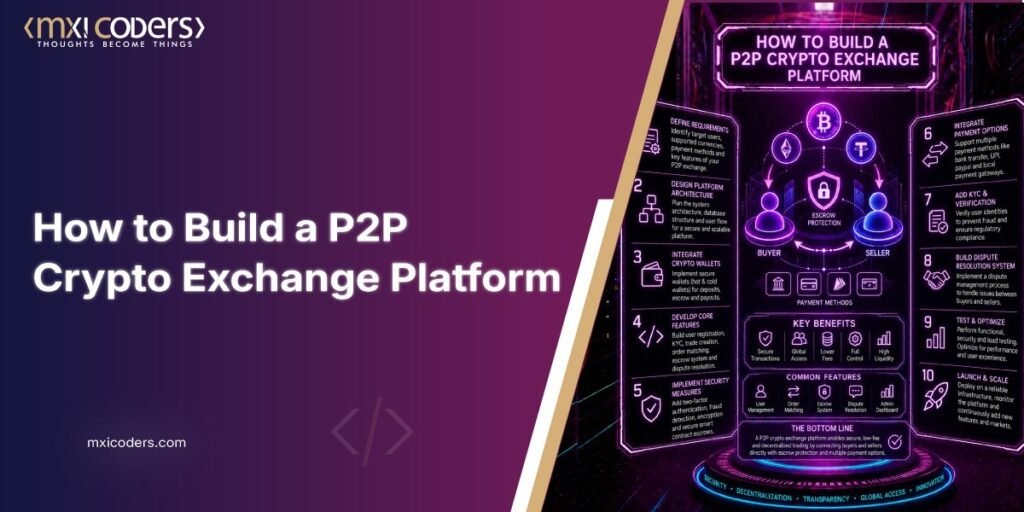
how to build a p2p crypto exchange platform (blog image)

A P2P crypto exchange enables buyers and sellers to trade cryptocurrency directly with each other while the platform provides the technology, escrow, payment options, security controls, and dispute-management tools needed to complete transactions. Building such a platform requires more than creating a trading interface. Businesses need to plan the marketplace model, wallet infrastructure, escrow process, KYC and AML controls, payment integrations, security architecture, and regulatory requirements before launch.

This guide explains how a P2P crypto exchange works, its essential features, the development process, and the major factors affecting development cost.

➤ What Is a P2P Crypto Exchange?

A peer-to-peer or P2P crypto exchange is an online marketplace where users can buy and sell cryptocurrencies directly with other users. Instead of relying entirely on a traditional exchange order book, sellers can create offers specifying details such as:

  • Cryptocurrency
  • Price
  • Minimum and maximum trade amount
  • Accepted payment method
  • Payment deadline
  • Trading conditions

Buyers can search these listings and select an offer that meets their requirements.

The platform typically acts as an intermediary by providing identity verification, escrow, ratings, transaction monitoring, notifications, and dispute resolution.

Escrow is particularly important. Once a trade begins, the seller’s cryptocurrency can be temporarily locked until the required payment conditions are satisfied. This reduces the possibility of either party completing their side of the transaction without the other fulfilling theirs.

➤ How Does a P2P Crypto Exchange Work?

The exact workflow varies between platforms, but a typical transaction follows seven steps:

  1. A user registers and completes the required identity verification.
  2. A seller creates an offer specifying price, cryptocurrency, limits, and payment methods.
  3. A buyer searches available offers and selects one.
  4. The required cryptocurrency is secured through the platform’s escrow mechanism.
  5. The buyer sends fiat payment using the agreed payment method.
  6. The seller verifies that the payment has been received.
  7. The cryptocurrency is released to the buyer.

If either party reports a problem, the platform’s dispute-management process may temporarily prevent the assets from being released while administrators examine available transaction evidence.

➤ Essential Features of a P2P Crypto Exchange

A reliable P2P marketplace requires several connected systems.

➥ User Registration and KYC

The platform should support account creation, identity verification, login security, user-risk checks, and account-management controls. AML and transaction-monitoring requirements should also be considered according to the jurisdictions in which the platform operates. FATF’s July 2026 update continues to highlight the importance of risk-based regulation and supervision of virtual assets and virtual asset service providers.

➥ Crypto Wallet

Users need secure cryptocurrency wallet functionality for deposits, withdrawals, and trading. Depending on the operating model, businesses may implement custodial wallets, external-wallet connectivity, or a combination of both.

➥ P2P Trading Marketplace

Users should be able to create, browse, modify, pause, and accept offers. Important information such as rates, transaction limits, payment methods, and trader history should be clearly displayed.

➥ Escrow System

The escrow mechanism protects both sides of a transaction by holding the relevant crypto while payment is completed and verified.

➥ Multiple Payment Methods

Depending on the market, users may require bank transfers, digital payment services, mobile payments, or other supported payment channels.

➥ Search and Offer Filtering

Filters can help users find suitable offers based on cryptocurrency, currency, transaction amount, payment method, price, and trader rating.

➥ Ratings and Reviews

A reputation system allows users to evaluate trading counterparties based on previous transactions and feedback.

➥ Dispute Resolution

The system should allow either participant to raise a dispute and provide supporting information for administrator review. Other important components include real-time notifications, an admin dashboard, transaction history, audit logs, fraud detection, withdrawal controls, and security monitoring.

➤ What Does It Mean to Start a P2P Crypto Exchange?

Starting an exchange means establishing both the technology and operating framework required to run a cryptocurrency marketplace. The first step is identifying the target market. Businesses should understand which users they intend to serve, which fiat currencies and cryptocurrencies will be supported, and which payment methods are commonly used.

The revenue model must also be defined. Possible models include trading fees, withdrawal fees, listing-related charges, or premium marketplace services.

Businesses should determine whether they want a standalone marketplace or functionality that could eventually connect with a multi-exchange crypto trading platform or other liquidity infrastructure. Regulatory analysis is equally important. Requirements differ significantly between jurisdictions and may include licensing or registration, AML controls, customer identification, sanctions screening, transaction reporting, and record keeping. For example, the European Union’s MiCA framework establishes requirements for covered crypto-asset service providers.

Legal and compliance specialists should therefore review the proposed business model before development and launch.

➤ Step-by-Step Process to Start a P2P Crypto Exchange

1. Define the Business Model

Identify target countries, users, supported currencies, transaction types, payment methods, fee structures, and revenue sources.

2. Plan the Platform Features

Document the complete user journey and define requirements for registration, KYC, wallets, marketplace listings, escrow, disputes, ratings, notifications, and administration.

3. Choose Blockchain and Technology

Select supported blockchain networks and define the backend, frontend, database, wallet, API, cloud, and monitoring architecture.

Blockchain provides a distributed, cryptographically linked transaction ledger, but the exchange still requires secure application infrastructure around it.

4. Develop Wallet, Escrow and Trading Systems

Build wallet functionality, transaction workflows, offer creation, order management, escrow controls, wallet reconciliation, and cryptocurrency deposit and withdrawal systems. For businesses researching a p2p crypto exchange platform, these transaction components are among the most critical parts of the architecture.

5. Integrate Payment Methods

Connect the required fiat payment options and create processes for users to confirm payments without exposing unnecessary financial information.

6. Implement Security and Compliance

Security measures may include:

  • Multi-factor authentication
  • Encryption
  • Secure key management
  • Withdrawal controls
  • Rate limiting
  • Device and session monitoring
  • Transaction-risk detection
  • Audit logs
  • API access controls

API security is particularly important because exchanges often depend heavily on internal and third-party APIs. OWASP identifies risks including broken authentication, authorization failures, security misconfiguration, and unsafe API consumption.

7. Test and Launch the Platform

Conduct functional, integration, security, wallet, payment, performance, and user-acceptance testing before production deployment.

8. Monitor, Maintain and Scale

After launch, monitor transaction failures, suspicious activity, liquidity, wallet balances, disputes, platform performance, API availability, and security events.

➤ How Much Does It Cost to Build a P2P Crypto Exchange?

There is no universal development cost because the final budget depends on the platform’s scope and operating requirements.

Major cost factors include:

  • Number of cryptocurrencies and blockchain networks
  • Custodial or non-custodial wallet architecture
  • Escrow complexity
  • Number of fiat payment integrations
  • KYC and AML integrations
  • Web and mobile applications
  • Security requirements
  • Admin and dispute-management features
  • Third-party APIs
  • Custom reporting and analytics
  • Infrastructure and ongoing maintenance

A basic MVP usually requires fewer integrations and trading functions, while a multi-region exchange with several blockchain networks, payment methods, advanced security controls, and compliance integrations requires considerably more development and testing.

➤ Conclusion

Building a P2P crypto exchange requires careful coordination between marketplace development, wallet infrastructure, escrow, payment processing, security, compliance, transaction monitoring, and user-support systems. Businesses should define their target market and regulatory obligations before choosing the technology stack or beginning development. Security testing and compliance should also be treated as continuous processes rather than one-time launch activities.

For businesses evaluating P2P Crypto Exchange Development Services, MXICoders can be considered when assessing development options for building and integrating a P2P exchange solution based on specific technical and operational requirements.

➤ Sources Used

➤ Frequently Asked Questions

Is escrow necessary for a P2P crypto exchange?
Escrow is one of the most important mechanisms for reducing counterparty risk in P2P transactions. It temporarily secures cryptocurrency while the buyer completes the agreed payment.
Does a P2P crypto exchange need KYC?
KYC requirements depend on the exchange's operating model and jurisdiction. Businesses should determine applicable licensing, AML, KYC, sanctions, and reporting requirements before launching.
How long does it take to develop a P2P crypto exchange?
Development time varies according to features, supported blockchain networks, payment integrations, security requirements, mobile applications, and compliance systems.
Can multiple cryptocurrencies be supported?
Yes. A P2P exchange can support multiple crypto assets, provided the required blockchain nodes, wallet architecture, transaction monitoring, deposit processing, and withdrawal systems are integrated correctly.
How does a P2P exchange make money?
Common revenue models can include transaction fees, withdrawal charges, marketplace services, or other platform fees permitted under the applicable business and regulatory framework.

Get In Touch

Get thoughtful updates on what’s new in technology and innovation

Feel free to Connect us on

Ready to transform your business with smart software solutions?

Harness the power of custom software development to streamline operations, reduce costs, and boost efficiency. Start by exploring cutting-edge approaches like cloud-native platforms, API-first architecture, and AI-driven automation to future-proof your systems and stay ahead of the competition.

Book free consultation

Let’s build your idea together and serve society.

Author

Ashok Rathod

Tech Consultant

Experience
25 Years
Growth Architect for Startups & SMEs | Blockchain, AI , MVP Development, & Data-Driven Marketing Expert.

Transform the Carbon Credit Industry

Build a Transparent, Scalable Carbon Credit Marketplace with Blockchain.

Let's build something real!

Share your ideas with us and we’ll turn them into powerful digital solutions.

500+

Projects

25+

Experience

255+

Clients

Tell us about your project

Our team will get back to you within 24 hours