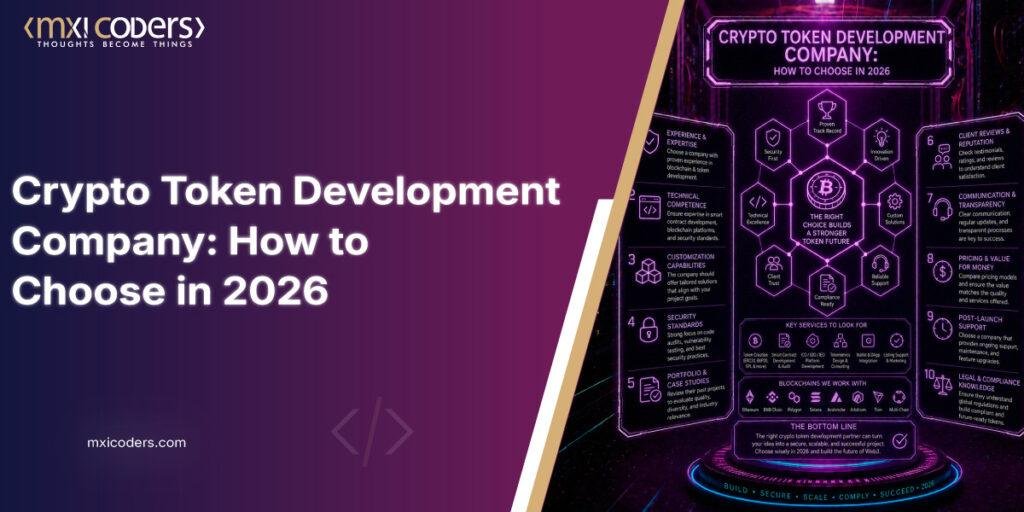
Choosing a crypto token development company comes down to five checks: clear tokenomics, a verifiable smart contract audit history, real multi-chain engineering depth, current regulatory awareness, and a transparent, itemized cost breakdown. Skip any one of these and you’re not saving money, you’re gambling with your project’s security and its legal standing.
The token market backs that up. The global blockchain technology market is valued at $54.08 billion in 2026 and is forecast to grow at a 62.4% compound annual rate, reaching $610.96 billion by 2031, according to MarketsandMarkets. Tokenized real world assets are following the same curve: Fortune Business Insights puts the global tokenization market at $4.07 billion in 2026, growing to $15.9 billion by 2034. More capital flowing into tokens means more low quality vendors trying to catch the wave, which makes vetting harder, not easier.
➤ What Should You Define Before You Talk to a Development Company?
Before you request a single quote, you need clarity on three things: your token’s core utility, its distribution and vesting structure, and the blockchain you’ll deploy on. These three decisions shape the smart contract’s complexity, which regulatory bucket your token falls into, and your total development cost, so they come first, not last.
- Token type and utility. A Utility token grants access to a product or service. A Governance token gives holders voting rights over protocol decisions. A Security token represents a regulated, equity-like claim. Under the EU’s Markets in Crypto-Assets Regulation, Regulation (EU) 2023/1114, utility tokens and governance tokens generally fall under the “other crypto-assets” bucket, separate from asset-referenced tokens pegged to non-fiat assets and e-money tokens pegged to a single fiat currency, as this 2026 MiCA and tokenized RWA breakdown explains, and that classification changes what disclosures you owe.
- Distribution and vesting. A written vesting schedule for founders and early backers, enforced directly in the smart contract, is what stops a sudden token dump from tanking the price on day one.
- Blockchain selection. Ethereum still carries the deepest liquidity and developer tooling. Solana, BNB Chain, and Polygon trade some of that for lower fees and faster finality. Get real numbers from your vendor on gas costs at your expected transaction volume before you commit to a chain.
| Option | Mechanism | Best fit | Trade-off |
| Utility token | Grants access to a product or service function | Apps, platforms, in-game economies | Regulatory grey area in several jurisdictions |
| Governance token | Token-weighted or vote-escrowed voting rights | DAOs and DeFi protocols wanting community input | Turnout is typically low and voting power concentrates in few wallets |
| Security token | Represents a regulated, equity-like ownership claim | Real estate, funds, revenue-sharing deals | Heaviest compliance load, often needs licensed intermediaries |
| Stablecoin (ART/EMT) | Pegged to fiat currency or a basket of assets | Payments, remittances, treasury management | Requires formal MiCA authorization and reserve audits in the EU |
➤ How Do You Judge a Team’s Real Blockchain Expertise?
Look for engineers who are fluent in Solidity for EVM chains and Rust for Solana, not just familiar with them. Ask how they keep up with network upgrades, and ask for concrete examples of gas optimization work, since poorly written contracts can waste real money on every single transaction. If your roadmap includes moving value between chains, ask specifically about their experience securing cross-chain bridges. Bridges are consistently one of the highest-risk components in Web3 architecture, and a developer who has never built one is not the right person to build yours.
➤ What Does a Real Security and Audit Process Look Like?
Security is not a feature you add later, it’s the reason your project survives. The scale of the risk is well documented: total Web3 losses hit $3.35 billion across more than 630 incidents in 2025, a 37% increase over 2024, with the average hack size up 66% year over year to $5.3 million, according to CertiK’s Hack3d 2025 report as summarized by Sherlock. A separate 2026 audit pricing analysis from QuillAudits found roughly $3.1 billion in Web3 losses in the first half of 2025 alone, with about $263 million of that traced directly to smart contract bugs.
That’s why a formal, external audit is non-negotiable, not an in-house checkbox. Expect the following:
- Secure coding standards that explicitly guard against reentrancy attacks, overflow and underflow errors, and unauthorized access.
- A named third-party auditor. Tier-one firms such as OpenZeppelin, Trail of Bits, and CertiK typically charge $30,000 to $200,000 for enterprise engagements, while mid-tier firms usually quote $15,000 to $70,000, per QuillAudits‘ 2026 pricing breakdown. Market-wide, Sherlock’s 2026 audit pricing reference puts the full range at $5,000 for a simple token contract up to more than $250,000 for enterprise-grade, multi-chain systems, with most DeFi audits landing between $25,000 and $100,000.
- A public, anonymized report you can actually read, not just a badge.
- Post-audit remediation, including at least one re-audit pass after fixes, which most market pricing puts at an additional $5,000 to $20,000.
- Infrastructure safeguards beyond the contract itself, including multi-signature treasury wallets and active transaction monitoring after launch.
One anonymized project we worked with came to us after a template vendor shipped a governance token whose voting logic simply couldn’t talk to the external voting platform the client needed. Months of patching later, the client asked us to rebuild the contract from scratch. We redesigned the logic to integrate cleanly with their existing dApp and migrated the token without disrupting holders. The lesson holds across the industry, not just for us: a cheap contract that has to be rewritten always costs more than the audit would have.
➤ Why Does Custom Development Beat a Template?
A template contract is fine for a quick experiment. It’s the wrong choice for anything with real funding or a long roadmap. Custom development gets you unique logic, such as burn-and-redistribute tax functions or specific price oracle integrations, plus upgradability through proxy patterns so you can patch bugs without forcing every holder onto a new contract. It also gets you an architecture built to handle real transaction volume rather than one that starts breaking the moment adoption takes off.
➤ How Do 2026 Regulations Affect Token Development?
The regulatory picture has moved a lot since 2025, and a development partner who can’t speak to it specifically is a red flag.
In the EU, MiCA’s full Crypto-Asset Service Provider authorization regime has been phasing in since December 2024, and the EU-wide transitional period for firms operating under national law closed on July 1, 2026, according to CEX.IO University’s 2026 MiCA explainer. From that date, only providers with actual MiCA authorization can legally serve EU clients, and ESMA has warned that user protections now depend on the specific licensed entity involved.
In the US, the picture has also clarified considerably. A joint SEC and CFTC ruling on March 17, 2026 classified 16 cryptocurrencies, including Bitcoin, Ethereum, and XRP, as digital commodities, as covered in this 2026 US/EU regulation comparison, and the two agencies followed that with a broader joint interpretive release establishing a five-category taxonomy: digital commodities, digital collectibles, digital tools, stablecoins, and digital securities, per WEEX’s April 2026 regulatory roundup. Ask any prospective vendor which of these five categories your token is likely to fall into and why. A vague answer is disqualifying.
If your token is meant to carry governance rights, be realistic about what that actually delivers. Concentration is the industry norm, not the exception: as Forbes reported in April 2026, less than 1% of token holders control roughly 90% of voting power across DAOs, and voter participation typically falls between 5% and 15% of eligible holders, even as DAOs collectively manage more than $25 billion in treasury assets. A competent partner should design your governance mechanics around that reality, for example through delegation or vote-escrow, rather than pretending every holder will show up to vote.
➤ How Do You Vet a Company’s Portfolio and Reputation?
Go past the logos on the homepage. Ask for the mainnet contract address of a past project and check it yourself on a block explorer such as Etherscan for real transaction volume and creation date. Ask for a public audit report, not a summary slide. Watch for a few specific red flags: a portfolio of only vague “a major exchange” style clients with no verification link, a track record still anchored in the 2017 to 2018 ICO era, or a quote so low it implies unaudited, off-the-shelf code.
➤ What Should You Expect From Communication and Post-Launch Support?
A serious vendor will show you their process before you sign anything: tokenomics consultation, smart contract development, testing, external audit, then deployment, each as a distinct milestone with its own timeline. You should get direct access to the engineers actually writing your contract, not only a sales contact, and a written commitment to post-launch support, typically six to twelve months, covering bug fixes and security monitoring after the token is live.
➤ What Does Crypto Token Development Actually Cost in 2026?
Cost scales almost entirely with complexity and audit scope, not with lines of code. A basic ERC-20 or BEP-20 token with no custom mechanics typically runs from a few thousand dollars up through the low tens of thousands, depending on the network’s gas fees at deployment time, per Comfygen’s 2026 ERC-20 cost breakdown. A more complete build with custom tokenomics, staking, vesting, and multi-chain support tends to fall in the $10,000 to $70,000 range, depending on the specific functionality and compliance needs for that token type, according to this 2026 enterprise token development cost analysis. On top of that, budget a separate line item for the audit itself, which as noted above can run from roughly $5,000 for a simple contract to well over $100,000 for a complex, multi-chain protocol.
Ask any vendor for an itemized quote broken into consultation and tokenomics design, smart contract coding, the third-party audit as its own line, deployment and gas fees, and post-launch support. A single lump-sum number with no breakdown is itself a warning sign.
➤ Limitations and Industry Challenges
Pricing bands for both development and audits move quickly and vary by chain, codebase size, and firm, so treat every figure above as a benchmark to negotiate from rather than a fixed quote. Regulatory classification is also genuinely unsettled in places: US token taxonomy only firmed up in 2026, and MiCA guidance on how governance tokens specifically should be treated is still evolving alongside it. Anyone, including this guide, who claims total certainty on either point is overstating it.
➤ Frequently asked questions
- How much does a crypto token development company charge for a basic ERC-20 token in 2026? A basic, template-style ERC-20 or BEP-20 build typically costs a few thousand dollars up to around ten thousand, largely driven by gas fees on the network at deployment time. Custom builds with staking, vesting, or multi-chain support run higher, generally in the $10,000 to $70,000 range, and that figure still excludes the audit.
- Is a smart contract audit really worth a separate $20,000 or more? Given that Web3 lost $3.35 billion across 630-plus incidents in 2025 alone, and that a large share of that came from contract-level bugs, yes. A $20,000 to $70,000 audit from a recognized firm is cheap relative to the cost of a single successful exploit, and it’s also what serious investors and exchanges expect to see before they’ll engage.
- Do I need a governance token if I’m building a DAO? Not automatically. Governance tokens work best when you have a real, engaged community and a plan for the low turnout that affects almost every DAO. If you don’t have both, a governance token can end up as pure speculation with no functional upside, which creates its own reputational and regulatory exposure.
- Does it matter whether my development company is based in my own country? Less than most founders assume. Web3 development is a remote-native industry, and the strongest teams are often concentrated in a handful of global hubs. Verifiable audit history, live contract addresses, and clear communication matter far more than physical location.
➤ Conclusion
Picking a crypto token development company is really a security and compliance decision wearing a hiring decision’s clothes. Get the tokenomics right first, then insist on a named third-party audit with a public report, confirm the team can speak specifically to how current EU and US rules apply to your token type, and get pricing broken into real line items instead of one number. None of that is expensive relative to what a rushed, unaudited launch can cost you.
Ready to plan your token launch? Contact Mxicoders for a strategy session covering tokenomics, security audits, and deployment across Ethereum, Solana, and other chains. You can also read more on smart contract development and blockchain consulting on the Mxicoders site.
➤ Sources Used
- Sherlock, “Top 10 Best Smart Contract Auditing Companies in 2026″ (CertiK Hack3d 2025 data)
- QuillAudits, “What Is the Price of a Smart Contract Audit in 2026?”
- Sherlock, “Smart Contract Audit Pricing: A Market Reference for 2026″
- CEX.IO University, “MiCA Regulation Explained: EU Crypto Rules for 2026″
- MiCA and Tokenized RWAs 2026 guide (Regulation (EU) 2023/1114 classification)
- Blockchain Council, “2026 US vs EU Crypto Regulation Guide: MiCA vs SEC”
- WEEX Crypto News, “Crypto Regulation News 2026: SEC-CFTC Framework, GENIUS Act, and MiCA 2 Coming”
- Forbes, “DAOs Keep Centralizing, Decades Of Governance Research Explain Why”
- MarketsandMarkets, “Blockchain Market Report 2026-2031″
- Fortune Business Insights, “Tokenization Market Size, Share, Forecast”
- Comfygen, “ERC-20 Token Creation Cost in 2026 — Full Breakdown & Guide”
- DEV Community, “The Real Cost of Token Development for Enterprises in 2026″