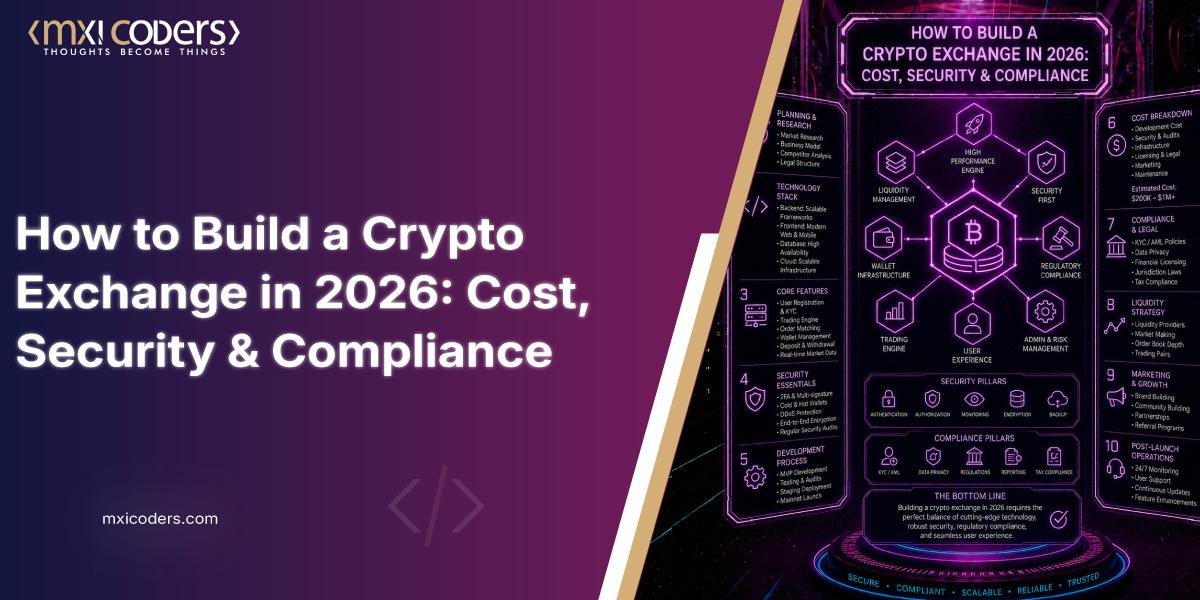
Building a crypto exchange in 2026 can cost anywhere from roughly $8,000 for a white label script to $80,000 or more for a custom build from scratch, before you add compliance, licensing, and ongoing security spend. The right choice depends less on your budget ceiling and more on how much control you need over the matching engine, wallet architecture, and regulatory footprint.
➤ How much does it cost to build a crypto exchange in 2026?
A cryptocurrency exchange script, essentially a pre-built platform you customize and rebrand, typically runs between $8,000 and $14,000, according to DappFort’s 2026 cost breakdown. Building from scratch, where you own the full codebase and design, averages around $80,000 and up, and can run well into six figures once you add a custom matching engine, multi-jurisdiction licensing, and SOC 2 style audits.
That range is wider than it used to be. Antier’s 2026 crypto exchange development report notes that AI has cut the cost of exploiting a smart contract to roughly $1.22 per attempt for well-resourced attackers, which pushes serious builders to spend more on AI-assisted threat detection and MPC wallet architecture than they would have two years ago. A quote that looks identical to what the same vendor offered in 2024 is worth questioning.
| Option | Mechanism | Best fit | Trade-off |
| Exchange script | Pre-built codebase, rebranded and configured | Founders who need to launch fast and validate demand | Limited customization, shared codebase with other clients |
| White label platform | Licensed infrastructure with your branding layered on top | Businesses entering a specific market or niche quickly | Ongoing licensing fees, less control over the roadmap |
| Custom build | Fully owned architecture, built to your specification | Platforms targeting institutional volume or multi-jurisdiction compliance | Longer timeline (typically three to nine months) and higher upfront cost |
➤ What security architecture actually protects a crypto trading platform?
No single wallet type protects a crypto trading platform on its own. The standard approach splits funds across hot wallets for liquidity, cold storage for the bulk of assets, and Multi-Party Computation wallets to move funds between the two without a single point of failure.
Security failures remain the dominant cause of catastrophic loss in this industry, and the scale keeps growing. Chainalysis’s 2026 Crypto Crime Report recorded roughly $3.4 billion stolen from crypto services between January and early December 2025, with a single incident, the February 2025 Bybit breach, accounting for close to $1.5 billion of that on its own. The FBI’s Internet Crime Complaint Center logged 181,565 crypto-related fraud complaints in 2025 totaling $11.366 billion in reported losses, a 22% increase year over year, per the FBI IC3 2025 Internet Crime Report.
A few practices show up consistently across platforms that avoid becoming the next headline:
- Hardware Security Modules. Purpose-built devices that generate and store private keys in a tamper-resistant environment, so a compromised server doesn’t expose the keys themselves.
- Multi-signature treasury controls. Requiring more than one authorized signer for large withdrawals, which blocks a single compromised credential from draining funds.
- Independent security audits. Regular, third-party penetration testing rather than a one-time review before launch.
- Least-privilege access. Limiting internal staff access to only the systems their role requires, which narrows the blast radius of an insider threat or a phished credential.
➤ How does smart order routing work on a crypto exchange?
Smart order routing (SOR) is the system that splits a large trade across multiple liquidity venues in real time so the trader gets the best available price instead of moving the market against themselves. It works in three steps: the system continuously monitors pricing and depth across connected liquidity sources, it breaks a large order into smaller pieces and routes each piece to whichever venue offers the best price at that moment, then it aggregates the fills and presents them to the user as one completed trade.
The engineering challenge isn’t the concept, it’s the plumbing underneath it. SOR depends on stable, low-latency data feeds from every connected liquidity provider, which usually means WebSocket connections for live pricing and an in-memory store like Redis to avoid the latency of hitting a disk-based database on every price check. If one liquidity source lags or drops, the router needs to fail over without ever letting the user see a stale price.
➤ Should you build a crypto exchange from a script, or from scratch?
Most first-time exchange founders should start with a script or white label platform, and move to a custom build only once trading volume justifies the added cost of owning the matching engine outright. A clone script gets a functional trading platform live in weeks rather than months, which matters most when the goal is validating demand before committing six figures.
Custom development earns its cost once you need something a template genuinely can’t offer, such as a proprietary matching engine tuned for a specific asset class, or compliance architecture built around a jurisdiction the standard scripts don’t support. Independent 2026 pricing guides put fully custom, regulator-ready builds anywhere from the low hundreds of thousands into the low millions depending on licensing scope, which is a different budget conversation than a script entirely.
➤ What compliance requirements apply to a crypto exchange in 2026?
Compliance now determines where you can operate before it determines how you operate. In the EU, MiCA’s Crypto-Asset Service Provider rules have been in force since December 2024, and authorization from one national regulator now lets a platform passport across all 27 member states, per the Blockchain Council’s 2026 MiCA guide. Minimum capital requirements start at €150,000 for exchange platforms specifically.
In the United States, a joint SEC and CFTC ruling on March 17, 2026 classified 16 major cryptocurrencies, including Bitcoin and Ethereum, as digital commodities, giving exchanges clearer jurisdictional footing, according to the same Blockchain Council analysis. A broader U.S. market structure bill aimed at permanently resolving SEC/CFTC overlap was still moving through Senate hearings as of early 2026, with industry estimates putting its odds of passing before the November 2026 midterms at roughly 50 to 60%, per DL News. That uncertainty is a real planning variable, not a footnote: building compliance architecture around today’s rules while staying adaptable to a bill that could pass mid-year is now a standard part of the technical roadmap, not just a legal one.
Baseline KYC and AML automation, using identity verification providers and machine-learning transaction monitoring, is table stakes regardless of jurisdiction at this point.
➤ What should you look for in a crypto exchange development company?
The most useful filter isn’t years in business, it’s whether the vendor can explain, unprompted, what changed in their build process in the last twelve months. If a 2026 quote for wallet security, matching engine architecture, or compliance tooling looks identical to what the same company quoted in 2024, that’s worth a direct question about what’s been left out.
Ask specifically how they handle MPC wallet key management, whether their matching engine has been load-tested at realistic volume rather than theoretical benchmarks, and which compliance jurisdictions they’ve actually shipped into versus which they merely support in documentation. In practice, the projects that blow past their estimated budget rarely fail on the matching engine itself. They fail because compliance and audit costs were treated as an afterthought instead of being scoped alongside the technical architecture from day one.
➤ Limitations and Industry Challenges
A few things worth stating plainly. Cost ranges vary significantly by vendor, region, and how “custom” a build actually is, so any figure here is a benchmark, not a quote. Regulatory status, particularly the U.S. market structure bill, was still in motion at the time of writing and could shift materially within 2026. And no wallet architecture or compliance stack eliminates risk entirely. Every practice above reduces exposure; none of them make a platform hack-proof.
➤ Frequently asked questions
- What’s the real difference between a crypto exchange script and building from scratch? A script is a working platform you configure, meaning the core matching engine and wallet logic already exist and were built for someone else’s use case first. Building from scratch means every architectural decision, from data structures in the order book to how liquidity is aggregated, is made specifically for your platform, which is why it costs roughly five to ten times more but gives you full ownership of the roadmap.
- How does smart order routing actually reduce slippage on a live platform? Slippage happens when a large order consumes all the available liquidity at the best price and starts filling at worse prices further down the book. SOR avoids this by splitting the order before it ever hits a single venue, so no single liquidity pool absorbs the full size of the trade at once.
- Do I need to comply with MiCA if my exchange isn’t based in the EU? If you serve EU-resident traders, MiCA’s Crypto-Asset Service Provider requirements generally apply regardless of where your company is incorporated, which is why several non-EU jurisdictions have started adopting MiCA-aligned rules of their own rather than maintaining a separate standard.
- How long does it realistically take to launch a compliant crypto exchange? A white label platform can go live in a few weeks. A custom, regulator-ready build with a proprietary matching engine and full licensing typically takes three to nine months, and that timeline is usually set by the compliance and audit process, not the software development itself.
- What should I ask a crypto exchange development company before signing a contract? Ask which jurisdictions they’ve actually launched exchanges into, not just which ones they claim to support, and ask them to walk through their MPC wallet key management process in specific technical terms. A vendor that can’t answer either question concretely is a bigger risk than any single line item in their quote.
➤ Conclusion
The technical decisions behind a crypto exchange, wallet architecture, matching engine design, and how orders get routed across liquidity, matter less in isolation than how they hold up against a compliance landscape that’s still being written in real time through 2026. The platforms most likely to still be standing in two years are the ones that treated security spend and regulatory scoping as part of the architecture from day one, not as line items added after the demo was already working.
➤ Ready to scope your build?
Mxicoders works on cryptocurrency exchange development engagements covering custom matching engines, crypto wallet development, and white label crypto exchange builds. If you’re weighing a script against a custom build, a free consultation can help map the real cost and timeline for your specific jurisdiction before you commit.
➤ Sources Used
- Chainalysis, 2026 Crypto Crime Report (Via Stingrai)
- FBI Internet Crime Complaint Center (IC3), 2025 Internet Crime Report (Via FinanceFeeds)
- DappFort, Crypto Exchange Development Cost in 2026
- Antier, Crypto Exchange Development Cost: 2026 Live Data Report
- Blockchain Council, 2026 US vs. EU Crypto Regulation Guide
- DL News, Key Dates for US Crypto Regulation in 2026