[ Your Headline ] [ Highlight Word ]

[ One or two lines describing the offer — e.g. "Experience our services with a FREE 30-minute consultation." ]

[ Optional second line, e.g. "Have a concept in mind? Let's brainstorm together!" ]

Google ★★★★★ 4.8
GoodFirms ★★★★★ 4.7
Clutch ★★★★★ 5.0
Uncategorized

ERC-20 vs ERC-721 vs ERC-1155: Which Token Standard Do You Need?

Ashok Rathod

Tech Consultant

Posted on
7th Aug 2026
8 min
Read
Share

Table of Contents

  • Quick Tips
  • Familiarize yourself with Cash App
  • Enable two-factor authentication
  • Utilize the optional Cash App
  • Conclusion

Choosing a token standard is one of the first technical decisions any Ethereum project has to make, and it is also one of the hardest to reverse once a contract is live. Data from DeFiLlama shows that ERC-20 alone underpins more than $230 billion in stablecoin supply across networks as of April 2026. Zooming out further, ERC-20, ERC-721, and ERC-1155 together account for over 99% of token transaction volume on EVM-compatible chains. Within that group, ERC-20 still dominates, representing close to 90% of all token activity on Ethereum and similar networks. These numbers make one thing clear: most builders will eventually work with one, or all, of these three standards. This guide breaks down what each one does, where it fits best, and how to avoid picking the wrong one for your project.

➤ What Are ERC Token Standards?

ERC stands for Ethereum Request for Comment. These are technical specifications, born out of the Ethereum Improvement Proposal (EIP) process, that define how a token contract should behave so that wallets, exchanges, and decentralized apps can all interact with it in a predictable way. Without a shared standard, every wallet or marketplace would need custom code to support every new token, which simply does not scale. A token standard essentially answers three questions: how ownership is tracked, how transfers happen, and how balances are reported.

➤ ERC-20 Explained: The Standard for Fungible Tokens

ERC-20, first proposed in 2015, defines fungible tokens, meaning every unit is identical and interchangeable, much like currency or shares of stock. It is the backbone of most stablecoins, governance tokens, and utility tokens in circulation today.

Key characteristics of ERC-20 include:

  • A single contract typically issues one token type, tracked through a shared balance ledger
  • Six core functions, including transfer, transferFrom, balanceOf, and totalSupply, handle nearly all activity
  • Read-only functions produce no on-chain events, while transfer functions generate the events that exchanges and wallets track
  • Best suited for currencies, reward points, DeFi collateral, and governance voting rights

If your project needs a token where one unit is worth exactly the same as another, ERC-20 is almost always the right starting point.

➤ ERC-721 Explained: The Standard for Unique Digital Assets

Proposed in 2018, ERC-721 introduced non-fungible tokens, where every token has a unique identifier and its own ownership record. This is what made digital collectibles like CryptoPunks and Bored Ape Yacht Club possible, since no two tokens are interchangeable.

ERC-721 handles three core operations:

  • Minting, which creates a new unique token
  • Transferring, which moves ownership from one wallet to another
  • Metadata storage, which links each token to details like name, image, and attributes through a URI pattern

Because each token carries individual provenance, ERC-721 is the natural fit for art, event tickets with unique serial numbers, real estate deeds, and any asset where individuality matters more than interchangeability.

➤ ERC-1155 Explained: The Multi-Token Standard

Also finalized in 2018, ERC-1155 was built to solve a real inefficiency: managing fungible and non-fungible assets used to require separate contracts, which was costly and hard to maintain. ERC-1155 lets a single contract issue multiple token types, fungible, non-fungible, or semi-fungible, all at once.

Its standout feature is native batch operations, which allow one transaction to mint or transfer several token IDs and quantities together. This matters because:

  • Gaming platforms can manage in-game currency, weapons, and rare skins under one contract
  • Marketplaces can list and trade different asset types in a single transaction
  • Gas costs drop noticeably compared to deploying separate ERC-20 and ERC-721 contracts for the same ecosystem

OpenZeppelin and other major infrastructure providers now recommend ERC-1155 as the scalable choice for asset-heavy systems like games, metaverse platforms, and large marketplaces.

smart contract benefits 

➤ ERC-20 vs ERC-721 vs ERC-1155: Key Differences

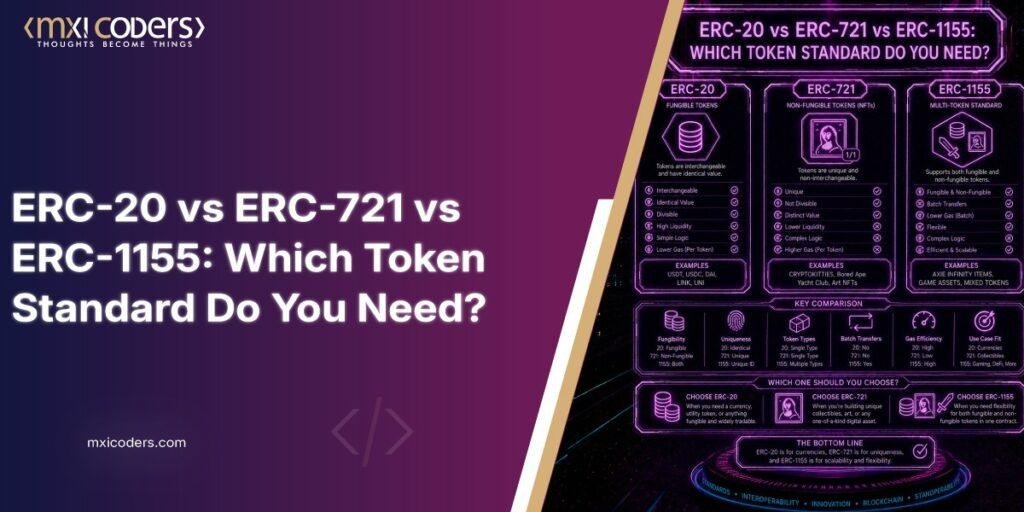
  • Fungibility: ERC-20 is fully fungible, ERC-721 is non-fungible, ERC-1155 supports both in one contract
  • Contract structure: ERC-20 usually issues one token type per contract, ERC-721 usually represents one collection per contract, ERC-1155 can hold unlimited token types in a single deployment
  • Transfer efficiency: ERC-1155’s batch transfers outperform both ERC-20 and ERC-721 when moving multiple assets at once
  • Typical use cases: currencies and DeFi (ERC-20), collectibles and unique ownership records (ERC-721), gaming inventories and hybrid marketplaces (ERC-1155)
  • Marketplace support: ERC-721 still has the deepest legacy support in analytics tools, though ERC-1155 is increasingly treated as a first-class standard by modern platforms

➤ Benefits of Choosing the Right Smart Contract Standard

Picking the correct standard early has real, measurable upside for a project. Some of the clearest smart contract benefits include lower long-term gas expenses, cleaner integration with wallets and exchanges, and fewer edge cases for auditors to review. A well-matched standard also reduces the chance of needing a costly migration later, since wallets and marketplaces build assumptions around how each standard behaves. Projects that match their asset model to the right standard from day one tend to launch faster and face fewer compatibility issues with third-party tools.

➤ Common Blockchain Mistakes When Selecting a Token Standard

Even experienced teams get this decision wrong. Some of the most frequent blockchain mistakes include:

  • Choosing ERC-721 for assets that are actually interchangeable, which adds unnecessary gas overhead
  • Building a game economy on ERC-20 alone, then bolting on unique items later instead of starting with ERC-1155
  • Underestimating metadata and URI planning for NFT projects, leading to broken image links after launch
  • Skipping a professional audit before mainnet deployment, since standard-compliant code can still contain logic bugs
  • Assuming every marketplace or analytics tool already supports newer standards like ERC-1155 without checking first

➤ Emerging Smart Contract Trends Shaping Token Standards

The token standard landscape keeps evolving alongside broader smart contract trends. ERC-4626 has emerged to standardize tokenized DeFi vaults, replacing the bespoke vault interfaces that used to increase integration risk. ERC-404 and similar experimental standards are testing hybrid fungible and non-fungible mechanics beyond what ERC-1155 offers. Account abstraction standards like ERC-4337 are also changing how wallets interact with all three legacy standards, making gasless and batched transactions more common across the board. Builders evaluating a new project in 2026 should factor these adjacent standards into their architecture, not just the original three.

➤ How to Choose the Right Standard for Your Project

Start by asking whether your asset is interchangeable or unique. If it is interchangeable, ERC-20 is likely correct. If every unit needs its own identity, look at ERC-721. If your product involves multiple asset types, such as an in-game currency alongside unique items, ERC-1155 usually saves both time and gas costs.

For larger organizations, this decision often extends beyond a single token. Custom enterprise blockchain development frequently involves combining standards, for example issuing a governance token on ERC-20 while managing supply chain certificates or loyalty rewards through ERC-1155. Enterprise teams should map out every asset type in the system before writing a single line of contract code, since retrofitting a standard after launch is far more expensive than planning for it upfront.

➤ When to Use a Smart Contract Development Service

Not every team has in-house Solidity expertise, and getting a token standard wrong can be expensive to fix after deployment. A specialized smart contract development service can help evaluate your asset model, recommend the right ERC standard, handle security audits, and ensure the contract integrates cleanly with wallets and marketplaces from day one. This is particularly valuable for projects with complex tokenomics, multi-chain deployment plans, or regulatory reporting requirements.

➤ Frequently asked questions

  1. Is ERC-1155 better than ERC-721? Neither is universally better. ERC-721 remains the standard with the deepest marketplace and analytics support for pure collectibles, while ERC-1155 is more gas-efficient for projects that need multiple asset types or frequent batch transfers.
  2. Can one project use more than one ERC standard? Yes. Many projects combine ERC-20 for a currency or governance token with ERC-721 or ERC-1155 for items, tickets, or in-game assets.
  3. Which standard is cheapest in terms of gas fees? ERC-1155 generally offers the lowest gas costs when handling multiple token types, thanks to its batch transfer capability.

➤ Conclusion

ERC-20, ERC-721, and ERC-1155 solve different problems, and the right choice depends entirely on whether your assets are interchangeable, unique, or a mix of both. ERC-20 remains the default for currencies and governance, ERC-721 for one-of-a-kind digital ownership, and ERC-1155 for hybrid systems like gaming and large marketplaces. Understanding these differences before writing a single contract can save significant time, gas costs, and rework down the line.

➤ References

  • Blockchain Council, Token Standards Deep Dive: ERC-20 vs ERC-721 vs ERC-1155 for Product Development – blockchain-council.org
  • Coincile, Token Standards: ERC-20, ERC-721, ERC-1155 – coincile.io
  • Eco, Essential ERC Standards Every Builder Should Know – eco.com/support
  • Webopedia, ERC Token Standards: Complete Guide for 2026 – webopedia.com
erc 20 vs erc 721 vs erc 1155 (blog image) 1

Choosing a token standard is one of the first technical decisions any Ethereum project has to make, and it is also one of the hardest to reverse once a contract is live. Data from DeFiLlama shows that ERC-20 alone underpins more than $230 billion in stablecoin supply across networks as of April 2026. Zooming out further, ERC-20, ERC-721, and ERC-1155 together account for over 99% of token transaction volume on EVM-compatible chains. Within that group, ERC-20 still dominates, representing close to 90% of all token activity on Ethereum and similar networks. These numbers make one thing clear: most builders will eventually work with one, or all, of these three standards. This guide breaks down what each one does, where it fits best, and how to avoid picking the wrong one for your project.

➤ What Are ERC Token Standards?

ERC stands for Ethereum Request for Comment. These are technical specifications, born out of the Ethereum Improvement Proposal (EIP) process, that define how a token contract should behave so that wallets, exchanges, and decentralized apps can all interact with it in a predictable way. Without a shared standard, every wallet or marketplace would need custom code to support every new token, which simply does not scale. A token standard essentially answers three questions: how ownership is tracked, how transfers happen, and how balances are reported.

➤ ERC-20 Explained: The Standard for Fungible Tokens

ERC-20, first proposed in 2015, defines fungible tokens, meaning every unit is identical and interchangeable, much like currency or shares of stock. It is the backbone of most stablecoins, governance tokens, and utility tokens in circulation today.

Key characteristics of ERC-20 include:

  • A single contract typically issues one token type, tracked through a shared balance ledger
  • Six core functions, including transfer, transferFrom, balanceOf, and totalSupply, handle nearly all activity
  • Read-only functions produce no on-chain events, while transfer functions generate the events that exchanges and wallets track
  • Best suited for currencies, reward points, DeFi collateral, and governance voting rights

If your project needs a token where one unit is worth exactly the same as another, ERC-20 is almost always the right starting point.

➤ ERC-721 Explained: The Standard for Unique Digital Assets

Proposed in 2018, ERC-721 introduced non-fungible tokens, where every token has a unique identifier and its own ownership record. This is what made digital collectibles like CryptoPunks and Bored Ape Yacht Club possible, since no two tokens are interchangeable.

ERC-721 handles three core operations:

  • Minting, which creates a new unique token
  • Transferring, which moves ownership from one wallet to another
  • Metadata storage, which links each token to details like name, image, and attributes through a URI pattern

Because each token carries individual provenance, ERC-721 is the natural fit for art, event tickets with unique serial numbers, real estate deeds, and any asset where individuality matters more than interchangeability.

➤ ERC-1155 Explained: The Multi-Token Standard

Also finalized in 2018, ERC-1155 was built to solve a real inefficiency: managing fungible and non-fungible assets used to require separate contracts, which was costly and hard to maintain. ERC-1155 lets a single contract issue multiple token types, fungible, non-fungible, or semi-fungible, all at once.

Its standout feature is native batch operations, which allow one transaction to mint or transfer several token IDs and quantities together. This matters because:

  • Gaming platforms can manage in-game currency, weapons, and rare skins under one contract
  • Marketplaces can list and trade different asset types in a single transaction
  • Gas costs drop noticeably compared to deploying separate ERC-20 and ERC-721 contracts for the same ecosystem

OpenZeppelin and other major infrastructure providers now recommend ERC-1155 as the scalable choice for asset-heavy systems like games, metaverse platforms, and large marketplaces.

smart contract benefits 

➤ ERC-20 vs ERC-721 vs ERC-1155: Key Differences

  • Fungibility: ERC-20 is fully fungible, ERC-721 is non-fungible, ERC-1155 supports both in one contract
  • Contract structure: ERC-20 usually issues one token type per contract, ERC-721 usually represents one collection per contract, ERC-1155 can hold unlimited token types in a single deployment
  • Transfer efficiency: ERC-1155’s batch transfers outperform both ERC-20 and ERC-721 when moving multiple assets at once
  • Typical use cases: currencies and DeFi (ERC-20), collectibles and unique ownership records (ERC-721), gaming inventories and hybrid marketplaces (ERC-1155)
  • Marketplace support: ERC-721 still has the deepest legacy support in analytics tools, though ERC-1155 is increasingly treated as a first-class standard by modern platforms

➤ Benefits of Choosing the Right Smart Contract Standard

Picking the correct standard early has real, measurable upside for a project. Some of the clearest smart contract benefits include lower long-term gas expenses, cleaner integration with wallets and exchanges, and fewer edge cases for auditors to review. A well-matched standard also reduces the chance of needing a costly migration later, since wallets and marketplaces build assumptions around how each standard behaves. Projects that match their asset model to the right standard from day one tend to launch faster and face fewer compatibility issues with third-party tools.

➤ Common Blockchain Mistakes When Selecting a Token Standard

Even experienced teams get this decision wrong. Some of the most frequent blockchain mistakes include:

  • Choosing ERC-721 for assets that are actually interchangeable, which adds unnecessary gas overhead
  • Building a game economy on ERC-20 alone, then bolting on unique items later instead of starting with ERC-1155
  • Underestimating metadata and URI planning for NFT projects, leading to broken image links after launch
  • Skipping a professional audit before mainnet deployment, since standard-compliant code can still contain logic bugs
  • Assuming every marketplace or analytics tool already supports newer standards like ERC-1155 without checking first

➤ Emerging Smart Contract Trends Shaping Token Standards

The token standard landscape keeps evolving alongside broader smart contract trends. ERC-4626 has emerged to standardize tokenized DeFi vaults, replacing the bespoke vault interfaces that used to increase integration risk. ERC-404 and similar experimental standards are testing hybrid fungible and non-fungible mechanics beyond what ERC-1155 offers. Account abstraction standards like ERC-4337 are also changing how wallets interact with all three legacy standards, making gasless and batched transactions more common across the board. Builders evaluating a new project in 2026 should factor these adjacent standards into their architecture, not just the original three.

➤ How to Choose the Right Standard for Your Project

Start by asking whether your asset is interchangeable or unique. If it is interchangeable, ERC-20 is likely correct. If every unit needs its own identity, look at ERC-721. If your product involves multiple asset types, such as an in-game currency alongside unique items, ERC-1155 usually saves both time and gas costs.

For larger organizations, this decision often extends beyond a single token. Custom enterprise blockchain development frequently involves combining standards, for example issuing a governance token on ERC-20 while managing supply chain certificates or loyalty rewards through ERC-1155. Enterprise teams should map out every asset type in the system before writing a single line of contract code, since retrofitting a standard after launch is far more expensive than planning for it upfront.

➤ When to Use a Smart Contract Development Service

Not every team has in-house Solidity expertise, and getting a token standard wrong can be expensive to fix after deployment. A specialized smart contract development service can help evaluate your asset model, recommend the right ERC standard, handle security audits, and ensure the contract integrates cleanly with wallets and marketplaces from day one. This is particularly valuable for projects with complex tokenomics, multi-chain deployment plans, or regulatory reporting requirements.

➤ Frequently asked questions

  1. Is ERC-1155 better than ERC-721? Neither is universally better. ERC-721 remains the standard with the deepest marketplace and analytics support for pure collectibles, while ERC-1155 is more gas-efficient for projects that need multiple asset types or frequent batch transfers.
  2. Can one project use more than one ERC standard? Yes. Many projects combine ERC-20 for a currency or governance token with ERC-721 or ERC-1155 for items, tickets, or in-game assets.
  3. Which standard is cheapest in terms of gas fees? ERC-1155 generally offers the lowest gas costs when handling multiple token types, thanks to its batch transfer capability.

➤ Conclusion

ERC-20, ERC-721, and ERC-1155 solve different problems, and the right choice depends entirely on whether your assets are interchangeable, unique, or a mix of both. ERC-20 remains the default for currencies and governance, ERC-721 for one-of-a-kind digital ownership, and ERC-1155 for hybrid systems like gaming and large marketplaces. Understanding these differences before writing a single contract can save significant time, gas costs, and rework down the line.

➤ References

  • Blockchain Council, Token Standards Deep Dive: ERC-20 vs ERC-721 vs ERC-1155 for Product Development – blockchain-council.org
  • Coincile, Token Standards: ERC-20, ERC-721, ERC-1155 – coincile.io
  • Eco, Essential ERC Standards Every Builder Should Know – eco.com/support
  • Webopedia, ERC Token Standards: Complete Guide for 2026 – webopedia.com

Feel free to Connect us on

Ready to transform your business with smart software solutions?

Harness the power of custom software development to streamline operations, reduce costs, and boost efficiency. Start by exploring cutting-edge approaches like cloud-native platforms, API-first architecture, and AI-driven automation to future-proof your systems and stay ahead of the competition.

Book free consultation

Let’s build your idea together and serve society.

Author

Ashok Rathod

Tech Consultant

Experience
25 Years
Growth Architect for Startups & SMEs | Blockchain, AI , MVP Development, & Data-Driven Marketing Expert.

Transform the Carbon Credit Industry

Build a Transparent, Scalable Carbon Credit Marketplace with Blockchain.

Index

Let's build something real!

Share your ideas with us and we’ll turn them into powerful digital solutions.

500+

Projects

8+

Experience

255+

Clients

Tell us about your project

Our team will get back to you within 24 hours