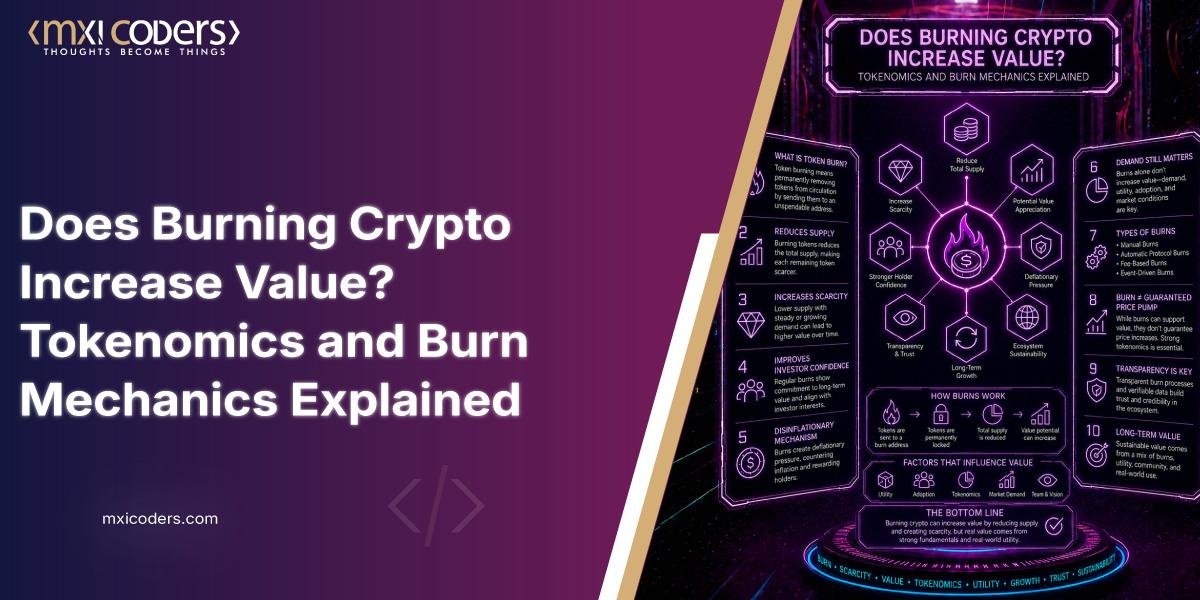
No, burning crypto tokens does not automatically increase value on its own. Token burn permanently removes coins from circulation, which can support scarcity, but price still depends on demand, adoption, and how the rest of a project’s tokenomics is structured.
➤ What Does It Actually Mean to Burn Crypto Tokens?
Burning crypto means sending tokens to a wallet address that nobody controls and that has no private key, often called a burn address or dead address. Once tokens land there, they’re gone permanently. No one can spend them, retrieve them, or move them again. This is different from simply “losing” a wallet password, because burn addresses are usually published and verifiable on-chain, so anyone can confirm the supply reduction independently.
➤ Does Reducing Supply Really Push the Price Up?
Basic economics says less supply against steady demand should raise price. In crypto, that logic only holds if demand stays constant, and demand rarely does. A useful real-world check on this: Shiba Inu’s best single burn day in late June 2026 removed about 4 million tokens, which worked out to roughly 0.0000007 percent of its circulating supply, and the seven-day burn rate then fell 16 percent the following week, according to FinanceFeeds‘ burn-tracker analysis. The token’s price barely moved on that news. When the amount burned is a rounding error against total supply, the scarcity effect is close to meaningless, no matter how large the burn sounds in a headline.
Ethereum tells a more mixed story. Since EIP-1559 launched in August 2021, the network has burned a large share of its transaction fees permanently, and combined with the shift away from mining, this has pushed Ethereum into net-deflationary stretches during high-activity periods. But that trend isn’t fixed. After the Dencun upgrade moved most Layer-2 transaction data off the main chain, burn volume dropped, and Ethereum’s supply actually grew again in parts of 2025 and 2026.
➤ What Are the Main Ways Projects Burn Tokens?
Not every burn works the same way. Some are automatic and written into the protocol itself, others are manual decisions made quarterly, and some happen through buybacks funded by revenue.
| Option | Mechanism | Best Fit | Trade-off |
| Protocol-level fee burn | A portion of every transaction fee is destroyed automatically by code | Large, high-activity Layer-1 networks | Burn rate depends entirely on network usage, so it can slow or reverse |
| Buyback-and-burn | The project uses revenue or reserves to buy tokens on the open market, then burns them | Exchanges and revenue-generating platforms | Requires ongoing income; burns can stop if revenue drops |
| Manual/scheduled burn | Team sends a fixed or formula-based amount to a burn address on a set schedule | Projects targeting a specific long-term supply cap | Centralized decision-making; depends on the team following through |
BNB Chain runs a version of the scheduled model. Its 36th quarterly Auto-Burn, completed in July 2026, removed 1,615,827.795 BNB, worth roughly $931.7 million at the time, bringing total supply down to about 133.17 million BNB, according to BNB Chain’s own blog post. The formula factors in BNB’s price and the number of blocks produced that quarter, and it runs independently of Binance the exchange, which is meant to make the process auditable rather than discretionary.
➤ How Does Proof of Stake Fit Into This?
Proof of stake is a separate mechanism from token burning, but the two are often confused because both affect circulating supply. Under proof of stake, holders lock up, or stake, their tokens to help validate transactions and earn rewards for doing so, rather than relying on energy-intensive mining. Ethereum’s move to proof of stake cut its energy use by more than 99.95 percent, according to the Ethereum Foundation’s own research.
Staking doesn’t destroy tokens the way burning does, but it does reduce the liquid, tradable supply, since staked coins are locked up rather than sitting on exchanges. As of May 2026, roughly 39 million ETH, close to 32 percent of total supply, was locked in staking contracts, with base annual yields sitting around 2.4 to 2.8 percent, according to data compiled by CoinLaw. For anyone studying tokenomics, it’s worth treating burning and staking as two separate levers: one permanently shrinks supply, the other temporarily removes coins from active circulation while paying holders to wait.
➤ What Are the Risks and Limitations of Burning Crypto?
Burning has real downsides that rarely make it into hype threads.
- Burns are irreversible. Sending tokens to the wrong address, whether it’s a genuine burn address or a typo, destroys them permanently with no recovery path.
- Tax exposure varies by country. Some jurisdictions treat a burn as a taxable disposal event, so it’s worth checking local rules before burning any meaningful amount.
- Scale matters more than headlines. As the Shiba Inu example above shows, a burn that sounds dramatic in percentage terms can still be a negligible fraction of total supply.
- Burns can mask weak fundamentals. A project with declining usage can still announce burns to generate short-term attention, without addressing why demand is falling in the first place.
➤ Frequently asked questions
- Is burning crypto tokens a good sign for a project?
It depends on why the burn is happening. A burn tied to real transaction volume or revenue (like a protocol fee burn or buyback) reflects genuine usage. A one-off manual burn announced without context is a weaker signal on its own. - Can burned crypto ever be recovered?
No. Burn addresses have no known private key, so any tokens sent there are permanently unspendable. This is different from a lost wallet, where a private key theoretically still exists somewhere. - Does burning crypto affect proof-of-stake rewards?
Not directly. Staking rewards come from protocol issuance and fees paid to validators, while burning removes tokens from the fee side of the equation. A network can burn tokens and pay staking rewards at the same time, which is exactly what Ethereum does. - How can I check how much of a token has actually been burned?
Most burn addresses are public. Blockchain explorers let you look up the address balance directly, and several projects run dedicated burn trackers that update in real time.
➤ Conclusion
Burning tokens is one lever in a much bigger tokenomics picture, not a shortcut to a higher price. The mechanism genuinely reduces supply, and in cases like Ethereum’s fee burn or BNB’s scheduled Auto-Burn, that reduction is real, auditable, and tied to actual network activity. But supply is only half the equation. Without steady or growing demand, even a large burn measured in dollars can be a small fraction of total supply and barely move price, as smaller-cap tokens have shown repeatedly. Anyone evaluating a project’s burn mechanism is better served asking what percentage of supply it actually removes, how it’s funded, and whether it’s paired with real usage, rather than reacting to the size of the headline number.
➤ Ready to build tokenomics that hold up under real usage?
If you’re designing burn mechanics, staking rewards, or a broader token supply model for a new project, getting the tokenomics structure right from the start matters more than any single burn event. Mxicoders works with teams on smart contract development, crypto wallet development, and full blockchain consulting to help projects design supply models that hold up over time. Book a free consultation to talk through your token model.
➤ Sources Used
FinanceFeeds, “Shiba Inu (SHIB) price prediction July 2026”
Ethereum Foundation, “Ethereum’s energy usage will soon decrease by ~99.95%”
BNB Chain, “36th BNB Burn”
CoinLaw, “ETH Staking Statistics 2026”