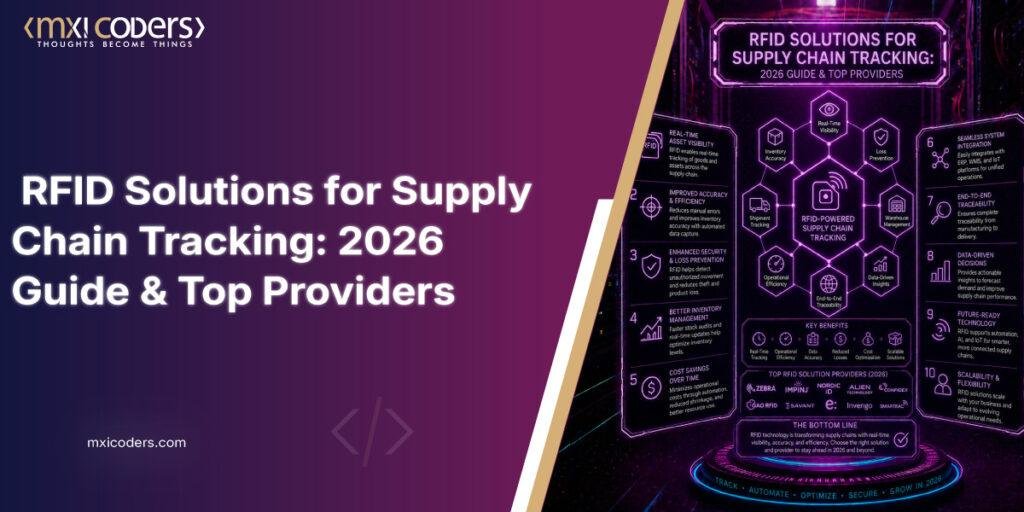
RFID tags for supply chain tracking use radio waves to identify tagged items without needing a direct line of sight, unlike barcodes. A reader picks up dozens of tags at once from several meters away, which is why warehouses, retailers, and logistics networks use RFID to cut manual scanning time and catch inventory errors that barcodes miss.
➤ What Problem Does RFID Actually Solve in Supply Chain Management?
Most supply chains run on inventory numbers that are wrong more often than people assume. Retailers using only manual counts and barcodes typically land somewhere between 60% and 80% inventory accuracy, according to Lowry Solutions. A widely cited McKinsey analysis found that RFID deployments deliver more than 25% improvements in inventory accuracy, along with measurable sell-through gains from fewer stockouts. Lululemon is a concrete example here: the retailer tags inventory across nearly 500 stores and reports 98% inventory accuracy with a payback period of a year or less, per the same McKinsey research.
The financial stakes are larger than most people expect. Inventory distortion (the combination of overstocks and out-of-stocks) costs global retailers roughly $1.7 trillion a year, and about 70% of that comes from products missing off the shelf rather than sitting in excess, according to IHL Group figures cited by Badger Technologies. That’s the gap RFID for supply chain management is built to close: not just counting items, but catching where they actually are before a sale is lost.
➤ How Does Automatic Identification RFID Technology Actually Work?
An automatic identification RFID solution has three parts working together. The tag holds a unique identifier, usually encoded to the GS1 EPC (Electronic Product Code) standard. The reader, whether a fixed portal at a dock door or a handheld scanner on the floor, sends out radio waves and captures the response from every tag in range. The software layer then matches that identifier against inventory or asset records in real time.
The dominant global protocol here is EPC Gen2, standardized by GS1, operating in the 860 to 960 MHz UHF band. GS1 also maintains EPCIS, an event-sharing standard that lets different companies in a supply chain (a manufacturer, a carrier, a retailer) share tracking events using one common data language, per GS1 Canada. That interoperability is why RFID scales across a supply chain rather than staying locked inside one warehouse.
One overlooked driver of adoption in 2026 is regulation, not just efficiency. The FDA’s FSMA Section 204 food traceability rule takes effect January 20, 2026, and pushes food suppliers toward EPCIS-based tracking. The EU’s deforestation regulation (EUDR) and upcoming Digital Product Passport rules add further pressure on manufacturers to adopt serialized, event-level tracking, a trend documented by Proud Tek. Several of these rules converge on the same GS1 EPCIS 2.0 data standard, which means one well-built RFID program can often satisfy multiple regulatory requirements at once rather than needing separate systems for each.
➤ What Should You Look For in an RFID Solution for Supply Chain Management?
An RFID solution for supply chain management needs to match how the operation actually runs, not just the tag itself.
Read range and environment. A dock door portal needs a different reader setup than a handheld count in a cold storage aisle. Passive UHF tags handle most warehouse and retail cases; active tags cost more but suit large, high-value assets tracked over longer distances.
Tag durability and data capacity. RFID tags can hold far more data than a barcode, including lot number, expiration date, and location history, and they hold up in harsher conditions than a printed label.
Integration path. The reader and middleware need to talk to the existing WMS or ERP system without a rebuild. This is usually where a project’s timeline and budget actually get decided.
Standards compliance. Sticking to GS1 EPC Gen2 and EPCIS avoids getting locked into one vendor’s proprietary format later.
| Tag Type | Mechanism | Best Fit | Trade-off |
| Passive UHF (RAIN RFID) | No internal battery, powered by reader’s radio signal | High-volume retail and warehouse inventory | Shorter range than active tags, typically under 10 to 12 meters |
| Passive HF/NFC | Short-range, high data security | Access control, item authentication, smartphone taps | Very limited read range, not suited to bulk warehouse scanning |
| Active RFID | Battery-powered, transmits continuously | Large asset tracking, yard management, cold chain | Higher per-tag cost, added battery maintenance |
| Semi-passive/sensor tags | Battery-assisted, adds temperature or humidity sensing | Cold chain and pharmaceutical shipments | More expensive, shorter tag lifespan than passive tags |
➤ Which Companies Are the Top RFID Solution Providers Right Now?
The RFID hardware and platform market is dominated by a handful of established names, according to MarketsAndMarkets: Zebra Technologies holds a broad end-to-end RFID portfolio across retail, logistics, and manufacturing; Impinj focuses on RAIN RFID chips and reader ICs; Avery Dennison supplies RFID inlays and labels at scale, including a 2025 partnership with Walmart on sensor-enabled tags for cold and high-moisture categories; and Honeywell continues expanding RFID into its mobile computing hardware line. Smaller, more specialized players like GAO RFID and Xemelgo compete on focused deployments rather than broad portfolios.
The wider market backs up why this space keeps attracting new entrants. The global RFID market is projected to grow from roughly $17 to $19 billion in 2026 to somewhere between $27 billion and $46 billion by the early 2030s, depending on the research firm’s methodology, with North America holding the largest regional share, per Fortune Business Insights and Research and Markets.
➤ Limitations and Industry Challenges
RFID isn’t a drop-in replacement for barcodes in every case. Metal and liquid interference can distort reads, tag costs still add up on very low-margin items even at cents apiece, and integrating RFID data into legacy WMS or ERP systems is frequently the slowest part of a rollout, not the hardware. Regulatory deadlines like FSMA 204 are also pushing adoption faster than some suppliers’ internal systems are ready for, which is creating real bottlenecks in food and pharma supply chains through 2026.
➤ Frequently asked questions
- Is RFID more accurate than barcode scanning for inventory?
Generally yes for bulk counts and non-line-of-sight reads, since a reader can capture dozens of tags at once without individually scanning each item. Barcodes still win on raw per-unit cost for very low-value goods. - How long does it take to see a return on an RFID rollout?
Retail case studies like lululemon’s report payback within a year, though that depends heavily on tag cost, integration complexity, and whether the business already had strong inventory processes beforehand. - Do RFID tags work outside the warehouse?
Yes. UHF passive tags are built to handle outdoor conditions and temperature swings, which is part of why they’re used in yard management and outdoor asset tracking, not just indoor shelves. - What’s the difference between RFID and NFC?
NFC is a short-range subset of RFID, mostly HF-based, designed for close-proximity taps like access badges or payment. RFID for supply chain tracking usually means UHF tags read from several meters away.
➤ Conclusion
RFID has moved from a “nice to have” efficiency project to something closer to a compliance requirement in food, pharma, and soon textiles, thanks to regulations converging on the same GS1 EPCIS data standard. For most operations, the technology question is less about whether RFID works (the accuracy and shrinkage data are well established at this point) and more about picking the right tag type, reader placement, and integration path for how the business actually moves goods.
➤ Where Mxicoders Fits In
Mxicoders works with retail, warehouse, and logistics teams on RFID solution deployments across the USA, UK, and Canada, covering automatic identification setup, wireless reader connectivity, multi-tag reading, and integration with existing store management or inventory systems. If you’re weighing an RFID rollout against your current barcode process, book a free consultation to talk through what fits your setup.
➤ Sources Used
Proud Tek — RFID Supply Chain Management & Regulatory Carriers
GS1 — RFID Standards
GS1 Canada — RFID Standards & EPCIS
McKinsey — RFID’s Renaissance in Retail
Badger Technologies — Verified Visibility (citing IHL Group)
Lowry Solutions — Measuring the Impact of RFID in Retailing
Fortune Business Insights — RFID Market Forecast
Research and Markets — RFID Global Market Report 2026
MarketsAndMarkets — RFID Market Report