Blockchain

10 Best Blockchain Development Tools for Developers in 2026

Ashok Rathod

Tech Consultant

Posted on
25th May 2026
6 min
Read
Share

Table of Contents

  • Quick Tips
  • Familiarize yourself with Cash App
  • Enable two-factor authentication
  • Utilize the optional Cash App
  • Conclusion

Blockchain technology is no longer a niche innovation. It has become a foundational layer of modern digital infrastructure. By 2026, the global blockchain market is projected to surpass $94 billion, growing at a compound annual growth rate of over 66% from 2022. Developers worldwide are racing to build the next generation of decentralized applications, and the demand for skilled professionals is at an all-time high.

Whether you are just beginning your journey of learning blockchain development or scaling enterprise-grade decentralized systems, the tools you choose directly impact your productivity, security, and success. This guide covers the 10 most essential blockchain development tools developers rely on in 2026 from programming languages and testing environments to oracle networks and wallet integrations.

➤ What Are Blockchain Development Tools?

Blockchain development tools are software frameworks, libraries, environments, and infrastructure solutions that help developers build, test, deploy, and interact with blockchain applications. They eliminate much of the complexity involved in writing reliable decentralized software by providing structured workflows, automation, and debugging capabilities.

➤ List of Top Blockchain Development Tools

The ecosystem spans several categories: programming languages like Solidity, development frameworks such as Hardhat and Truffle, browser-based IDEs like Remix, blockchain infrastructure clients like Geth, JavaScript libraries including Web3.js and Ethers.js, wallet tools like MetaMask, local testing environments like Ganache, and oracle networks like Chainlink.

1. Solidity

Solidity is the primary object-oriented programming language for writing Ethereum smart contracts. It compiles to EVM bytecode and is compatible with any Ethereum Virtual Machine-based blockchain. Solidity supports token standards like ERC-20 and ERC-721, making it the go-to language for DeFi protocols, NFT marketplaces, and DAO creation. Its large developer community and thorough official documentation make it the industry standard for anyone entering smart contract development.

2. Geth

Geth (Go Ethereum) is the official Ethereum client written in Go. It allows developers to run full Ethereum nodes, synchronize blockchain data, validate transactions, and interact with the network through a command-line interface. Geth is critical for teams building node infrastructure or requiring direct access to the Ethereum network without relying on third-party providers. It remains the backbone of serious Ethereum infrastructure deployment.

3. MetaMask

MetaMask is the world’s most widely used cryptocurrency wallet and Web3 browser gateway, with over 30 million active users globally. It connects users and developers to decentralized applications across multiple networks including Ethereum, Polygon, and BNB Chain. For developers, MetaMask is indispensable during testing phases enabling wallet integration, user authentication flows, and seamless dApp connectivity without complex backend setup.

4. Remix IDE

Remix IDE is a browser-based development environment purpose-built for writing and deploying Solidity contracts. It requires no installation and provides built-in compilation, deployment, and step-by-step debugging tools directly in the browser. Remix is particularly valuable for learning Ethereum development, as beginners can start writing and deploying contracts within minutes. It is also widely used for rapid prototyping before migrating to a more comprehensive local framework.

5. Truffle

Truffle is one of the most established smart contract development frameworks in the Ethereum ecosystem. It provides project scaffolding, automated testing pipelines, and migration management for deploying contracts across different networks. Truffle integrates smoothly with Ganache for local testing and has extensive learning resources, making it well-suited for full-stack blockchain projects that require structure and repeatability across environments.

Also Read: Top Blockchain Development Companies in New York in 2026

6. Web3.js

Web3.js is a JavaScript library that enables frontend applications to communicate with Ethereum nodes via HTTP, WebSocket, or IPC. It handles transaction management, smart contract interaction, and event monitoring, making it a critical bridge between user interfaces and the blockchain. Web3.js has a well-established ecosystem with broad compatibility across browsers and Node.js environments, making it a reliable choice for teams building Ethereum-based dApps.

7. Hardhat

Hardhat has become the dominant Ethereum development framework for professional teams. It provides a local development network, advanced stack traces, console logging from within Solidity, and a flexible plugin architecture that extends functionality significantly. Hardhat’s speed during testing and its compatibility with TypeScript make it the preferred environment for teams delivering a smart contract development service at scale, where efficiency and debuggability are non-negotiable.

8. Chainlink

Chainlink is the leading decentralized oracle network, enabling smart contracts to securely access real-world data such as price feeds, weather information, and sports results. It also provides automation services and cross-chain interoperability features. DeFi protocols depend heavily on Chainlink’s tamper-proof data feeds to function correctly. Any project working on custom enterprise blockchain development that requires external data integration will almost certainly incorporate Chainlink into its architecture.

9. Ganache

Ganache is a personal blockchain simulator used for local development and testing. It spins up a private Ethereum environment instantly, allowing developers to test contract behavior, simulate transactions, and inspect state changes without interacting with public testnets. Its fast transaction simulation dramatically shortens development cycles. Ganache pairs naturally with Truffle and Hardhat, making it a staple in most smart contract testing workflows.

10. Ethers.js

Ethers.js is a lightweight, modular JavaScript library for interacting with the Ethereum blockchain. It provides wallet interaction, contract communication, and transaction handling in a cleaner, more developer-friendly API compared to older alternatives. Ethers.js has gained strong adoption in modern Web3 frontend projects due to its smaller bundle size and excellent TypeScript support. A thorough smart contract audit often involves reviewing interaction logic built with Ethers.js to ensure proper signing and transaction handling.

➤ How to Choose the Right Blockchain Development Tool

Beginners should start with Remix IDE, MetaMask, and Solidity low barrier tools that require minimal setup. Smart contract developers will benefit most from Hardhat, Truffle, and Solidity in combination. dApp developers building user-facing products should lean on Ethers.js, Web3.js, and MetaMask for frontend integration. Infrastructure and scaling projects will depend on Geth for node management and Chainlink for reliable external data.

➤ Conclusion

No single tool covers every requirement in blockchain development. The most effective developers build a thoughtful stack combining a reliable language like Solidity with a robust framework like Hardhat, a testing environment like Ganache, and connectivity tools like Ethers.js or MetaMask. As the ecosystem matures in 2026, matching your toolset to your project goals, target blockchain, and team expertise remains the most important decision you can make before writing your first line of code.
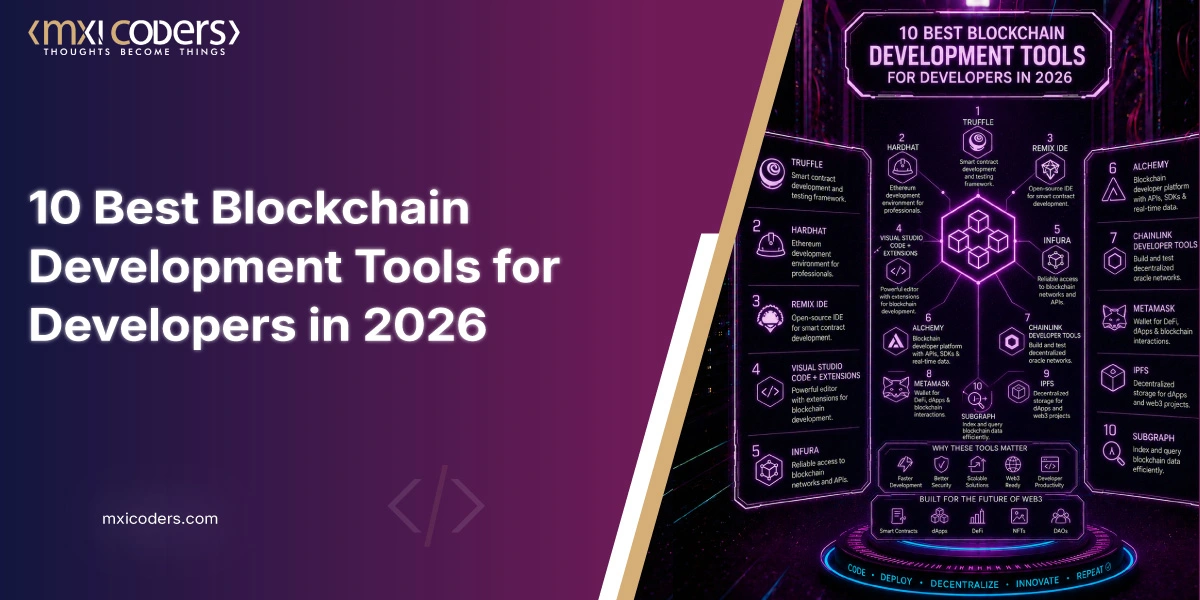
10 best blockchain development tools for developers in 2026

Blockchain technology is no longer a niche innovation. It has become a foundational layer of modern digital infrastructure. By 2026, the global blockchain market is projected to surpass $94 billion, growing at a compound annual growth rate of over 66% from 2022. Developers worldwide are racing to build the next generation of decentralized applications, and the demand for skilled professionals is at an all-time high.

Whether you are just beginning your journey of learning blockchain development or scaling enterprise-grade decentralized systems, the tools you choose directly impact your productivity, security, and success. This guide covers the 10 most essential blockchain development tools developers rely on in 2026 from programming languages and testing environments to oracle networks and wallet integrations.

➤ What Are Blockchain Development Tools?

Blockchain development tools are software frameworks, libraries, environments, and infrastructure solutions that help developers build, test, deploy, and interact with blockchain applications. They eliminate much of the complexity involved in writing reliable decentralized software by providing structured workflows, automation, and debugging capabilities.

➤ List of Top Blockchain Development Tools

The ecosystem spans several categories: programming languages like Solidity, development frameworks such as Hardhat and Truffle, browser-based IDEs like Remix, blockchain infrastructure clients like Geth, JavaScript libraries including Web3.js and Ethers.js, wallet tools like MetaMask, local testing environments like Ganache, and oracle networks like Chainlink.

1. Solidity

Solidity is the primary object-oriented programming language for writing Ethereum smart contracts. It compiles to EVM bytecode and is compatible with any Ethereum Virtual Machine-based blockchain. Solidity supports token standards like ERC-20 and ERC-721, making it the go-to language for DeFi protocols, NFT marketplaces, and DAO creation. Its large developer community and thorough official documentation make it the industry standard for anyone entering smart contract development.

2. Geth

Geth (Go Ethereum) is the official Ethereum client written in Go. It allows developers to run full Ethereum nodes, synchronize blockchain data, validate transactions, and interact with the network through a command-line interface. Geth is critical for teams building node infrastructure or requiring direct access to the Ethereum network without relying on third-party providers. It remains the backbone of serious Ethereum infrastructure deployment.

3. MetaMask

MetaMask is the world’s most widely used cryptocurrency wallet and Web3 browser gateway, with over 30 million active users globally. It connects users and developers to decentralized applications across multiple networks including Ethereum, Polygon, and BNB Chain. For developers, MetaMask is indispensable during testing phases enabling wallet integration, user authentication flows, and seamless dApp connectivity without complex backend setup.

4. Remix IDE

Remix IDE is a browser-based development environment purpose-built for writing and deploying Solidity contracts. It requires no installation and provides built-in compilation, deployment, and step-by-step debugging tools directly in the browser. Remix is particularly valuable for learning Ethereum development, as beginners can start writing and deploying contracts within minutes. It is also widely used for rapid prototyping before migrating to a more comprehensive local framework.

5. Truffle

Truffle is one of the most established smart contract development frameworks in the Ethereum ecosystem. It provides project scaffolding, automated testing pipelines, and migration management for deploying contracts across different networks. Truffle integrates smoothly with Ganache for local testing and has extensive learning resources, making it well-suited for full-stack blockchain projects that require structure and repeatability across environments.

Also Read: Top Blockchain Development Companies in New York in 2026

6. Web3.js

Web3.js is a JavaScript library that enables frontend applications to communicate with Ethereum nodes via HTTP, WebSocket, or IPC. It handles transaction management, smart contract interaction, and event monitoring, making it a critical bridge between user interfaces and the blockchain. Web3.js has a well-established ecosystem with broad compatibility across browsers and Node.js environments, making it a reliable choice for teams building Ethereum-based dApps.

7. Hardhat

Hardhat has become the dominant Ethereum development framework for professional teams. It provides a local development network, advanced stack traces, console logging from within Solidity, and a flexible plugin architecture that extends functionality significantly. Hardhat’s speed during testing and its compatibility with TypeScript make it the preferred environment for teams delivering a smart contract development service at scale, where efficiency and debuggability are non-negotiable.

8. Chainlink

Chainlink is the leading decentralized oracle network, enabling smart contracts to securely access real-world data such as price feeds, weather information, and sports results. It also provides automation services and cross-chain interoperability features. DeFi protocols depend heavily on Chainlink’s tamper-proof data feeds to function correctly. Any project working on custom enterprise blockchain development that requires external data integration will almost certainly incorporate Chainlink into its architecture.

9. Ganache

Ganache is a personal blockchain simulator used for local development and testing. It spins up a private Ethereum environment instantly, allowing developers to test contract behavior, simulate transactions, and inspect state changes without interacting with public testnets. Its fast transaction simulation dramatically shortens development cycles. Ganache pairs naturally with Truffle and Hardhat, making it a staple in most smart contract testing workflows.

10. Ethers.js

Ethers.js is a lightweight, modular JavaScript library for interacting with the Ethereum blockchain. It provides wallet interaction, contract communication, and transaction handling in a cleaner, more developer-friendly API compared to older alternatives. Ethers.js has gained strong adoption in modern Web3 frontend projects due to its smaller bundle size and excellent TypeScript support. A thorough smart contract audit often involves reviewing interaction logic built with Ethers.js to ensure proper signing and transaction handling.

➤ How to Choose the Right Blockchain Development Tool

Beginners should start with Remix IDE, MetaMask, and Solidity low barrier tools that require minimal setup. Smart contract developers will benefit most from Hardhat, Truffle, and Solidity in combination. dApp developers building user-facing products should lean on Ethers.js, Web3.js, and MetaMask for frontend integration. Infrastructure and scaling projects will depend on Geth for node management and Chainlink for reliable external data.

➤ Conclusion

No single tool covers every requirement in blockchain development. The most effective developers build a thoughtful stack combining a reliable language like Solidity with a robust framework like Hardhat, a testing environment like Ganache, and connectivity tools like Ethers.js or MetaMask. As the ecosystem matures in 2026, matching your toolset to your project goals, target blockchain, and team expertise remains the most important decision you can make before writing your first line of code.

Ready to transform your business with smart software solutions?

Harness the power of custom software development to streamline operations, reduce costs, and boost efficiency. Start by exploring cutting-edge approaches like cloud-native platforms, API-first architecture, and AI-driven automation to future-proof your systems and stay ahead of the competition.

Book free consultation

Let’s build your idea together and serve society.

Author

Ashok Rathod

Tech Consultant

Experience
25 Years
Growth Architect for Startups & SMEs | Blockchain, AI , MVP Development, & Data-Driven Marketing Expert.

Transform the Carbon Credit Industry

Build a Transparent, Scalable Carbon Credit Marketplace with Blockchain.

Index