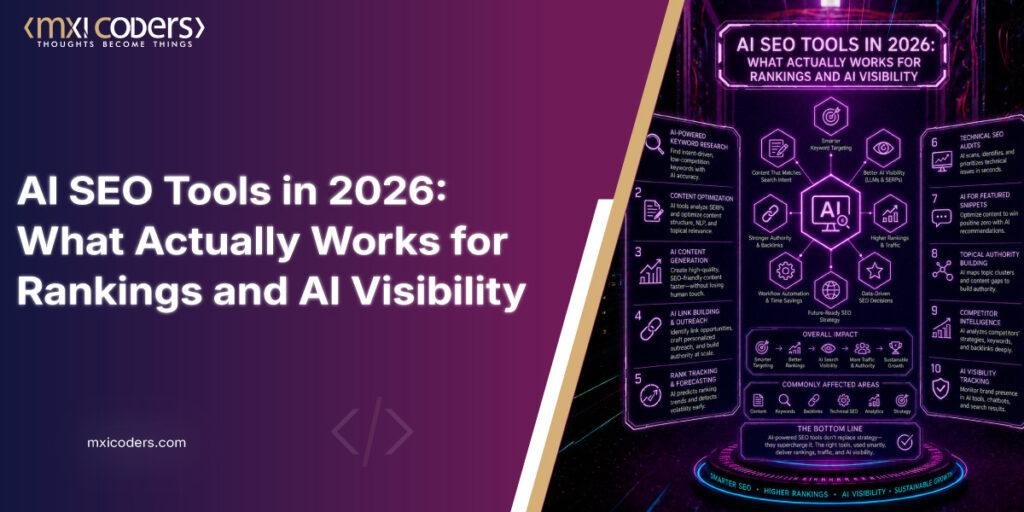
AI SEO tools speed up keyword research, content optimization, and technical audits by analyzing search data at a scale no human team can match. They don’t replace an SEO strategy, they execute pieces of one faster, while a person still needs to decide what to target and why.
➤ What Changed in Search That Makes This Urgent
Search itself looks different than it did even a year ago. AI Overviews now show up on roughly 48 to 50 percent of US Google queries, up from about 6.5 percent at the start of 2025, and reach more than 1.5 billion monthly users across over 200 countries and 40-plus languages, according to Google’s own Search blog. That expansion changes the math on clicks. A Pew Research Center analysis of 900 US adults and nearly 69,000 real Google searches found that when an AI summary appeared, people clicked a traditional result only 8 percent of the time, compared to 15 percent when no summary showed up. Ranking on page one still matters, but getting cited inside the AI answer itself is now a separate goal that needs its own strategy.
➤ Which AI SEO Tools Actually Cover Which Job
There’s no single AI SEO tools that does everything well. Picking one usually means picking a job first.
| Option | Mechanism | Best fit | Trade-off |
| Keyword research tool (Ahrefs, Semrush) | Mines historical search and clickstream data to surface volume, intent, and long-tail variations | Teams planning content around what people actually search for | Doesn’t tell you whether AI platforms will cite the page once it’s built |
| Content optimization tool (Surfer, Clearscope) | Scores a draft against top-ranking competitor pages for terms, structure, and length | Writers who need a data-backed brief before drafting | Optimizing to match what already ranks can produce commodity content that AI engines skip over |
| AI writing tool (Jasper, Writesonic) | Generates or expands drafts from a brief or outline | Teams that need volume and speed on first drafts | Needs a human editing pass for accuracy, voice, and any factual claims |
| AI visibility / brand tracking (Ahrefs Brand Radar) | Tracks whether a brand or topic is being surfaced across AI Overviews, ChatGPT, Perplexity, Gemini, and Copilot | Anyone who needs to know if their content is actually getting cited, not just ranked | A newer category, so coverage and accuracy vary by platform and are still maturing |
Ahrefs’ own Brand Radar, for instance, pulls from more than 300 million monthly search-backed prompts across six AI platforms to show where a brand gets mentioned or cited, according to Ahrefs. That’s a genuinely new capability. Two years ago, “how do I rank” and “how do I get cited by an AI answer” were the same question. Now they’re related but distinct, and tools are starting to split accordingly.
➤ How Should Keyword Research Change for AI Search?
Keyword research still starts with search volume and intent, but it now needs an extra filter: does this topic tend to trigger an AI Overview at all? Long, question-style, and informational queries trigger AI summaries far more often than short transactional ones, which changes which keywords are worth targeting for visibility versus which ones are worth targeting for a straight click. Building a page around a question people actually type, then answering it directly in the opening lines, does more for AI citation than keyword density ever will.
➤ Can AI Writing Tools Produce Content That Ranks?
AI writing tools are genuinely useful for outlines, first drafts, and expanding a rough idea into structure. What they can’t do on their own is supply the thing that gets a page cited: a specific number, a named example, an original point of view backed by a source. A draft that reads like a summary of five other articles on the same topic gives search engines nothing new to point to. The fix isn’t avoiding AI writing tools, it’s using them for speed and adding the specific, sourced detail yourself before publishing.
➤ Limitations and Open Questions
AI visibility tracking is still young, and different tools measure “citation” differently, so numbers from one platform won’t always match another. AI Overview trigger rates also vary widely by study, industry, and country, meaning any single percentage should be read as a range rather than a fixed target. And because AI search engines change their retrieval and ranking behavior frequently, a strategy that works today may need adjustment within months rather than years.
➤ Frequently Asked Questions
- Do AI SEO tools replace the need for an SEO strategist?
No. They speed up research and drafting, but deciding what to target, what’s worth publishing, and how to differentiate from competitors still needs a person making judgment calls the tools can’t make on their own. - How is AI keyword research different from traditional keyword research?
It adds intent and citation likelihood on top of volume, factoring in things like whether a query tends to trigger an AI Overview, not just how often people search it. - Is content written entirely by AI penalized by Google?
Google has stated it evaluates content on quality and helpfulness regardless of how it was produced, but thin, unedited AI drafts tend to lack the specificity and sourcing that both readers and AI citation systems favor.
➤ Conclusion
The tools have gotten faster, but the underlying job hasn’t changed: find what people are actually asking, answer it more clearly and more specifically than anyone else has, and back it up with something real. AI SEO tools handle the research and drafting speed. Getting cited, whether that’s a page-one ranking or a mention inside an AI Overview, still comes down to whether the content says something worth citing.
Want help turning a keyword strategy like this into custom software or a content platform built for it? Mxicoders works with teams building AI-driven marketing and content systems from the ground up. Book a free consultation to talk through what that could look like for your site.