[ Your Headline ] [ Highlight Word ]

[ One or two lines describing the offer — e.g. "Experience our services with a FREE 30-minute consultation." ]

[ Optional second line, e.g. "Have a concept in mind? Let's brainstorm together!" ]

Google ★★★★★ 4.8
GoodFirms ★★★★★ 4.7
Clutch ★★★★★ 5.0
Blockchain

Is Blockchain Developer a Good Career in 2026? Salary, Jobs, and Hiring Data

Ashok Rathod

Tech Consultant

Posted on
20th Jul 2026
14 min
Read
Share

Table of Contents

  • Quick Tips
  • Familiarize yourself with Cash App
  • Enable two-factor authentication
  • Utilize the optional Cash App
  • Conclusion

Yes, blockchain developer is still a strong career choice in 2026 for anyone with solid programming fundamentals. National salary averages sit between $139,715 and $161,000 depending on the source, senior and specialized roles regularly clear $200,000, and labor market data shows tens of thousands of active blockchain developer jobs globally rather than a shrinking niche.

➤ How Much Does a Blockchain Developer Salary Actually Look Like in 2026?

There isn’t one number, because different data sources sample different populations, and the gap between them tells you something useful on its own. Glassdoor’s broad sample of blockchain developer salaries puts the national average at $139,715 a year, with a typical range of $111,373 to $177,320 and top earners pushing past $218,000. Staffing firm KORE1’s 2026 salary guide shows how much the picture shifts depending on who’s answering. ZipRecruiter’s sample lands far lower, around $111,845 on average, largely because it captures more remote and small-shop listings that Glassdoor’s respondent pool doesn’t reach.

City matters more than most job seekers expect. Glassdoor’s location-specific data shows a blockchain developer salary of $160,933 in New York, roughly 15 percent above the national figure, and $179,311 in San Francisco, about 28 percent higher. Los Angeles sits closer to the middle at $157,301. If you’re comparing offers, adjust for city before you compare the base number at all, otherwise you’re comparing apples sitting in completely different cost-of-living baskets.

Seniority and specialization shift the number just as much as geography does. Glassdoor’s data on senior-specific roles puts the average senior blockchain developer salary at $143,609, which actually reads lower than some general “blockchain developer” figures until you notice the sample size is small and skews toward roles that include heavy equity or token components not captured in base pay. Where the real ceiling shows up is in Web3-native hiring outside the general aggregators. Job boards built specifically for crypto and Web3 list senior smart-contract and Solidity engineers well past $185,000 base, and protocols like Ondo Finance and Chainlink Labs have posted senior smart-contract roles into the low $200,000s before token allocation.

A few patterns hold up across every source I checked.

Specialization pays. Solidity and smart contract work, especially anything touching DeFi or Layer 2 scaling, consistently sits above general blockchain engineering roles.

Location still matters even for remote roles. Companies frequently anchor pay bands to where the role is legally based, not where the developer happens to sit.

Shipped work outweighs credentials. Hiring managers I’ve worked with consistently rank a track record of deployed, audited smart contracts above certificates or bootcamp completions when setting an offer.

In practice, I’ve seen junior developers coming out of six-month bootcamps land first roles in the $70,000 to $90,000 range, while engineers with three or more years of Solidity experience and an actual audit track record pull offers north of $160,000 base before any token or equity component gets added. That gap is almost entirely about demonstrated, shippable experience rather than years on a resume.

➤ How Many Blockchain Developer Jobs Are Actually Open Right Now?

Demand is real, but it looks different than the hiring waves of 2021 and 2022, and the labor-market data backs that up in a way salary figures alone can’t. According to a 2026 crypto and Web3 hiring analysis, LinkedIn’s blockchain-related job postings have stabilized at roughly 18,000 active listings globally, while Indeed shows around 12,000 crypto-specific openings across experience levels. Those figures span technical development, compliance, and business roles, not just engineering, but the technical share remains the largest single category.

Crypto-native job boards tell a fuller story on the developer-specific side. Career resource site web3.career reported more than 73,000 live blockchain roles as of May 2026, including a meaningful contract and freelance subset, since protocols regularly need short-term smart contract or integration work that doesn’t justify a full-time hire. That’s a very different number than the LinkedIn count, largely because it aggregates crypto-native boards that general platforms don’t fully index.

The nature of the demand has shifted too, and this matters more than the raw counts. A 2026 fintech careers report notes that speculative roles have decreased while infrastructure and governance roles have increased, with hiring now driven by regulatory clarity and institutional adoption rather than token price cycles. Practically, that means fewer roles built around a single project’s speculative token launch, and more roles tied to supply chain tracking, tokenized assets, cross-border payments, and digital identity systems that don’t disappear when a coin price drops.

Market sizing backs up the demand story at the industry level. Grand View Research valued the global blockchain technology market at $57.7 billion in 2025, projecting growth to $108.3 billion in 2026 at a compound annual growth rate of 88.2 percent through 2033. Market growth of that size historically translates into sustained engineering headcount rather than a short-lived spike, though it’s fair to note that market-size projections and actual hiring don’t always move in lockstep, so treat that figure as directional rather than a hiring guarantee.

Job posting volume has also stayed genuinely volatile month to month, which is worth being honest about rather than glossing over. Zero To Mastery’s tech job market tracker has repeatedly flagged double-digit swings in blockchain job postings from one month to the next, at one point noting open positions up over 70 percent versus the prior month, then down 71 percent the month after that. The underlying trend line is upward, but anyone job hunting in this field should expect noisy, uneven posting volume rather than a smooth ramp.

If you’re weighing blockchain against adjacent engineering paths, here’s how the main routes compare.

Career PathCore MechanismBest Fit ForTrade-off
Smart Contract DeveloperWrites and audits self-executing code on chains like EthereumDevelopers who enjoy security-critical, detail-heavy workHigh responsibility, since bugs can mean irreversible financial loss
Blockchain Solution ArchitectDesigns system-level architecture and chain selectionExperienced engineers who like big-picture designRequires years of hands-on blockchain experience first
DApp DeveloperBuilds user-facing apps on top of smart contractsDevelopers with existing frontend or full-stack skillsStill needs solid Web3.js or ethers.js knowledge
Blockchain ConsultantAdvises companies on adoption strategyStrong communicators with broad technical groundingLess hands-on coding, more business and stakeholder work

➤ What Does It Cost to Hire a Blockchain Developer?

If you’re hiring rather than job hunting, the number you actually need isn’t a salary figure, it’s an all-in cost, and that varies enormously by engagement model. Agency pricing tends to be the most transparent starting point. Clutch’s July 2026 pricing data shows blockchain development agencies commonly charging $25 to $49 an hour, based on verified client reviews, though that’s a headline rate and doesn’t reflect the full scope of a larger engagement.

Freelance rates span a much wider range depending on the platform and vetting level. According to a 2026 freelance blockchain developer breakdown, Upwork’s entry tier runs $20 to $60 an hour, mid-level freelancers on Upwork run $50 to $120, and vetted marketplaces like Arc.dev or Toptal push that up to $80 to $250 an hour depending on seniority. Arc.dev’s own 2026 data puts the typical blockchain developer hourly rate at $81 to $100. A separate cost-to-hire analysis breaks it down by tier: expect $41 to $60 an hour for entry-level work, $60 to $100 for mid-level, and $100 to $150-plus for senior developers with deep protocol knowledge, with the global average hovering near $78 an hour across regions.

Project-based pricing is where the picture becomes clearer if you’re scoping a specific build rather than a headcount. A 2026 buyer’s guide puts simple smart contracts at $3,000 to $8,000, complete DeFi protocols at $25,000 to $75,000, and comprehensive dApp projects, including security auditing and deployment support, at $50,000 to $200,000 through an established company. That same guide is direct about when each option actually makes sense: choose a company when your project has multiple moving parts, enterprise compliance requirements, or serious security exposure, and companies generally deliver better value than solo freelancers for anything requiring ongoing maintenance.

A few things consistently separate a well-run hire from an expensive mistake, in my experience reviewing vendor proposals for clients weighing this decision.

Rate alone tells you almost nothing. A freelancer quoting $45 an hour could be genuinely skilled, or could be learning smart contract security on your production code. Ask for a GitHub history and, ideally, a prior audit report before rate ever enters the conversation.

Contract work suits bounded scopes. A single audit before launch, a migration to a new chain, or a proof of concept with a hard deadline rarely justifies a full-time hire, and the crypto industry is more comfortable with contract engagements than most.

Agencies absorb risk that solo freelancers can’t. If a smart contract vulnerability slips through on a project with real assets at stake, a company with a security process and team redundancy has more capacity to catch it, and more accountability if it doesn’t.

The highest-rate niche worth knowing about, even if it’s not your first hire, is smart contract security auditing specifically. Independent senior auditors reportedly charge $500 to $1,500 an hour for pre-launch reviews, which sounds steep until you compare it against the cost of a live exploit on an unaudited contract holding real funds.

➤ What Skills Do You Actually Need to Land Blockchain Developer Jobs?

You need working proficiency in at least one blockchain-native language, most commonly Solidity for Ethereum-based work or Rust for chains like Solana. Beyond syntax, you need a working grasp of how consensus mechanisms, cryptographic hashing, and decentralized architecture actually function, because blockchain bugs behave very differently from a typical web app bug. A logic error in a smart contract isn’t a bad user experience, it’s frequently an irreversible loss of real money.

A handful of practical skills come up constantly in real hiring conversations, not just on job description checklists.

Smart contract auditing. Being able to spot reentrancy bugs, integer overflow, and access control mistakes before code ships is the single most valued skill in the current market, given how much hiring has shifted toward infrastructure and security-conscious roles.

Testing frameworks. Familiarity with tools like Hardhat or Foundry for writing and running contract tests separates candidates who can talk about smart contracts from candidates who can actually ship them safely.

Cross-chain awareness. Understanding how a project’s choice of chain, whether that’s Ethereum, Solana, Polygon, or something else, changes the tooling, gas economics, and constraints you’re working within.

Soft skills matter more here than most engineers expect going in. You’ll frequently be explaining irreversible, high-stakes design decisions to non-technical stakeholders who are trusting you with real financial exposure, so being able to communicate risk in plain language is a genuine differentiator, not a nice-to-have bullet point on a resume.

➤ Do You Need a Computer Science Degree to Break Into Blockchain?

No, a degree isn’t required, but you do need to demonstrate equivalent depth some other way. Employers consistently care more about a working portfolio, contributions to open-source blockchain projects, or a track record of shipped, auditable smart contracts than about a diploma. That said, a computer science background does make the underlying data structures and algorithms easier to pick up quickly, so self-taught developers often need to deliberately study those fundamentals rather than jumping straight into Solidity syntax and hoping the gaps don’t show.

A reasonable starting sequence looks like this in practice. Learn a general-purpose language first, since Python or JavaScript both work well for building programming fundamentals. Move into blockchain fundamentals next, focusing on how blocks, consensus, and cryptographic signatures actually function under the hood rather than memorizing buzzwords. Then specialize in Solidity or Rust and start building small, real projects such as a basic token contract or a simple voting DApp, something you can point to and walk through line by line in an interview without hesitating.

➤ What Are the Honest Limitations of a Blockchain Developer Career?

This isn’t a career without friction, and it’s worth being direct about the downside before you commit six months of study to it. Tooling changes fast. What counted as Solidity best practice two years ago has already shifted more than once, so ongoing learning genuinely isn’t optional the way it might be in a more mature stack.

Competition for the most visible roles, especially at well-known protocols, is intense, and many postings draw well over a hundred applicants for a single opening. Token-based compensation at early-stage projects can be volatile in a way base salary isn’t, and a package that looks generous on paper can lose a meaningful chunk of its real value if the token price drops before it vests.

Breaking in without prior experience is also genuinely harder than breaking into general web development, since fewer companies are set up to train junior blockchain hires from scratch the way larger software companies run structured junior programs. And the job posting volatility mentioned earlier in the demand section cuts both ways. It’s a real market, but it’s not always a smooth or predictable one month to month, so budget for a job search that might take longer than a comparable general software role.

➤ Frequently asked questions

  1. Is blockchain development a stable long-term career, or is it tied to crypto hype cycles?
    It’s become more stable than it was during the 2021 to 2022 speculative boom. Current hiring is increasingly tied to enterprise adoption in payments, supply chain, and identity verification rather than purely to token prices, though crypto market swings still affect hiring specifically at crypto-native firms and DeFi protocols more than at enterprise blockchain teams.
  2. What’s the difference between a blockchain developer and a smart contract developer?
    Blockchain developer is the broader title, covering architecture, infrastructure, and application-layer work across a system. Smart contract developer is a specialization focused specifically on writing and auditing the on-chain code that executes automatically once set conditions are met, and it typically commands a pay premium over general blockchain roles.
  3. How much does it actually cost to hire a blockchain developer for a small project?
    For a bounded scope like a single smart contract or a security audit before launch, expect $3,000 to $8,000 through an established company, or an hourly rate of roughly $41 to $150 depending on seniority if you’re hiring a freelancer directly. Larger dApp builds with auditing and deployment support typically run $50,000 to $200,000.
  4. How long does it realistically take to become job-ready?
    For someone who already codes in another language, six to twelve months of focused study and project building is a realistic range. For a complete beginner, expect closer to eighteen months to two years, since you’re learning general programming fundamentals and blockchain-specific concepts at the same time rather than layering one onto the other.
  5. Can I work as a blockchain developer remotely, and are there really enough blockchain jobs to make that practical?
    Yes, remote work is common in this field, more so than in many traditional software roles, since a large share of blockchain hiring happens at distributed, crypto-native companies with no central office. Between LinkedIn’s roughly 18,000 stabilized global listings, Indeed’s crypto-specific postings, and the tens of thousands of roles aggregated on crypto-native boards, the market has enough depth to support a genuine remote job search, even if posting volume varies noticeably month to month.

➤ Conclusion

Blockchain development still holds up as a strong career choice heading into 2026, but not for the reasons the hype cycle sold a few years back. The pay is real and consistently above general software developer averages, the market growth numbers back up continued hiring rather than a temporary spike, and the work itself sits at a genuinely interesting intersection of cryptography, distributed systems, and financial infrastructure. What’s changed is that success now depends less on catching a speculative wave and more on building durable, auditable skills, particularly around smart contract security, that hold their value regardless of what any single token happens to be doing that week. For anyone hiring rather than job hunting, the same shift applies in reverse: the developers worth paying a premium for are the ones who can point to shipped, audited work, not just a resume full of buzzwords.

Ready to build blockchain capability instead of chasing individual candidates one hire at a time? Mxicoders offers blockchain development and smart contract development services, and can help you hire a dedicated blockchain developer matched to your project’s scope and timeline. Book a free consultation to talk through your specific use case.

➤ Sources Used

  • Glassdoor: Blockchain Developer Salary, 2026
  • Glassdoor: Blockchain Developer Salary, New York NY, July 2026
  • Glassdoor: Blockchain Developer Salary, San Francisco CA, July 2026
  • Glassdoor: Blockchain Developer Salary, Los Angeles CA, July 2026
  • Glassdoor: Senior Blockchain Developer Salary, 2026
  • KORE1: Blockchain Developer Salary Guide 2026
  • Bitget Academy: Crypto and Web3 Jobs 2026, LinkedIn and Indeed Hiring Guide, March 2026
  • web3.career: Freelance Blockchain Developer 2026 Guide, June 2026
  • Fintech Careers: Crypto and Blockchain Jobs in 2026, February 2026
  • Grand View Research: Blockchain Technology Market Size Report, 2026 to 2033
  • Zero To Mastery: Tech Job Market Trends Monthly, June 2026
  • Clutch: Blockchain Development Pricing Guide, July 2026
  • theblockopedia: Blockchain Development Company vs Freelancer 2026 Guide, June 2026
  • Arc.dev: Blockchain Developer Hourly Rate 2026
  • Flexiple: Cost to Hire a Blockchain Developer
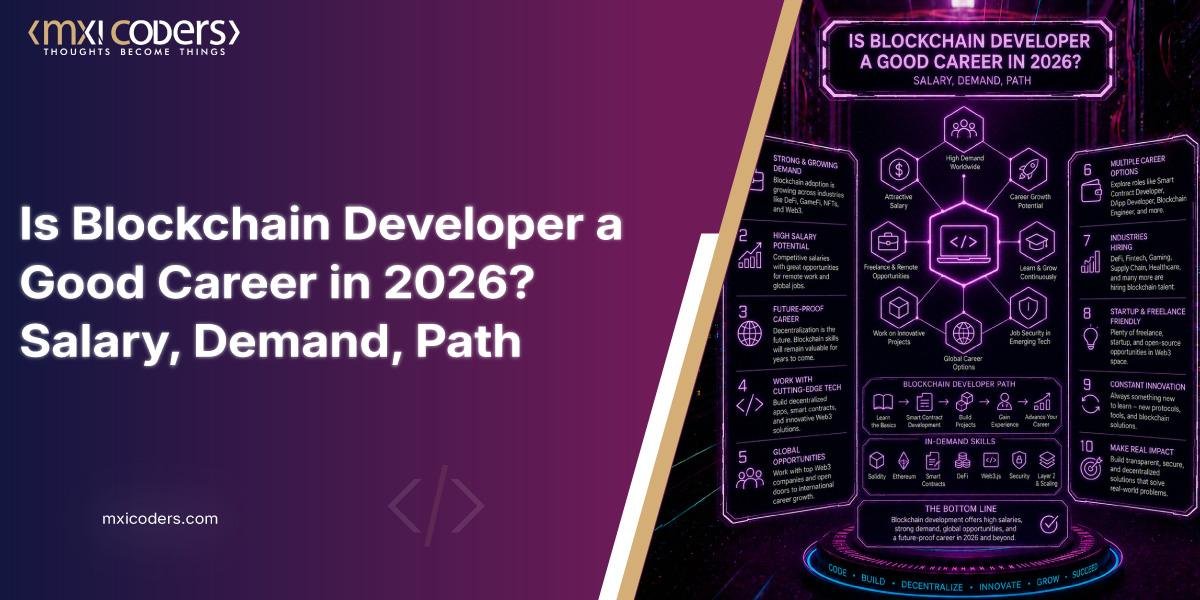
is blockchain developer a good career in 2026 (blog image)

Yes, blockchain developer is still a strong career choice in 2026 for anyone with solid programming fundamentals. National salary averages sit between $139,715 and $161,000 depending on the source, senior and specialized roles regularly clear $200,000, and labor market data shows tens of thousands of active blockchain developer jobs globally rather than a shrinking niche.

➤ How Much Does a Blockchain Developer Salary Actually Look Like in 2026?

There isn’t one number, because different data sources sample different populations, and the gap between them tells you something useful on its own. Glassdoor’s broad sample of blockchain developer salaries puts the national average at $139,715 a year, with a typical range of $111,373 to $177,320 and top earners pushing past $218,000. Staffing firm KORE1’s 2026 salary guide shows how much the picture shifts depending on who’s answering. ZipRecruiter’s sample lands far lower, around $111,845 on average, largely because it captures more remote and small-shop listings that Glassdoor’s respondent pool doesn’t reach.

City matters more than most job seekers expect. Glassdoor’s location-specific data shows a blockchain developer salary of $160,933 in New York, roughly 15 percent above the national figure, and $179,311 in San Francisco, about 28 percent higher. Los Angeles sits closer to the middle at $157,301. If you’re comparing offers, adjust for city before you compare the base number at all, otherwise you’re comparing apples sitting in completely different cost-of-living baskets.

Seniority and specialization shift the number just as much as geography does. Glassdoor’s data on senior-specific roles puts the average senior blockchain developer salary at $143,609, which actually reads lower than some general “blockchain developer” figures until you notice the sample size is small and skews toward roles that include heavy equity or token components not captured in base pay. Where the real ceiling shows up is in Web3-native hiring outside the general aggregators. Job boards built specifically for crypto and Web3 list senior smart-contract and Solidity engineers well past $185,000 base, and protocols like Ondo Finance and Chainlink Labs have posted senior smart-contract roles into the low $200,000s before token allocation.

A few patterns hold up across every source I checked.

Specialization pays. Solidity and smart contract work, especially anything touching DeFi or Layer 2 scaling, consistently sits above general blockchain engineering roles.

Location still matters even for remote roles. Companies frequently anchor pay bands to where the role is legally based, not where the developer happens to sit.

Shipped work outweighs credentials. Hiring managers I’ve worked with consistently rank a track record of deployed, audited smart contracts above certificates or bootcamp completions when setting an offer.

In practice, I’ve seen junior developers coming out of six-month bootcamps land first roles in the $70,000 to $90,000 range, while engineers with three or more years of Solidity experience and an actual audit track record pull offers north of $160,000 base before any token or equity component gets added. That gap is almost entirely about demonstrated, shippable experience rather than years on a resume.

➤ How Many Blockchain Developer Jobs Are Actually Open Right Now?

Demand is real, but it looks different than the hiring waves of 2021 and 2022, and the labor-market data backs that up in a way salary figures alone can’t. According to a 2026 crypto and Web3 hiring analysis, LinkedIn’s blockchain-related job postings have stabilized at roughly 18,000 active listings globally, while Indeed shows around 12,000 crypto-specific openings across experience levels. Those figures span technical development, compliance, and business roles, not just engineering, but the technical share remains the largest single category.

Crypto-native job boards tell a fuller story on the developer-specific side. Career resource site web3.career reported more than 73,000 live blockchain roles as of May 2026, including a meaningful contract and freelance subset, since protocols regularly need short-term smart contract or integration work that doesn’t justify a full-time hire. That’s a very different number than the LinkedIn count, largely because it aggregates crypto-native boards that general platforms don’t fully index.

The nature of the demand has shifted too, and this matters more than the raw counts. A 2026 fintech careers report notes that speculative roles have decreased while infrastructure and governance roles have increased, with hiring now driven by regulatory clarity and institutional adoption rather than token price cycles. Practically, that means fewer roles built around a single project’s speculative token launch, and more roles tied to supply chain tracking, tokenized assets, cross-border payments, and digital identity systems that don’t disappear when a coin price drops.

Market sizing backs up the demand story at the industry level. Grand View Research valued the global blockchain technology market at $57.7 billion in 2025, projecting growth to $108.3 billion in 2026 at a compound annual growth rate of 88.2 percent through 2033. Market growth of that size historically translates into sustained engineering headcount rather than a short-lived spike, though it’s fair to note that market-size projections and actual hiring don’t always move in lockstep, so treat that figure as directional rather than a hiring guarantee.

Job posting volume has also stayed genuinely volatile month to month, which is worth being honest about rather than glossing over. Zero To Mastery’s tech job market tracker has repeatedly flagged double-digit swings in blockchain job postings from one month to the next, at one point noting open positions up over 70 percent versus the prior month, then down 71 percent the month after that. The underlying trend line is upward, but anyone job hunting in this field should expect noisy, uneven posting volume rather than a smooth ramp.

If you’re weighing blockchain against adjacent engineering paths, here’s how the main routes compare.

Career PathCore MechanismBest Fit ForTrade-off
Smart Contract DeveloperWrites and audits self-executing code on chains like EthereumDevelopers who enjoy security-critical, detail-heavy workHigh responsibility, since bugs can mean irreversible financial loss
Blockchain Solution ArchitectDesigns system-level architecture and chain selectionExperienced engineers who like big-picture designRequires years of hands-on blockchain experience first
DApp DeveloperBuilds user-facing apps on top of smart contractsDevelopers with existing frontend or full-stack skillsStill needs solid Web3.js or ethers.js knowledge
Blockchain ConsultantAdvises companies on adoption strategyStrong communicators with broad technical groundingLess hands-on coding, more business and stakeholder work

➤ What Does It Cost to Hire a Blockchain Developer?

If you’re hiring rather than job hunting, the number you actually need isn’t a salary figure, it’s an all-in cost, and that varies enormously by engagement model. Agency pricing tends to be the most transparent starting point. Clutch’s July 2026 pricing data shows blockchain development agencies commonly charging $25 to $49 an hour, based on verified client reviews, though that’s a headline rate and doesn’t reflect the full scope of a larger engagement.

Freelance rates span a much wider range depending on the platform and vetting level. According to a 2026 freelance blockchain developer breakdown, Upwork’s entry tier runs $20 to $60 an hour, mid-level freelancers on Upwork run $50 to $120, and vetted marketplaces like Arc.dev or Toptal push that up to $80 to $250 an hour depending on seniority. Arc.dev’s own 2026 data puts the typical blockchain developer hourly rate at $81 to $100. A separate cost-to-hire analysis breaks it down by tier: expect $41 to $60 an hour for entry-level work, $60 to $100 for mid-level, and $100 to $150-plus for senior developers with deep protocol knowledge, with the global average hovering near $78 an hour across regions.

Project-based pricing is where the picture becomes clearer if you’re scoping a specific build rather than a headcount. A 2026 buyer’s guide puts simple smart contracts at $3,000 to $8,000, complete DeFi protocols at $25,000 to $75,000, and comprehensive dApp projects, including security auditing and deployment support, at $50,000 to $200,000 through an established company. That same guide is direct about when each option actually makes sense: choose a company when your project has multiple moving parts, enterprise compliance requirements, or serious security exposure, and companies generally deliver better value than solo freelancers for anything requiring ongoing maintenance.

A few things consistently separate a well-run hire from an expensive mistake, in my experience reviewing vendor proposals for clients weighing this decision.

Rate alone tells you almost nothing. A freelancer quoting $45 an hour could be genuinely skilled, or could be learning smart contract security on your production code. Ask for a GitHub history and, ideally, a prior audit report before rate ever enters the conversation.

Contract work suits bounded scopes. A single audit before launch, a migration to a new chain, or a proof of concept with a hard deadline rarely justifies a full-time hire, and the crypto industry is more comfortable with contract engagements than most.

Agencies absorb risk that solo freelancers can’t. If a smart contract vulnerability slips through on a project with real assets at stake, a company with a security process and team redundancy has more capacity to catch it, and more accountability if it doesn’t.

The highest-rate niche worth knowing about, even if it’s not your first hire, is smart contract security auditing specifically. Independent senior auditors reportedly charge $500 to $1,500 an hour for pre-launch reviews, which sounds steep until you compare it against the cost of a live exploit on an unaudited contract holding real funds.

➤ What Skills Do You Actually Need to Land Blockchain Developer Jobs?

You need working proficiency in at least one blockchain-native language, most commonly Solidity for Ethereum-based work or Rust for chains like Solana. Beyond syntax, you need a working grasp of how consensus mechanisms, cryptographic hashing, and decentralized architecture actually function, because blockchain bugs behave very differently from a typical web app bug. A logic error in a smart contract isn’t a bad user experience, it’s frequently an irreversible loss of real money.

A handful of practical skills come up constantly in real hiring conversations, not just on job description checklists.

Smart contract auditing. Being able to spot reentrancy bugs, integer overflow, and access control mistakes before code ships is the single most valued skill in the current market, given how much hiring has shifted toward infrastructure and security-conscious roles.

Testing frameworks. Familiarity with tools like Hardhat or Foundry for writing and running contract tests separates candidates who can talk about smart contracts from candidates who can actually ship them safely.

Cross-chain awareness. Understanding how a project’s choice of chain, whether that’s Ethereum, Solana, Polygon, or something else, changes the tooling, gas economics, and constraints you’re working within.

Soft skills matter more here than most engineers expect going in. You’ll frequently be explaining irreversible, high-stakes design decisions to non-technical stakeholders who are trusting you with real financial exposure, so being able to communicate risk in plain language is a genuine differentiator, not a nice-to-have bullet point on a resume.

➤ Do You Need a Computer Science Degree to Break Into Blockchain?

No, a degree isn’t required, but you do need to demonstrate equivalent depth some other way. Employers consistently care more about a working portfolio, contributions to open-source blockchain projects, or a track record of shipped, auditable smart contracts than about a diploma. That said, a computer science background does make the underlying data structures and algorithms easier to pick up quickly, so self-taught developers often need to deliberately study those fundamentals rather than jumping straight into Solidity syntax and hoping the gaps don’t show.

A reasonable starting sequence looks like this in practice. Learn a general-purpose language first, since Python or JavaScript both work well for building programming fundamentals. Move into blockchain fundamentals next, focusing on how blocks, consensus, and cryptographic signatures actually function under the hood rather than memorizing buzzwords. Then specialize in Solidity or Rust and start building small, real projects such as a basic token contract or a simple voting DApp, something you can point to and walk through line by line in an interview without hesitating.

➤ What Are the Honest Limitations of a Blockchain Developer Career?

This isn’t a career without friction, and it’s worth being direct about the downside before you commit six months of study to it. Tooling changes fast. What counted as Solidity best practice two years ago has already shifted more than once, so ongoing learning genuinely isn’t optional the way it might be in a more mature stack.

Competition for the most visible roles, especially at well-known protocols, is intense, and many postings draw well over a hundred applicants for a single opening. Token-based compensation at early-stage projects can be volatile in a way base salary isn’t, and a package that looks generous on paper can lose a meaningful chunk of its real value if the token price drops before it vests.

Breaking in without prior experience is also genuinely harder than breaking into general web development, since fewer companies are set up to train junior blockchain hires from scratch the way larger software companies run structured junior programs. And the job posting volatility mentioned earlier in the demand section cuts both ways. It’s a real market, but it’s not always a smooth or predictable one month to month, so budget for a job search that might take longer than a comparable general software role.

➤ Frequently asked questions

  1. Is blockchain development a stable long-term career, or is it tied to crypto hype cycles?
    It’s become more stable than it was during the 2021 to 2022 speculative boom. Current hiring is increasingly tied to enterprise adoption in payments, supply chain, and identity verification rather than purely to token prices, though crypto market swings still affect hiring specifically at crypto-native firms and DeFi protocols more than at enterprise blockchain teams.
  2. What’s the difference between a blockchain developer and a smart contract developer?
    Blockchain developer is the broader title, covering architecture, infrastructure, and application-layer work across a system. Smart contract developer is a specialization focused specifically on writing and auditing the on-chain code that executes automatically once set conditions are met, and it typically commands a pay premium over general blockchain roles.
  3. How much does it actually cost to hire a blockchain developer for a small project?
    For a bounded scope like a single smart contract or a security audit before launch, expect $3,000 to $8,000 through an established company, or an hourly rate of roughly $41 to $150 depending on seniority if you’re hiring a freelancer directly. Larger dApp builds with auditing and deployment support typically run $50,000 to $200,000.
  4. How long does it realistically take to become job-ready?
    For someone who already codes in another language, six to twelve months of focused study and project building is a realistic range. For a complete beginner, expect closer to eighteen months to two years, since you’re learning general programming fundamentals and blockchain-specific concepts at the same time rather than layering one onto the other.
  5. Can I work as a blockchain developer remotely, and are there really enough blockchain jobs to make that practical?
    Yes, remote work is common in this field, more so than in many traditional software roles, since a large share of blockchain hiring happens at distributed, crypto-native companies with no central office. Between LinkedIn’s roughly 18,000 stabilized global listings, Indeed’s crypto-specific postings, and the tens of thousands of roles aggregated on crypto-native boards, the market has enough depth to support a genuine remote job search, even if posting volume varies noticeably month to month.

➤ Conclusion

Blockchain development still holds up as a strong career choice heading into 2026, but not for the reasons the hype cycle sold a few years back. The pay is real and consistently above general software developer averages, the market growth numbers back up continued hiring rather than a temporary spike, and the work itself sits at a genuinely interesting intersection of cryptography, distributed systems, and financial infrastructure. What’s changed is that success now depends less on catching a speculative wave and more on building durable, auditable skills, particularly around smart contract security, that hold their value regardless of what any single token happens to be doing that week. For anyone hiring rather than job hunting, the same shift applies in reverse: the developers worth paying a premium for are the ones who can point to shipped, audited work, not just a resume full of buzzwords.

Ready to build blockchain capability instead of chasing individual candidates one hire at a time? Mxicoders offers blockchain development and smart contract development services, and can help you hire a dedicated blockchain developer matched to your project’s scope and timeline. Book a free consultation to talk through your specific use case.

➤ Sources Used

  • Glassdoor: Blockchain Developer Salary, 2026
  • Glassdoor: Blockchain Developer Salary, New York NY, July 2026
  • Glassdoor: Blockchain Developer Salary, San Francisco CA, July 2026
  • Glassdoor: Blockchain Developer Salary, Los Angeles CA, July 2026
  • Glassdoor: Senior Blockchain Developer Salary, 2026
  • KORE1: Blockchain Developer Salary Guide 2026
  • Bitget Academy: Crypto and Web3 Jobs 2026, LinkedIn and Indeed Hiring Guide, March 2026
  • web3.career: Freelance Blockchain Developer 2026 Guide, June 2026
  • Fintech Careers: Crypto and Blockchain Jobs in 2026, February 2026
  • Grand View Research: Blockchain Technology Market Size Report, 2026 to 2033
  • Zero To Mastery: Tech Job Market Trends Monthly, June 2026
  • Clutch: Blockchain Development Pricing Guide, July 2026
  • theblockopedia: Blockchain Development Company vs Freelancer 2026 Guide, June 2026
  • Arc.dev: Blockchain Developer Hourly Rate 2026
  • Flexiple: Cost to Hire a Blockchain Developer

Feel free to Connect us on

Ready to transform your business with smart software solutions?

Harness the power of custom software development to streamline operations, reduce costs, and boost efficiency. Start by exploring cutting-edge approaches like cloud-native platforms, API-first architecture, and AI-driven automation to future-proof your systems and stay ahead of the competition.

Book free consultation

Let’s build your idea together and serve society.

Author

Ashok Rathod

Tech Consultant

Experience
25 Years
Growth Architect for Startups & SMEs | Blockchain, AI , MVP Development, & Data-Driven Marketing Expert.

Transform the Carbon Credit Industry

Build a Transparent, Scalable Carbon Credit Marketplace with Blockchain.

Let's build something real!

Share your ideas with us and we’ll turn them into powerful digital solutions.

500+

Projects

8+

Experience

255+

Clients

Tell us about your project

Our team will get back to you within 24 hours