[ Your Headline ] [ Highlight Word ]

[ One or two lines describing the offer — e.g. "Experience our services with a FREE 30-minute consultation." ]

[ Optional second line, e.g. "Have a concept in mind? Let's brainstorm together!" ]

Google ★★★★★ 4.8
GoodFirms ★★★★★ 4.7
Clutch ★★★★★ 5.0
Blockchain

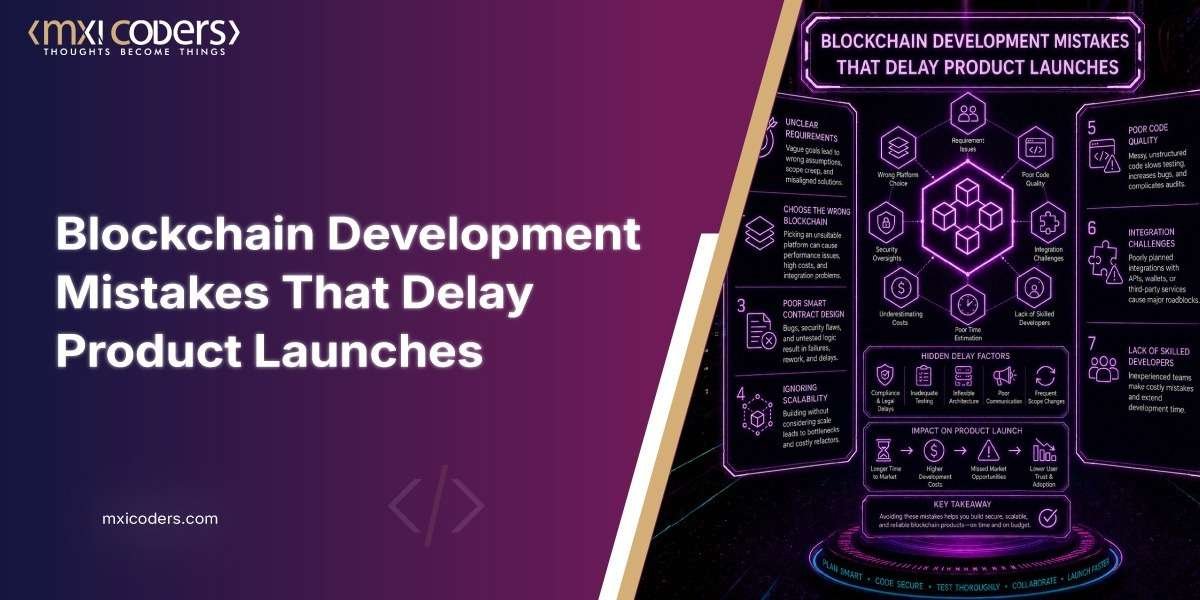
Blockchain Development Mistakes That Delay Product Launches

hitesh s

Posted on
25th Aug 2026
7 min
Read
Share

Table of Contents

  • Quick Tips
  • Familiarize yourself with Cash App
  • Enable two-factor authentication
  • Utilize the optional Cash App
  • Conclusion

Launch delays in blockchain projects are rarely a mystery once you look at the data. Nearly 80% of new blockchain startups fail within their first year, and CertiK reported over $370 million in crypto losses in January 2026 alone, with most incidents traced back to rushed audits, skipped architecture reviews, and process failures rather than sophisticated attacks. Once a smart contract is live, it is largely immutable, which means a mistake caught after deployment is not a quick bug fix but a permanent liability sitting on-chain. This guide breaks down the most common mistakes that push blockchain launches past their deadline, and what teams can do differently to avoid becoming another statistic.

➤ Why Blockchain Projects Miss Their Launch Dates

Traditional software delays are usually recoverable. A blockchain launch delay is often the result of a team discovering, late in the process, that a mistake made months earlier cannot simply be patched.

➥ The Core Reason Blockchain Timelines Slip

  • Contracts are immutable once deployed, so errors surface as expensive rework rather than routine bug fixes
  • Teams frequently underestimate how different smart contract development is from traditional software cycles
  • Security reviews get compressed at the end of a project instead of built in throughout

Also Read: 7 Blockchain Security Risks Every Business Should Know

➤ Common Blockchain Development Mistakes that Delays Product Launch

➥ Mistake 1: Treating Smart Contract Development Like Standard Software

Many teams approach smart contract work with a design, write, test, ship mentality borrowed from conventional app development. This approach consistently breaks down because a smart contract cannot be updated the way a mobile app can with a quick patch release.

Why This Approach Fails

  • Bugs in production are permanent unless the contract was specifically designed with upgrade mechanisms
  • Skipping architecture reviews early on means costly redesigns once the contract is nearly finished
  • Teams often discover integration issues with external systems only after most of the code is already written

A properly structured smart contract development lifecycle treats testing, auditing, and deployment as distinct phases, each with its own checkpoints, rather than a single linear rush to mainnet.

➥ Mistake 2: Skipping or Rushing Security Audits

Given that access control flaws alone have led to hundreds of millions of dollars in losses, treating an audit as a final formality rather than a core project phase is one of the most damaging mistakes a team can make.

  • Comprehensive audits typically cost between $20,000 and $150,000 depending on contract complexity, and rushing this step to save time usually costs far more later
  • First-pass audits almost always surface findings, and fix-and-re-audit cycles need to be budgeted into the timeline from the start
  • Choosing an auditor based only on price rather than track record often results in surface-level reviews that miss deeper logic flaws

➥ Mistake 3: Ignoring Gas Optimization Until It’s Too Late

Poorly optimized contracts do not just cost users more at transaction time, they can also create scalability problems that surface only under real network load. Applying gas optimization techniques early in development, rather than retrofitting them after the contract is functionally complete, prevents a scramble to rewrite core logic close to launch.

  • Batch operations and efficient storage patterns reduce both cost and execution time
  • Testing gas consumption under realistic transaction volume catches issues that a small-scale test environment will miss
  • Refactoring for gas efficiency late in development often introduces new bugs that require another full testing cycle

➥ Mistake 4: Underestimating Enterprise Requirements

Consumer-facing token projects and enterprise blockchain builds face very different constraints, and applying a consumer development timeline to an enterprise project is a common source of delay. Projects pursuing custom enterprise blockchain development often need permissioned network architecture, compliance documentation, and integration with legacy internal systems, all of which add review cycles that a typical consumer app timeline does not account for.

What Enterprise Projects Often Miss Early

  • Governance and access-control requirements that only surface during legal or compliance review
  • Integration testing against existing internal systems, which is frequently scheduled far too late
  • Underestimating the time needed for stakeholder sign-off across legal, security, and business teams

➥ Mistake 5: Choosing the Wrong Development Partner

Not every team building a blockchain product has deep in-house Solidity or architecture expertise, and misjudging that gap early on is one of the most common root causes of missed deadlines. Working with an experienced custom enterprise blockchain development company from the start can shorten the discovery and testing phases meaningfully, since a team that has already built and shipped similar systems avoids the trial-and-error cycles that first-time builders often fall into.

  • Verify a potential partner’s track record with projects of similar scope and complexity
  • Ask specifically how they handle audit findings and fix-and-re-audit cycles, not just whether they offer audits
  • Confirm whether ongoing smart contract development service support is included post-launch, since most launch delays trace back to inadequate planning during this exact phase

➥ Mistake 6: Deferring Testing Until the End of the Project

Stress testing, integration testing, and edge case testing each surface different classes of problems, and skipping any of them dramatically increases the odds of a costly post-launch discovery.

  • Unit testing validates individual functions in isolation before anything else happens
  • Integration testing confirms contracts interact correctly with other contracts and external systems
  • Stress testing simulates high transaction volumes to catch performance bottlenecks before real users do
  • Edge case testing explores unusual or unexpected user behavior that real-world usage inevitably produces

➥ Mistake 7: Poor Communication Between Technical and Business Teams

Delays often trace back to misalignment rather than pure technical failure. When business stakeholders and development teams are not synced on scope and priorities, requirements shift mid-project, forcing rework that could have been avoided with clearer upfront planning.

  • Lock core requirements before development begins, treating changes as exceptions rather than routine
  • Schedule regular technical reviews with non-technical stakeholders so scope creep is caught early
  • Document decisions around architecture and security tradeoffs so the reasoning is not lost mid-project

➤ Frequently Asked Questions

  1. What is the single biggest cause of blockchain launch delays? Rushed or skipped security audits are consistently cited as the leading cause, since discovering a serious flaw close to launch often forces teams back into architecture and testing phases they assumed were complete.
  2. How much extra time should be budgeted for smart contract audits? Beyond the initial audit window, teams should budget an additional four to eight weeks for fix-and-re-audit cycles, since first-pass audits almost always surface findings that require rework.
  3. Does hiring an experienced development partner actually reduce launch delays? Generally yes. Teams with prior experience shipping similar systems tend to avoid the discovery-phase mistakes that commonly extend timelines for first-time blockchain builders.

➤ Building a Timeline That Avoids These Mistakes

A realistic blockchain launch timeline treats architecture review, testing, and auditing as sequential, non-negotiable phases rather than tasks to compress under deadline pressure. Locking scope early, budgeting real time for audit and fix cycles, and syncing technical and business teams regularly are the habits that most reliably separate projects that launch on schedule from those stuck explaining yet another delay.

➤ Conclusion

Blockchain launch delays rarely come from a single catastrophic error. They accumulate through a series of avoidable mistakes: treating immutable contracts like ordinary software, rushing audits, ignoring gas efficiency until late in the process, and underestimating what enterprise-grade requirements actually demand. Teams that respect each phase of development, particularly testing and auditing, consistently launch closer to their original timeline and with far fewer expensive surprises after going live.
➤ References

  1. CoinLaw, Smart Contract Security Risks and Audits Statistics 2026
  2. Antier Solutions, Smart Contract Development Guide for Enterprises 2026
  3. CryptoTicker, Why Crypto Projects Are Failing: The Hidden Truth Behind the 2026 Stagnation
  4. 2Tokens, Why 2026 Financial Systems Must Plan for Smart Contract Failure

blockchain development mistakes that delay product launches

Launch delays in blockchain projects are rarely a mystery once you look at the data. Nearly 80% of new blockchain startups fail within their first year, and CertiK reported over $370 million in crypto losses in January 2026 alone, with most incidents traced back to rushed audits, skipped architecture reviews, and process failures rather than sophisticated attacks. Once a smart contract is live, it is largely immutable, which means a mistake caught after deployment is not a quick bug fix but a permanent liability sitting on-chain. This guide breaks down the most common mistakes that push blockchain launches past their deadline, and what teams can do differently to avoid becoming another statistic.

➤ Why Blockchain Projects Miss Their Launch Dates

Traditional software delays are usually recoverable. A blockchain launch delay is often the result of a team discovering, late in the process, that a mistake made months earlier cannot simply be patched.

➥ The Core Reason Blockchain Timelines Slip

  • Contracts are immutable once deployed, so errors surface as expensive rework rather than routine bug fixes
  • Teams frequently underestimate how different smart contract development is from traditional software cycles
  • Security reviews get compressed at the end of a project instead of built in throughout

Also Read: 7 Blockchain Security Risks Every Business Should Know

➤ Common Blockchain Development Mistakes that Delays Product Launch

➥ Mistake 1: Treating Smart Contract Development Like Standard Software

Many teams approach smart contract work with a design, write, test, ship mentality borrowed from conventional app development. This approach consistently breaks down because a smart contract cannot be updated the way a mobile app can with a quick patch release.

Why This Approach Fails

  • Bugs in production are permanent unless the contract was specifically designed with upgrade mechanisms
  • Skipping architecture reviews early on means costly redesigns once the contract is nearly finished
  • Teams often discover integration issues with external systems only after most of the code is already written

A properly structured smart contract development lifecycle treats testing, auditing, and deployment as distinct phases, each with its own checkpoints, rather than a single linear rush to mainnet.

➥ Mistake 2: Skipping or Rushing Security Audits

Given that access control flaws alone have led to hundreds of millions of dollars in losses, treating an audit as a final formality rather than a core project phase is one of the most damaging mistakes a team can make.

  • Comprehensive audits typically cost between $20,000 and $150,000 depending on contract complexity, and rushing this step to save time usually costs far more later
  • First-pass audits almost always surface findings, and fix-and-re-audit cycles need to be budgeted into the timeline from the start
  • Choosing an auditor based only on price rather than track record often results in surface-level reviews that miss deeper logic flaws

➥ Mistake 3: Ignoring Gas Optimization Until It’s Too Late

Poorly optimized contracts do not just cost users more at transaction time, they can also create scalability problems that surface only under real network load. Applying gas optimization techniques early in development, rather than retrofitting them after the contract is functionally complete, prevents a scramble to rewrite core logic close to launch.

  • Batch operations and efficient storage patterns reduce both cost and execution time
  • Testing gas consumption under realistic transaction volume catches issues that a small-scale test environment will miss
  • Refactoring for gas efficiency late in development often introduces new bugs that require another full testing cycle

➥ Mistake 4: Underestimating Enterprise Requirements

Consumer-facing token projects and enterprise blockchain builds face very different constraints, and applying a consumer development timeline to an enterprise project is a common source of delay. Projects pursuing custom enterprise blockchain development often need permissioned network architecture, compliance documentation, and integration with legacy internal systems, all of which add review cycles that a typical consumer app timeline does not account for.

What Enterprise Projects Often Miss Early

  • Governance and access-control requirements that only surface during legal or compliance review
  • Integration testing against existing internal systems, which is frequently scheduled far too late
  • Underestimating the time needed for stakeholder sign-off across legal, security, and business teams

➥ Mistake 5: Choosing the Wrong Development Partner

Not every team building a blockchain product has deep in-house Solidity or architecture expertise, and misjudging that gap early on is one of the most common root causes of missed deadlines. Working with an experienced custom enterprise blockchain development company from the start can shorten the discovery and testing phases meaningfully, since a team that has already built and shipped similar systems avoids the trial-and-error cycles that first-time builders often fall into.

  • Verify a potential partner’s track record with projects of similar scope and complexity
  • Ask specifically how they handle audit findings and fix-and-re-audit cycles, not just whether they offer audits
  • Confirm whether ongoing smart contract development service support is included post-launch, since most launch delays trace back to inadequate planning during this exact phase

➥ Mistake 6: Deferring Testing Until the End of the Project

Stress testing, integration testing, and edge case testing each surface different classes of problems, and skipping any of them dramatically increases the odds of a costly post-launch discovery.

  • Unit testing validates individual functions in isolation before anything else happens
  • Integration testing confirms contracts interact correctly with other contracts and external systems
  • Stress testing simulates high transaction volumes to catch performance bottlenecks before real users do
  • Edge case testing explores unusual or unexpected user behavior that real-world usage inevitably produces

➥ Mistake 7: Poor Communication Between Technical and Business Teams

Delays often trace back to misalignment rather than pure technical failure. When business stakeholders and development teams are not synced on scope and priorities, requirements shift mid-project, forcing rework that could have been avoided with clearer upfront planning.

  • Lock core requirements before development begins, treating changes as exceptions rather than routine
  • Schedule regular technical reviews with non-technical stakeholders so scope creep is caught early
  • Document decisions around architecture and security tradeoffs so the reasoning is not lost mid-project

➤ Frequently Asked Questions

  1. What is the single biggest cause of blockchain launch delays? Rushed or skipped security audits are consistently cited as the leading cause, since discovering a serious flaw close to launch often forces teams back into architecture and testing phases they assumed were complete.
  2. How much extra time should be budgeted for smart contract audits? Beyond the initial audit window, teams should budget an additional four to eight weeks for fix-and-re-audit cycles, since first-pass audits almost always surface findings that require rework.
  3. Does hiring an experienced development partner actually reduce launch delays? Generally yes. Teams with prior experience shipping similar systems tend to avoid the discovery-phase mistakes that commonly extend timelines for first-time blockchain builders.

➤ Building a Timeline That Avoids These Mistakes

A realistic blockchain launch timeline treats architecture review, testing, and auditing as sequential, non-negotiable phases rather than tasks to compress under deadline pressure. Locking scope early, budgeting real time for audit and fix cycles, and syncing technical and business teams regularly are the habits that most reliably separate projects that launch on schedule from those stuck explaining yet another delay.

➤ Conclusion

Blockchain launch delays rarely come from a single catastrophic error. They accumulate through a series of avoidable mistakes: treating immutable contracts like ordinary software, rushing audits, ignoring gas efficiency until late in the process, and underestimating what enterprise-grade requirements actually demand. Teams that respect each phase of development, particularly testing and auditing, consistently launch closer to their original timeline and with far fewer expensive surprises after going live.

➤ References

  1. CoinLaw, Smart Contract Security Risks and Audits Statistics 2026
  2. Antier Solutions, Smart Contract Development Guide for Enterprises 2026
  3. CryptoTicker, Why Crypto Projects Are Failing: The Hidden Truth Behind the 2026 Stagnation
  4. 2Tokens, Why 2026 Financial Systems Must Plan for Smart Contract Failure

Feel free to Connect us on

Ready to transform your business with smart software solutions?

Harness the power of custom software development to streamline operations, reduce costs, and boost efficiency. Start by exploring cutting-edge approaches like cloud-native platforms, API-first architecture, and AI-driven automation to future-proof your systems and stay ahead of the competition.

Book free consultation

Let’s build your idea together and serve society.

Author

hitesh s

Experience

Transform the Carbon Credit Industry

Build a Transparent, Scalable Carbon Credit Marketplace with Blockchain.

Let's build something real!

Share your ideas with us and we’ll turn them into powerful digital solutions.

500+

Projects

20+

Experience

255+

Clients

Tell us about your project

Our team will get back to you within 24 hours