Self-executing code written directly into blockchain networks has quietly become one of the most transformative technologies of this decade. Smart contracts eliminate the need for intermediaries, automate trust, and execute agreements with precision that traditional systems struggle to match. The global blockchain market is projected to surpass $469 billion by 2030, and smart contracts sit at the core of that growth. From decentralized finance protocols processing billions in daily transactions to healthcare platforms securing patient consent records, adoption is accelerating across virtually every major industry.
Yet for all the promise, the path from idea to production-ready contract is far from simple. Bugs are notoriously expensive. In 2023 alone, blockchain exploits drained over $1.8 billion from protocols, with the majority of losses linked to vulnerabilities introduced during development. Businesses and developers who approach blockchain projects without a structured process are not just risking code quality; they are risking real financial and reputational damage.
This guide walks through every stage of the smart contract development lifecycle so you can build with clarity, confidence, and security.
➤ What Is the Smart Contract Development Lifecycle?
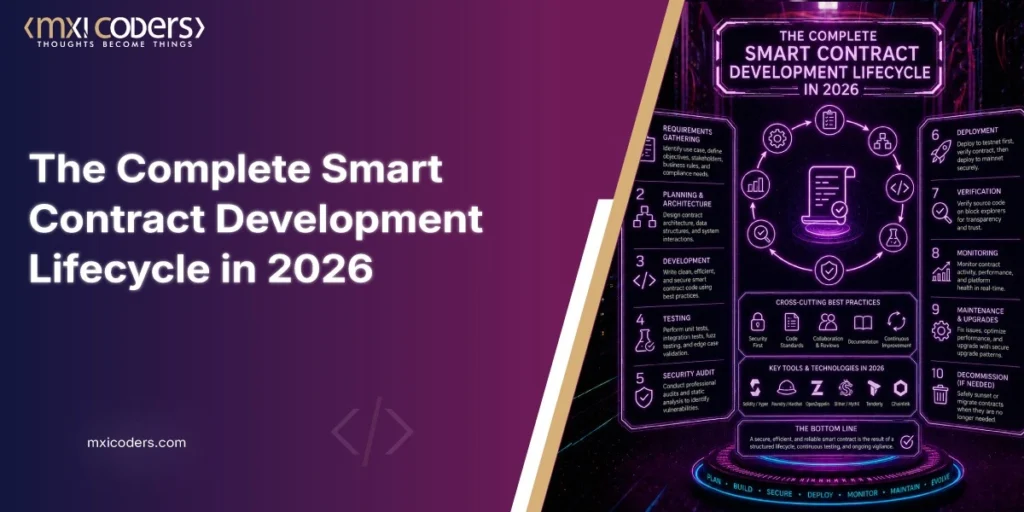
The smart contract development lifecycle is a structured, repeatable process that takes a blockchain project from initial business need to a deployed, monitored application. Unlike traditional software, smart contracts are immutable once deployed to most networks, which means errors cannot be patched with a simple update. Every decision made during development carries lasting consequences. The lifecycle exists to enforce discipline at every stage: planning, design, coding, testing, auditing, deployment, integration, and ongoing maintenance.
➥ Why Following a Structured Lifecycle Matters
A disciplined lifecycle reduces costly rework, tightens security, and shortens deployment timelines. It also helps teams meet the growing wave of regulatory expectations around blockchain applications, particularly in finance and healthcare. For any organization working with a smart contract development agency or building an in-house team, following a defined process is the clearest way to manage risk and deliver reliable results.
➤ Smart Contract Development Process: Key Stages Explained
Stage 1: Requirement Analysis and Project Planning
Every successful contract starts with honest answers to basic questions: What problem does this contract solve? What should it automate? What does success actually look like? Teams that skip this stage often build technically correct contracts that solve the wrong problem.
Platform selection also happens here. Ethereum remains the dominant choice for applications requiring deep tooling and developer ecosystems. Solana blockchain development suits use cases demanding high throughput and low transaction fees. Polygon, BNB Smart Chain, and Avalanche each offer distinct trade-offs around speed, cost, and decentralization. The choice of platform shapes every subsequent decision, so it deserves careful analysis up front.
Key deliverables at this stage include a business requirements document, technical specifications, and a blockchain selection roadmap.
Stage 2: Architecture and Design
With requirements locked, the team designs the contract’s internal logic. This means mapping out business rules, transaction workflows, and access permissions. Data structures are defined: storage variables, mappings, structs, and arrays, each chosen with gas efficiency in mind.
Security requirements are also established at this stage rather than bolted on later. Role-based access control, emergency pause mechanisms, and upgradeability patterns should be deliberate design decisions, not afterthoughts.
Stage 3: Development and Coding
Development begins with language selection. Solidity remains the language of choice for Ethereum and EVM-compatible chains. Rust is standard for Solana. Vyper offers a Python-like alternative prioritizing simplicity and auditability, while Move is gaining traction on newer chains built for resource-oriented programming.
Framework selection matters equally. Hardhat and Foundry are the dominant choices for modern smart contract development service workflows, offering robust testing environments, deployment scripting, and plugin ecosystems. Truffle, once the industry standard, has largely given way to these newer tools. Remix IDE remains useful for rapid prototyping and learning.
During coding, teams implement contract functions, configure event logging for on-chain transparency, and build out error handling to ensure contracts fail predictably rather than silently.
Stage 4: Testing and Quality Assurance
Testing is where most projects either earn or forfeit the right to deploy. Because deployed contracts cannot be easily changed, bugs discovered post-launch are often catastrophic. Every function must be validated in isolation through unit testing.
Integration testing confirms contracts interact with each other and with external systems as intended. Stress testing simulates high transaction volumes to surface performance bottlenecks, while edge case testing explores unexpected user behavior that real-world usage inevitably produces.
No amount of testing eliminates all risk, but skipping testing layers dramatically increases it.
Also Read: Top Benefits of Smart Contracts in Blockchain Technology in 2026
Stage 5: Security Auditing
Before any contract touches a mainnet, it should be reviewed by independent security professionals. The history of blockchain is littered with protocols that bypassed this step and paid dearly for it. Auditors systematically probe for reentrancy attacks, integer overflows, access control flaws, front-running vulnerabilities, and oracle manipulation.
A completed audit produces a vulnerability report, a risk assessment, and remediation recommendations. This documentation also serves a practical business purpose: it signals to users, investors, and partners that the project has been held to a professional standard.
Stage 6: Deployment
Deployment begins on a testnet, a sandboxed network that mirrors mainnet conditions without real financial stakes. Only after testnet validation does the team proceed to mainnet deployment.
Gas fees, network congestion, and bytecode optimization all require attention at this stage. Contracts are verified on block explorers after deployment, making source code publicly reviewable and building user trust.
Stage 7: Integration with dApps and External Systems
A deployed contract without a usable interface is a locked vault. Frontend applications connect via Web3 libraries, with wallet connectivity enabling users to sign and submit transactions directly. Oracle integration brings real-world data on-chain, supporting price feeds, event triggers, and external API inputs that contracts cannot access natively.
Off-chain systems handle data storage and business logic that would be too costly or impractical to run entirely on-chain, creating hybrid architectures that balance decentralization with practical efficiency.
Stage 8: Monitoring, Maintenance, and Upgrades
Production is not the finish line. Transaction tracking, event monitoring, and performance metrics give teams visibility into how contracts behave in the wild. When updates are necessary, proxy patterns and governance-controlled upgrade mechanisms allow changes without full redeployment in systems built for upgradeability. Ongoing security management, including bug bounty programs and continuous audits, keeps contracts resilient against evolving threat landscapes.
➤ Best Practices for a Successful Smart Contract Development Process
Start with clear, documented requirements. Prioritize security from the first line of design, not the last day before launch. Use established frameworks and audited libraries rather than reinventing foundational logic. Test in multiple rounds across multiple environments. Invest in professional security audits regardless of contract complexity. Plan for long-term maintenance from day one, because the most valuable contracts are the ones that operate reliably for years.
➤ Final Thoughts
The smart contract development process is not bureaucratic overhead. It is the systematic process that separates projects that endure from those that collapse under their own complexity or fall to a single exploited vulnerability. As Ethereum development tooling matures and cross-chain interoperability expands, the technical landscape will keep evolving. What will not change is the fundamental need for planning, rigorous testing, and independent auditing at every stage. Businesses that commit to this process do not just ship better code; they build the kind of trust that blockchain applications ultimately depend on.
The smart contract development lifecycle consists of requirement analysis, architecture design, coding, testing, auditing, deployment, integration, and ongoing maintenance. Following each stage systematically ensures secure, scalable, and reliable blockchain applications.