Blockchain,Tokenization

Solana Blockchain Tokenization Capabilities Explained

Ashok Rathod

Tech Consultant

Posted on
18th May 2026
6 min
Read
Share

Table of Contents

  • Quick Tips
  • Familiarize yourself with Cash App
  • Enable two-factor authentication
  • Utilize the optional Cash App
  • Conclusion

The financial world is undergoing a quiet but profound transformation. Assets that once required mountains of paperwork, weeks of settlement, and layers of intermediaries are now being moved on-chain, represented as digital tokens on a blockchain. This shift toward real world asset tokenization is no longer experimental. It’s happening across industries, at scale, right now.

At the center of this movement is a fundamental requirement: the blockchain infrastructure must be fast, affordable, and capable of handling millions of transactions without grinding to a halt. Slow networks and high gas fees make tokenization impractical. That’s where Solana enters the picture.

Solana is a high-performance Layer 1 blockchain engineered specifically for speed and scalability. With near-instant settlement times, minimal transaction costs, and a robust security model, it provides the technical foundation that serious tokenization projects demand.

The industries recognizing this potential span a wide spectrum from finance and real estate to gaming, supply chain management, and digital identity verification. Each of these sectors stands to gain from moving assets on-chain, and Solana’s architecture makes that transition viable at an enterprise level.

➤ What Is Blockchain Tokenization?

➥ Definition of Tokenization

Tokenization is the process of converting ownership rights over a real-world or digital asset into a blockchain-based token. Instead of holding a paper deed, a stock certificate, or a warehouse receipt, ownership is represented digitally as a programmable token on a public or permissioned blockchain.

This token can be transferred, traded, subdivided, or held, all without the friction of traditional financial infrastructure.

➥ Types of Tokenized Assets

The range of assets that can be tokenized is remarkably broad:

  • Real estate: residential, commercial, and industrial properties
  • Stocks and securities: equity and debt instruments
  • Commodities: gold, oil, agricultural products
  • Art and collectibles: physical or digital creative works
  • Intellectual property: music rights, patents, licensing agreements
  • Stablecoins: fiat currency represented on-chain

Each of these asset classes benefits from being brought onto a transparent, programmable ledger.

➥ Why Tokenization Matters

The deeper value of asset tokenization lies in what it unlocks. Illiquid assets like a commercial building or a fine art collection become tradeable in secondary markets. Fractional ownership lowers the barrier to entry, allowing smaller investors to participate in asset classes that were previously inaccessible. Transactions settle faster, sometimes in seconds rather than days. And because everything is recorded on a public ledger, transparency and auditability improve dramatically. Global accessibility means a buyer in Mumbai can own a fraction of a property in Miami without navigating a maze of cross-border regulations.

➤ What Is Solana Blockchain?

➥ Overview of Solana

Solana is a high-performance, Layer 1 blockchain launched in 2020. It was built from the ground up to solve the scalability limitations that plagued earlier blockchain networks. Where other chains prioritized decentralization at the expense of speed, Solana pursued all three decentralization, security, and scalability simultaneously.

➥ Key Features of Solana

Four technical characteristics make Solana particularly well-suited for tokenization:

Low transaction costs: average fees on Solana are fractions of a cent, making high-frequency tokenized transactions economically viable.

High throughput: Solana can theoretically handle up to 65,000 transactions per second, far exceeding most competing networks.

Fast finality: transactions achieve confirmation in under a second, enabling real-time asset transfers.

Energy efficiency: Solana’s Proof of History consensus mechanism is significantly more energy-efficient than traditional Proof of Work systems.

➥ How Solana Differs from Traditional Blockchains

The architectural difference that sets Solana apart is its ability to process transactions in parallel rather than sequentially. Most legacy blockchains handle transactions one at a time, creating bottlenecks during periods of high demand. Solana’s parallel processing eliminates this congestion, delivering consistent performance even at scale, a critical requirement for institutional-grade tokenization platforms.

Also Read: How Tokenizing Real World Assets Is Changing Capital Markets

➤ Core Tokenization Capabilities of Solana

➥ Real-World Asset (RWA) Tokenization

Solana has emerged as a strong foundation for real estate tokenization, enabling fractional ownership of properties through programmable tokens. Beyond property, it supports commodity-backed tokens representing gold, energy, or agricultural products on-chain and tokenized financial instruments like bonds and private equity.

➥ NFT and Digital Asset Tokenization

The Solana ecosystem has a proven track record with non-fungible tokens. Gaming assets, in-game economies, music rights, and digital collectibles have all found a natural home on the network. Low fees make minting and trading NFTs accessible at a scale that other networks struggle to match.

➥ Fractional Ownership Models

One of Solana’s most democratizing capabilities is enabling genuine fractional ownership. A commercial property worth ₹10 crore can be divided into thousands of tokens, each representing a proportional ownership stake. This lowers investment barriers and opens new capital formation pathways for asset owners.

➥ Cross-Border Transactions

Traditional cross-border asset transfers involve correspondent banks, currency conversions, and multi-day settlement windows. On Solana, the same transfer happens in under a second, with minimal fees and no intermediaries. This makes global asset markets genuinely accessible.

➥ On-Chain Transparency

Every transaction on Solana is recorded on a public ledger permanently and immutably. This provides a level of auditability that legacy financial systems simply cannot match, reducing fraud risk and building trust among institutional participants.

➤ Benefits of Using Solana for Tokenization

➥ High-Speed Performance

Speed isn’t just a technical metric, it directly shapes user experience. Real-time asset transfers, instant settlement, and responsive trading interfaces are only possible when the underlying network performs consistently. Solana delivers this reliably.

➥ Reduced Operational Costs

The benefits of blockchain are often theoretical until cost savings become concrete. On Solana, gas fees averaging $0.00025 per transaction translate into dramatically lower operational costs for platforms processing thousands of daily transactions, savings that flow directly to users and operators.

➥ Enterprise Scalability

Institutional adoption demands infrastructure that won’t buckle under load. Solana’s architecture is designed to scale horizontally, making it suitable for enterprise platforms that need to tokenize large portfolios and serve global user bases simultaneously.

➥ Enhanced User Accessibility

Lower costs and faster transactions don’t just benefit institutions, they open participation to retail investors worldwide. Someone with a modest investment budget can now access tokenized assets that were previously gated behind high minimums and geographic restrictions.

➥ Improved Liquidity Opportunities

Tokenized assets can trade on secondary markets around the clock, without the closing-time constraints of traditional exchanges. This dramatically improves liquidity for asset classes like real estate that have historically been difficult to exit quickly.

➤ Conclusion

Solana’s combination of speed, low cost, and enterprise-grade scalability positions it as one of the most capable blockchains for the tokenized economy. Whether the use case involves bringing property on-chain, representing commodity ownership digitally, or enabling fractional investing in financial instruments, Solana’s technical architecture meets the demand.

That said, challenges remain network outages in Solana’s history, evolving regulatory frameworks around tokenized assets, and the complexity of bridging legal ownership structures with on-chain representations. These are real considerations that any serious project must navigate.

Businesses looking to build in this space often partner with a smart contract development agency to ensure their tokenization infrastructure is built to production-grade standards with security, compliance, and scalability built in from day one.

The long-term potential is significant. As more assets migrate on-chain and infrastructure matures, tokenized economies could reshape how capital flows globally. Solana, with its performance-first design, is well-placed to be a core layer in that future.
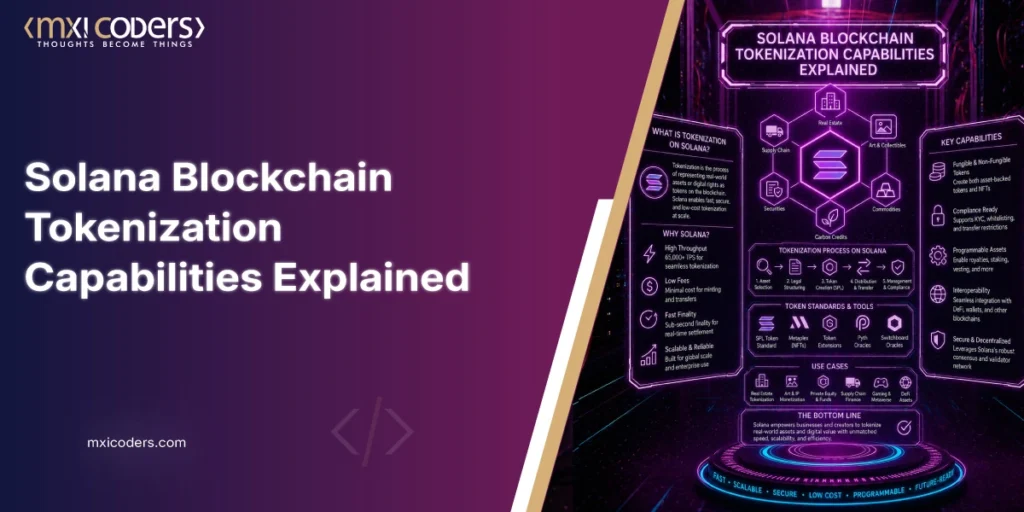

solana blockchain tokenization capabilities explained

The financial world is undergoing a quiet but profound transformation. Assets that once required mountains of paperwork, weeks of settlement, and layers of intermediaries are now being moved on-chain, represented as digital tokens on a blockchain. This shift toward real world asset tokenization is no longer experimental. It’s happening across industries, at scale, right now.

At the center of this movement is a fundamental requirement: the blockchain infrastructure must be fast, affordable, and capable of handling millions of transactions without grinding to a halt. Slow networks and high gas fees make tokenization impractical. That’s where Solana enters the picture.

Solana is a high-performance Layer 1 blockchain engineered specifically for speed and scalability. With near-instant settlement times, minimal transaction costs, and a robust security model, it provides the technical foundation that serious tokenization projects demand.

The industries recognizing this potential span a wide spectrum from finance and real estate to gaming, supply chain management, and digital identity verification. Each of these sectors stands to gain from moving assets on-chain, and Solana’s architecture makes that transition viable at an enterprise level.

➤ What Is Blockchain Tokenization?

➥ Definition of Tokenization

Tokenization is the process of converting ownership rights over a real-world or digital asset into a blockchain-based token. Instead of holding a paper deed, a stock certificate, or a warehouse receipt, ownership is represented digitally as a programmable token on a public or permissioned blockchain.

This token can be transferred, traded, subdivided, or held, all without the friction of traditional financial infrastructure.

➥ Types of Tokenized Assets

The range of assets that can be tokenized is remarkably broad:

  • Real estate: residential, commercial, and industrial properties
  • Stocks and securities: equity and debt instruments
  • Commodities: gold, oil, agricultural products
  • Art and collectibles: physical or digital creative works
  • Intellectual property: music rights, patents, licensing agreements
  • Stablecoins: fiat currency represented on-chain

Each of these asset classes benefits from being brought onto a transparent, programmable ledger.

➥ Why Tokenization Matters

The deeper value of asset tokenization lies in what it unlocks. Illiquid assets like a commercial building or a fine art collection become tradeable in secondary markets. Fractional ownership lowers the barrier to entry, allowing smaller investors to participate in asset classes that were previously inaccessible. Transactions settle faster, sometimes in seconds rather than days. And because everything is recorded on a public ledger, transparency and auditability improve dramatically. Global accessibility means a buyer in Mumbai can own a fraction of a property in Miami without navigating a maze of cross-border regulations.

➤ What Is Solana Blockchain?

➥ Overview of Solana

Solana is a high-performance, Layer 1 blockchain launched in 2020. It was built from the ground up to solve the scalability limitations that plagued earlier blockchain networks. Where other chains prioritized decentralization at the expense of speed, Solana pursued all three decentralization, security, and scalability simultaneously.

➥ Key Features of Solana

Four technical characteristics make Solana particularly well-suited for tokenization:

Low transaction costs: average fees on Solana are fractions of a cent, making high-frequency tokenized transactions economically viable.

High throughput: Solana can theoretically handle up to 65,000 transactions per second, far exceeding most competing networks.

Fast finality: transactions achieve confirmation in under a second, enabling real-time asset transfers.

Energy efficiency: Solana’s Proof of History consensus mechanism is significantly more energy-efficient than traditional Proof of Work systems.

➥ How Solana Differs from Traditional Blockchains

The architectural difference that sets Solana apart is its ability to process transactions in parallel rather than sequentially. Most legacy blockchains handle transactions one at a time, creating bottlenecks during periods of high demand. Solana’s parallel processing eliminates this congestion, delivering consistent performance even at scale, a critical requirement for institutional-grade tokenization platforms.

Also Read: How Tokenizing Real World Assets Is Changing Capital Markets

➤ Core Tokenization Capabilities of Solana

➥ Real-World Asset (RWA) Tokenization

Solana has emerged as a strong foundation for real estate tokenization, enabling fractional ownership of properties through programmable tokens. Beyond property, it supports commodity-backed tokens representing gold, energy, or agricultural products on-chain and tokenized financial instruments like bonds and private equity.

➥ NFT and Digital Asset Tokenization

The Solana ecosystem has a proven track record with non-fungible tokens. Gaming assets, in-game economies, music rights, and digital collectibles have all found a natural home on the network. Low fees make minting and trading NFTs accessible at a scale that other networks struggle to match.

➥ Fractional Ownership Models

One of Solana’s most democratizing capabilities is enabling genuine fractional ownership. A commercial property worth ₹10 crore can be divided into thousands of tokens, each representing a proportional ownership stake. This lowers investment barriers and opens new capital formation pathways for asset owners.

➥ Cross-Border Transactions

Traditional cross-border asset transfers involve correspondent banks, currency conversions, and multi-day settlement windows. On Solana, the same transfer happens in under a second, with minimal fees and no intermediaries. This makes global asset markets genuinely accessible.

➥ On-Chain Transparency

Every transaction on Solana is recorded on a public ledger permanently and immutably. This provides a level of auditability that legacy financial systems simply cannot match, reducing fraud risk and building trust among institutional participants.

➤ Benefits of Using Solana for Tokenization

➥ High-Speed Performance

Speed isn’t just a technical metric, it directly shapes user experience. Real-time asset transfers, instant settlement, and responsive trading interfaces are only possible when the underlying network performs consistently. Solana delivers this reliably.

➥ Reduced Operational Costs

The benefits of blockchain are often theoretical until cost savings become concrete. On Solana, gas fees averaging $0.00025 per transaction translate into dramatically lower operational costs for platforms processing thousands of daily transactions, savings that flow directly to users and operators.

➥ Enterprise Scalability

Institutional adoption demands infrastructure that won’t buckle under load. Solana’s architecture is designed to scale horizontally, making it suitable for enterprise platforms that need to tokenize large portfolios and serve global user bases simultaneously.

➥ Enhanced User Accessibility

Lower costs and faster transactions don’t just benefit institutions, they open participation to retail investors worldwide. Someone with a modest investment budget can now access tokenized assets that were previously gated behind high minimums and geographic restrictions.

➥ Improved Liquidity Opportunities

Tokenized assets can trade on secondary markets around the clock, without the closing-time constraints of traditional exchanges. This dramatically improves liquidity for asset classes like real estate that have historically been difficult to exit quickly.

➤ Conclusion

Solana’s combination of speed, low cost, and enterprise-grade scalability positions it as one of the most capable blockchains for the tokenized economy. Whether the use case involves bringing property on-chain, representing commodity ownership digitally, or enabling fractional investing in financial instruments, Solana’s technical architecture meets the demand.

That said, challenges remain network outages in Solana’s history, evolving regulatory frameworks around tokenized assets, and the complexity of bridging legal ownership structures with on-chain representations. These are real considerations that any serious project must navigate.

Businesses looking to build in this space often partner with a smart contract development agency to ensure their tokenization infrastructure is built to production-grade standards with security, compliance, and scalability built in from day one.

The long-term potential is significant. As more assets migrate on-chain and infrastructure matures, tokenized economies could reshape how capital flows globally. Solana, with its performance-first design, is well-placed to be a core layer in that future.

Ready to transform your business with smart software solutions?

Harness the power of custom software development to streamline operations, reduce costs, and boost efficiency. Start by exploring cutting-edge approaches like cloud-native platforms, API-first architecture, and AI-driven automation to future-proof your systems and stay ahead of the competition.

Book free consultation

Let’s build your idea together and serve society.

Author

Ashok Rathod

Tech Consultant

Experience
25 Years
Growth Architect for Startups & SMEs | Blockchain, AI , MVP Development, & Data-Driven Marketing Expert.

Transform the Carbon Credit Industry

Build a Transparent, Scalable Carbon Credit Marketplace with Blockchain.

Index