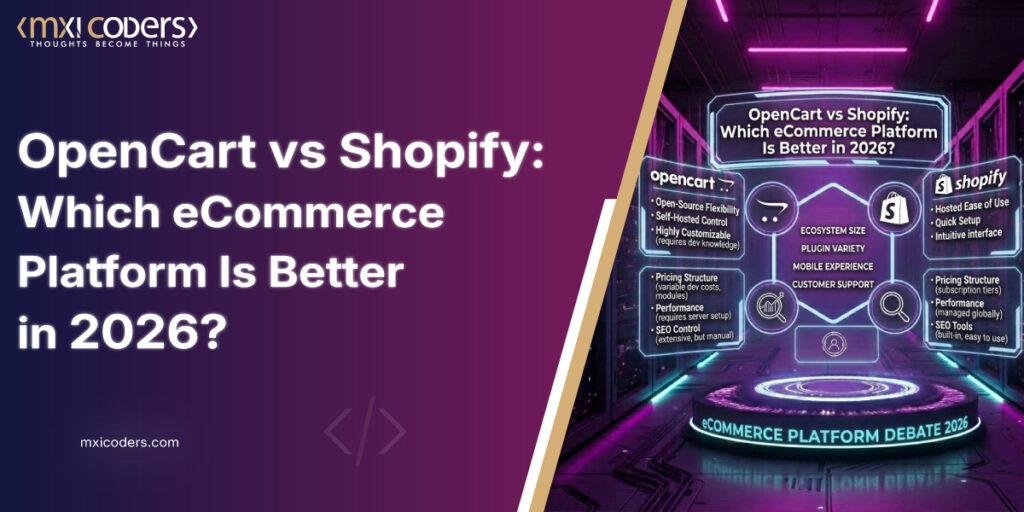
For most merchants, Shopify is the faster, lower-maintenance choice if you want a hosted store running in days with predictable monthly costs, while OpenCart fits businesses with an in-house PHP team that need full control over hosting, data, and checkout logic and are willing to trade convenience for that ownership.
➤ How Much Does Each Platform Actually Cost in 2026?
Shopify’s public pricing runs Basic at $39 a month, Grow at $105, Advanced at $399, and Plus from roughly $2,300, based on Shopify’s own pricing page as tracked by Craftshift in May 2026. If you skip Shopify Payments for a third-party gateway like PayPal or Stripe, Shopify adds its own surcharge on top of the gateway’s fee: 2% on Basic, dropping to 1% on Grow, 0.6% on Advanced, and 0.2% on Plus, according to the same pricing breakdown.
OpenCart’s core software carries no license fee at all since it’s open source, but that isn’t the same as free. Total cost of ownership shifts entirely to hosting, security patching, and developer time, a pattern documented across open-source ecommerce platforms broadly by Swell, where meaningful implementations commonly run from a few thousand dollars to well over $60,000 depending on scope.
➤ Is OpenCart Still a Viable Platform in 2026?
Yes, but its footprint is shrinking. Independent tracking firm Store Leads counted 180,807 live OpenCart stores as of 2026, with quarter-over-quarter and year-over-year declines. A separate technographic tracker found OpenCart holding under 1% of the ecommerce platform market and reported a 12% year-over-year drop across a 169,925-store crawl in Q1 2026. It hasn’t disappeared, and it still suits a specific kind of merchant, but it’s no longer growing.
➤ What’s Genuinely New on Shopify for 2026?
The most concrete 2026 change isn’t a vague “AI co-developer” claim, it’s a real product shift: Shopify launched an Agentic plan at $0 a month that sells a merchant’s catalog directly through AI assistants including ChatGPT, Gemini, Copilot, Perplexity, and the Shop app, charging only per completed sale rather than a subscription, per reporting from Website Builder Expert. Separately, Shopify raised its per-product variant ceiling from 100 to 2,048 as of an official Shopify changelog update on October 15, 2025, though the cap on option types (like size, color, material) stays at three, a detail confirmed in Shopify’s own developer documentation.
➤ How Big Is the Ecommerce Market These Two Platforms Are Competing For?
Global retail ecommerce sales are projected to reach roughly $6.88 trillion by the end of 2026, according to Shopify’s own enterprise research. That’s a meaningfully more conservative figure than the “$8 trillion” claims that circulate in marketing copy, and it matters because it sets realistic expectations for how much runway either platform choice actually has.
➤ Shopify vs OpenCart at a Glance
| Option | Mechanism | Best fit | Trade-off |
|---|---|---|---|
| Shopify | Hosted SaaS with a fixed subscription plus per-transaction processing fees | Brands that want a live store in days and don’t have in-house DevOps | You don’t own the underlying platform, and third-party gateway surcharges add up at scale |
| OpenCart | Self-hosted, open-source PHP application with no license fee | Teams with dedicated developers who need custom checkout logic or full data control | You absorb hosting, security patching, and every point release yourself |
For a merchant with a live catalog already, our team’s Shopify development services work handles both scenarios directly: standing up a new Shopify ecommerce platform storefront from scratch, or restructuring an existing OpenCart catalog for a cleaner migration.
➤ What Are the Real Trade-offs of Each Platform?
Shopify’s downside is platform lock-in and processing costs. You’re building on infrastructure you don’t own, and if your region or industry can’t use Shopify Payments, the added gateway surcharge compounds with every sale.
OpenCart’s downside is that “free” software still requires a real budget. Security patching, hosting performance, and premium extensions all land on you, and in 2026’s threat environment that’s not optional maintenance, it’s ongoing risk management.
➤ Limitations and Caveats
This comparison reflects public list pricing and platform data as of July 2026. Shopify’s rates vary by country and negotiated volume, and Shopify Plus contracts in particular are individually priced. OpenCart’s actual total cost depends heavily on hosting choice and developer rates in your market, so the figures above are directional, not a quote. Neither platform’s AI-assistant selling features (Shopify’s Agentic plan, or third-party AI tools bolted onto OpenCart) have a long enough track record yet to say how they perform on conversion.
➤ Frequently Asked Questions
- Does Shopify take a percentage of every sale, even on the cheapest plan? Only if you don’t use Shopify Payments. On Basic, using a third-party gateway adds a 2% surcharge on top of that gateway’s own fee; using Shopify Payments directly removes the surcharge entirely.
- Can I move an existing OpenCart store to Shopify without losing data? Product, customer, and order data can typically be migrated, but custom OpenCart extensions, unique checkout logic, and custom database structures usually need to be rebuilt rather than transferred as-is.
- Do I need to hire a developer to run an OpenCart store? Not to install it, but realistically yes for anything beyond a basic catalog. Security patching, performance tuning, and custom features all require PHP development skill that Shopify’s hosted model doesn’t require.
- Is Shopify or OpenCart better for a small, budget-conscious store? Shopify’s Basic plan has a predictable low monthly floor with no separate hosting to manage. OpenCart can be cheaper long-term for a technical team but usually costs more upfront in developer time.
➤ Conclusion
The honest answer is that “which platform is better” depends entirely on whether you’re optimizing for speed or ownership. Shopify’s 2026 roadmap, especially the shift toward selling directly through AI assistants, points toward a platform betting heavily on convenience and discoverability. OpenCart’s declining but still real install base suggests a smaller, more technical audience that values control over growth speed. Neither trend makes one platform objectively better, they make the two platforms better suited to genuinely different businesses.
➤ Ready to Build on the Right Platform?
Whether you’re leaning toward a hosted Shopify ecommerce platform or want to keep full control with an open-source setup, getting the technical foundation right matters more than the platform name. Our team can help you hire a Shopify developer for a new storefront build, or if your stack runs on WordPress and you’d rather hire a WooCommerce developer for a self-hosted alternative, we handle both paths.
Book a free consultation to talk through your specific catalog, budget, and timeline before you commit either way.
➤ Sources Used
- Shopify Developer Changelog — product variant limit increase
- Shopify official changelog announcement, October 15, 2025
- Shopify Enterprise Blog — Global Ecommerce Statistics
- Craftshift — Shopify Pricing Plans 2026 breakdown
- Website Builder Expert — Shopify Pricing 2026, Agentic plan
- Store Leads— The State of OpenCart in 2026
- TechnologyChecker.io — OpenCart market share report
- Swell— Open Source Ecommerce Statistics