...

[ Your Headline ] [ Highlight Word ]

[ One or two lines describing the offer — e.g. "Experience our services with a FREE 30-minute consultation." ]

[ Optional second line, e.g. "Have a concept in mind? Let's brainstorm together!" ]

Google ★★★★★ 4.8
GoodFirms ★★★★★ 4.7
Clutch ★★★★★ 5.0
Software,Technology

What Is the Best Tobacco Store POS System for Inventory Control?

Ashok Rathod

Tech Consultant

Posted on
25th Jul 2026
8 min
Read
Share

Table of Contents

  • Quick Tips
  • Familiarize yourself with Cash App
  • Enable two-factor authentication
  • Utilize the optional Cash App
  • Conclusion

The best tobacco store POS system pairs a retail inventory system built for carton and pack level tracking with compliance tools for age verification and tax reporting. For most independent shops, a purpose built tobacco POS system outperforms general retail software, and custom POS development closes the gaps that off the shelf tools still leave open.

➤ Why Do General Retail POS Systems Struggle with Tobacco Inventory?

A standard retail inventory system treats every SKU as a single countable unit. Tobacco doesn’t work that way. A carton contains ten packs, a box of cigars may hold twenty five individually serialized sticks, and a single sale needs to decrement stock at both the carton and pack level simultaneously. Generic POS platforms built for grocery or apparel usually bolt this on as an afterthought, which is why tobacco specific systems built around case break logic tend to outperform them on accuracy.

There’s a second gap: regulated add on categories. Many smoke shops now also carry CBD, delta 8, kratom, and vapor products alongside traditional tobacco, each with its own age rule and, in some states, its own tax treatment. A generic tobacco pos system that wasn’t designed with these categories in mind forces staff to manage exceptions manually, which is where compliance mistakes creep in.

➤ What Compliance Features Does a Tobacco POS System Actually Need?

Age verification is the feature that carries legal weight, not just convenience. Under a final rule from the U.S. Food and Drug Administration, retailers must check photo identification for any tobacco or e-cigarette purchaser who could plausibly be under 30, not 27 as the rule previously required, and tobacco vending machines are now restricted to facilities where only adults 21 and older can enter. A capable smoke shop POS should force this ID check at the register rather than leaving it to a cashier’s judgment call, since the FDA has been explicit that appearance alone is an unreliable way to estimate age.

If a store ships tobacco or vapor products to customers directly, a second compliance layer applies. The Bureau of Alcohol, Tobacco, Firearms and Explosives requires any seller who ships cigarettes or smokeless tobacco across state lines to register with the ATF and with each destination state’s tobacco tax administrator, then file a monthly delivery report in every one of those states. A POS or ecommerce layer that can’t generate these reports automatically turns a routine filing into a manual, error prone task every month.

➤ Why Does Carton Pack Inventory Tracking Matter So Much for Profitability?

Inventory losses are a real cost problem, and tobacco’s high unit value makes shrink expensive fast. Retail shrink across all US categories reached roughly 1.6 percent of sales in a recent year, translating to more than $112 billion in industry wide losses, according to the National Retail Federation. In a tobacco store, where a single carton can be worth what a shelf of lower ticket merchandise sells for combined, an inventory system that can’t reconcile carton and pack counts in real time is effectively guaranteeing a chunk of that loss lands in this category.

A retail inventory system purpose built for tobacco automatically breaks a carton into packs the moment either unit sells, keeps a running count at both levels, and flags when a reorder point is hit based on actual sales velocity rather than a manual recount. That single feature is usually the difference between a store that catches shrink early and one that only discovers it during a full physical count.

➤ What Should a Comparison of Tobacco POS Options Actually Look Like?

There isn’t one correct answer. The right choice depends on how specialized the store’s product mix is and how much the owner is willing to trade customization for a faster, cheaper setup.

OptionMechanismBest fitTrade-off
Tobacco-specific POS (e.g., Cigars POS style platforms)Prebuilt carton/pack logic, cigar SKU databases, and scan data reporting out of the boxSingle-location specialty tobacco or cigar shopsLess flexible once a store adds unrelated product categories or multiple locations
Retail-focused POS (e.g., KORONA POS style platforms)Strong general inventory and reporting, with tobacco compliance layered on as an add-onMulti-product smoke shops selling tobacco alongside vape, CBD, or general merchandiseCompliance and age-verification depth often needs configuration or a third-party add-on
Ecommerce-first POS (e.g., Lightspeed style platforms)Built around omnichannel and online catalog managementShops with significant non-restricted online salesWeaker native support for tobacco-specific compliance and scan data workflows
Custom POS development for tobacco retailersBuilt around the store’s exact product mix, compliance obligations, and existing accounting or ERP stackMulti-location chains or retailers with unusual product mixes (tobacco plus NFT loyalty programs, high-end serialized cigars, etc.)Higher upfront cost and longer setup timeline than an off-the-shelf plan

➤ When Does Custom POS Development Make Sense Instead of an Off-the-Shelf Tool?

Off the shelf tobacco POS systems cover the majority of single location shops well. Custom POS development for tobacco retailers earns its higher upfront cost when a business outgrows what a template can do: multi-state chains juggling different tax and delivery rules per state, retailers combining tobacco with an unrelated regulated category, or operations that need their POS to talk directly to an existing ERP or accounting system rather than through a generic integration. In those cases, the cost of forcing a business to fit a rigid template usually exceeds the cost of building the exception handling once, correctly.

➤ How Should a Tobacco Retailer Roll Out a New POS Without Losing Sales Days?

A phased rollout limits the two biggest risks: data loss during migration and staff confusion at the register during a busy week.

  1. Needs assessment. Document the current product mix, compliance obligations, and any existing accounting or ERP system that the new POS needs to talk to.
  2. Data migration and configuration. Move historical inventory and customer data over, then configure carton/pack relationships and compliance rules before go-live, not after.
  3. Staff training and soft launch. Run the new system alongside the old one for a short window so cashiers build confidence before the full cutover.
  4. Ongoing optimization. Monitor shrink, reorder accuracy, and compliance logs after launch, since real gaps in a new system usually show up in the first full inventory cycle, not on day one.

➤ Limitations and Caveats Retailers Should Weigh Before Switching

No POS system, custom or off the shelf, eliminates compliance risk by itself. Age verification hardware still depends on a cashier actually using it, and a system can log every ID check without preventing an employee from waving a customer through. Data migration from an old system to a new one also carries real risk of dropped or duplicated inventory records if it isn’t audited carefully during the transition. Finally, state level tobacco tax and delivery rules vary and change often; a POS vendor’s PACT Act reporting feature reduces manual work but doesn’t remove a retailer’s responsibility to confirm the rules for every state it ships into.

➤ Frequently Asked Questions

  1. What is the best POS system for a smoke shop? There’s no single best system across the board. Tobacco-specific platforms tend to win on carton/pack accuracy and scan data reporting, retail-focused platforms tend to win on general inventory depth and pricing flexibility, and a custom build wins when a store’s compliance or product mix doesn’t fit either template cleanly.
  2. How much does a tobacco store POS system cost? Costs vary widely by vendor and by whether pricing is subscription based or bundled with payment processing, and many providers use quote-based pricing rather than public list prices. Custom POS development for tobacco retailers typically carries a higher upfront project cost than a subscription platform, offset over time by not paying for features a generic plan includes but the store doesn’t need.
  3. Does a tobacco POS system need built-in age verification, or can a manual check work? A manual “eyeball” check no longer meets the federal standard. Since the FDA’s rule requires ID verification for anyone who could plausibly be under 30, most compliance-focused retailers now configure their POS to prompt an ID check on every restricted-item sale rather than leaving the judgment call to staff.
  4. Can a smoke shop POS system handle online or delivery orders for tobacco products? Yes, but online and delivery sales of tobacco trigger the PACT Act’s separate compliance layer, including ATF registration and monthly state-by-state reporting. A POS that only handles in-store sales won’t cover this on its own; it needs either a built-in delivery-compliant ecommerce layer or a separate integration that does.
  5. Is a carton-pack inventory tracking feature really necessary, or is basic stock counting enough? Basic stock counting works for single-unit products, but tobacco is sold in nested units (cartons of packs, boxes of cigars), so a system that can’t automatically reconcile both levels in real time creates a recurring reconciliation task that basic counting doesn’t need for other retail categories.

➤ Getting the Right POS Built for Your Store

Choosing between an off-the-shelf tobacco POS and a custom build comes down to how closely your product mix and compliance needs match a template. Mxicoders works with tobacco and smoke shop retailers who’ve outgrown a generic platform, building custom POS development around the store’s actual inventory structure, compliance obligations, and existing business systems rather than forcing the business to adapt to someone else’s template. If you’re evaluating whether a custom build makes sense for your store, get in touch with Mxicoders for a needs assessment.

➤ Sources Used

  • U.S. Food and Drug Administration (FDA), Final Rule on Tobacco Age Verification (2024)
  • Bureau of Alcohol, Tobacco, Firearms and Explosives (ATF), PACT Act Requirements
  • National Retail Federation (NRF), National Retail Security Survey 2023
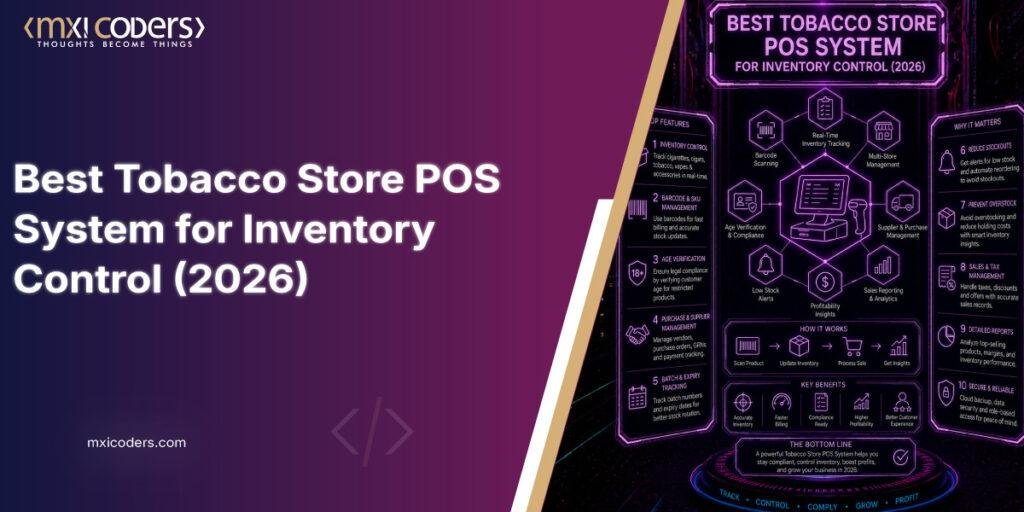
The best tobacco store POS system pairs a retail inventory system built for carton and pack level tracking with compliance tools for age verification and tax reporting. For most independent shops, a purpose built tobacco POS system outperforms general retail software, and custom POS development closes the gaps that off the shelf tools still leave open.

➤ Why Do General Retail POS Systems Struggle with Tobacco Inventory?

A standard retail inventory system treats every SKU as a single countable unit. Tobacco doesn’t work that way. A carton contains ten packs, a box of cigars may hold twenty five individually serialized sticks, and a single sale needs to decrement stock at both the carton and pack level simultaneously. Generic POS platforms built for grocery or apparel usually bolt this on as an afterthought, which is why tobacco specific systems built around case break logic tend to outperform them on accuracy.

There’s a second gap: regulated add on categories. Many smoke shops now also carry CBD, delta 8, kratom, and vapor products alongside traditional tobacco, each with its own age rule and, in some states, its own tax treatment. A generic tobacco pos system that wasn’t designed with these categories in mind forces staff to manage exceptions manually, which is where compliance mistakes creep in.

➤ What Compliance Features Does a Tobacco POS System Actually Need?

Age verification is the feature that carries legal weight, not just convenience. Under a final rule from the U.S. Food and Drug Administration, retailers must check photo identification for any tobacco or e-cigarette purchaser who could plausibly be under 30, not 27 as the rule previously required, and tobacco vending machines are now restricted to facilities where only adults 21 and older can enter. A capable smoke shop POS should force this ID check at the register rather than leaving it to a cashier’s judgment call, since the FDA has been explicit that appearance alone is an unreliable way to estimate age.

If a store ships tobacco or vapor products to customers directly, a second compliance layer applies. The Bureau of Alcohol, Tobacco, Firearms and Explosives requires any seller who ships cigarettes or smokeless tobacco across state lines to register with the ATF and with each destination state’s tobacco tax administrator, then file a monthly delivery report in every one of those states. A POS or ecommerce layer that can’t generate these reports automatically turns a routine filing into a manual, error prone task every month.

➤ Why Does Carton Pack Inventory Tracking Matter So Much for Profitability?

Inventory losses are a real cost problem, and tobacco’s high unit value makes shrink expensive fast. Retail shrink across all US categories reached roughly 1.6 percent of sales in a recent year, translating to more than $112 billion in industry wide losses, according to the National Retail Federation. In a tobacco store, where a single carton can be worth what a shelf of lower ticket merchandise sells for combined, an inventory system that can’t reconcile carton and pack counts in real time is effectively guaranteeing a chunk of that loss lands in this category.

A retail inventory system purpose built for tobacco automatically breaks a carton into packs the moment either unit sells, keeps a running count at both levels, and flags when a reorder point is hit based on actual sales velocity rather than a manual recount. That single feature is usually the difference between a store that catches shrink early and one that only discovers it during a full physical count.

➤ What Should a Comparison of Tobacco POS Options Actually Look Like?

There isn’t one correct answer. The right choice depends on how specialized the store’s product mix is and how much the owner is willing to trade customization for a faster, cheaper setup.

OptionMechanismBest fitTrade-off
Tobacco-specific POS (e.g., Cigars POS style platforms)Prebuilt carton/pack logic, cigar SKU databases, and scan data reporting out of the boxSingle-location specialty tobacco or cigar shopsLess flexible once a store adds unrelated product categories or multiple locations
Retail-focused POS (e.g., KORONA POS style platforms)Strong general inventory and reporting, with tobacco compliance layered on as an add-onMulti-product smoke shops selling tobacco alongside vape, CBD, or general merchandiseCompliance and age-verification depth often needs configuration or a third-party add-on
Ecommerce-first POS (e.g., Lightspeed style platforms)Built around omnichannel and online catalog managementShops with significant non-restricted online salesWeaker native support for tobacco-specific compliance and scan data workflows
Custom POS development for tobacco retailersBuilt around the store’s exact product mix, compliance obligations, and existing accounting or ERP stackMulti-location chains or retailers with unusual product mixes (tobacco plus NFT loyalty programs, high-end serialized cigars, etc.)Higher upfront cost and longer setup timeline than an off-the-shelf plan

➤ When Does Custom POS Development Make Sense Instead of an Off-the-Shelf Tool?

Off the shelf tobacco POS systems cover the majority of single location shops well. Custom POS development for tobacco retailers earns its higher upfront cost when a business outgrows what a template can do: multi-state chains juggling different tax and delivery rules per state, retailers combining tobacco with an unrelated regulated category, or operations that need their POS to talk directly to an existing ERP or accounting system rather than through a generic integration. In those cases, the cost of forcing a business to fit a rigid template usually exceeds the cost of building the exception handling once, correctly.

➤ How Should a Tobacco Retailer Roll Out a New POS Without Losing Sales Days?

A phased rollout limits the two biggest risks: data loss during migration and staff confusion at the register during a busy week.

  1. Needs assessment. Document the current product mix, compliance obligations, and any existing accounting or ERP system that the new POS needs to talk to.
  2. Data migration and configuration. Move historical inventory and customer data over, then configure carton/pack relationships and compliance rules before go-live, not after.
  3. Staff training and soft launch. Run the new system alongside the old one for a short window so cashiers build confidence before the full cutover.
  4. Ongoing optimization. Monitor shrink, reorder accuracy, and compliance logs after launch, since real gaps in a new system usually show up in the first full inventory cycle, not on day one.

➤ Limitations and Caveats Retailers Should Weigh Before Switching

No POS system, custom or off the shelf, eliminates compliance risk by itself. Age verification hardware still depends on a cashier actually using it, and a system can log every ID check without preventing an employee from waving a customer through. Data migration from an old system to a new one also carries real risk of dropped or duplicated inventory records if it isn’t audited carefully during the transition. Finally, state level tobacco tax and delivery rules vary and change often; a POS vendor’s PACT Act reporting feature reduces manual work but doesn’t remove a retailer’s responsibility to confirm the rules for every state it ships into.

➤ Frequently Asked Questions

  1. What is the best POS system for a smoke shop? There’s no single best system across the board. Tobacco-specific platforms tend to win on carton/pack accuracy and scan data reporting, retail-focused platforms tend to win on general inventory depth and pricing flexibility, and a custom build wins when a store’s compliance or product mix doesn’t fit either template cleanly.
  2. How much does a tobacco store POS system cost? Costs vary widely by vendor and by whether pricing is subscription based or bundled with payment processing, and many providers use quote-based pricing rather than public list prices. Custom POS development for tobacco retailers typically carries a higher upfront project cost than a subscription platform, offset over time by not paying for features a generic plan includes but the store doesn’t need.
  3. Does a tobacco POS system need built-in age verification, or can a manual check work? A manual “eyeball” check no longer meets the federal standard. Since the FDA’s rule requires ID verification for anyone who could plausibly be under 30, most compliance-focused retailers now configure their POS to prompt an ID check on every restricted-item sale rather than leaving the judgment call to staff.
  4. Can a smoke shop POS system handle online or delivery orders for tobacco products? Yes, but online and delivery sales of tobacco trigger the PACT Act’s separate compliance layer, including ATF registration and monthly state-by-state reporting. A POS that only handles in-store sales won’t cover this on its own; it needs either a built-in delivery-compliant ecommerce layer or a separate integration that does.
  5. Is a carton-pack inventory tracking feature really necessary, or is basic stock counting enough? Basic stock counting works for single-unit products, but tobacco is sold in nested units (cartons of packs, boxes of cigars), so a system that can’t automatically reconcile both levels in real time creates a recurring reconciliation task that basic counting doesn’t need for other retail categories.

➤ Getting the Right POS Built for Your Store

Choosing between an off-the-shelf tobacco POS and a custom build comes down to how closely your product mix and compliance needs match a template. Mxicoders works with tobacco and smoke shop retailers who’ve outgrown a generic platform, building custom POS development around the store’s actual inventory structure, compliance obligations, and existing business systems rather than forcing the business to adapt to someone else’s template. If you’re evaluating whether a custom build makes sense for your store, get in touch with Mxicoders for a needs assessment.

➤ Sources Used

  • U.S. Food and Drug Administration (FDA), Final Rule on Tobacco Age Verification (2024)
  • Bureau of Alcohol, Tobacco, Firearms and Explosives (ATF), PACT Act Requirements
  • National Retail Federation (NRF), National Retail Security Survey 2023

Feel free to Connect us on

Ready to transform your business with smart software solutions?

Harness the power of custom software development to streamline operations, reduce costs, and boost efficiency. Start by exploring cutting-edge approaches like cloud-native platforms, API-first architecture, and AI-driven automation to future-proof your systems and stay ahead of the competition.

Book free consultation

Let’s build your idea together and serve society.

Author

Ashok Rathod

Tech Consultant

Experience
25 Years
Growth Architect for Startups & SMEs | Blockchain, AI , MVP Development, & Data-Driven Marketing Expert.

Transform the Carbon Credit Industry

Build a Transparent, Scalable Carbon Credit Marketplace with Blockchain.

Index

Get in Touch

Ready to transform your ideas into reality? Contact our team today and let’s discuss your project.