[ Your Headline ] [ Highlight Word ]

[ One or two lines describing the offer — e.g. "Experience our services with a FREE 30-minute consultation." ]

[ Optional second line, e.g. "Have a concept in mind? Let's brainstorm together!" ]

Google ★★★★★ 4.8
GoodFirms ★★★★★ 4.7
Clutch ★★★★★ 5.0
Ecommerce

What Is Ecommerce? A Practical Guide to Online Business in 2026

Ashok Rathod

Tech Consultant

Posted on
18th Jul 2026
9 min
Read
Share

Table of Contents

  • Quick Tips
  • Familiarize yourself with Cash App
  • Enable two-factor authentication
  • Utilize the optional Cash App
  • Conclusion

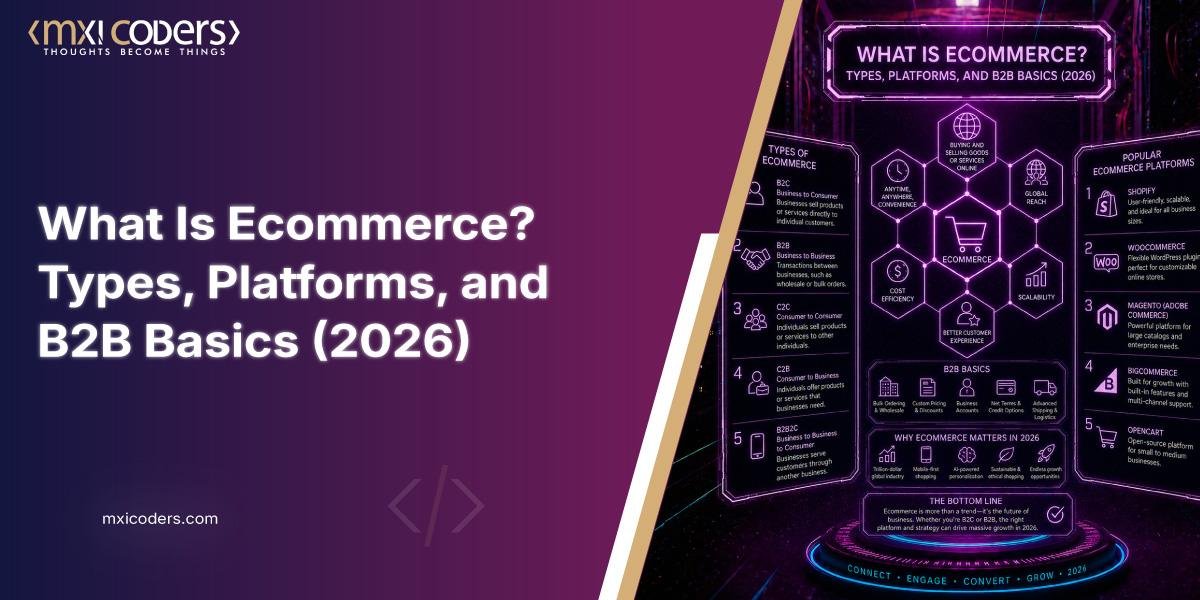
Ecommerce is the buying and selling of goods, services, or digital products over the internet, using a website, app, or online marketplace instead of a physical store. It covers every model from a single retailer selling to consumers to two companies trading through a private B2B portal.

The global ecommerce market has moved well past the early “online store” phase. According to eMarketer’s 2026 projections, global e-commerce sales are expected to reach $7.41 trillion in 2026, up about 8 percent from 2025. That figure covers business to consumer sales. B2B ecommerce, where companies sell to other companies rather than individual shoppers, is a separate and much larger category: the International Trade Administration projects global B2B ecommerce sales will reach $36.2 trillion by 2026, roughly five times the size of the B2C market. If you’re building a strategy around “ecommerce” as a broad term, it’s worth knowing early which half of that number your business actually competes in.

➤ How Does Ecommerce Actually Work?

An ecommerce business sells products or services online without the customer ever walking into a physical location. In practice, that means six things have to work together: a product or service worth selling, a storefront that displays it clearly, a payment gateway that processes the transaction securely, a marketing channel that brings people to the store, an inventory system that tracks what’s in stock, and a fulfillment process that gets the order to the customer. Miss any one of these and the rest of the setup doesn’t matter much. Most new sellers underestimate fulfillment and inventory until the first order backlog hits.

➤ What’s the Difference Between B2B Ecommerce and B2C Ecommerce?

B2C ecommerce sells directly to individual shoppers, usually in smaller order sizes with impulse-driven or convenience-driven buying decisions. B2B ecommerce sells to other businesses, typically involves larger order values, longer sales cycles, negotiated pricing, and repeat purchasing through account-based portals rather than a public storefront.

The practical differences show up fast once you’re building the store. B2B buyers expect features that B2C buyers never ask for: tiered pricing by account, purchase order workflows, bulk reordering, and integration with the buyer’s own procurement software. A B2C store built on a standard theme usually can’t support that without custom development.

➤ What Are the Main Types of Ecommerce Business Models?

Most ecommerce businesses fall into one of a handful of models, and the right one depends on who you’re selling to and how you want to handle inventory.

Business to Consumer (B2C). A business sells directly to individual shoppers, the traditional retail model most people picture when they hear “ecommerce.”

Business to Business (B2B). A business sells to other businesses, usually at higher order values with longer, relationship-driven sales cycles.

Consumer to Consumer (C2C). A platform lets individuals sell directly to other individuals, common for secondhand goods, handmade items, and peer to peer services.

Direct to Consumer (D2C). A brand sells its own products straight to shoppers, skipping retailers and wholesalers to keep control over pricing and customer experience.

Dropshipping. A store sells products without holding inventory, passing orders straight to a manufacturer or supplier who ships directly to the customer.

White label. A business sells goods manufactured by a third party under its own branding, without ever handling production.

➤ Which Ecommerce Platform Should You Build On?

Choosing a platform is usually the first real decision a new ecommerce business makes, and it’s also the one that’s hardest to reverse later. Here’s how the major options actually compare.

PlatformMechanismBest fitTrade-off
ShopifyHosted, all-in-one SaaS with an app marketplaceStartups and multi-channel sellers who want to launch fastMonthly fees plus transaction costs on top-tier apps
WooCommerceFree, open-source plugin on top of WordPressBusinesses that already run WordPress and want full controlRequires more hands-on maintenance and hosting management
BigCommerceHosted platform built for higher sales volumeGrowing stores that need multi-channel selling without heavy customizationSteeper learning curve for smaller catalogs
Magento (Adobe Commerce)Highly customizable, self-hosted or cloud enterprise platformLarge catalogs needing complex logic, like B2B pricing tiersNeeds developer resources to run well
WixDrag-and-drop website builder with ecommerce add-onsBeginners who want a simple store live quicklyLimited scalability for larger catalogs

If your business sells to other businesses rather than individual shoppers, the platform decision changes further. Not every platform handles the account-based pricing, quote workflows, and bulk ordering that B2B ecommerce needs out of the box; some require dedicated B2B extensions or a fully custom build.

➤ What Are the Real Benefits of Selling Online?

The advantages of ecommerce go beyond “it’s open 24/7,” though that’s true too.

Lower operating costs. No rent, no in-store staffing, no physical utilities, which frees up budget for marketing and product development instead.

Wider reach. A single online store can sell to a national or global audience instead of whoever happens to walk past a storefront.

Better data on customers. Every purchase, cart abandonment, and repeat visit generates data you can use to personalize offers and improve the product mix.

Faster iteration. Changing a price, adding a product, or running a promotion online takes minutes, not a store remodel.

➤ How Do You Market an Ecommerce Business?

Ecommerce marketing covers the channels and tactics a store uses to bring in traffic and convert it into sales. A few channels do most of the heavy lifting for most stores.

Search engine optimization. Ranking for the terms your buyers actually search keeps a steady stream of intent-driven traffic without paying per click.

Email marketing. Cart abandonment sequences and post-purchase flows tend to be some of the highest-converting ecommerce marketing channels, since the list is already warm.

Paid social and search ads. Platforms like Google Ads and Meta Ads let you target by intent or interest, useful for scaling beyond organic traffic.

Influencer and affiliate partnerships. Especially effective for D2C brands trying to build trust with a new audience quickly.

For B2B ecommerce specifically, marketing looks different again. Long sales cycles mean content marketing, case studies, and account-based outreach tend to outperform impulse-driven tactics like flash sales.

➤ What Compliance Rules Apply to Selling Online?

A few regulatory areas come up for almost every online seller, regardless of size.

Sales tax nexus. Most U.S. states require you to collect sales tax once you have a physical or economic presence there, and the threshold varies by state.

Data privacy. Any store collecting customer data needs to comply with applicable privacy law, and requirements differ meaningfully depending on which countries or states your customers are in.

Advertising and endorsement disclosures. In the United States, the Federal Trade Commission enforces truth in advertising standards for online marketing, including disclosure requirements for affiliate and sponsored content, and its maximum per-violation penalty for deceptive practices rose to $53,088 in 2026.

Consumer protection. Return policies, warranties, and product labeling requirements vary by jurisdiction and product category, and they matter more once you’re selling across state or national lines.

➤ Limitations and Open Challenges in Ecommerce Right Now

No guide to ecommerce is complete without naming what’s genuinely unresolved. Cart abandonment remains stubbornly high across the industry regardless of platform choice, and no single fix (exit-intent popups, email reminders, faster checkout) solves it completely. Cross-border selling still runs into a patchwork of tax, shipping, and compliance rules that differ by country, and smaller sellers often underestimate the cost of getting that wrong. And the gap between B2C ecommerce content online, which massively outnumbers B2B content, and the actual size of the B2B market, which dwarfs B2C by the ITA’s own figures, means most new sellers researching “ecommerce” find advice skewed toward a smaller slice of the industry than they realize.

➤ Frequently asked questions

  1. Is ecommerce the same as online shopping?
    Online shopping is the consumer-facing part of ecommerce. Ecommerce is the broader business model, covering everything from payment processing to inventory management that makes online shopping possible.
  2. Can a business do both B2B and B2C ecommerce?
    Yes, this is common with a hybrid model, though it usually requires separate pricing logic, checkout flows, and sometimes separate storefronts, since B2B buyers need different tools than individual consumers.
  3. Do I need a business license to start an ecommerce store?
    Requirements vary by location and business structure, so this is worth confirming with a local accountant or business attorney before you launch, rather than assuming one region’s rules apply everywhere.
  4. How much does it cost to start an ecommerce business?
    Costs vary widely based on platform choice, product sourcing, and whether you build custom features, with hosted platforms generally cheaper to start than a custom-built store.

➤ Conclusion

Ecommerce isn’t one thing anymore. It’s a B2C storefront competing in a $7.41 trillion market, and it’s a B2B portal competing in a market nearly five times that size, and the tools, marketing, and compliance obligations differ meaningfully between the two. Picking a platform, a business model, and a marketing channel mix only makes sense once you know which side of that split your business is actually on.

Building or scaling an ecommerce store is a different project depending on whether you’re selling B2C, B2B, or both, and the platform choice above is usually where that gets decided. If you want a second set of eyes on which model or platform fits your specific catalog, Mxicoders’ ecommerce development team works across Shopify, WooCommerce, Magento, and custom marketplace builds, and can also help scope a B2B ecommerce platform if that’s the direction you’re headed.

Ready to build or upgrade your ecommerce store? Book a free consultation and we’ll help you scope the right platform for your business, not just the most popular one.

➤ Sources Used

  • eMarketer 2026 global ecommerce sales projection ($7.41 trillion), via Fungies.io
  • International Trade Administration 2026 B2B ecommerce projection ($36.2 trillion), via Practical Ecommerce
  • FTC maximum per-violation penalty increase to $53,088 in 2026, via The Stacc
what is ecommerce (blog image)

Ecommerce is the buying and selling of goods, services, or digital products over the internet, using a website, app, or online marketplace instead of a physical store. It covers every model from a single retailer selling to consumers to two companies trading through a private B2B portal.

The global ecommerce market has moved well past the early “online store” phase. According to eMarketer’s 2026 projections, global e-commerce sales are expected to reach $7.41 trillion in 2026, up about 8 percent from 2025. That figure covers business to consumer sales. B2B ecommerce, where companies sell to other companies rather than individual shoppers, is a separate and much larger category: the International Trade Administration projects global B2B ecommerce sales will reach $36.2 trillion by 2026, roughly five times the size of the B2C market. If you’re building a strategy around “ecommerce” as a broad term, it’s worth knowing early which half of that number your business actually competes in.

➤ How Does Ecommerce Actually Work?

An ecommerce business sells products or services online without the customer ever walking into a physical location. In practice, that means six things have to work together: a product or service worth selling, a storefront that displays it clearly, a payment gateway that processes the transaction securely, a marketing channel that brings people to the store, an inventory system that tracks what’s in stock, and a fulfillment process that gets the order to the customer. Miss any one of these and the rest of the setup doesn’t matter much. Most new sellers underestimate fulfillment and inventory until the first order backlog hits.

➤ What’s the Difference Between B2B Ecommerce and B2C Ecommerce?

B2C ecommerce sells directly to individual shoppers, usually in smaller order sizes with impulse-driven or convenience-driven buying decisions. B2B ecommerce sells to other businesses, typically involves larger order values, longer sales cycles, negotiated pricing, and repeat purchasing through account-based portals rather than a public storefront.

The practical differences show up fast once you’re building the store. B2B buyers expect features that B2C buyers never ask for: tiered pricing by account, purchase order workflows, bulk reordering, and integration with the buyer’s own procurement software. A B2C store built on a standard theme usually can’t support that without custom development.

➤ What Are the Main Types of Ecommerce Business Models?

Most ecommerce businesses fall into one of a handful of models, and the right one depends on who you’re selling to and how you want to handle inventory.

Business to Consumer (B2C). A business sells directly to individual shoppers, the traditional retail model most people picture when they hear “ecommerce.”

Business to Business (B2B). A business sells to other businesses, usually at higher order values with longer, relationship-driven sales cycles.

Consumer to Consumer (C2C). A platform lets individuals sell directly to other individuals, common for secondhand goods, handmade items, and peer to peer services.

Direct to Consumer (D2C). A brand sells its own products straight to shoppers, skipping retailers and wholesalers to keep control over pricing and customer experience.

Dropshipping. A store sells products without holding inventory, passing orders straight to a manufacturer or supplier who ships directly to the customer.

White label. A business sells goods manufactured by a third party under its own branding, without ever handling production.

➤ Which Ecommerce Platform Should You Build On?

Choosing a platform is usually the first real decision a new ecommerce business makes, and it’s also the one that’s hardest to reverse later. Here’s how the major options actually compare.

PlatformMechanismBest fitTrade-off
ShopifyHosted, all-in-one SaaS with an app marketplaceStartups and multi-channel sellers who want to launch fastMonthly fees plus transaction costs on top-tier apps
WooCommerceFree, open-source plugin on top of WordPressBusinesses that already run WordPress and want full controlRequires more hands-on maintenance and hosting management
BigCommerceHosted platform built for higher sales volumeGrowing stores that need multi-channel selling without heavy customizationSteeper learning curve for smaller catalogs
Magento (Adobe Commerce)Highly customizable, self-hosted or cloud enterprise platformLarge catalogs needing complex logic, like B2B pricing tiersNeeds developer resources to run well
WixDrag-and-drop website builder with ecommerce add-onsBeginners who want a simple store live quicklyLimited scalability for larger catalogs

If your business sells to other businesses rather than individual shoppers, the platform decision changes further. Not every platform handles the account-based pricing, quote workflows, and bulk ordering that B2B ecommerce needs out of the box; some require dedicated B2B extensions or a fully custom build.

➤ What Are the Real Benefits of Selling Online?

The advantages of ecommerce go beyond “it’s open 24/7,” though that’s true too.

Lower operating costs. No rent, no in-store staffing, no physical utilities, which frees up budget for marketing and product development instead.

Wider reach. A single online store can sell to a national or global audience instead of whoever happens to walk past a storefront.

Better data on customers. Every purchase, cart abandonment, and repeat visit generates data you can use to personalize offers and improve the product mix.

Faster iteration. Changing a price, adding a product, or running a promotion online takes minutes, not a store remodel.

➤ How Do You Market an Ecommerce Business?

Ecommerce marketing covers the channels and tactics a store uses to bring in traffic and convert it into sales. A few channels do most of the heavy lifting for most stores.

Search engine optimization. Ranking for the terms your buyers actually search keeps a steady stream of intent-driven traffic without paying per click.

Email marketing. Cart abandonment sequences and post-purchase flows tend to be some of the highest-converting ecommerce marketing channels, since the list is already warm.

Paid social and search ads. Platforms like Google Ads and Meta Ads let you target by intent or interest, useful for scaling beyond organic traffic.

Influencer and affiliate partnerships. Especially effective for D2C brands trying to build trust with a new audience quickly.

For B2B ecommerce specifically, marketing looks different again. Long sales cycles mean content marketing, case studies, and account-based outreach tend to outperform impulse-driven tactics like flash sales.

➤ What Compliance Rules Apply to Selling Online?

A few regulatory areas come up for almost every online seller, regardless of size.

Sales tax nexus. Most U.S. states require you to collect sales tax once you have a physical or economic presence there, and the threshold varies by state.

Data privacy. Any store collecting customer data needs to comply with applicable privacy law, and requirements differ meaningfully depending on which countries or states your customers are in.

Advertising and endorsement disclosures. In the United States, the Federal Trade Commission enforces truth in advertising standards for online marketing, including disclosure requirements for affiliate and sponsored content, and its maximum per-violation penalty for deceptive practices rose to $53,088 in 2026.

Consumer protection. Return policies, warranties, and product labeling requirements vary by jurisdiction and product category, and they matter more once you’re selling across state or national lines.

➤ Limitations and Open Challenges in Ecommerce Right Now

No guide to ecommerce is complete without naming what’s genuinely unresolved. Cart abandonment remains stubbornly high across the industry regardless of platform choice, and no single fix (exit-intent popups, email reminders, faster checkout) solves it completely. Cross-border selling still runs into a patchwork of tax, shipping, and compliance rules that differ by country, and smaller sellers often underestimate the cost of getting that wrong. And the gap between B2C ecommerce content online, which massively outnumbers B2B content, and the actual size of the B2B market, which dwarfs B2C by the ITA’s own figures, means most new sellers researching “ecommerce” find advice skewed toward a smaller slice of the industry than they realize.

➤ Frequently asked questions

  1. Is ecommerce the same as online shopping?
    Online shopping is the consumer-facing part of ecommerce. Ecommerce is the broader business model, covering everything from payment processing to inventory management that makes online shopping possible.
  2. Can a business do both B2B and B2C ecommerce?
    Yes, this is common with a hybrid model, though it usually requires separate pricing logic, checkout flows, and sometimes separate storefronts, since B2B buyers need different tools than individual consumers.
  3. Do I need a business license to start an ecommerce store?
    Requirements vary by location and business structure, so this is worth confirming with a local accountant or business attorney before you launch, rather than assuming one region’s rules apply everywhere.
  4. How much does it cost to start an ecommerce business?
    Costs vary widely based on platform choice, product sourcing, and whether you build custom features, with hosted platforms generally cheaper to start than a custom-built store.

➤ Conclusion

Ecommerce isn’t one thing anymore. It’s a B2C storefront competing in a $7.41 trillion market, and it’s a B2B portal competing in a market nearly five times that size, and the tools, marketing, and compliance obligations differ meaningfully between the two. Picking a platform, a business model, and a marketing channel mix only makes sense once you know which side of that split your business is actually on.

Building or scaling an ecommerce store is a different project depending on whether you’re selling B2C, B2B, or both, and the platform choice above is usually where that gets decided. If you want a second set of eyes on which model or platform fits your specific catalog, Mxicoders’ ecommerce development team works across Shopify, WooCommerce, Magento, and custom marketplace builds, and can also help scope a B2B ecommerce platform if that’s the direction you’re headed.

Ready to build or upgrade your ecommerce store? Book a free consultation and we’ll help you scope the right platform for your business, not just the most popular one.

➤ Sources Used

  • eMarketer 2026 global ecommerce sales projection ($7.41 trillion), via Fungies.io
  • International Trade Administration 2026 B2B ecommerce projection ($36.2 trillion), via Practical Ecommerce
  • FTC maximum per-violation penalty increase to $53,088 in 2026, via The Stacc

Feel free to Connect us on

Ready to transform your business with smart software solutions?

Harness the power of custom software development to streamline operations, reduce costs, and boost efficiency. Start by exploring cutting-edge approaches like cloud-native platforms, API-first architecture, and AI-driven automation to future-proof your systems and stay ahead of the competition.

Book free consultation

Let’s build your idea together and serve society.

Author

Ashok Rathod

Tech Consultant

Experience
25 Years
Growth Architect for Startups & SMEs | Blockchain, AI , MVP Development, & Data-Driven Marketing Expert.

Transform the Carbon Credit Industry

Build a Transparent, Scalable Carbon Credit Marketplace with Blockchain.

Let's build something real!

Share your ideas with us and we’ll turn them into powerful digital solutions.

500+

Projects

20+

Experience

255+

Clients

Tell us about your project

Our team will get back to you within 24 hours