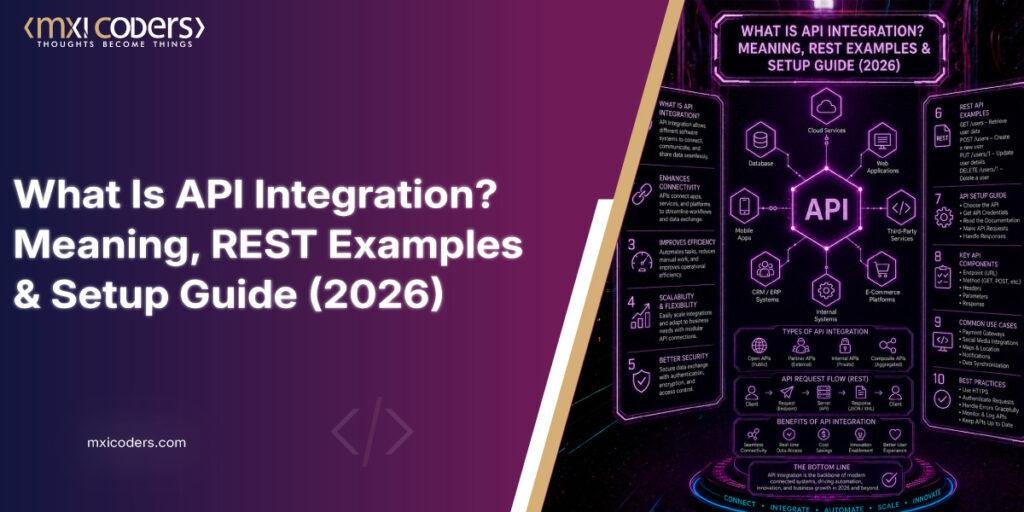
API integration is the process of connecting two or more software systems so they can exchange data and trigger actions automatically, using an application programming interface, or API, as the shared set of rules for that exchange. In practice, it’s what lets your CRM, payment processor, and shipping tool talk to each other without anyone manually copying data between them.
➤ What Is an API, Exactly?
An API is a defined set of rules that lets one piece of software request data or functionality from another, without either side needing to know how the other one works internally. Think of it as a contract: send a request in the agreed format, and you get a predictable response back.
A useful way to picture it is a restaurant. You don’t walk into the kitchen to cook your own meal. You tell a waiter what you want, the waiter passes that request to the kitchen, and the kitchen sends the finished dish back out. The waiter is the API. They handle the request and the response, and you never need to see what’s happening behind the kitchen door.
➤ What Does “API Integration” Actually Mean?
API integration meaning, in plain terms, is the act of wiring one application’s API into another system so the two can share data continuously, rather than as a one-time export or manual entry. It’s the difference between downloading a spreadsheet from your accounting tool once a month and having that accounting tool update automatically every time a sale happens in your storefront.
This is where most of the real engineering work sits. Finding an API is easy. Making it fit cleanly into your existing product, handle errors gracefully, and stay reliable under load is the part that takes planning.
➤ How Does REST API Integration Work?
REST, short for representational state transfer, is by far the most common style of API integration in production systems today, built on standard HTTP methods like GET, POST, PUT, and DELETE. A REST API integration typically works like this: your application sends an HTTP request to an endpoint (a specific URL), includes any needed authentication credentials and data, and receives a structured response back, usually in JSON.
Most modern REST APIs are documented using the OpenAPI Specification, maintained by the OpenAPI Initiative under the Linux Foundation, with version 3.2.0 released in September 2025 as the current standard. That documentation format matters more than it sounds. It’s what lets a developer, or increasingly an AI coding agent, understand exactly what an API can do without reading through someone else’s source code.
➤ REST vs. Other Integration Styles
| Option | Mechanism | Best Fit | Trade-off |
| REST API | HTTP requests/responses, resource-based URLs | Public APIs, web and mobile apps, most SaaS integrations | Can require multiple calls to assemble complex data |
| GraphQL | Single endpoint, client specifies exact data shape | Apps needing flexible, nested data in one request | Steeper learning curve, harder to cache |
| Webhooks | Server pushes data to you on an event | Real-time notifications (payment received, order shipped) | You don’t control timing, and must handle retries |
| SOAP | XML-based messaging protocol, strict contracts | Legacy enterprise systems, banking, insurance | Verbose, slower, largely being phased out for new builds |
➤ Why Does API Integration Matter More in 2026?
APIs have shifted from purely human-facing tools into infrastructure that AI agents call directly and autonomously. Postman’s 2025 State of the API Report, based on a survey of more than 5,700 developers and architects, found that 89 percent of developers now use AI tools daily, yet only 24 percent design their APIs with AI agents in mind, leaving a real gap between how APIs are built and how they’re actually being consumed.
That gap has security consequences. Salt Security’s H1 2026 State of AI and API Security Report found that two thirds of organizations saw API growth of over 50 percent in the past year, while security capability has struggled to keep pace, a pattern Salt refers to as the agentic security gap.
In client work, the pattern that shows up most often isn’t a lack of available APIs. It’s teams bolting on a third-party API late in a project without planning for what happens when that API changes its rate limits or goes down mid-transaction. Projects that map out authentication, error handling, and fallback behavior before writing integration code consistently launch with fewer post-release fire drills than ones that treat the API call as an afterthought.
➤ Limitations and Real-World Challenges
No API is guaranteed to be 100 percent reliable, and integrating a third-party API always means accepting some dependency on someone else’s uptime and documentation quality. Rate limits, undocumented breaking changes, and inconsistent error responses are common even with well-known providers. Before committing to an integration, it’s worth reviewing the provider’s documentation quality, checking their status page history, and building a fallback plan for what your system does if that API becomes unavailable.
Security also needs to be planned in from the start rather than added later. Broken authentication remains the single most common API vulnerability found in real breach reports, responsible for roughly a quarter of documented cases according to 42Crunch’s 2026 State of API Security analysis, which reviewed 200 real-world breach reports from 2024 and 2025.
➤ Frequently asked questions
- What is API integration in simple terms?
It’s connecting two applications so they can send data back and forth automatically, using each one’s API as the shared communication method, instead of someone manually exporting and re-entering information. - What’s the difference between an API and API integration?
An API is the interface itself, the set of rules a system exposes. API integration is the work of connecting that interface into your own product so it functions as part of your workflow, including authentication, error handling, and data mapping. - Is REST API integration hard to learn?
The core concept, sending an HTTP request and handling the response, is approachable for most developers within a few days. What takes longer to get right is handling authentication securely, managing rate limits, and building retry logic for when the third-party service has an outage. - Do I need a developer to set up API integration, or can I use no-code tools?
Many common integrations (payment processors, CRMs, email tools) now support no-code platforms like Zapier or Make for simple, low-volume tasks. Custom or high-volume integrations, especially anything touching payments or sensitive data, generally still need a developer to handle security and error handling properly.
➤ Conclusion
API integration has moved well past the “nice to have” stage. As more of the software stack is called by AI agents rather than only human users, the systems that treat integration as a first-class part of the architecture, with real documentation, authentication planning, and fallback handling, are the ones that hold up. The technical concept hasn’t changed much in years. What’s changed is how much now depends on getting it right.
➤ Ready to Build a Reliable API Integration?
If you’re planning an API-first system, whether that’s connecting payment gateways, wiring up AI agents, or modernizing a legacy integration, our team can help you scope it properly before a single line of code gets written. Explore our software development services or book a free consultation to talk through your specific setup.
➤ Sources Used
- Postman, 2025 State of the API Report (October 2025)
- OpenAPI Initiative, OpenAPI Specification (Version 3.2.0) (September 2025)
- Salt Security, H1 2026 State of AI and API Security Report (2026)
- 42Crunch (via Nordic APIs), “The 5 Most Common API Vulnerabilities in 2026″ (March 2026)