A peer to peer crypto exchange lets traders buy and sell digital assets directly with one another instead of routing funds through a company-held wallet. The platform’s job is narrower than people expect: it matches orders, holds funds in escrow until both sides confirm the trade, and settles disputes. Everything else, including which coins you support and how you price it, is a business decision layered on top.
➤ What Makes a P2P Crypto Exchange Different from a Centralized One?
On a centralized exchange, the platform itself holds custody of user funds and acts as counterparty to every trade. On a P2P crypto exchange, users retain control of their assets until the moment of the trade, and the platform’s role is to guarantee that trade completes fairly, usually through a smart contract escrow. That structural difference is why P2P models tend to see lower withdrawal friction, fewer jurisdictional restrictions on which coins can be listed, and, as seen with Brazilian traders using P2P rails to hedge against currency devaluation, genuine grassroots adoption in inflation-hit markets.
➤ What Features Does a Crypto Trading Platform Need in 2026?
A crypto trading platform built for P2P has to get a short list of things right, because any one of them failing breaks user trust immediately.
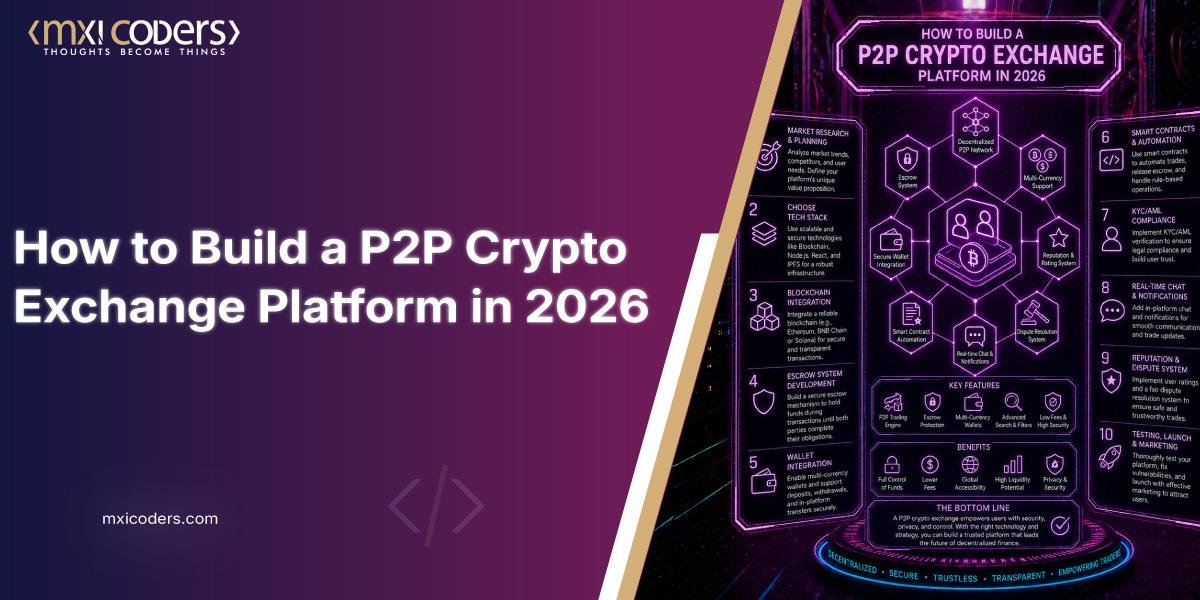
- Matching engine. Pairs buy and sell orders by price, volume, and accepted payment method. Weak matching means thin liquidity and traders walking away mid-search.
- Smart contract escrow. Locks the seller’s crypto automatically the moment a trade starts and releases it only once payment is confirmed. This is the single feature that makes P2P trustless rather than just informal.
- Multi-currency wallet. Needs to support both the crypto assets you list and the fiat rails your users actually pay with locally.
- Reputation system. Public trade history and ratings are how P2P users self-police counterparty risk, since there’s no central custodian vetting every trade.
- Dispute resolution workflow. Escrow prevents most fraud, but disagreements over payment timing or partial payments still happen and need a moderator queue with clear rules.
- Compliance layer. KYC onboarding and Travel Rule data handling, covered in detail below, are no longer optional add-ons for anyone serious about launching in 2026.
➤ How Do You Build a Crypto Exchange, Step by Step?
- Discovery and planning. Define which coins, which fiat currencies, and which regions you’re targeting first. This decision shapes your entire compliance obligations downstream.
- UI/UX design. Map the full trade journey from signup through dispute resolution before writing code.
- Backend and frontend build. The matching engine, order book, and API layer get built here, alongside the user-facing trading interface.
- Smart contract development and audit. Escrow logic gets written and independently audited. Skipping or shortcutting this step is where a disproportionate share of exploits still originate.
- Security hardening. Two-factor authentication, encryption at rest, and cold storage policy for any platform-held reserves.
- QA and stress testing. Simulated trade volume, adversarial testing, and load testing before any real funds touch the system.
- Launch. Deployment plus a go-to-market plan, since a P2P exchange with no early liquidity on either side of the order book fails fast.
- Post-launch maintenance. Ongoing patching, feature iteration, and compliance updates as regulations shift under you, which they currently are.
➤ How Much Does It Cost to Build a P2P Crypto Exchange in 2026?
| Option | Mechanism | Best fit | Trade-off |
| White label | Licensed, pre-built exchange software customized with your branding and coin list | Founders who want to test a business model fast with limited capital | Less control over core matching logic and harder to differentiate technically |
| Custom build | Full exchange written from scratch to your exact spec | Businesses with a clearly differentiated product or compliance requirement | Longer timeline and materially higher upfront cost |
| Hybrid / API-based | Custom frontend and compliance layer on top of a licensed matching engine or liquidity API | Teams that want brand control without owning core exchange infrastructure | Ongoing dependency on a third-party engine provider |
Actual budgets vary widely by scope, but the biggest cost drivers are consistent across projects: the number of fiat and crypto pairs supported, the complexity of the escrow and dispute system, and how much custom compliance tooling (KYC, Travel Rule data exchange) you build in-house versus license from a vendor.
➤ What Compliance Rules Apply to a Peer to Peer Crypto Exchange in 2026?
Two frameworks now define what “compliant” means for a P2P exchange, and both have hard 2026 deadlines.
The FATF Travel Rule requires virtual asset service providers, which explicitly includes P2P platforms, to collect and transmit sender and recipient identity data on qualifying transfers, the same principle banks have followed since 1996. As of 2026, about 73% of assessed jurisdictions have passed Travel Rule legislation, with enforcement active in more than 70 countries. Thresholds differ sharply by region: the EU’s Transfer of Funds Regulation applies a zero-value threshold for CASP-to-CASP transfers, while the US still uses a $3,000 threshold under the Funds Transfer Rule.
MiCA (Markets in Crypto-Assets Regulation) is the EU’s unified licensing regime for any exchange, custodian, or broker serving EU users. The transitional grace period ends on July 1, 2026, after which every crypto-asset service provider serving EU customers needs full CASP authorization from a national regulator, with no extension mechanism built into the regulation. As of June 2026, 204 exchanges and service providers already hold full CASP authorization, and operating past the deadline without one exposes a firm to administrative fines and potential license revocation.
For anyone building a P2P exchange with EU or globally distributed users, both of these need to be architected in from day one rather than retrofitted after launch.
➤ How Secure Are P2P Crypto Exchanges Right Now?
Security in 2026 looks different than it did even two years ago. According to TRM Labs’ H1 2026 data, the industry saw a record 207 hacking incidents in the first half of the year, yet total losses of roughly $972 million came in below $1 billion for the first time in years, a sign that smart contract auditing investment is producing real results even as attack frequency climbs. The bigger shift is where the damage is concentrated: major infrastructure and key-management compromises accounted for about 15% of incidents but roughly 76% of the assets actually stolen, with two North Korea-linked attacks on Drift Protocol and KelpDAO alone responsible for around $643 million. The practical takeaway for anyone building an exchange: a smart contract audit is necessary but no longer sufficient. Key management, signing infrastructure, and social-engineering resistance now matter as much as the escrow code itself.
➤ What’s Next for P2P Trading?
Cross-chain settlement, where users trade assets across different blockchains without a bridge intermediary, is gaining ground as bridge exploits remain one of the industry’s costlier attack vectors. AI-assisted dispute triage is also emerging, using trade and communication logs to flag likely-fair resolutions before a human moderator steps in. Neither is table stakes yet, but both are worth architecting room for if you’re building for a multi-year horizon rather than a one-year launch.
➤ Limitations and Open Challenges
No compliance framework fully closes the gap between regulation and enforcement. FATF’s own 2026 update noted that many jurisdictions have Travel Rule law on paper but are only beginning to test cross-border enforcement in practice. Cost estimates for custom builds also vary enormously by team location and feature scope, so any number quoted, including the ranges above, should be treated as a starting point for a scoping conversation rather than a fixed price.
➤ Frequently asked questions
- Is a P2P crypto exchange legal?
Yes, in most jurisdictions, but “legal” now means holding the right license. In the EU specifically, operating past July 1, 2026 without CASP authorization under MiCA is not a gray area, it’s a breach of the regulation. - Do I need to comply with the Travel Rule if my platform is peer to peer?
Yes. FATF guidance explicitly classifies P2P and decentralized platforms as VASPs subject to the Travel Rule once the business facilitates, holds, or transmits assets on a customer’s behalf, even if trades are technically direct between users. - How long does it typically take to launch a P2P exchange?
White label builds can go live in a few months. Custom builds with full smart contract audits and compliance tooling more commonly run six months to over a year, depending on how many jurisdictions you’re launching into simultaneously. - What’s the biggest security risk for a new P2P exchange today?
Based on 2026 incident data, it’s no longer purely smart contract bugs. Key management and social engineering now account for the majority of dollars lost industry-wide, even as the number of smaller code-level exploits keeps climbing.
➤ Conclusion
Building a P2P crypto exchange in 2026 is less about picking flashy features and more about sequencing three things correctly: a matching and escrow system that actually holds up under adversarial conditions, a compliance architecture that treats the Travel Rule and MiCA as day-one requirements rather than launch-week paperwork, and a security posture that assumes the attack will target your people and your keys, not just your code. Get that sequencing right and the feature list mostly takes care of itself.
Our team has deployed a P2P crypto exchange platform that has processed over $75 million in trading volume with 70% of assets held in cold storage, completed within a 120-day build cycle. If you’re scoping a similar build, we’re glad to talk through what that looked like.
Get in touch about crypto exchange development or explore our P2P crypto exchange development services, cryptocurrency exchange development services, and smart contract development services.
➤ Sources Used
- FATF Travel Rule enforcement data and thresholds: Blockchain Council, June 2026
- US Travel Rule threshold detail: eco.com Support, June 2026
- MiCA July 1, 2026 deadline and enforcement: Bleap Finance, June 2026
- MiCA CASP authorization count (204 as of June 2026): Paybis, June 2026
- H1 2026 crypto hack and loss data: TRM Labs, June 2026
- P2P adoption in inflation-hit markets: Coherent Market Insights, 2026