[ Your Headline ] [ Highlight Word ]

[ One or two lines describing the offer — e.g. "Experience our services with a FREE 30-minute consultation." ]

[ Optional second line, e.g. "Have a concept in mind? Let's brainstorm together!" ]

Google ★★★★★ 4.8
GoodFirms ★★★★★ 4.7
Clutch ★★★★★ 5.0
Blockchain Consulting

Blockchain Development Company in Virginia: What to Know Before You Hire

Ashok Rathod

Tech Consultant

Posted on
9th Jul 2026
7 min
Read
Share

Table of Contents

  • Quick Tips
  • Familiarize yourself with Cash App
  • Enable two-factor authentication
  • Utilize the optional Cash App
  • Conclusion

A blockchain development company builds and maintains decentralized applications, smart contracts, and custom ledger infrastructure for businesses that need tamper resistant records, automated settlement, or reduced reliance on intermediaries. In Virginia, that work spans everything from fintech and defense contracting to real estate tokenization and supply chain tracking.

➤ What does a blockchain development company actually do?

A blockchain development company designs, codes, audits, and deploys the systems that run on distributed ledgers. That includes smart contract development (the self-executing code that governs a transaction), wallet and custody integration, and the backend infrastructure that connects a blockchain to a company’s existing software. Most agencies also offer ongoing maintenance, since smart contracts that go live with unpatched bugs are difficult or impossible to quietly fix afterward.

The technical work generally breaks into three areas. Smart contract development covers writing and auditing the code that automates an agreement, most commonly in Solidity for Ethereum-based systems or in Rust for newer high-throughput chains. Enterprise blockchain solutions cover permissioned networks, typically built on frameworks like Hyperledger Fabric, where a consortium of businesses shares a ledger without exposing it publicly. And integration work covers connecting either of those to a company’s existing ERP, CRM, or payment rails, which is usually the most underestimated part of a project’s timeline.

➤ How much does it cost to hire a blockchain developer?

Cost depends heavily on whether you’re hiring an individual freelancer or an agency, and on how security critical the contract is. According to Clutch’s blockchain development pricing data, agencies on its platform average $25 to $49 an hour, with most projects landing under $50,000. Independent contractors and specialized Solidity auditors tend to bill higher: Arc.dev’s 2026 rate data puts typical blockchain developer rates at $81 to $100 an hour. In Virginia specifically, ZipRecruiter’s 2026 salary data shows entry-level, in-house blockchain developers earning an average of $99,405 a year, which is a useful benchmark if you’re weighing a full-time hire against an agency contract.

OptionMechanismBest fitTrade-off
Freelance developerIndividual contractor, hourly or fixed bidSmall, well-scoped smart contractsNo built-in second reviewer for security bugs
Boutique agencySmall team, project-based pricingFull dApp or wallet builds under $50KLess bench depth for large-scale systems
Enterprise consultancyLarger team, formal audit processPermissioned networks, regulated industriesHigher cost, longer onboarding
In-house hireFull-time salaried developerOngoing product with continuous iterationSlower to start, harder to scale down

➤ What’s the difference between blockchain development and smart contract development?

Blockchain development is the broader discipline: it covers network architecture, node infrastructure, wallet systems, and how a company’s software talks to a chain. Smart contract development is one piece inside that, specifically the code that automatically executes an agreement once its conditions are met, like releasing funds when a shipment is confirmed. A project can need blockchain development without much smart contract work (say, a data integrity system), or it can be almost entirely smart contract work bolted onto an existing chain. Getting a vendor to clarify which one your project actually needs is one of the fastest ways to avoid overpaying.

➤ Why would a business need enterprise blockchain solutions instead of a normal database?

The honest answer is that most businesses don’t, and a reputable vendor should tell you that upfront rather than sell you a blockchain project by default. Enterprise blockchain earns its cost when multiple independent organizations need to share a single source of truth without one party controlling it, which is why financial services and supply chain make up the bulk of live enterprise deployments today, according to industry analysis of 2026 enterprise adoption. If your use case is internal to one company, a well-designed conventional database is usually cheaper and faster to build.

➤ Is blockchain technology still worth adopting in 2026?

For the right use case, yes, and the market reflects that: it’s projected to grow from roughly $54 billion in 2026 to over $610 billion by 2031, according to MarketsandMarkets‘ 2026 blockchain technology market report. But adoption isn’t uniform. It’s concentrated in sectors with a specific, expensive coordination problem, not a general-purpose upgrade every business needs.

Security is the part most companies underweight. The OWASP Smart Contract Top 10 for 2026 found roughly $905 million in losses across 122 documented smart contract incidents in 2025 alone, with access control flaws as the single largest cause. That’s not a reason to avoid smart contracts, but it is a reason to treat a single audit as a minimum, not a finish line, and to ask any vendor how many independent audits they build into a project’s timeline.

➤ Where does Virginia fit into this?

Virginia has an active, if still developing, blockchain talent base. Virginia Tech’s Blockchain Ecosystem Catalyst runs training and certification programs specifically to build regional blockchain talent for mid-career professionals, and the state’s proximity to federal contracting and defense work means a meaningful share of local blockchain roles skew toward cybersecurity and data integrity applications rather than consumer crypto products.

➤ Limitations and industry challenges

Blockchain projects still run into predictable friction: integrating a distributed ledger with legacy ERPs and core systems typically requires custom middleware, which extends timelines beyond initial estimates. Regulatory clarity has improved but still varies by use case and jurisdiction. And even audited smart contracts aren’t immune to failure, since a meaningful share of 2025 and 2026 exploits targeted infrastructure and process gaps outside the code an audit typically scopes. None of this makes blockchain a bad investment, but any vendor who doesn’t mention these trade-offs upfront is worth a second look.

➤ Conclusion

Choosing a blockchain development partner comes down to matching the vendor’s specialty (smart contracts, enterprise networks, or integration work) to what your project actually needs, and asking specifically about audit practices before signing anything. The technology has moved well past hype cycles into measurable, if concentrated, real-world use. A team that can explain honestly where blockchain doesn’t fit is usually a better sign than one that pitches it as a universal upgrade.

➤ Frequently asked questions

  • How long does a typical smart contract development project take?
    Straightforward contracts with one audit cycle often run four to eight weeks. Enterprise permissioned network builds with integration work typically run several months, largely because of legacy system connections rather than the blockchain code itself.
  • Do I need a blockchain developer or a full development team?
    A single experienced developer can handle a scoped smart contract. Anything involving wallet infrastructure, backend integration, and security auditing usually needs at least a small team so the code isn’t only reviewed by the person who wrote it.
  • What questions should I ask before hiring a blockchain development company?
    Ask how many independent security audits are included, which specific blockchain or framework they specialize in, and for a reference project similar in scope and industry to yours, not just a general portfolio.
  • Can an existing business system be migrated to blockchain later instead of building on it from day one?
    Yes, and it’s often the more sensible path. Many companies pilot a smart contract for one narrow, high-value process before deciding whether a broader migration is worth the integration cost.

➤ Ready to talk through your project?

If you’re weighing whether your Virginia business needs custom smart contract development or a full enterprise blockchain build, Mxicoders works across blockchain consulting, DApp development, and crypto wallet integration. Book a free consultation to scope out what your specific use case actually requires.

➤ Sources Used

  • Clutch: Blockchain Development Pricing Guide, July 2026
  • Arc.dev: Blockchain Developer Hourly Rate 2026
  • ZipRecruiter: Entry Level Blockchain Developer Salary in Virginia, 2026
  • OWASP Smart Contract Top 10: 2026
  • MarketsandMarkets: Blockchain Technology Market Report 2026-2031
  • Enterprise blockchain adoption analysis, 2026
  • Virginia Tech Blockchain Ecosystem Catalyst
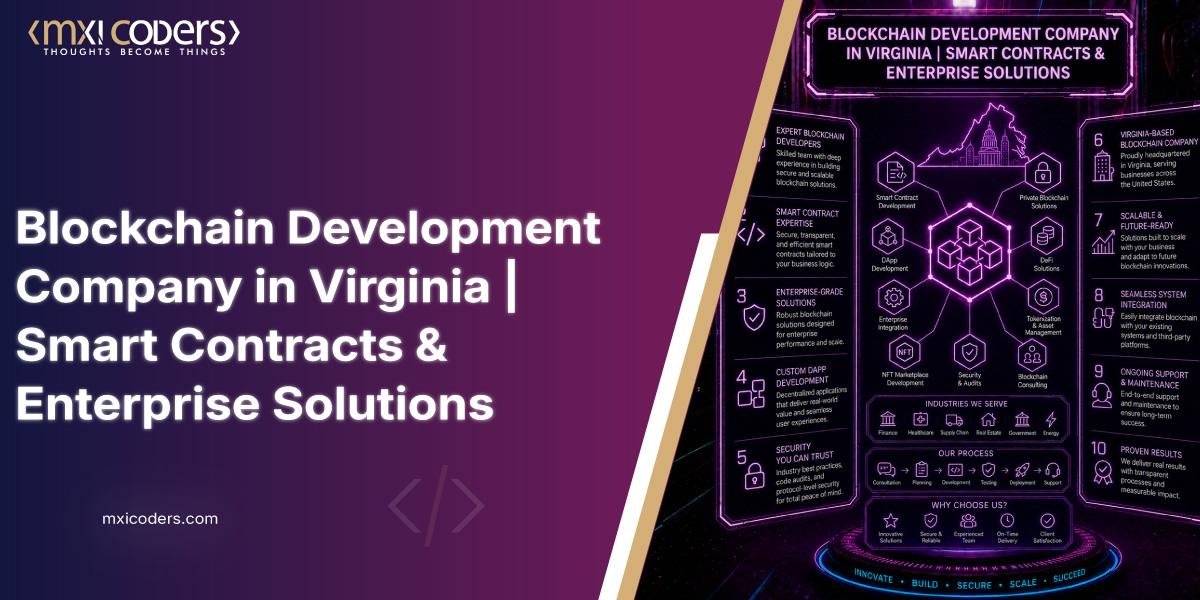
blockchain development agency in Virginia

A blockchain development company builds and maintains decentralized applications, smart contracts, and custom ledger infrastructure for businesses that need tamper resistant records, automated settlement, or reduced reliance on intermediaries. In Virginia, that work spans everything from fintech and defense contracting to real estate tokenization and supply chain tracking.

➤ What does a blockchain development company actually do?

A blockchain development company designs, codes, audits, and deploys the systems that run on distributed ledgers. That includes smart contract development (the self-executing code that governs a transaction), wallet and custody integration, and the backend infrastructure that connects a blockchain to a company’s existing software. Most agencies also offer ongoing maintenance, since smart contracts that go live with unpatched bugs are difficult or impossible to quietly fix afterward.

The technical work generally breaks into three areas. Smart contract development covers writing and auditing the code that automates an agreement, most commonly in Solidity for Ethereum-based systems or in Rust for newer high-throughput chains. Enterprise blockchain solutions cover permissioned networks, typically built on frameworks like Hyperledger Fabric, where a consortium of businesses shares a ledger without exposing it publicly. And integration work covers connecting either of those to a company’s existing ERP, CRM, or payment rails, which is usually the most underestimated part of a project’s timeline.

➤ How much does it cost to hire a blockchain developer?

Cost depends heavily on whether you’re hiring an individual freelancer or an agency, and on how security critical the contract is. According to Clutch’s blockchain development pricing data, agencies on its platform average $25 to $49 an hour, with most projects landing under $50,000. Independent contractors and specialized Solidity auditors tend to bill higher: Arc.dev’s 2026 rate data puts typical blockchain developer rates at $81 to $100 an hour. In Virginia specifically, ZipRecruiter’s 2026 salary data shows entry-level, in-house blockchain developers earning an average of $99,405 a year, which is a useful benchmark if you’re weighing a full-time hire against an agency contract.

OptionMechanismBest fitTrade-off
Freelance developerIndividual contractor, hourly or fixed bidSmall, well-scoped smart contractsNo built-in second reviewer for security bugs
Boutique agencySmall team, project-based pricingFull dApp or wallet builds under $50KLess bench depth for large-scale systems
Enterprise consultancyLarger team, formal audit processPermissioned networks, regulated industriesHigher cost, longer onboarding
In-house hireFull-time salaried developerOngoing product with continuous iterationSlower to start, harder to scale down

➤ What’s the difference between blockchain development and smart contract development?

Blockchain development is the broader discipline: it covers network architecture, node infrastructure, wallet systems, and how a company’s software talks to a chain. Smart contract development is one piece inside that, specifically the code that automatically executes an agreement once its conditions are met, like releasing funds when a shipment is confirmed. A project can need blockchain development without much smart contract work (say, a data integrity system), or it can be almost entirely smart contract work bolted onto an existing chain. Getting a vendor to clarify which one your project actually needs is one of the fastest ways to avoid overpaying.

➤ Why would a business need enterprise blockchain solutions instead of a normal database?

The honest answer is that most businesses don’t, and a reputable vendor should tell you that upfront rather than sell you a blockchain project by default. Enterprise blockchain earns its cost when multiple independent organizations need to share a single source of truth without one party controlling it, which is why financial services and supply chain make up the bulk of live enterprise deployments today, according to industry analysis of 2026 enterprise adoption. If your use case is internal to one company, a well-designed conventional database is usually cheaper and faster to build.

➤ Is blockchain technology still worth adopting in 2026?

For the right use case, yes, and the market reflects that: it’s projected to grow from roughly $54 billion in 2026 to over $610 billion by 2031, according to MarketsandMarkets‘ 2026 blockchain technology market report. But adoption isn’t uniform. It’s concentrated in sectors with a specific, expensive coordination problem, not a general-purpose upgrade every business needs.

Security is the part most companies underweight. The OWASP Smart Contract Top 10 for 2026 found roughly $905 million in losses across 122 documented smart contract incidents in 2025 alone, with access control flaws as the single largest cause. That’s not a reason to avoid smart contracts, but it is a reason to treat a single audit as a minimum, not a finish line, and to ask any vendor how many independent audits they build into a project’s timeline.

➤ Where does Virginia fit into this?

Virginia has an active, if still developing, blockchain talent base. Virginia Tech’s Blockchain Ecosystem Catalyst runs training and certification programs specifically to build regional blockchain talent for mid-career professionals, and the state’s proximity to federal contracting and defense work means a meaningful share of local blockchain roles skew toward cybersecurity and data integrity applications rather than consumer crypto products.

➤ Limitations and industry challenges

Blockchain projects still run into predictable friction: integrating a distributed ledger with legacy ERPs and core systems typically requires custom middleware, which extends timelines beyond initial estimates. Regulatory clarity has improved but still varies by use case and jurisdiction. And even audited smart contracts aren’t immune to failure, since a meaningful share of 2025 and 2026 exploits targeted infrastructure and process gaps outside the code an audit typically scopes. None of this makes blockchain a bad investment, but any vendor who doesn’t mention these trade-offs upfront is worth a second look.

➤ Conclusion

Choosing a blockchain development partner comes down to matching the vendor’s specialty (smart contracts, enterprise networks, or integration work) to what your project actually needs, and asking specifically about audit practices before signing anything. The technology has moved well past hype cycles into measurable, if concentrated, real-world use. A team that can explain honestly where blockchain doesn’t fit is usually a better sign than one that pitches it as a universal upgrade.

➤ Frequently asked questions

  • How long does a typical smart contract development project take?
    Straightforward contracts with one audit cycle often run four to eight weeks. Enterprise permissioned network builds with integration work typically run several months, largely because of legacy system connections rather than the blockchain code itself.
  • Do I need a blockchain developer or a full development team?
    A single experienced developer can handle a scoped smart contract. Anything involving wallet infrastructure, backend integration, and security auditing usually needs at least a small team so the code isn’t only reviewed by the person who wrote it.
  • What questions should I ask before hiring a blockchain development company?
    Ask how many independent security audits are included, which specific blockchain or framework they specialize in, and for a reference project similar in scope and industry to yours, not just a general portfolio.
  • Can an existing business system be migrated to blockchain later instead of building on it from day one?
    Yes, and it’s often the more sensible path. Many companies pilot a smart contract for one narrow, high-value process before deciding whether a broader migration is worth the integration cost.

➤ Ready to talk through your project?

If you’re weighing whether your Virginia business needs custom smart contract development or a full enterprise blockchain build, Mxicoders works across blockchain consulting, DApp development, and crypto wallet integration. Book a free consultation to scope out what your specific use case actually requires.

➤ Sources Used

  • Clutch: Blockchain Development Pricing Guide, July 2026
  • Arc.dev: Blockchain Developer Hourly Rate 2026
  • ZipRecruiter: Entry Level Blockchain Developer Salary in Virginia, 2026
  • OWASP Smart Contract Top 10: 2026
  • MarketsandMarkets: Blockchain Technology Market Report 2026-2031
  • Enterprise blockchain adoption analysis, 2026
  • Virginia Tech Blockchain Ecosystem Catalyst

Feel free to Connect us on

Ready to transform your business with smart software solutions?

Harness the power of custom software development to streamline operations, reduce costs, and boost efficiency. Start by exploring cutting-edge approaches like cloud-native platforms, API-first architecture, and AI-driven automation to future-proof your systems and stay ahead of the competition.

Book free consultation

Let’s build your idea together and serve society.

Author

Ashok Rathod

Tech Consultant

Experience
25 Years
Growth Architect for Startups & SMEs | Blockchain, AI , MVP Development, & Data-Driven Marketing Expert.

Transform the Carbon Credit Industry

Build a Transparent, Scalable Carbon Credit Marketplace with Blockchain.

Index

Get in Touch

Ready to transform your ideas into reality? Contact our team today and let’s discuss your project.