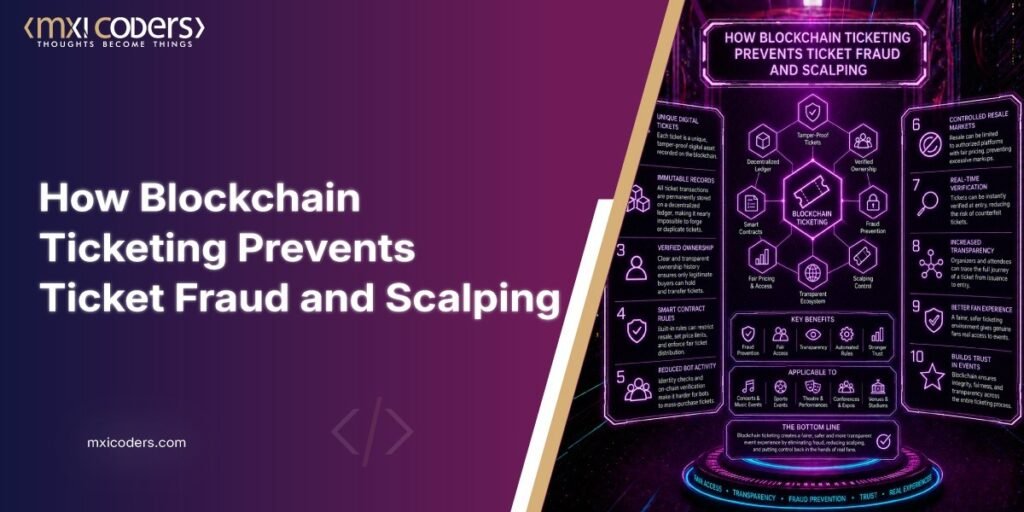
Ticket fraud has moved well beyond opportunistic scalpers reselling a few extra seats. American consumers lost more than $12.5 billion to ticketing scams in a recent year, UK fans alone lost over £5 million in 2025, and bad bots now account for nearly 40% of all ticketing traffic industry-wide. One documented case involved organized crime using ticket purchases to validate 47,000 stolen payment cards within six weeks, treating event ticketing as a testing ground for stolen credit card data rather than a way to actually attend anything. When Coachella introduced blockchain tickets for select events, counterfeit attempts dropped by more than 90%, a result significant enough that FIFA built its entire 2026 World Cup ticketing model around a customized blockchain network. This guide breaks down exactly how blockchain ticketing addresses fraud and scalping at a structural level, not just as an incremental improvement over existing systems.
➤ Why Traditional Ticketing Systems Are So Vulnerable
Conventional ticketing platforms rely on static barcodes and centralized databases that were never designed to withstand the scale of automated fraud seen today.
➥ Structural Weaknesses in Legacy Ticketing
- Static QR codes and barcodes can be copied, screenshotted, and resold multiple times without detection
- Centralized databases create a single point of failure that scalping bots and fraud rings can target at scale
- Secondary resale markets operate with little transparency, making it difficult to trace where a given ticket has actually been sold
- Manual fraud detection struggles to keep pace with automated bot purchasing that can acquire large ticket blocks within seconds of release
➤ How a Blockchain Ticketing Platform Actually Works
A properly designed blockchain ticketing platform replaces the static, centralized model with a decentralized, cryptographically verifiable record of every ticket’s full lifecycle, from initial issuance through every subsequent transfer.
- Each ticket is issued as a unique token, often an NFT, recorded on a blockchain ledger that cannot be altered after the fact
- Ownership transfers are recorded transparently, creating a permanent, auditable trail for every resale or transfer
- Smart contracts can automatically enforce resale rules, such as price caps or transfer restrictions, without requiring manual policing
- Because each ticket exists as a single, traceable record, duplicating or counterfeiting it becomes computationally and practically infeasible
➤ Blockchain Ticket Verification Stops Duplication and Counterfeiting
At the core of fraud prevention sits reliable blockchain ticket verification, which confirms a ticket’s authenticity and current ownership at the moment of entry rather than relying on a static code that could have already been copied.
- Every ticket carries a cryptographic signature tied to its specific blockchain record, making forgery essentially impossible without controlling the underlying network
- Verification happens in real time against the distributed ledger, immediately flagging any ticket that has already been used or duplicated
- Dynamic, blockchain-linked identifiers replace static barcodes, closing the most common vulnerability scalpers and counterfeiters have historically exploited
- Because the verification record is distributed rather than centralized, there is no single database an attacker can compromise to generate valid-looking fake tickets
➤ How Blockchain Disrupts Scalping Specifically
Fraud and scalping are related but distinct problems, and blockchain ticketing addresses scalping through mechanisms that go beyond simple authenticity checks.
- Smart contracts can cap resale prices programmatically, removing the financial incentive that drives scalping in the first place
- Ownership history baked into the blockchain lets organizers identify and restrict accounts showing bot-like purchasing patterns before tickets even reach the secondary market
- Some platforms use a rights-based model, separating the right to purchase from the ticket itself, which shifts where secondary market activity actually happens and keeps more of that value with the original organizer rather than third-party resale sites
- Verified fan and allowlist programs, enforced through wallet-linked identity, make it far harder for a single bot operation to acquire disproportionate ticket volume
➤ A Real-World Test at Global Scale: FIFA’s 2026 World Cup
The clearest large-scale validation of this approach is unfolding in real time. FIFA built its 2026 World Cup ticketing model on a customized blockchain network specifically to address bots, fraud, and runaway secondary-market prices, using a rights-based mechanism that gives verified fans priority access before tickets become publicly available. This approach deliberately shifts where secondary sales activity happens, aiming to keep more of the value generated by high demand within FIFA’s own ecosystem rather than letting third-party resale platforms capture it after the fact, as has historically been the case with major ticketed events.
➤ Additional Layers That Strengthen Blockchain Ticketing
Blockchain ticket verification works best when combined with complementary technologies rather than deployed in isolation.
- AI-driven anti-scalping modules can analyze purchasing behavior in real time, flagging bot-like patterns such as unusually rapid purchases or high-volume buying from a single IP range
- Facial recognition or biometric entry validation can confirm that the person entering a venue matches the verified ticket holder
- Regulated resale functions can require organizer confirmation before a transfer is finalized, adding a manual check on top of automated smart contract enforcement
- Dynamic pricing models reduce the profit margin available to scalpers by adjusting ticket prices to reflect real-time demand rather than a fixed face value
➤ Why This Matters Beyond Fraud Prevention Alone
Blockchain ticketing does more than stop bad actors. It changes the underlying economics and data ownership of live events in ways that benefit organizers directly.
- Organizers retain a direct relationship with the actual attendee, rather than losing that data to a third-party resale platform when a ticket changes hands
- Transparent transaction history gives organizers accurate attendance and resale data they can use for future event planning
- The global secondary ticket market is projected to exceed $20 billion by 2033, meaning organizers who capture more of that value through their own platform stand to benefit substantially
- Tightening consumer protection regulations around resale pricing are placing more verification responsibility directly on organizers, making a traceable, blockchain-based system increasingly a compliance advantage rather than just a fraud deterrent
➤ Choosing the Right Development Partner for a Ticketing Platform
Building a secure, scalable ticketing system requires more than deploying a generic NFT contract, since resale rules, identity verification, and high-volume transaction handling all need to work together under real event-day load.
- Verify a development partner’s experience specifically with high-traffic, time-sensitive transaction systems, since ticket releases create sudden, extreme demand spikes unlike most other blockchain applications
- Confirm whether the platform supports programmable resale restrictions natively, rather than relying entirely on off-chain enforcement
- Organizations exploring a broader move into Web3 infrastructure often approach ticketing as part of a larger custom enterprise blockchain development strategy, since the same identity verification and transaction infrastructure frequently extends to loyalty programs, merchandise authentication, and other fan engagement systems
➤ Frequently Asked Questions
- Can blockchain ticketing completely eliminate scalping?
Not entirely, but it significantly raises the cost and difficulty of scalping at scale. Programmable resale caps, verified purchasing patterns, and transparent ownership records remove much of the anonymity and profit margin that make scalping viable in the first place. - Is blockchain ticketing only useful for large events like the World Cup?
No. While large-scale events highlight the technology’s impact most visibly, small and mid-sized venues can use the same underlying verification and anti-fraud mechanisms at a scale appropriate to their ticket volume. - Does blockchain ticket verification slow down entry at venues?
Generally no. Verification against a distributed ledger happens in real time, and when paired with dynamic QR codes or mobile wallet integration, entry speed is comparable to or faster than traditional ticket scanning.
➤ What to Look for When Evaluating a Blockchain Ticketing Solution
- Confirm the platform issues tickets as unique, non-duplicable tokens rather than simply digitizing a traditional barcode
- Check whether resale price caps and transfer restrictions are enforced automatically through smart contracts
- Ask how the system handles sudden demand spikes without creating bottlenecks or vulnerabilities during high-traffic release windows
- Verify the platform provides organizers with transparent, exportable transaction and attendance data
➤ Conclusion
Blockchain ticketing addresses fraud and scalping at a structural level that traditional barcode-based systems simply cannot match, replacing copyable static codes with unique, traceable, and programmable tickets. The results already visible at scale, from Coachella’s counterfeit reduction to FIFA’s 2026 World Cup deployment, suggest this shift is moving well past early experimentation into genuine infrastructure for major events. As bot traffic and organized fraud continue escalating, organizers adopting verifiable, blockchain-based ticketing now are positioned to protect both revenue and fan trust more effectively than those still relying on systems built for a much less adversarial ticketing environment.
➤ Sources Used
- Softjourn, Preventing Ticketing Fraud in 2026: Technology and Strategies – softjourn.com/insights/prevent-ticketing-fraud
- CoinDesk, FIFA Wanted Avalanche’s Blockchain to Help Curb World Cup Ticket Scalping. Here’s How It’s Going – coindesk.com/tech/2026/06/17/fifa-wanted-avalanches-blockchain-to-help-curb-world-cup-ticket-scalping-heres-how-its-going
- Vivenu, How to Prevent Ticket Scalping and Fraud: The Ticketing Managers Guide – vivenu.com/blog/prevent-ticket-scalping-fraud-guide
- Softjourn, Top Event Ticketing Industry Challenges in 2026 – softjourn.com/insights/ticketing-challenges