[ Your Headline ] [ Highlight Word ]

[ One or two lines describing the offer — e.g. "Experience our services with a FREE 30-minute consultation." ]

[ Optional second line, e.g. "Have a concept in mind? Let's brainstorm together!" ]

Google ★★★★★ 4.8
GoodFirms ★★★★★ 4.7
Clutch ★★★★★ 5.0
Blockchain,Tokenization

How to Build a Secure and Scalable Asset Tokenization Platform

Ashok Rathod

Tech Consultant

Posted on
15th Sep 2026
7 min
Read
Share

Table of Contents

  • Quick Tips
  • Familiarize yourself with Cash App
  • Enable two-factor authentication
  • Utilize the optional Cash App
  • Conclusion

Asset tokenization is reshaping how ownership, investment, and capital raising work. Instead of holding a paper deed or a share certificate, an investor can hold a digital token that represents a verified claim on a real-world asset — and trade it with far less friction than traditional systems allow. For founders, financial firms, and real estate companies exploring this space, the real question isn’t whether tokenization matters — it’s how to build a platform that is secure, compliant, and ready to scale as adoption grows.

This guide walks through the practical steps of building an asset tokenization platform, from regulatory groundwork to architecture, blockchain selection, security, and launch.

➤ What Is an Asset Tokenization Platform?

An asset tokenization  is a software system that converts ownership rights to a physical or financial asset into a digital token recorded on a blockchain. Each token represents a defined share or right in the underlying asset, and the blockchain ledger tracks issuance, transfers, and ownership changes transparently.

Common examples of tokenized assets include:

  • Real estate — buildings, land parcels, or rental income streams
  • Commodities — gold, oil, or other physical goods
  • Investment funds — fund shares and private equity stakes
  • Bonds and debt instruments — fixed-income products
  • Artwork and collectibles — high-value items split into fractional shares

The core idea is straightforward: representing ownership as a token makes assets easier to divide, transfer, and track than they are under paper-based or siloed digital record systems.

➤ Build the Regulatory and Ownership Framework

Before writing a single line of code, the ownership and legal structure of the asset needs to be settled. This step protects investors and keeps the platform out of legal trouble later.

Key considerations include:

  • Verifying ownership and authenticity of the underlying asset before it’s tokenized
  • Defining exactly what legal rights the token represents (equity, debt, revenue share, etc.)
  • Accounting for jurisdiction-specific securities regulations, since rules differ significantly between countries
  • Implementing KYC/AML checks and investor eligibility requirements
  • Defining custody, transfer, and redemption rules in advance
  • Involving legal experts before finalizing technical architecture, not after

Skipping this step is one of the most common — and costly — mistakes in tokenization projects.

➤ Design the Platform Architecture

A tokenization platform is made up of several interdependent components rather than a single monolithic app. At a high level, these typically include:

  • Asset onboarding module — for registering and documenting assets
  • Investor onboarding and identity verification — for registering and vetting investors
  • Token issuance engine — for minting tokens against verified assets
  • Smart contract system — for enforcing ownership and transfer logic
  • Wallet and custody integration — for secure token storage
  • Compliance engine — for enforcing eligibility and transfer restrictions
  • Transaction and settlement system — for processing trades
  • Admin and asset management dashboard — for internal operations
  • Analytics and reporting — for tracking performance and generating audit trails

Designing these as modular, loosely coupled components makes the platform easier to maintain, test, and scale later.

➤ Choose the Right Blockchain Infrastructure

Blockchain selection should be driven by the asset type and business requirements, not by trend. Factors worth weighing include:

  • Transaction speed and network capacity
  • Transaction (gas) costs, especially for high-frequency transfers
  • Smart contract support and maturity of developer tooling
  • Security track record and ecosystem stability
  • Interoperability and multi-chain support for future expansion

A platform tokenizing real estate with infrequent trades has very different infrastructure needs than one handling high-volume commodity trading.

➤ Develop Secure Token and Smart Contract Logic

Smart contracts encode the rules governing a token’s lifecycle. This includes:

  • Defining ownership and transfer rules
  • Automating compliance restrictions (e.g., blocking transfers to unverified wallets)
  • Building minting, burning, transfer, and redemption functions
  • Implementing role-based permissions for issuers, admins, and investors
  • Protecting administrative functions from unauthorized access

Because tokenization commonly represents ownership of real-world assets, blockchain analytics providers note that smart contracts are frequently paired with oracles — services that feed verified off-chain data (like asset valuations) into the contract logic. Independent smart contract audits before deployment are essential, since a flaw here can directly compromise investor funds.

➤ Add Identity, KYC/AML, and Access Controls

Compliance isn’t a one-time checkbox — it needs to be built into the platform’s ongoing operations:

  • Investor registration and identity verification
  • AML screening against watchlists
  • Accredited or eligible investor checks where regulations require them
  • Wallet whitelisting so tokens can only move to approved addresses
  • Role-based access control across the platform
  • Continuous compliance monitoring, not just at onboarding

➤ Secure Wallets, Custody, and Private Keys

Wallet security is arguably the single most critical technical safeguard in a tokenization platform, since a compromised key can mean an irreversible loss of assets. Best practices include:

  • Considering institutional-grade custody solutions for large holdings
  • Using secure key-management practices throughout the stack
  • Requiring multi-signature authorization for high-value transactions
  • Using hardware security modules (HSMs) where appropriate
  • Building backup and recovery mechanisms into the custody design

➤ Make the Platform Scalable From the Beginning

Scalability should be a design principle from day one, not a retrofit. This means:

  • Using modular architecture that allows components to be updated independently
  • Supporting horizontal scaling as user and transaction volume grows
  • Optimizing blockchain interactions to reduce latency and cost
  • Using APIs and middleware for external integrations
  • Preparing for multiple asset classes and potentially multiple blockchain networks
  • Building monitoring systems that flag performance bottlenecks before they affect users

➤ Connect the Platform With External Systems

Real-world tokenization platforms rarely operate in isolation. They typically need to connect with:

  • KYC/AML providers
  • Custodians
  • Banking and payment systems
  • Market-data and oracle providers
  • Accounting and ERP systems
  • Underlying blockchain networks
  • Secondary-market infrastructure for trading

This integration layer is what lets on-chain functionality work alongside existing financial infrastructure, rather than replacing it entirely.

➤ Create the Investor and Admin Experience

Investor side: account creation, KYC verification, browsing available assets, purchasing tokens, tracking a portfolio, and reviewing transaction history.

Admin side: asset onboarding, token issuance, investor management, compliance monitoring, transaction oversight, and reporting/analytics.

A platform that’s technically sound but confusing to use will struggle with adoption — the interface matters as much as the backend.

➤ Launch and Continuously Monitor the Platform

A controlled pilot launch, rather than a full public rollout, allows teams to observe real behavior before scaling exposure. After launch:

  • Monitor transactions and system performance continuously
  • Track suspicious activity and compliance events
  • Maintain and update smart contracts and integrations
  • Regularly review security controls
  • Upgrade infrastructure as transaction volume increases

➤ Final Takeaway

Asset tokenization is more than putting an asset on a blockchain. A platform that actually works for issuers and investors needs legal clarity, secure technology, embedded compliance, and infrastructure built to scale. Start by getting the asset and business requirements right, then design an architecture that can expand as your assets, investor base, transaction volume, and jurisdictions grow.

If you’re planning to build a blockchain based asset tokenization platform, working with a team that has handled the full lifecycle — from smart contract development to compliance integration — can save significant time and reduce costly rework. Mxicoders’ asset tokenization platform development services cover issuance, compliance, custody, and investor management in a single connected system, so you’re not stitching together multiple vendors to get a secure, launch-ready platform.

Ready to build your tokenization platform? Talk to Mxicoders’ blockchain team to scope your project, from regulatory groundwork to a fully audited, scalable launch.

➤ Frequently Asked Questions

  1. What is an asset tokenization platform?
    It’s a software system that converts ownership rights to a real-world asset — like property, equity, or commodities — into digital tokens recorded and managed on a blockchain.
  2. Is asset tokenization the same as creating an NFT?
    Not usually. NFTs typically represent unique, non-divisible items, while asset tokenization more often involves fungible tokens that represent fractional, divisible ownership shares in an asset.
  3. How long does it take to build a tokenization platform? 
    Timelines vary with asset complexity and regulatory scope, but most projects move from requirements gathering through legal structuring, development, and testing to a controlled launch over several months.
  4. What blockchain is best for asset tokenization?
    There’s no single best choice — it depends on transaction speed, cost, smart contract support, and security needs specific to the asset class and expected transaction volume.
  5. Do smart contracts need to be audited before launch?
    Yes. Independent smart contract audits are a standard best practice before deployment, since flaws in contract logic can directly affect investor funds and are difficult to reverse once tokens are live.

➤ References

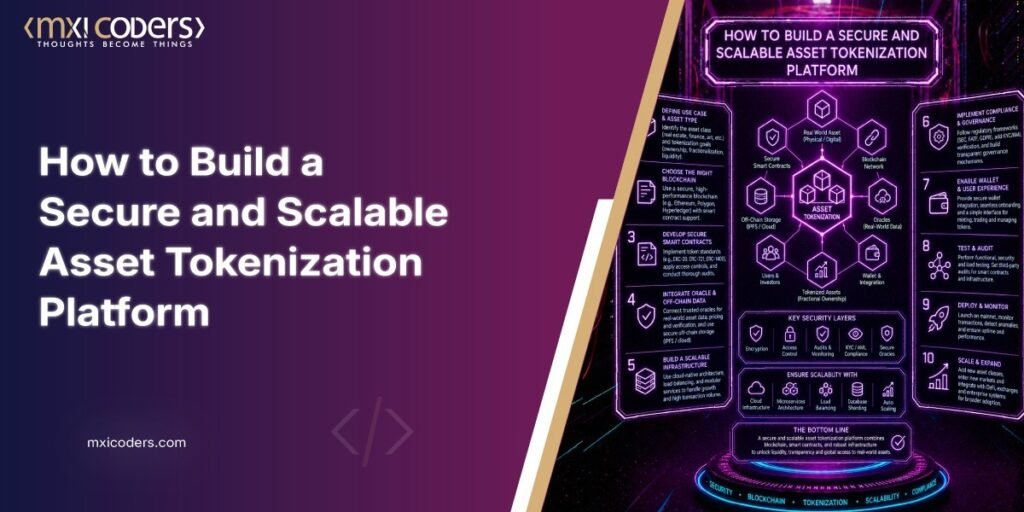
how to build a secure and scalable asset tokenization platform (blog image)

Asset tokenization is reshaping how ownership, investment, and capital raising work. Instead of holding a paper deed or a share certificate, an investor can hold a digital token that represents a verified claim on a real-world asset — and trade it with far less friction than traditional systems allow. For founders, financial firms, and real estate companies exploring this space, the real question isn’t whether tokenization matters — it’s how to build a platform that is secure, compliant, and ready to scale as adoption grows.

This guide walks through the practical steps of building an asset tokenization platform, from regulatory groundwork to architecture, blockchain selection, security, and launch.

➤ What Is an Asset Tokenization Platform?

An asset tokenization  is a software system that converts ownership rights to a physical or financial asset into a digital token recorded on a blockchain. Each token represents a defined share or right in the underlying asset, and the blockchain ledger tracks issuance, transfers, and ownership changes transparently.

Common examples of tokenized assets include:

  • Real estate — buildings, land parcels, or rental income streams
  • Commodities — gold, oil, or other physical goods
  • Investment funds — fund shares and private equity stakes
  • Bonds and debt instruments — fixed-income products
  • Artwork and collectibles — high-value items split into fractional shares

The core idea is straightforward: representing ownership as a token makes assets easier to divide, transfer, and track than they are under paper-based or siloed digital record systems.

➤ Build the Regulatory and Ownership Framework

Before writing a single line of code, the ownership and legal structure of the asset needs to be settled. This step protects investors and keeps the platform out of legal trouble later.

Key considerations include:

  • Verifying ownership and authenticity of the underlying asset before it’s tokenized
  • Defining exactly what legal rights the token represents (equity, debt, revenue share, etc.)
  • Accounting for jurisdiction-specific securities regulations, since rules differ significantly between countries
  • Implementing KYC/AML checks and investor eligibility requirements
  • Defining custody, transfer, and redemption rules in advance
  • Involving legal experts before finalizing technical architecture, not after

Skipping this step is one of the most common — and costly — mistakes in tokenization projects.

➤ Design the Platform Architecture

A tokenization platform is made up of several interdependent components rather than a single monolithic app. At a high level, these typically include:

  • Asset onboarding module — for registering and documenting assets
  • Investor onboarding and identity verification — for registering and vetting investors
  • Token issuance engine — for minting tokens against verified assets
  • Smart contract system — for enforcing ownership and transfer logic
  • Wallet and custody integration — for secure token storage
  • Compliance engine — for enforcing eligibility and transfer restrictions
  • Transaction and settlement system — for processing trades
  • Admin and asset management dashboard — for internal operations
  • Analytics and reporting — for tracking performance and generating audit trails

Designing these as modular, loosely coupled components makes the platform easier to maintain, test, and scale later.

➤ Choose the Right Blockchain Infrastructure

Blockchain selection should be driven by the asset type and business requirements, not by trend. Factors worth weighing include:

  • Transaction speed and network capacity
  • Transaction (gas) costs, especially for high-frequency transfers
  • Smart contract support and maturity of developer tooling
  • Security track record and ecosystem stability
  • Interoperability and multi-chain support for future expansion

A platform tokenizing real estate with infrequent trades has very different infrastructure needs than one handling high-volume commodity trading.

➤ Develop Secure Token and Smart Contract Logic

Smart contracts encode the rules governing a token’s lifecycle. This includes:

  • Defining ownership and transfer rules
  • Automating compliance restrictions (e.g., blocking transfers to unverified wallets)
  • Building minting, burning, transfer, and redemption functions
  • Implementing role-based permissions for issuers, admins, and investors
  • Protecting administrative functions from unauthorized access

Because tokenization commonly represents ownership of real-world assets, blockchain analytics providers note that smart contracts are frequently paired with oracles — services that feed verified off-chain data (like asset valuations) into the contract logic. Independent smart contract audits before deployment are essential, since a flaw here can directly compromise investor funds.

➤ Add Identity, KYC/AML, and Access Controls

Compliance isn’t a one-time checkbox — it needs to be built into the platform’s ongoing operations:

  • Investor registration and identity verification
  • AML screening against watchlists
  • Accredited or eligible investor checks where regulations require them
  • Wallet whitelisting so tokens can only move to approved addresses
  • Role-based access control across the platform
  • Continuous compliance monitoring, not just at onboarding

➤ Secure Wallets, Custody, and Private Keys

Wallet security is arguably the single most critical technical safeguard in a tokenization platform, since a compromised key can mean an irreversible loss of assets. Best practices include:

  • Considering institutional-grade custody solutions for large holdings
  • Using secure key-management practices throughout the stack
  • Requiring multi-signature authorization for high-value transactions
  • Using hardware security modules (HSMs) where appropriate
  • Building backup and recovery mechanisms into the custody design

➤ Make the Platform Scalable From the Beginning

Scalability should be a design principle from day one, not a retrofit. This means:

  • Using modular architecture that allows components to be updated independently
  • Supporting horizontal scaling as user and transaction volume grows
  • Optimizing blockchain interactions to reduce latency and cost
  • Using APIs and middleware for external integrations
  • Preparing for multiple asset classes and potentially multiple blockchain networks
  • Building monitoring systems that flag performance bottlenecks before they affect users

➤ Connect the Platform With External Systems

Real-world tokenization platforms rarely operate in isolation. They typically need to connect with:

  • KYC/AML providers
  • Custodians
  • Banking and payment systems
  • Market-data and oracle providers
  • Accounting and ERP systems
  • Underlying blockchain networks
  • Secondary-market infrastructure for trading

This integration layer is what lets on-chain functionality work alongside existing financial infrastructure, rather than replacing it entirely.

➤ Create the Investor and Admin Experience

Investor side: account creation, KYC verification, browsing available assets, purchasing tokens, tracking a portfolio, and reviewing transaction history.

Admin side: asset onboarding, token issuance, investor management, compliance monitoring, transaction oversight, and reporting/analytics.

A platform that’s technically sound but confusing to use will struggle with adoption — the interface matters as much as the backend.

➤ Launch and Continuously Monitor the Platform

A controlled pilot launch, rather than a full public rollout, allows teams to observe real behavior before scaling exposure. After launch:

  • Monitor transactions and system performance continuously
  • Track suspicious activity and compliance events
  • Maintain and update smart contracts and integrations
  • Regularly review security controls
  • Upgrade infrastructure as transaction volume increases

➤ Final Takeaway

Asset tokenization is more than putting an asset on a blockchain. A platform that actually works for issuers and investors needs legal clarity, secure technology, embedded compliance, and infrastructure built to scale. Start by getting the asset and business requirements right, then design an architecture that can expand as your assets, investor base, transaction volume, and jurisdictions grow.

If you’re planning to build a blockchain based asset tokenization platform, working with a team that has handled the full lifecycle — from smart contract development to compliance integration — can save significant time and reduce costly rework. Mxicoders’ asset tokenization platform development services cover issuance, compliance, custody, and investor management in a single connected system, so you’re not stitching together multiple vendors to get a secure, launch-ready platform.

Ready to build your tokenization platform? Talk to Mxicoders’ blockchain team to scope your project, from regulatory groundwork to a fully audited, scalable launch.

➤ Frequently Asked Questions

  1. What is an asset tokenization platform?
    It’s a software system that converts ownership rights to a real-world asset — like property, equity, or commodities — into digital tokens recorded and managed on a blockchain.
  2. Is asset tokenization the same as creating an NFT?
    Not usually. NFTs typically represent unique, non-divisible items, while asset tokenization more often involves fungible tokens that represent fractional, divisible ownership shares in an asset.
  3. How long does it take to build a tokenization platform? 
    Timelines vary with asset complexity and regulatory scope, but most projects move from requirements gathering through legal structuring, development, and testing to a controlled launch over several months.
  4. What blockchain is best for asset tokenization?
    There’s no single best choice — it depends on transaction speed, cost, smart contract support, and security needs specific to the asset class and expected transaction volume.
  5. Do smart contracts need to be audited before launch?
    Yes. Independent smart contract audits are a standard best practice before deployment, since flaws in contract logic can directly affect investor funds and are difficult to reverse once tokens are live.

➤ References

Feel free to Connect us on

Ready to transform your business with smart software solutions?

Harness the power of custom software development to streamline operations, reduce costs, and boost efficiency. Start by exploring cutting-edge approaches like cloud-native platforms, API-first architecture, and AI-driven automation to future-proof your systems and stay ahead of the competition.

Book free consultation

Let’s build your idea together and serve society.

Author

Ashok Rathod

Tech Consultant

Experience
25 Years
Growth Architect for Startups & SMEs | Blockchain, AI , MVP Development, & Data-Driven Marketing Expert.

Transform the Carbon Credit Industry

Build a Transparent, Scalable Carbon Credit Marketplace with Blockchain.

Let's build something real!

Share your ideas with us and we’ll turn them into powerful digital solutions.

500+

Projects

20+

Experience

255+

Clients

Tell us about your project

Our team will get back to you within 24 hours