[ Your Headline ] [ Highlight Word ]

[ One or two lines describing the offer — e.g. "Experience our services with a FREE 30-minute consultation." ]

[ Optional second line, e.g. "Have a concept in mind? Let's brainstorm together!" ]

Google ★★★★★ 4.8
GoodFirms ★★★★★ 4.7
Clutch ★★★★★ 5.0
Blockchain,Mobile Apps Development

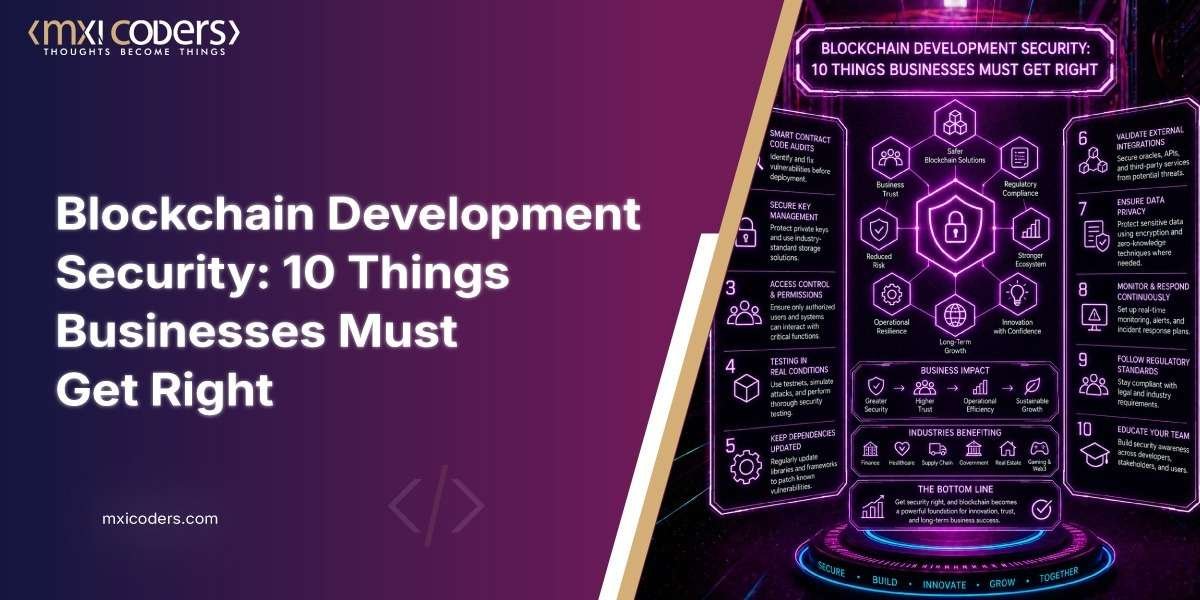
Blockchain Development Security: 10 Things Businesses Must Get Right

Ashok Rathod

Tech Consultant

Posted on
8th Sep 2026
7 min
Read
Share

Table of Contents

  • Quick Tips
  • Familiarize yourself with Cash App
  • Enable two-factor authentication
  • Utilize the optional Cash App
  • Conclusion

Blockchain security failures are not shrinking as the technology matures, they are accelerating. CertiK counted $1.316 billion lost across 344 documented incidents in just the first half of 2026, while TRM Labs recorded 207 separate hacks in the same period, its highest six-month total on record. Access control vulnerabilities alone accounted for more than $953 million in losses in a single recent year, and roughly 40% of the industry’s cumulative $16.69 billion in historical losses traces back to compromised private keys rather than flawed smart contract code. These numbers point to a clear pattern: most blockchain security failures are preventable, and they repeat because the same gaps keep getting overlooked. This guide breaks down the ten things businesses must get right during blockchain development to avoid becoming the next statistic.

➤ Why Blockchain Security Requires a Different Mindset

Traditional software vulnerabilities can usually be patched quickly once discovered. Blockchain applications operate under a fundamentally different constraint that changes how seriously every security decision must be treated.

➥ What Makes Blockchain Security Uniquely Unforgiving

  • Deployed smart contracts are largely immutable, so a flaw discovered after launch often cannot simply be patched
  • Financial value is frequently embedded directly in the code itself, making successful exploits immediately and irreversibly profitable
  • Recovery rates for stolen funds after a major breach remain in the low single digits industry-wide

➤ Here are 10 Security Measures for Blockchain Development

1. Smart Contract Auditing Before Every Deployment

Skipping or rushing a smart contract security audit remains one of the most consistently cited root causes of major losses, and the data on this has not improved with time.

  • Comprehensive audits from reputable firms should be treated as mandatory, not optional, regardless of how confident the development team feels
  • First-pass audits almost always surface findings, and budgeting time for fix-and-re-audit cycles prevents rushed, last-minute patches
  • Multiple independent audits from different firms catch different classes of issues, since no single auditor catches everything

2. Rigorous Access Control Implementation

Access control vulnerabilities were responsible for the largest single category of smart contract losses in recent industry data, dwarfing other categories like logic errors and reentrancy attacks combined.

  • Clearly define which functions can be called by which roles, and enforce those restrictions at the contract level
  • Avoid overly broad admin privileges that concentrate too much control in a single key or wallet
  • Regularly review and revoke access for team members or systems that no longer need it

3. Preventing Reentrancy and Logic Errors

Reentrancy remains a top recurring exploit category even years after it was first identified as a major smart contract risk, largely because the underlying pattern keeps getting reintroduced in new codebases.

  • Apply the checks-effects-interactions pattern consistently to prevent a contract from being re-entered mid-execution
  • Use well-audited, standardized libraries rather than writing custom implementations of common patterns from scratch
  • Test explicitly for reentrancy scenarios during the smart contract development lifecycle, rather than treating it as a single audit checklist item

4. Securing Private Key and Wallet Management

Key management failures, not sophisticated zero-day exploits, account for a disproportionate share of the industry’s cumulative losses, which makes this one of the highest-leverage areas to get right.

  • Use multi-signature wallets for any funds or contracts controlling significant value
  • Store keys in hardware security modules or dedicated custody solutions rather than on developer laptops or shared drives
  • Rotate and audit key access regularly, particularly after any team member departure

5. Guarding Against Social Engineering and Phishing

Recent data shows phishing driving nearly two-thirds of total losses in some reporting periods, often through a single well-executed social engineering attack rather than a technical exploit at all.

  • Train team members to recognize fake support calls, spoofed interfaces, and credential-harvesting attempts
  • Verify transaction details independently before approving any multisig transaction, especially high-value ones
  • Treat unsolicited contact from “support” or “IT” requesting credentials or recovery phrases as an automatic red flag

6. Securing Bridge and Cross-Chain Infrastructure

Bridges connecting different blockchains have consistently emerged as a high-risk category, since they handle asynchronous state across networks with complex validation requirements.

  • Choose bridge infrastructure with a proven security track record rather than the newest or fastest option available
  • Understand exactly how validator compromise or adapter errors could affect funds moving through the bridge
  • Limit the total value exposed to any single bridge at one time where operationally possible

Also Read: How Asset Tokenization Is Changing the Future of Fundraising

7. Building Formal Verification Into High-Value Contracts

For contracts controlling significant value, standard testing alone is often insufficient to catch every possible execution path.

  • Formal verification mathematically proves certain properties of a contract’s behavior hold under all conditions, not just the ones tested
  • This process is more resource-intensive than standard audits, but it is increasingly considered essential for high-value or highly complex contracts
  • Combining formal verification with traditional auditing catches a broader range of issues than either approach alone

8. Applying Gas Optimization Techniques Without Introducing New Risk

Efficient contracts are not just cheaper to run, they are also easier to audit and reason about, but optimization work introduces its own risk if handled carelessly.

  • Apply gas optimization techniques early in development rather than retrofitting them late, when changes are more likely to introduce new bugs
  • Re-test thoroughly after any optimization pass, since even small code changes can alter execution behavior in subtle ways
  • Avoid overly clever, hard-to-audit optimizations that trade long-term security for marginal gas savings

9. Establishing Ongoing Monitoring, Not Just Pre-Launch Testing

Security is not a milestone achieved once at launch. It is an ongoing operational discipline, and the protocols treating it that way are consistently the ones avoiding major incidents.

  • Set up real-time monitoring for unusual transaction patterns or unexpected contract state changes
  • Establish a clear incident response plan before an incident happens, not while one is unfolding
  • Review audit findings and industry incident reports regularly, since attack techniques and target patterns shift over time

10. Choosing the Right Development and Security Partner

Not every organization has deep in-house blockchain security expertise, and this gap is often the underlying reason several of the mistakes above happen in the first place.

  • Verify a development partner’s audit history and track record with contracts of similar value and complexity
  • Ask specifically how they approach custom enterprise blockchain development, since enterprise projects often carry compliance and access-control requirements that standard consumer builds do not
  • Confirm ongoing security support is part of the relationship, not just a one-time audit at launch, since new vulnerabilities and attack techniques continue to emerge after deployment

➤ Frequently Asked Questions

  1. What is the single biggest cause of blockchain security losses?
    Access control vulnerabilities and compromised private keys together account for the largest share of losses industry-wide, generally outweighing purely technical exploits like reentrancy or logic errors.
  2. Can a smart contract be made completely secure?
    No system can be guaranteed completely secure, but combining rigorous auditing, formal verification for high-value contracts, strong access control, and ongoing monitoring significantly reduces risk compared to relying on any single measure alone.
  3. How often should a live smart contract be re-audited?
    Any time significant code changes are made, or if new attack techniques relevant to the contract’s function are identified, a re-audit is worth considering rather than assuming the original audit remains sufficient indefinitely.

➤ Building Security Into the Process, Not Bolting It On

The businesses that avoid becoming part of next year’s breach statistics are consistently the ones treating security as integrated into every phase of development, not a final checkbox before launch. Auditing, access control, key management, and monitoring all need to work together rather than being addressed in isolation, since attackers routinely exploit the gaps between individually secure components.

➤ Conclusion

Blockchain security failures overwhelmingly repeat familiar patterns: weak access control, poor key management, rushed audits, and social engineering that bypasses even well-written code entirely. None of the ten areas covered here require exotic new techniques, they require consistent discipline applied throughout development rather than concentrated entirely at the end. Businesses that treat these ten areas as ongoing operational requirements, not one-time launch tasks, are the ones most likely to avoid contributing to next year’s breach totals.
➤ References

Blockchain development security

Blockchain security failures are not shrinking as the technology matures, they are accelerating. CertiK counted $1.316 billion lost across 344 documented incidents in just the first half of 2026, while TRM Labs recorded 207 separate hacks in the same period, its highest six-month total on record. Access control vulnerabilities alone accounted for more than $953 million in losses in a single recent year, and roughly 40% of the industry’s cumulative $16.69 billion in historical losses traces back to compromised private keys rather than flawed smart contract code. These numbers point to a clear pattern: most blockchain security failures are preventable, and they repeat because the same gaps keep getting overlooked. This guide breaks down the ten things businesses must get right during blockchain development to avoid becoming the next statistic.

➤ Why Blockchain Security Requires a Different Mindset

Traditional software vulnerabilities can usually be patched quickly once discovered. Blockchain applications operate under a fundamentally different constraint that changes how seriously every security decision must be treated.

➥ What Makes Blockchain Security Uniquely Unforgiving

  • Deployed smart contracts are largely immutable, so a flaw discovered after launch often cannot simply be patched
  • Financial value is frequently embedded directly in the code itself, making successful exploits immediately and irreversibly profitable
  • Recovery rates for stolen funds after a major breach remain in the low single digits industry-wide

➤ Here are 10 Security Measures for Blockchain Development

1. Smart Contract Auditing Before Every Deployment

Skipping or rushing a smart contract security audit remains one of the most consistently cited root causes of major losses, and the data on this has not improved with time.

  • Comprehensive audits from reputable firms should be treated as mandatory, not optional, regardless of how confident the development team feels
  • First-pass audits almost always surface findings, and budgeting time for fix-and-re-audit cycles prevents rushed, last-minute patches
  • Multiple independent audits from different firms catch different classes of issues, since no single auditor catches everything

2. Rigorous Access Control Implementation

Access control vulnerabilities were responsible for the largest single category of smart contract losses in recent industry data, dwarfing other categories like logic errors and reentrancy attacks combined.

  • Clearly define which functions can be called by which roles, and enforce those restrictions at the contract level
  • Avoid overly broad admin privileges that concentrate too much control in a single key or wallet
  • Regularly review and revoke access for team members or systems that no longer need it

3. Preventing Reentrancy and Logic Errors

Reentrancy remains a top recurring exploit category even years after it was first identified as a major smart contract risk, largely because the underlying pattern keeps getting reintroduced in new codebases.

  • Apply the checks-effects-interactions pattern consistently to prevent a contract from being re-entered mid-execution
  • Use well-audited, standardized libraries rather than writing custom implementations of common patterns from scratch
  • Test explicitly for reentrancy scenarios during the smart contract development lifecycle, rather than treating it as a single audit checklist item

4. Securing Private Key and Wallet Management

Key management failures, not sophisticated zero-day exploits, account for a disproportionate share of the industry’s cumulative losses, which makes this one of the highest-leverage areas to get right.

  • Use multi-signature wallets for any funds or contracts controlling significant value
  • Store keys in hardware security modules or dedicated custody solutions rather than on developer laptops or shared drives
  • Rotate and audit key access regularly, particularly after any team member departure

5. Guarding Against Social Engineering and Phishing

Recent data shows phishing driving nearly two-thirds of total losses in some reporting periods, often through a single well-executed social engineering attack rather than a technical exploit at all.

  • Train team members to recognize fake support calls, spoofed interfaces, and credential-harvesting attempts
  • Verify transaction details independently before approving any multisig transaction, especially high-value ones
  • Treat unsolicited contact from “support” or “IT” requesting credentials or recovery phrases as an automatic red flag

6. Securing Bridge and Cross-Chain Infrastructure

Bridges connecting different blockchains have consistently emerged as a high-risk category, since they handle asynchronous state across networks with complex validation requirements.

  • Choose bridge infrastructure with a proven security track record rather than the newest or fastest option available
  • Understand exactly how validator compromise or adapter errors could affect funds moving through the bridge
  • Limit the total value exposed to any single bridge at one time where operationally possible

Also Read: How Asset Tokenization Is Changing the Future of Fundraising

7. Building Formal Verification Into High-Value Contracts

For contracts controlling significant value, standard testing alone is often insufficient to catch every possible execution path.

  • Formal verification mathematically proves certain properties of a contract’s behavior hold under all conditions, not just the ones tested
  • This process is more resource-intensive than standard audits, but it is increasingly considered essential for high-value or highly complex contracts
  • Combining formal verification with traditional auditing catches a broader range of issues than either approach alone

8. Applying Gas Optimization Techniques Without Introducing New Risk

Efficient contracts are not just cheaper to run, they are also easier to audit and reason about, but optimization work introduces its own risk if handled carelessly.

  • Apply gas optimization techniques early in development rather than retrofitting them late, when changes are more likely to introduce new bugs
  • Re-test thoroughly after any optimization pass, since even small code changes can alter execution behavior in subtle ways
  • Avoid overly clever, hard-to-audit optimizations that trade long-term security for marginal gas savings

9. Establishing Ongoing Monitoring, Not Just Pre-Launch Testing

Security is not a milestone achieved once at launch. It is an ongoing operational discipline, and the protocols treating it that way are consistently the ones avoiding major incidents.

  • Set up real-time monitoring for unusual transaction patterns or unexpected contract state changes
  • Establish a clear incident response plan before an incident happens, not while one is unfolding
  • Review audit findings and industry incident reports regularly, since attack techniques and target patterns shift over time

10. Choosing the Right Development and Security Partner

Not every organization has deep in-house blockchain security expertise, and this gap is often the underlying reason several of the mistakes above happen in the first place.

  • Verify a development partner’s audit history and track record with contracts of similar value and complexity
  • Ask specifically how they approach custom enterprise blockchain development, since enterprise projects often carry compliance and access-control requirements that standard consumer builds do not
  • Confirm ongoing security support is part of the relationship, not just a one-time audit at launch, since new vulnerabilities and attack techniques continue to emerge after deployment

➤ Frequently Asked Questions

  1. What is the single biggest cause of blockchain security losses?
    Access control vulnerabilities and compromised private keys together account for the largest share of losses industry-wide, generally outweighing purely technical exploits like reentrancy or logic errors.
  2. Can a smart contract be made completely secure?
    No system can be guaranteed completely secure, but combining rigorous auditing, formal verification for high-value contracts, strong access control, and ongoing monitoring significantly reduces risk compared to relying on any single measure alone.
  3. How often should a live smart contract be re-audited?
    Any time significant code changes are made, or if new attack techniques relevant to the contract’s function are identified, a re-audit is worth considering rather than assuming the original audit remains sufficient indefinitely.

➤ Building Security Into the Process, Not Bolting It On

The businesses that avoid becoming part of next year’s breach statistics are consistently the ones treating security as integrated into every phase of development, not a final checkbox before launch. Auditing, access control, key management, and monitoring all need to work together rather than being addressed in isolation, since attackers routinely exploit the gaps between individually secure components.

➤ Conclusion

Blockchain security failures overwhelmingly repeat familiar patterns: weak access control, poor key management, rushed audits, and social engineering that bypasses even well-written code entirely. None of the ten areas covered here require exotic new techniques, they require consistent discipline applied throughout development rather than concentrated entirely at the end. Businesses that treat these ten areas as ongoing operational requirements, not one-time launch tasks, are the ones most likely to avoid contributing to next year’s breach totals.

➤ References

Feel free to Connect us on

Ready to transform your business with smart software solutions?

Harness the power of custom software development to streamline operations, reduce costs, and boost efficiency. Start by exploring cutting-edge approaches like cloud-native platforms, API-first architecture, and AI-driven automation to future-proof your systems and stay ahead of the competition.

Book free consultation

Let’s build your idea together and serve society.

Author

Ashok Rathod

Tech Consultant

Experience
25 Years
Growth Architect for Startups & SMEs | Blockchain, AI , MVP Development, & Data-Driven Marketing Expert.

Transform the Carbon Credit Industry

Build a Transparent, Scalable Carbon Credit Marketplace with Blockchain.

Let's build something real!

Share your ideas with us and we’ll turn them into powerful digital solutions.

500+

Projects

20+

Experience

255+

Clients

Tell us about your project

Our team will get back to you within 24 hours