[ Your Headline ] [ Highlight Word ]

[ One or two lines describing the offer — e.g. "Experience our services with a FREE 30-minute consultation." ]

[ Optional second line, e.g. "Have a concept in mind? Let's brainstorm together!" ]

Google ★★★★★ 4.8
GoodFirms ★★★★★ 4.7
Clutch ★★★★★ 5.0
Blockchain,Tokenization

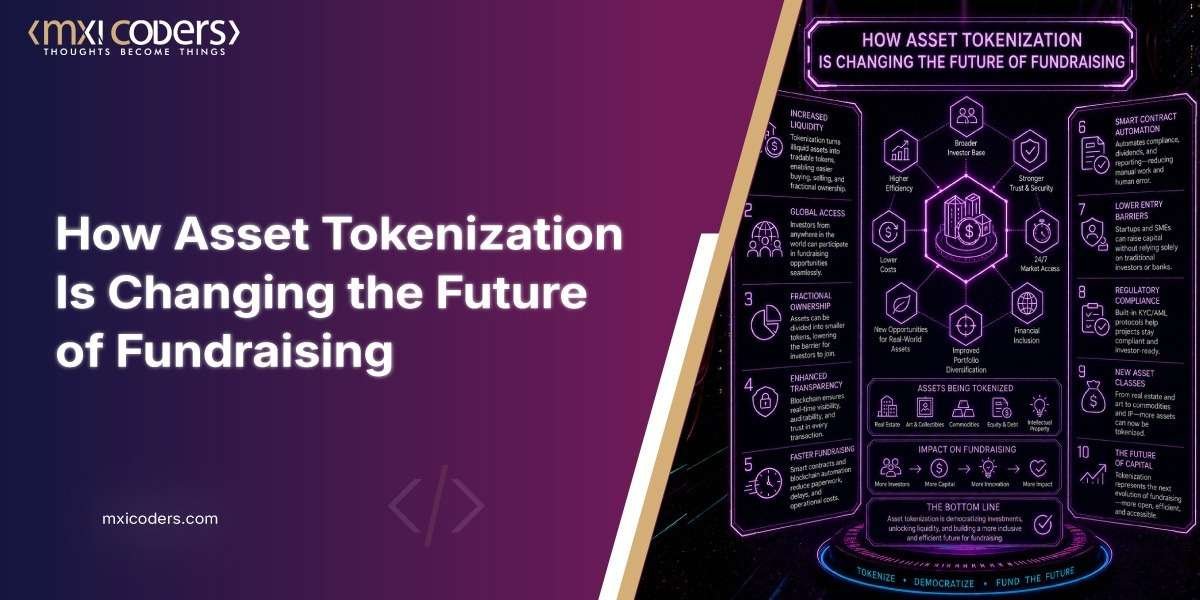
How Asset Tokenization Is Changing the Future of Fundraising

hitesh s

Posted on
2nd Sep 2026
8 min
Read
Share

Table of Contents

  • Quick Tips
  • Familiarize yourself with Cash App
  • Enable two-factor authentication
  • Utilize the optional Cash App
  • Conclusion

Fundraising has traditionally meant a narrow set of paths: bank loans, venture capital, or a public offering with all its regulatory weight. Tokenization is quietly opening a fourth path, and the market data shows how fast it is moving. The tokenized real-world asset market reached roughly $33.69 billion in distributed value by May 2026, up from about $19.32 billion just two months earlier, a 256.7% increase over fifteen months. Ripple and BCG project the broader tokenized asset market expanding from around $0.6 trillion in 2025 to $18.9 trillion by 2033, and institutional projects now include more than 200 active initiatives backed by over 40 major financial institutions. For businesses and asset owners exploring capital raising, tokenization is no longer a speculative concept sitting on a whitepaper, it is an active, growing mechanism already reshaping how capital moves.

➤ What Asset Tokenization Actually Means

Asset tokenization is the process of converting ownership rights in a real-world asset, such as property, private credit, or company equity, into digital tokens recorded on a blockchain. Each token represents a fractional or full claim on the underlying asset, and ownership can be transferred, traded, or verified without the layers of paperwork a traditional transaction usually requires.

➥ Core Elements of a Tokenized Asset

  • A legal structure connecting the token to enforceable ownership rights in the underlying asset
  • A blockchain network recording issuance, transfers, and current ownership transparently
  • Smart contracts automating distributions, compliance checks, and transfer restrictions
  • A custody or verification layer confirming the token remains backed by the real asset it represents

➤ Why Tokenization Is Changing How Businesses Raise Capital

Traditional fundraising concentrates access among institutional investors and requires navigating lengthy, often expensive regulatory processes before capital can move. Tokenization chips away at both barriers simultaneously.

  • Fractional ownership allows a single asset, such as a commercial property or a private credit pool, to be divided into thousands of smaller, more accessible investment units
  • Settlement that once took days or weeks through traditional intermediaries can now happen in near real time on-chain
  • Smart contracts automate much of the compliance and distribution work that previously required manual administration
  • Global investor access becomes possible without the same infrastructure overhead traditional cross-border fundraising requires

➤ Real Estate Tokenization Leading the Charge

Among asset classes exploring tokenization, real estate has emerged as one of the most active use cases for raising capital outside traditional channels.

  • Real estate tokenization has reached approximately $20 billion in value, with some forecasts suggesting significantly higher long-term growth as infrastructure matures
  • Fractional real estate tokens let developers raise construction or acquisition capital from a broader pool of smaller investors rather than relying solely on a handful of large backers
  • Secondary trading of real estate tokens introduces liquidity to an asset class that has historically been difficult to exit quickly

One documented case involved a sustainable real estate initiative that raised $10 million in funding within 60 days using tokenized offerings, while achieving a 25% increase in investor participation compared to a traditional raise. Separately, a large-scale real estate tokenization platform has processed more than $2 billion in tokenized property value, alongside a 20% reduction in transaction costs compared to conventional property transfers.

➤ Where Institutional Capital Is Actually Flowing

Despite the broader market’s rapid growth, institutional activity remains heavily concentrated in a narrow set of asset classes, and understanding this concentration matters for anyone evaluating tokenization as a fundraising tool.

  • Tokenized US Treasury debt has reached approximately $15 billion across roughly 100 assets, making it the most production-ready and institutionally accepted tokenized asset class today
  • Private credit and tokenized money-market instruments have also seen strong institutional uptake, with major asset managers including BlackRock and Franklin Templeton launching live tokenized products
  • Roughly 97% of tokenized real-world asset value currently remains inaccessible to US retail investors, reflecting how much of this activity is still institutional rather than broadly public

➤ Benefits of Tokenized Fundraising Over Traditional Methods

Businesses evaluating tokenization as a fundraising mechanism should weigh several concrete advantages against the traditional alternative.

  • Broader investor pools: Fractionalization lowers the minimum investment threshold, opening access to investors who could not previously participate in large asset classes like commercial real estate or private credit
  • Faster capital formation: Digital issuance and automated compliance checks can meaningfully shorten the time between structuring an offering and closing it
  • Programmable compliance: Smart contracts can automatically enforce transfer restrictions, accreditation requirements, and distribution schedules, reducing manual administrative overhead
  • Secondary market potential: Tokenized assets can, in the right regulatory environment, trade on secondary markets, offering investors an exit path that illiquid traditional assets typically lack

Also Read: Blockchain Development Mistakes That Delay Product Launches

➤ The Regulatory and Liquidity Challenges Still Ahead

Tokenization’s rapid growth has not resolved every structural challenge, and businesses considering this path need a clear-eyed view of where the friction still exists.

  • 39% of tokenized RWA value currently lacks an identifiable regulatory framework, creating uncertainty for both issuers and investors
  • Liquidity remains uneven across the market, since a large share of tokenized assets by count show little to no weekly trading activity even as total market value grows
  • Jurisdictional differences in securities law mean a tokenized offering compliant in one region may require substantial restructuring to operate legally in another
  • Custody and verification infrastructure connecting the token to its underlying real-world asset still varies significantly in maturity across providers

➤ Building a Tokenized Fundraising Strategy

Businesses exploring this path should treat tokenization as a fundraising structure requiring the same rigor as any traditional securities offering, not a shortcut around regulatory obligations.

  • Confirm the legal structure connecting tokens to enforceable ownership rights before any technical development begins
  • Choose a blockchain network and custody provider with a proven track record in the specific asset class being tokenized
  • Build compliance requirements, including investor accreditation and transfer restrictions, directly into the smart contract logic from the start
  • Plan for ongoing reporting and verification obligations, since tokenized offerings do not eliminate the underlying regulatory responsibilities tied to the asset itself

➤ The Role of Tokenomics in a Successful Raise

A tokenized fundraising structure is only as strong as the underlying token economics behind it. Careful tokenomics planning, covering supply structure, distribution schedule, and how returns or dividends flow back to token holders, is what separates a well-structured raise from one that struggles to attract serious investor confidence. Businesses that treat tokenomics as an afterthought, bolted on after the legal and technical work is complete, frequently discover pricing and liquidity issues only after the offering has already launched.

➤ Choosing the Right Development Partner for Asset Tokenization

Building a compliant, technically sound tokenization platform requires expertise spanning securities structuring, smart contract development, and custody integration simultaneously. Working with an experienced asset tokenization development partner can significantly reduce both the technical risk and the regulatory blind spots that often derail first-time tokenization projects, since experienced teams have typically already navigated the compliance and custody questions a new issuer would otherwise be solving from scratch.

➤ Frequently Asked Questions

  1. Is asset tokenization only relevant for large institutions?
    Not exclusively, though most current activity remains institutional. Real estate developers, private credit funds, and mid-sized businesses have all successfully used tokenization to raise capital from a broader investor base than traditional channels typically reach.
  2. Does tokenizing an asset remove the need for regulatory compliance?
    No. Tokenization changes how an asset is represented and transferred, not the underlying legal and regulatory obligations tied to the asset itself. Securities laws, investor accreditation requirements, and disclosure obligations still apply.
  3. Which asset classes are furthest along in tokenized fundraising?
    US Treasuries and private credit currently represent the most production-ready and institutionally accepted tokenized asset classes, while real estate and equities are growing quickly but remain less mature in terms of regulatory clarity and liquidity.

➤ What This Means for the Future of Fundraising

As infrastructure matures and regulatory clarity improves in more jurisdictions, tokenization is likely to expand well beyond its current concentration in Treasuries and private credit. Businesses that build tokenized offerings on a solid legal and technical foundation now are positioned to benefit as investor familiarity and secondary market liquidity continue to grow through 2027 and beyond, rather than treating tokenization as a temporary trend to revisit later.

➤ Conclusion

Asset tokenization is reshaping fundraising by lowering investment minimums, automating compliance, and opening access to asset classes that were previously reserved for large institutional investors. The market’s rapid growth, from under $20 billion to nearly $34 billion in distributed value within months, signals genuine momentum, even as regulatory clarity and liquidity remain uneven across asset classes. Businesses considering tokenized fundraising should approach it with the same structural rigor as any traditional offering, backed by sound tokenomics and experienced technical partners, rather than treating the technology alone as a substitute for careful planning.
➤ References

How asset tokenization is changing the future of fundraising

Fundraising has traditionally meant a narrow set of paths: bank loans, venture capital, or a public offering with all its regulatory weight. Tokenization is quietly opening a fourth path, and the market data shows how fast it is moving. The tokenized real-world asset market reached roughly $33.69 billion in distributed value by May 2026, up from about $19.32 billion just two months earlier, a 256.7% increase over fifteen months. Ripple and BCG project the broader tokenized asset market expanding from around $0.6 trillion in 2025 to $18.9 trillion by 2033, and institutional projects now include more than 200 active initiatives backed by over 40 major financial institutions. For businesses and asset owners exploring capital raising, tokenization is no longer a speculative concept sitting on a whitepaper, it is an active, growing mechanism already reshaping how capital moves.

➤ What Asset Tokenization Actually Means

Asset tokenization is the process of converting ownership rights in a real-world asset, such as property, private credit, or company equity, into digital tokens recorded on a blockchain. Each token represents a fractional or full claim on the underlying asset, and ownership can be transferred, traded, or verified without the layers of paperwork a traditional transaction usually requires.

➥ Core Elements of a Tokenized Asset

  • A legal structure connecting the token to enforceable ownership rights in the underlying asset
  • A blockchain network recording issuance, transfers, and current ownership transparently
  • Smart contracts automating distributions, compliance checks, and transfer restrictions
  • A custody or verification layer confirming the token remains backed by the real asset it represents

➤ Why Tokenization Is Changing How Businesses Raise Capital

Traditional fundraising concentrates access among institutional investors and requires navigating lengthy, often expensive regulatory processes before capital can move. Tokenization chips away at both barriers simultaneously.

  • Fractional ownership allows a single asset, such as a commercial property or a private credit pool, to be divided into thousands of smaller, more accessible investment units
  • Settlement that once took days or weeks through traditional intermediaries can now happen in near real time on-chain
  • Smart contracts automate much of the compliance and distribution work that previously required manual administration
  • Global investor access becomes possible without the same infrastructure overhead traditional cross-border fundraising requires

➤ Real Estate Tokenization Leading the Charge

Among asset classes exploring tokenization, real estate has emerged as one of the most active use cases for raising capital outside traditional channels.

  • Real estate tokenization has reached approximately $20 billion in value, with some forecasts suggesting significantly higher long-term growth as infrastructure matures
  • Fractional real estate tokens let developers raise construction or acquisition capital from a broader pool of smaller investors rather than relying solely on a handful of large backers
  • Secondary trading of real estate tokens introduces liquidity to an asset class that has historically been difficult to exit quickly

One documented case involved a sustainable real estate initiative that raised $10 million in funding within 60 days using tokenized offerings, while achieving a 25% increase in investor participation compared to a traditional raise. Separately, a large-scale real estate tokenization platform has processed more than $2 billion in tokenized property value, alongside a 20% reduction in transaction costs compared to conventional property transfers.

➤ Where Institutional Capital Is Actually Flowing

Despite the broader market’s rapid growth, institutional activity remains heavily concentrated in a narrow set of asset classes, and understanding this concentration matters for anyone evaluating tokenization as a fundraising tool.

  • Tokenized US Treasury debt has reached approximately $15 billion across roughly 100 assets, making it the most production-ready and institutionally accepted tokenized asset class today
  • Private credit and tokenized money-market instruments have also seen strong institutional uptake, with major asset managers including BlackRock and Franklin Templeton launching live tokenized products
  • Roughly 97% of tokenized real-world asset value currently remains inaccessible to US retail investors, reflecting how much of this activity is still institutional rather than broadly public

➤ Benefits of Tokenized Fundraising Over Traditional Methods

Businesses evaluating tokenization as a fundraising mechanism should weigh several concrete advantages against the traditional alternative.

  • Broader investor pools: Fractionalization lowers the minimum investment threshold, opening access to investors who could not previously participate in large asset classes like commercial real estate or private credit
  • Faster capital formation: Digital issuance and automated compliance checks can meaningfully shorten the time between structuring an offering and closing it
  • Programmable compliance: Smart contracts can automatically enforce transfer restrictions, accreditation requirements, and distribution schedules, reducing manual administrative overhead
  • Secondary market potential: Tokenized assets can, in the right regulatory environment, trade on secondary markets, offering investors an exit path that illiquid traditional assets typically lack

Also Read: Blockchain Development Mistakes That Delay Product Launches

➤ The Regulatory and Liquidity Challenges Still Ahead

Tokenization’s rapid growth has not resolved every structural challenge, and businesses considering this path need a clear-eyed view of where the friction still exists.

  • 39% of tokenized RWA value currently lacks an identifiable regulatory framework, creating uncertainty for both issuers and investors
  • Liquidity remains uneven across the market, since a large share of tokenized assets by count show little to no weekly trading activity even as total market value grows
  • Jurisdictional differences in securities law mean a tokenized offering compliant in one region may require substantial restructuring to operate legally in another
  • Custody and verification infrastructure connecting the token to its underlying real-world asset still varies significantly in maturity across providers

➤ Building a Tokenized Fundraising Strategy

Businesses exploring this path should treat tokenization as a fundraising structure requiring the same rigor as any traditional securities offering, not a shortcut around regulatory obligations.

  • Confirm the legal structure connecting tokens to enforceable ownership rights before any technical development begins
  • Choose a blockchain network and custody provider with a proven track record in the specific asset class being tokenized
  • Build compliance requirements, including investor accreditation and transfer restrictions, directly into the smart contract logic from the start
  • Plan for ongoing reporting and verification obligations, since tokenized offerings do not eliminate the underlying regulatory responsibilities tied to the asset itself

➤ The Role of Tokenomics in a Successful Raise

A tokenized fundraising structure is only as strong as the underlying token economics behind it. Careful tokenomics planning, covering supply structure, distribution schedule, and how returns or dividends flow back to token holders, is what separates a well-structured raise from one that struggles to attract serious investor confidence. Businesses that treat tokenomics as an afterthought, bolted on after the legal and technical work is complete, frequently discover pricing and liquidity issues only after the offering has already launched.

➤ Choosing the Right Development Partner for Asset Tokenization

Building a compliant, technically sound tokenization platform requires expertise spanning securities structuring, smart contract development, and custody integration simultaneously. Working with an experienced asset tokenization development partner can significantly reduce both the technical risk and the regulatory blind spots that often derail first-time tokenization projects, since experienced teams have typically already navigated the compliance and custody questions a new issuer would otherwise be solving from scratch.

➤ Frequently Asked Questions

  1. Is asset tokenization only relevant for large institutions?
    Not exclusively, though most current activity remains institutional. Real estate developers, private credit funds, and mid-sized businesses have all successfully used tokenization to raise capital from a broader investor base than traditional channels typically reach.
  2. Does tokenizing an asset remove the need for regulatory compliance?
    No. Tokenization changes how an asset is represented and transferred, not the underlying legal and regulatory obligations tied to the asset itself. Securities laws, investor accreditation requirements, and disclosure obligations still apply.
  3. Which asset classes are furthest along in tokenized fundraising?
    US Treasuries and private credit currently represent the most production-ready and institutionally accepted tokenized asset classes, while real estate and equities are growing quickly but remain less mature in terms of regulatory clarity and liquidity.

➤ What This Means for the Future of Fundraising

As infrastructure matures and regulatory clarity improves in more jurisdictions, tokenization is likely to expand well beyond its current concentration in Treasuries and private credit. Businesses that build tokenized offerings on a solid legal and technical foundation now are positioned to benefit as investor familiarity and secondary market liquidity continue to grow through 2027 and beyond, rather than treating tokenization as a temporary trend to revisit later.

➤ Conclusion

Asset tokenization is reshaping fundraising by lowering investment minimums, automating compliance, and opening access to asset classes that were previously reserved for large institutional investors. The market’s rapid growth, from under $20 billion to nearly $34 billion in distributed value within months, signals genuine momentum, even as regulatory clarity and liquidity remain uneven across asset classes. Businesses considering tokenized fundraising should approach it with the same structural rigor as any traditional offering, backed by sound tokenomics and experienced technical partners, rather than treating the technology alone as a substitute for careful planning.

➤ References

Feel free to Connect us on

Ready to transform your business with smart software solutions?

Harness the power of custom software development to streamline operations, reduce costs, and boost efficiency. Start by exploring cutting-edge approaches like cloud-native platforms, API-first architecture, and AI-driven automation to future-proof your systems and stay ahead of the competition.

Book free consultation

Let’s build your idea together and serve society.

Author

hitesh s

Experience

Transform the Carbon Credit Industry

Build a Transparent, Scalable Carbon Credit Marketplace with Blockchain.

Let's build something real!

Share your ideas with us and we’ll turn them into powerful digital solutions.

500+

Projects

20+

Experience

255+

Clients

Tell us about your project

Our team will get back to you within 24 hours