...

[ Your Headline ] [ Highlight Word ]

[ One or two lines describing the offer — e.g. "Experience our services with a FREE 30-minute consultation." ]

[ Optional second line, e.g. "Have a concept in mind? Let's brainstorm together!" ]

Google ★★★★★ 4.8
GoodFirms ★★★★★ 4.7
Clutch ★★★★★ 5.0
Blockchain,Crypto,Crypto Exchange,Cybersecurity

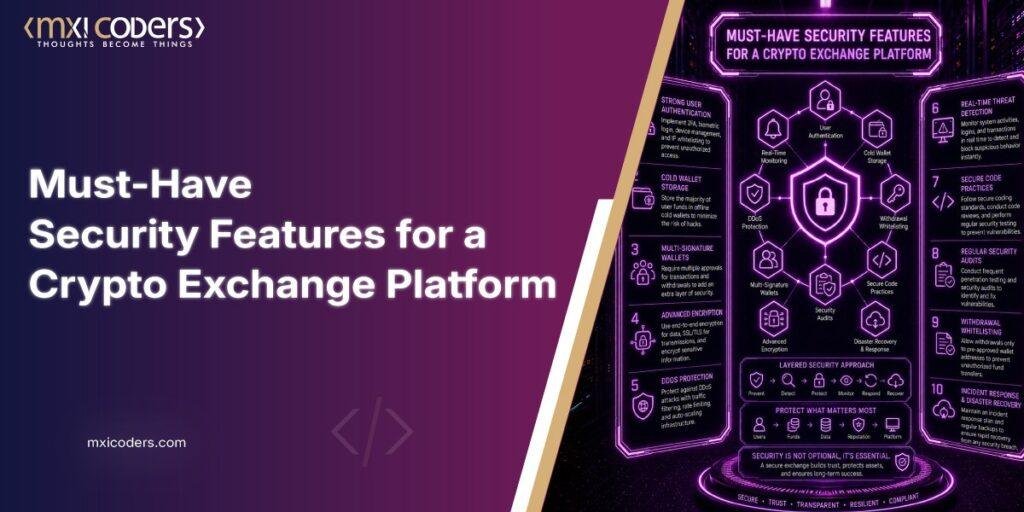
Must-Have Security Features for a Crypto Exchange Platform

Ashok Rathod

Tech Consultant

Posted on
24th Jul 2026
7 min
Read
Share

Table of Contents

  • Quick Tips
  • Familiarize yourself with Cash App
  • Enable two-factor authentication
  • Utilize the optional Cash App
  • Conclusion

A crypto exchange is, at its core, a warehouse of other people’s money sitting on the open internet. Security is not a feature you bolt on later, it is the condition that determines whether the platform survives its first serious attack. A single breach can wipe out years of user trust in a matter of hours, and the financial fallout rarely stops at the stolen funds themselves.

The scale of the risk is hard to overstate. Chainalysis reported that illicit cryptocurrency addresses received at least $154 billion in 2025, a 162% jump from the year before, and exchange related theft alone reached roughly $3.4 billion in 2025, the highest annual total on record. A single incident, the February 2025 Bybit breach, accounted for about $1.5 billion of that figure on its own, and the top three hacks of the year made up 69% of all service side losses combined. The FBI’s IC3 unit separately logged more than 181,000 crypto related fraud complaints in 2025, totaling over $11 billion in reported losses. Numbers like these are why regulators, banking partners, and users alike now expect an exchange to prove its security posture rather than simply claim one, and why security must be designed into the architecture from day one rather than patched in after launch.

Why Is Security Important for a Crypto Exchange Platform?

Cryptocurrency exchanges manage highly liquid digital assets alongside sensitive personal data, which makes them a constant target for hackers, organized cybercrime groups, and occasionally state sponsored actors. Unlike a traditional bank, a compromised exchange often cannot reverse a fraudulent transfer once it settles on-chain, which raises the stakes of every security decision.

A breach at an exchange typically results in more than a single loss. It can trigger:

  • Loss of user funds that may never be recovered
  • Theft of personal and financial data
  • Unauthorized transactions across customer accounts
  • Extended business disruption while systems are secured
  • Regulatory penalties and forced audits
  • Long term loss of customer trust

Because of this, security has to be treated as a core business requirement, on the same level as liquidity or product design, not as a checklist item handled by a single team after launch.

Common Security Risks Faced by Crypto Exchanges

  • Account takeover attacks
  • Phishing and social engineering
  • Private key theft
  • Wallet vulnerabilities
  • API attacks
  • DDoS attacks
  • Insider threats
  • Malware and ransomware
  • Smart contract vulnerabilities
  • Fraudulent transactions and market manipulation

What Are the Must-Have Security Features for a Crypto Exchange?

1. Multi-Factor Authentication (MFA)

MFA adds a verification layer beyond a password, using authentication apps or hardware security keys to confirm that the person logging in is who they claim to be. Sensitive actions deserve an additional step-up check on top of standard login. MFA should be enforced across:

  • Login
  • Withdrawals
  • Password changes
  • API access
  • Security settings changes

2. Cold Wallet and Hot Wallet Security

The majority of digital assets should sit in offline cold wallets, with only the liquidity needed for daily operations kept in hot wallets. Strict access controls around wallet operations, multi-signature authorization for high-value transfers, and well tested backup and recovery procedures all reduce the exposure of funds that must remain online.

3. Multi-Signature Wallet Protection

Requiring multiple authorized parties to approve a sensitive transaction removes the single point of failure that comes with one compromised private key. Defining clear approval thresholds and separating wallet management responsibilities across different trusted roles makes it much harder for one bad actor, internal or external, to move funds alone.

4. End-to-End Data Encryption

Sensitive data needs protection both while it moves across the network and while it sits in storage, using secure communication protocols throughout. This covers:

  • User credentials
  • Personal information
  • Transaction data
  • Private keys
  • API credentials

Strong key management practices need to sit behind all of this, since encryption is only as good as the keys protecting it.

5. Secure Private Key Management

Private keys should live behind hardened infrastructure with access limited strictly by role and permission level. Hardware security modules are worth deploying where appropriate, alongside routine key rotation, secure backup procedures, and tight operational controls around who can ever touch a key.

6. Role-Based Access Control (RBAC)

Access should be restricted according to what an employee’s role actually requires, following the principle of least privilege. Administrative and operational permissions need to stay separated, privileged account activity should be actively monitored, and access permissions deserve regular review rather than a one-time setup.

7. Withdrawal Security and Transaction Controls

Withdrawal limits and velocity checks catch abnormal activity before it becomes a loss. Additional authentication for suspicious withdrawals, address whitelisting, cooling-off periods for newly added withdrawal addresses, and manual approval for high-risk transactions all add friction exactly where it matters most.

8. Real-Time Transaction Monitoring

Continuous monitoring for suspicious activity helps catch unusual transaction patterns and abnormal account behavior as they happen, not after the fact. Automated alerts paired with a clear investigation workflow let a security team act on flagged transactions quickly instead of discovering them in a post-incident review.

9. Anti-DDoS and Infrastructure Protection

Exchange infrastructure needs protection from Distributed Denial-of-Service attacks through traffic filtering and rate limiting, backed by firewalls and a Web Application Firewall. Redundancy, failover systems, and real-time infrastructure monitoring keep the platform available even under sustained attack pressure.

10. Smart Contract Security

For exchanges that interact with DeFi protocols, tokenized assets, or on-chain contracts, smart contract security becomes its own discipline. This is one of the clearer smart contract benefits an exchange gains from partnering with a specialized smart contract development service: independent audits, both automated and manual code review, thorough pre-deployment testing, ongoing monitoring of deployed contracts, and a documented emergency response plan for when something does go wrong.

11. Anti-Fraud and Account Takeover Protection

Detecting suspicious login behavior, unexpected device or location changes, and unusual trading patterns lets a platform catch account takeovers before real damage occurs. Behavioral analytics can flag anomalies that rule based systems miss, and additional verification should trigger automatically whenever risk levels climb.

12. Backup and Disaster Recovery

Encrypted backups of critical data, combined with a documented disaster recovery plan, are what keep an exchange operational after an infrastructure failure or security incident. Recovery time objectives and recovery point objectives need to be defined in advance and tested regularly, not written down once and forgotten.

Security Features vs. Security Practices: What’s the Difference?

Security FeaturesSecurity Practices
Multi-factor authenticationRegular security audits
Cold wallet storageEmployee security training
EncryptionPenetration testing
Withdrawal controlsIncident response planning
DDoS protectionVulnerability management
Transaction monitoringAccess reviews
RBACDisaster recovery testing

Features are the technical controls built into the platform, while practices are the ongoing human and organizational habits that keep those controls effective. A platform with excellent technical features but no regular audits, no training, and no incident response plan is still exposed, because attackers exploit gaps in process just as often as gaps in code. Continuous security management, not a one-time implementation, is what actually keeps an exchange safe over time.

Security Should Be the Foundation of Every Crypto Exchange

No single feature on this list is enough by itself. Real protection comes from layering technical controls, regulatory compliance, continuous monitoring, human oversight, and ongoing testing into one coordinated system that evolves as new threats appear. Attackers do not stand still, and neither can the defenses built against them.

For any business planning to launch or upgrade an exchange, working with a proven cryptocurrency exchange development company from the earliest architecture decisions makes it far easier to build these protections in from the start rather than retrofitting them under pressure after an incident. Whether you need a full platform built from scratch or specialized cryptocurrency exchange development services to harden an existing system, treating security as the foundation, not an afterthought, is what separates exchanges that last from the ones that end up as a statistic in next year’s breach report.

If you’re weighing where the underlying transaction data and settlement layer fits into that architecture, our post onhow blockchain is streamlining operations for commercial banks is a useful next read, alongside our primer onwhat a dApp actually is in crypto for teams building beyond a pure exchange model.

Must-Have Security Features for a Crypto Exchange Platform

A crypto exchange is, at its core, a warehouse of other people’s money sitting on the open internet. Security is not a feature you bolt on later, it is the condition that determines whether the platform survives its first serious attack. A single breach can wipe out years of user trust in a matter of hours, and the financial fallout rarely stops at the stolen funds themselves.

The scale of the risk is hard to overstate. Chainalysis reported that illicit cryptocurrency addresses received at least $154 billion in 2025, a 162% jump from the year before, and exchange related theft alone reached roughly $3.4 billion in 2025, the highest annual total on record. A single incident, the February 2025 Bybit breach, accounted for about $1.5 billion of that figure on its own, and the top three hacks of the year made up 69% of all service side losses combined. The FBI’s IC3 unit separately logged more than 181,000 crypto related fraud complaints in 2025, totaling over $11 billion in reported losses. Numbers like these are why regulators, banking partners, and users alike now expect an exchange to prove its security posture rather than simply claim one, and why security must be designed into the architecture from day one rather than patched in after launch.

Why Is Security Important for a Crypto Exchange Platform?

Cryptocurrency exchanges manage highly liquid digital assets alongside sensitive personal data, which makes them a constant target for hackers, organized cybercrime groups, and occasionally state sponsored actors. Unlike a traditional bank, a compromised exchange often cannot reverse a fraudulent transfer once it settles on-chain, which raises the stakes of every security decision.

A breach at an exchange typically results in more than a single loss. It can trigger:

  • Loss of user funds that may never be recovered
  • Theft of personal and financial data
  • Unauthorized transactions across customer accounts
  • Extended business disruption while systems are secured
  • Regulatory penalties and forced audits
  • Long term loss of customer trust

Because of this, security has to be treated as a core business requirement, on the same level as liquidity or product design, not as a checklist item handled by a single team after launch.

Common Security Risks Faced by Crypto Exchanges

  • Account takeover attacks
  • Phishing and social engineering
  • Private key theft
  • Wallet vulnerabilities
  • API attacks
  • DDoS attacks
  • Insider threats
  • Malware and ransomware
  • Smart contract vulnerabilities
  • Fraudulent transactions and market manipulation

What Are the Must-Have Security Features for a Crypto Exchange?

1. Multi-Factor Authentication (MFA)

MFA adds a verification layer beyond a password, using authentication apps or hardware security keys to confirm that the person logging in is who they claim to be. Sensitive actions deserve an additional step-up check on top of standard login. MFA should be enforced across:

  • Login
  • Withdrawals
  • Password changes
  • API access
  • Security settings changes

2. Cold Wallet and Hot Wallet Security

The majority of digital assets should sit in offline cold wallets, with only the liquidity needed for daily operations kept in hot wallets. Strict access controls around wallet operations, multi-signature authorization for high-value transfers, and well tested backup and recovery procedures all reduce the exposure of funds that must remain online.

3. Multi-Signature Wallet Protection

Requiring multiple authorized parties to approve a sensitive transaction removes the single point of failure that comes with one compromised private key. Defining clear approval thresholds and separating wallet management responsibilities across different trusted roles makes it much harder for one bad actor, internal or external, to move funds alone.

4. End-to-End Data Encryption

Sensitive data needs protection both while it moves across the network and while it sits in storage, using secure communication protocols throughout. This covers:

  • User credentials
  • Personal information
  • Transaction data
  • Private keys
  • API credentials

Strong key management practices need to sit behind all of this, since encryption is only as good as the keys protecting it.

5. Secure Private Key Management

Private keys should live behind hardened infrastructure with access limited strictly by role and permission level. Hardware security modules are worth deploying where appropriate, alongside routine key rotation, secure backup procedures, and tight operational controls around who can ever touch a key.

6. Role-Based Access Control (RBAC)

Access should be restricted according to what an employee’s role actually requires, following the principle of least privilege. Administrative and operational permissions need to stay separated, privileged account activity should be actively monitored, and access permissions deserve regular review rather than a one-time setup.

7. Withdrawal Security and Transaction Controls

Withdrawal limits and velocity checks catch abnormal activity before it becomes a loss. Additional authentication for suspicious withdrawals, address whitelisting, cooling-off periods for newly added withdrawal addresses, and manual approval for high-risk transactions all add friction exactly where it matters most.

8. Real-Time Transaction Monitoring

Continuous monitoring for suspicious activity helps catch unusual transaction patterns and abnormal account behavior as they happen, not after the fact. Automated alerts paired with a clear investigation workflow let a security team act on flagged transactions quickly instead of discovering them in a post-incident review.

9. Anti-DDoS and Infrastructure Protection

Exchange infrastructure needs protection from Distributed Denial-of-Service attacks through traffic filtering and rate limiting, backed by firewalls and a Web Application Firewall. Redundancy, failover systems, and real-time infrastructure monitoring keep the platform available even under sustained attack pressure.

10. Smart Contract Security

For exchanges that interact with DeFi protocols, tokenized assets, or on-chain contracts, smart contract security becomes its own discipline. This is one of the clearer smart contract benefits an exchange gains from partnering with a specialized smart contract development service: independent audits, both automated and manual code review, thorough pre-deployment testing, ongoing monitoring of deployed contracts, and a documented emergency response plan for when something does go wrong.

11. Anti-Fraud and Account Takeover Protection

Detecting suspicious login behavior, unexpected device or location changes, and unusual trading patterns lets a platform catch account takeovers before real damage occurs. Behavioral analytics can flag anomalies that rule based systems miss, and additional verification should trigger automatically whenever risk levels climb.

12. Backup and Disaster Recovery

Encrypted backups of critical data, combined with a documented disaster recovery plan, are what keep an exchange operational after an infrastructure failure or security incident. Recovery time objectives and recovery point objectives need to be defined in advance and tested regularly, not written down once and forgotten.

Security Features vs. Security Practices: What’s the Difference?

Security FeaturesSecurity Practices
Multi-factor authenticationRegular security audits
Cold wallet storageEmployee security training
EncryptionPenetration testing
Withdrawal controlsIncident response planning
DDoS protectionVulnerability management
Transaction monitoringAccess reviews
RBACDisaster recovery testing

Features are the technical controls built into the platform, while practices are the ongoing human and organizational habits that keep those controls effective. A platform with excellent technical features but no regular audits, no training, and no incident response plan is still exposed, because attackers exploit gaps in process just as often as gaps in code. Continuous security management, not a one-time implementation, is what actually keeps an exchange safe over time.

Security Should Be the Foundation of Every Crypto Exchange

No single feature on this list is enough by itself. Real protection comes from layering technical controls, regulatory compliance, continuous monitoring, human oversight, and ongoing testing into one coordinated system that evolves as new threats appear. Attackers do not stand still, and neither can the defenses built against them.

For any business planning to launch or upgrade an exchange, working with a proven cryptocurrency exchange development company from the earliest architecture decisions makes it far easier to build these protections in from the start rather than retrofitting them under pressure after an incident. Whether you need a full platform built from scratch or specialized cryptocurrency exchange development services to harden an existing system, treating security as the foundation, not an afterthought, is what separates exchanges that last from the ones that end up as a statistic in next year’s breach report.

If you’re weighing where the underlying transaction data and settlement layer fits into that architecture, our post onhow blockchain is streamlining operations for commercial banks is a useful next read, alongside our primer onwhat a dApp actually is in crypto for teams building beyond a pure exchange model.

Feel free to Connect us on

Ready to transform your business with smart software solutions?

Harness the power of custom software development to streamline operations, reduce costs, and boost efficiency. Start by exploring cutting-edge approaches like cloud-native platforms, API-first architecture, and AI-driven automation to future-proof your systems and stay ahead of the competition.

Book free consultation

Let’s build your idea together and serve society.

Author

Ashok Rathod

Tech Consultant

Experience
25 Years
Growth Architect for Startups & SMEs | Blockchain, AI , MVP Development, & Data-Driven Marketing Expert.

Transform the Carbon Credit Industry

Build a Transparent, Scalable Carbon Credit Marketplace with Blockchain.

Index

Get in Touch

Ready to transform your ideas into reality? Contact our team today and let’s discuss your project.