...
Uncategorized

Top Benefits of Smart Contracts in Blockchain Technology in 2026

Ashok Rathod

Tech Consultant

Posted on
8th Jun 2026
9 min
Read
Share

Table of Contents

  • Quick Tips
  • Familiarize yourself with Cash App
  • Enable two-factor authentication
  • Utilize the optional Cash App
  • Conclusion

Self-executing code is quietly replacing lawyers, banks, and brokers as the default enforcer of business agreements. According to Grand View Research, the global smart contract market was valued at $1.73 billion in 2024 and is projected to grow at a CAGR of 82.2% through 2030. A separate survey by Gartner found that by 2026, more than 25% of global organizations will use smart contracts in some form of business operation. IBM’s Institute for Business Value reports that companies using automated contract systems reduce procurement costs by up to 40% compared to traditional paper-based processes.

This momentum is being driven by three forces: enterprises demanding more automation, rising distrust in centralized intermediaries, and the maturation of blockchain platforms capable of handling real-world complexity. This article breaks down exactly what smart contracts are, why businesses are rushing to adopt them, and the ten most compelling benefits they deliver in 2026.

➤ What Are Smart Contracts?

A smart contract is a self-executing program stored on a blockchain network that automatically carries out predefined actions when specific conditions are met. Unlike a traditional contract, which relies on third parties such as banks, notaries, or courts to enforce its terms, a smart contract runs on code. Once deployed, it cannot be altered, and it executes without human intervention.

Understanding smart contract working begins with recognizing that the logic is written directly into the code: “if X happens, then do Y.” When both conditions are verifiably met on the blockchain, the contract executes instantly. No phone calls. No paperwork. No waiting.

In 2026, smart contracts matter more than ever because global commerce is faster, more cross-border, and more automated than at any point in history. Businesses that rely on slow, dispute-prone manual contracts simply cannot keep pace.

➤ Why Businesses Are Adopting Smart Contracts Faster Than Ever

Growing blockchain adoption across banking, healthcare, logistics, and real estate has created the infrastructure smart contracts need to thrive. Digital transformation initiatives are pushing companies to eliminate manual processes wherever possible, and smart contracts are among the most effective automation tools available. The demand for transparency, particularly in multi-party agreements where trust is limited, makes the visible, tamper-proof nature of smart contracts especially attractive to enterprises operating at scale.

➤ Why Smart Contracts Are Important in Blockchain Technology

➥ The Need for Automation in Modern Business

Modern supply chains span dozens of countries. Financial transactions settle across time zones. Insurance claims involve multiple stakeholders. Managing all of this with human-driven processes creates delays, errors, and costs that compound over time. Automation is no longer optional — it is a competitive necessity.

➥ Limitations of Traditional Contracts

Traditional contracts depend on interpretation, enforcement mechanisms, and trust between parties. They are slow to execute, expensive to dispute, and vulnerable to fraud or bad-faith actors. Cross-border contracts introduce additional layers of legal complexity, making enforcement even more unpredictable.

➥ How Blockchain Enhances Contract Execution

Blockchain provides the trustless infrastructure that makes automated contracts enforceable without a central authority. Once written and deployed, a smart contract executes exactly as coded. The blockchain’s immutability guarantees that terms cannot be retroactively altered by any party.

Summary of core advantages:

  • Removes processing delays from multi-party approvals
  • Reduces disputes by eliminating ambiguity in contract terms
  • Increases transparency since all parties see the same code
  • Improves trust through verifiable, tamper-proof execution

Also Read: Real Business Benefits of Blockchain Technology in 2026

➤ Top Benefits of Smart Contracts in Blockchain Technology

1. Automation of Business Processes

Smart contracts execute agreements the moment predefined conditions are satisfied. There is no need for manual paperwork, approval chains, or human intermediaries to trigger action. 

For Example, In insurance, a policyholder who suffers a verified weather-related crop loss can receive an automatic payout the moment satellite data confirms the damage threshold was crossed. This kind of seamless, condition-based execution is transforming how industries handle routine agreements.

2. Reduced Operational Costs

Removing intermediaries from business transactions significantly cuts costs. Fewer lawyers, brokers, and administrative staff are needed to manage, verify, and enforce agreements. In banking, trade finance costs drop when letters of credit are replaced by smart contract logic. 

Insurance companies reduce claims-processing overhead. Real estate transactions eliminate escrow and title agent fees. Supply chain operators cut reconciliation costs across vendor networks. Industries that once absorbed these expenses as unavoidable overhead are now recovering them as margin.

3. Faster Transaction Processing

Where a traditional wire transfer might settle in two to five days, a blockchain-based smart contract completes the same transaction in seconds. Cross-border payments, trade finance settlements, and digital asset transfers are all accelerated because the verification and execution happen simultaneously on-chain. Real-time settlement removes the float risk and counterparty uncertainty that plague conventional financial systems.

4. Enhanced Security

Every smart contract is protected by cryptographic algorithms that make unauthorized modification virtually impossible. Records stored on a blockchain are decentralized across thousands of nodes, so there is no single point of failure for attackers to target. 

The immutable audit trail ensures that every transaction can be traced and verified without relying on any single party’s records. These features collectively reduce fraud risks far below what traditional contract systems can achieve.

5. Greater Transparency

All parties to a smart contract can view the same code and the same transaction history. There are no side agreements, no hidden clauses, and no selective disclosure. 

This shared visibility is particularly valuable in government contracting and public procurement, where accountability is essential, and in supply chain management, where buyers want to verify that goods meet agreed standards before payment is released.

6. Increased Accuracy

Manual contract processes introduce human error at every step. Data entry mistakes, missed signatures, and misread terms create disputes that cost time and money to resolve. 

Smart contracts eliminate these failure points by automating data validation and execution logic. Every action is carried out exactly as the code specifies, consistently and reliably. The result is fewer disputes, stronger regulatory compliance, and more dependable record keeping across the organization.

7. Improved Trust Between Parties

Because the rules of a smart contract are visible to all parties before deployment and cannot be changed afterward, every participant knows exactly what to expect. There is no room for one party to manipulate the outcome after the fact.

 This predictability is critical in global transactions involving counterparties who have no prior relationship, in multi-party agreements spanning several organizations, and in decentralized ecosystems where no central authority exists to arbitrate disputes.

8. Better Regulatory Compliance

Regulators are increasingly comfortable with blockchain-based systems because they offer auditable, timestamped records of every action. Smart contracts can automate KYC checks, AML verification, and financial reporting obligations, ensuring compliance happens in real time rather than after the fact. Engaging a smart contract development agency that understands compliance requirements for your industry ensures the code meets regulatory standards from the start.

9. 24/7 Execution Without Downtime

Unlike human-staffed processes, smart contracts operate around the clock without breaks, holidays, or business-hour restrictions. Cryptocurrency exchanges, DeFi platforms, and digital marketplaces depend on this continuous availability. A user on the other side of the world can initiate, execute, and settle a transaction at 3 a.m. local time with the same speed and reliability as during peak business hours.

10. Reduced Fraud and Manipulation

Once a transaction is recorded on a blockchain, no party can alter or delete it. The immutable transaction history makes after-the-fact manipulation impossible, and the verification mechanisms built into smart contracts prevent unauthorized actions from being initiated in the first place. Finance, healthcare, logistics, and real estate; all sectors where fraud costs are historically high and stand to benefit most from this level of protection.

➤ How Businesses Can Successfully Implement Smart Contracts

➥ Identify Suitable Business Processes

Start by mapping processes that involve repetitive, rules-based decisions between multiple parties. Contract execution, payment triggering, compliance checks, and asset transfers are strong starting points. Not every workflow benefits from automation, so prioritize those where delays, disputes, or intermediary costs are measurably hurting the business.

➥ Select the Right Blockchain Platform

Ethereum remains the most widely used platform for smart contract deployment, but Solana, Polygon, and Hyperledger offer compelling alternatives depending on your throughput and privacy requirements. The platform you choose will shape your development costs, transaction fees, and the developer talent pool available to you.

➥ Conduct Smart Contract Audits

Before any contract goes live, independent security review is non-negotiable. A thorough smart contract audit verifies that the code performs as intended and does not contain exploitable vulnerabilities. Past high-profile exploits that drained hundreds of millions from DeFi protocols underscore what is at stake when this step is skipped.

➥ Ensure Regulatory Compliance

Work with legal and compliance teams early in the development process. Regulatory requirements vary significantly by jurisdiction and industry, and building compliance into the contract logic from the outset is far less costly than retrofitting it later.

➥ Monitor and Update Smart Contract Infrastructure

Post-deployment monitoring ensures the contract continues to behave correctly as external conditions change. While the core contract logic is immutable, proxy patterns and upgradeable architecture allow for controlled updates when genuinely necessary. Budget for ongoing monitoring as part of the total cost of ownership.

➤ Final Thoughts

The future of blockchain technology runs directly through smart contract adoption. Businesses that have already deployed them are reporting measurable reductions in costs, faster deal cycles, and fewer disputes. Those still evaluating the technology are increasingly aware that competitors who move first will set the pace.

Whether you procure a targeted smart contract development service for a specific workflow or choose to hire blockchain developers for in-house capability, the strategic direction is the same. Automation, transparency, and trustless execution are becoming baseline expectations in modern commerce, not premium features.

Smart contracts are not just a tool for tech-forward companies. In 2026, they are becoming the infrastructure on which reliable, scalable, and cost-efficient business operations are built. Organizations that invest in custom enterprise blockchain development tailored to their regulatory environment and operational needs will be the ones defining industry standards in the years ahead.
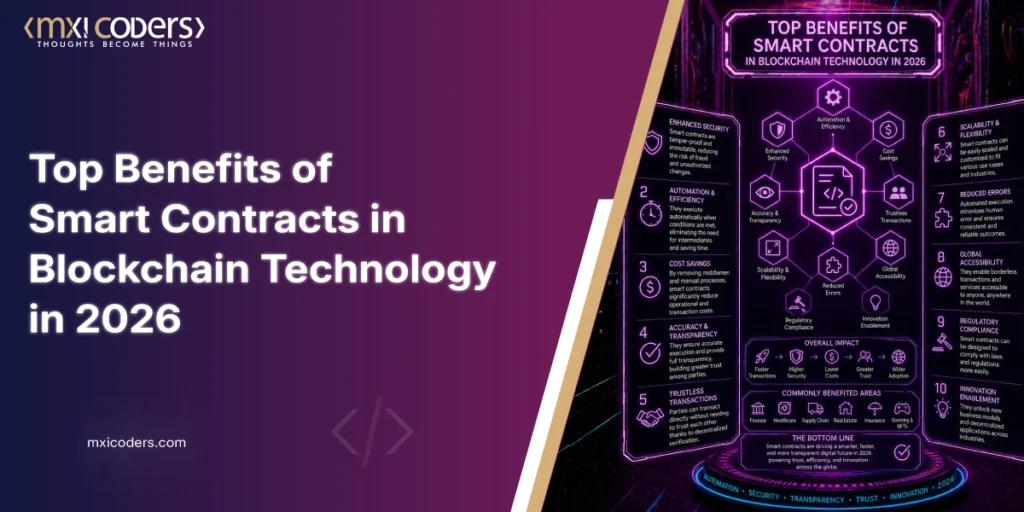

top benefits of smart contracts in blockchain technology

Self-executing code is quietly replacing lawyers, banks, and brokers as the default enforcer of business agreements. According to Grand View Research, the global smart contract market was valued at $1.73 billion in 2024 and is projected to grow at a CAGR of 82.2% through 2030. A separate survey by Gartner found that by 2026, more than 25% of global organizations will use smart contracts in some form of business operation. IBM’s Institute for Business Value reports that companies using automated contract systems reduce procurement costs by up to 40% compared to traditional paper-based processes.

This momentum is being driven by three forces: enterprises demanding more automation, rising distrust in centralized intermediaries, and the maturation of blockchain platforms capable of handling real-world complexity. This article breaks down exactly what smart contracts are, why businesses are rushing to adopt them, and the ten most compelling benefits they deliver in 2026.

➤ What Are Smart Contracts?

A smart contract is a self-executing program stored on a blockchain network that automatically carries out predefined actions when specific conditions are met. Unlike a traditional contract, which relies on third parties such as banks, notaries, or courts to enforce its terms, a smart contract runs on code. Once deployed, it cannot be altered, and it executes without human intervention.

Understanding smart contract working begins with recognizing that the logic is written directly into the code: “if X happens, then do Y.” When both conditions are verifiably met on the blockchain, the contract executes instantly. No phone calls. No paperwork. No waiting.

In 2026, smart contracts matter more than ever because global commerce is faster, more cross-border, and more automated than at any point in history. Businesses that rely on slow, dispute-prone manual contracts simply cannot keep pace.

➤ Why Businesses Are Adopting Smart Contracts Faster Than Ever

Growing blockchain adoption across banking, healthcare, logistics, and real estate has created the infrastructure smart contracts need to thrive. Digital transformation initiatives are pushing companies to eliminate manual processes wherever possible, and smart contracts are among the most effective automation tools available. The demand for transparency, particularly in multi-party agreements where trust is limited, makes the visible, tamper-proof nature of smart contracts especially attractive to enterprises operating at scale.

➤ Why Smart Contracts Are Important in Blockchain Technology

➥ The Need for Automation in Modern Business

Modern supply chains span dozens of countries. Financial transactions settle across time zones. Insurance claims involve multiple stakeholders. Managing all of this with human-driven processes creates delays, errors, and costs that compound over time. Automation is no longer optional — it is a competitive necessity.

➥ Limitations of Traditional Contracts

Traditional contracts depend on interpretation, enforcement mechanisms, and trust between parties. They are slow to execute, expensive to dispute, and vulnerable to fraud or bad-faith actors. Cross-border contracts introduce additional layers of legal complexity, making enforcement even more unpredictable.

➥ How Blockchain Enhances Contract Execution

Blockchain provides the trustless infrastructure that makes automated contracts enforceable without a central authority. Once written and deployed, a smart contract executes exactly as coded. The blockchain’s immutability guarantees that terms cannot be retroactively altered by any party.

Summary of core advantages:

  • Removes processing delays from multi-party approvals
  • Reduces disputes by eliminating ambiguity in contract terms
  • Increases transparency since all parties see the same code
  • Improves trust through verifiable, tamper-proof execution

Also Read: Real Business Benefits of Blockchain Technology in 2026

➤ Top Benefits of Smart Contracts in Blockchain Technology

1. Automation of Business Processes

Smart contracts execute agreements the moment predefined conditions are satisfied. There is no need for manual paperwork, approval chains, or human intermediaries to trigger action. 

For Example, In insurance, a policyholder who suffers a verified weather-related crop loss can receive an automatic payout the moment satellite data confirms the damage threshold was crossed. This kind of seamless, condition-based execution is transforming how industries handle routine agreements.

2. Reduced Operational Costs

Removing intermediaries from business transactions significantly cuts costs. Fewer lawyers, brokers, and administrative staff are needed to manage, verify, and enforce agreements. In banking, trade finance costs drop when letters of credit are replaced by smart contract logic. 

Insurance companies reduce claims-processing overhead. Real estate transactions eliminate escrow and title agent fees. Supply chain operators cut reconciliation costs across vendor networks. Industries that once absorbed these expenses as unavoidable overhead are now recovering them as margin.

3. Faster Transaction Processing

Where a traditional wire transfer might settle in two to five days, a blockchain-based smart contract completes the same transaction in seconds. Cross-border payments, trade finance settlements, and digital asset transfers are all accelerated because the verification and execution happen simultaneously on-chain. Real-time settlement removes the float risk and counterparty uncertainty that plague conventional financial systems.

4. Enhanced Security

Every smart contract is protected by cryptographic algorithms that make unauthorized modification virtually impossible. Records stored on a blockchain are decentralized across thousands of nodes, so there is no single point of failure for attackers to target. 

The immutable audit trail ensures that every transaction can be traced and verified without relying on any single party’s records. These features collectively reduce fraud risks far below what traditional contract systems can achieve.

5. Greater Transparency

All parties to a smart contract can view the same code and the same transaction history. There are no side agreements, no hidden clauses, and no selective disclosure. 

This shared visibility is particularly valuable in government contracting and public procurement, where accountability is essential, and in supply chain management, where buyers want to verify that goods meet agreed standards before payment is released.

6. Increased Accuracy

Manual contract processes introduce human error at every step. Data entry mistakes, missed signatures, and misread terms create disputes that cost time and money to resolve. 

Smart contracts eliminate these failure points by automating data validation and execution logic. Every action is carried out exactly as the code specifies, consistently and reliably. The result is fewer disputes, stronger regulatory compliance, and more dependable record keeping across the organization.

7. Improved Trust Between Parties

Because the rules of a smart contract are visible to all parties before deployment and cannot be changed afterward, every participant knows exactly what to expect. There is no room for one party to manipulate the outcome after the fact.

 This predictability is critical in global transactions involving counterparties who have no prior relationship, in multi-party agreements spanning several organizations, and in decentralized ecosystems where no central authority exists to arbitrate disputes.

8. Better Regulatory Compliance

Regulators are increasingly comfortable with blockchain-based systems because they offer auditable, timestamped records of every action. Smart contracts can automate KYC checks, AML verification, and financial reporting obligations, ensuring compliance happens in real time rather than after the fact. Engaging a smart contract development agency that understands compliance requirements for your industry ensures the code meets regulatory standards from the start.

9. 24/7 Execution Without Downtime

Unlike human-staffed processes, smart contracts operate around the clock without breaks, holidays, or business-hour restrictions. Cryptocurrency exchanges, DeFi platforms, and digital marketplaces depend on this continuous availability. A user on the other side of the world can initiate, execute, and settle a transaction at 3 a.m. local time with the same speed and reliability as during peak business hours.

10. Reduced Fraud and Manipulation

Once a transaction is recorded on a blockchain, no party can alter or delete it. The immutable transaction history makes after-the-fact manipulation impossible, and the verification mechanisms built into smart contracts prevent unauthorized actions from being initiated in the first place. Finance, healthcare, logistics, and real estate; all sectors where fraud costs are historically high and stand to benefit most from this level of protection.

➤ How Businesses Can Successfully Implement Smart Contracts

➥ Identify Suitable Business Processes

Start by mapping processes that involve repetitive, rules-based decisions between multiple parties. Contract execution, payment triggering, compliance checks, and asset transfers are strong starting points. Not every workflow benefits from automation, so prioritize those where delays, disputes, or intermediary costs are measurably hurting the business.

➥ Select the Right Blockchain Platform

Ethereum remains the most widely used platform for smart contract deployment, but Solana, Polygon, and Hyperledger offer compelling alternatives depending on your throughput and privacy requirements. The platform you choose will shape your development costs, transaction fees, and the developer talent pool available to you.

➥ Conduct Smart Contract Audits

Before any contract goes live, independent security review is non-negotiable. A thorough smart contract audit verifies that the code performs as intended and does not contain exploitable vulnerabilities. Past high-profile exploits that drained hundreds of millions from DeFi protocols underscore what is at stake when this step is skipped.

➥ Ensure Regulatory Compliance

Work with legal and compliance teams early in the development process. Regulatory requirements vary significantly by jurisdiction and industry, and building compliance into the contract logic from the outset is far less costly than retrofitting it later.

➥ Monitor and Update Smart Contract Infrastructure

Post-deployment monitoring ensures the contract continues to behave correctly as external conditions change. While the core contract logic is immutable, proxy patterns and upgradeable architecture allow for controlled updates when genuinely necessary. Budget for ongoing monitoring as part of the total cost of ownership.

➤ Final Thoughts

The future of blockchain technology runs directly through smart contract adoption. Businesses that have already deployed them are reporting measurable reductions in costs, faster deal cycles, and fewer disputes. Those still evaluating the technology are increasingly aware that competitors who move first will set the pace.

Whether you procure a targeted smart contract development service for a specific workflow or choose to hire blockchain developers for in-house capability, the strategic direction is the same. Automation, transparency, and trustless execution are becoming baseline expectations in modern commerce, not premium features.

Smart contracts are not just a tool for tech-forward companies. In 2026, they are becoming the infrastructure on which reliable, scalable, and cost-efficient business operations are built. Organizations that invest in custom enterprise blockchain development tailored to their regulatory environment and operational needs will be the ones defining industry standards in the years ahead.

Feel free to Connect us on

Ready to transform your business with smart software solutions?

Harness the power of custom software development to streamline operations, reduce costs, and boost efficiency. Start by exploring cutting-edge approaches like cloud-native platforms, API-first architecture, and AI-driven automation to future-proof your systems and stay ahead of the competition.

Book free consultation

Let’s build your idea together and serve society.

Author

Ashok Rathod

Tech Consultant

Experience
25 Years
Growth Architect for Startups & SMEs | Blockchain, AI , MVP Development, & Data-Driven Marketing Expert.

Transform the Carbon Credit Industry

Build a Transparent, Scalable Carbon Credit Marketplace with Blockchain.

Index